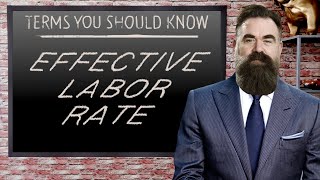
Chris Collins breaks down why a shop's posted labor rate is fiction. The effective rate is what you actually collect: sold labor dollars divided by hours sold. Accurate time-tracking and loss leaders matter more than the number on your board.
Questions this video answers
Sold labor dollars ÷ hours sold (in the shop).
Foreign.
Let's talk about terms you should know.
It's, it surprises me. I do these strategy sessions where I, I go through somebody's service department or their shop, I go through their numbers, and most people don't understand what effective labor it is. It blows me away. What most service managers or shop owners want to talk about is what their posted labor rate is. And I was trying to think of an analogy.
How you describe what a posted labor rate is, but a posted labor rate is a fictional number that doesn't, it doesn't matter. It's what you hope you collected for every hour, but you're not selling every hour of labor for that fictional number. So at the end of the day, if you're doing oil changes at a lower effective labor rate, you're doing maintenance, whatever your pricing strategy is, should you even have a pricing strategy? Or if you're just following what the competition is doing, which is probably the most dangerous pricing strategy, but what most people in our industry are doing, you'll, you'll, you'll have a very low effective labor rate. So you'll, you'll say, oh well, my, my labor rate's $120. And then we look at it and your effective labor rate is 80. And so what the, the formula for effective labor rate is, it's your labor dollars. So your sold labor dollars divided by your hours sold in the shop. So you take how much you sold in labor and divided by how many hours were sold in the shop, and that gives you your effective labor. Now, a couple things that you want to understand about that that are variables is one is if you have hourly techs and you're not having them flag, then that isn't giving you a true, a true.
Cost of labor. And so you want to have all of your technicians actually flagging. In a lot of shops that I run into, especially in truck and heavy duty trucks, a lot of the shops, their text are hourly. They're not flagging, nobody's tracking it. And so you don't really have a real number to figure out what your effective labor rate is. So it's really important that the, for this number to mean anything and to understand what do we actually collect for every hour of labor we sell? Is it $80, is it 90? But it, that's at the end of the day, what you're going to pay your bills with. And so what are we actually collecting for every hour of labor that we sell, not the fictional number. When it's all said and done, when we take fleet accounts in to consideration our loss leaders, oil changes, heavy line, whatever it is, all of our labor.
What do we collect on average for every hour that we sell? That is your effective labor rate. And you want to have everybody flagging you. Actually, the effective labor rate becomes truer when you really have a shop that is vested in how many hours they're flagging, right? Because you're gonna sell more hours. But it also gives you a true idea of what what the number is. Because if they're not flagging for oil changes, if you're just running those through a zeros but you're collecting labor, it throws your effective labor rate off. So the lesson here doesn't matter what you have as a posted labor rate. Really forget about that because it's a fictional number. What really matters is what do I collect for every hour of labor I sell? And the formula for that is my labor dollars divided by hours sold in the shop that gives you your effective labor rate. Thank you so much for watching this clip of Service Drive Revolution. Now you can catch the full episode on YouTube, iTunes, or Spotify or wherever you consume your podcast. If you have any questions, go ahead and post them in the comments below. Make sure you subscribe and hit the bell icon so you're notified when we post new episodes. I'm Chris Collins and you can find me on Facebook and Instagram at Chris Bulldog Collins and I'll see you again on the next episode.