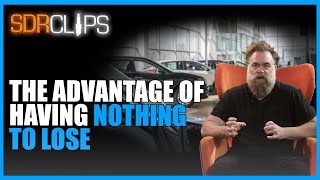
Chris Collins recounts growing up poor (missionary family, raised by a single mother, periods of homelessness), his youth as a talented soccer player discouraged from pursuing professional soccer, and the resulting stress and sleeplessness. He describes starting work at a car dealership as a porter, rising to service advisor, and earning substantial income (mentions industry pay tied to performance, long hours, and a peak advisor year of about $122,000 in his early 20s). He contrasts past industry demands and personal willingness to work long hours with later changes and generational differences.
Questions this video answers
July 29, 2021
$65,000 (mentioned as a notable salary at the time)
About $122,000 (in his last year as an advisor)
Chapters
Yeah, Your question made me reflect a lot, and I thought a lot about it in the sense that, you know, I was a kid that grew up really poor, and so my parents were missionaries. And then when my mom and stepdad divorced, I was raised by a single mom. We literally were, you know, bouncing around from couches. You could. You could say that we were homeless and it wouldn't be inaccurate. And it was rough, and I did not want to be poor. And I felt a lot of pressure as a young kid because I wasn't really good in school.
I did not have mentors. I didn't.
I just think back, like, I had a soccer coach. So because I grew up in Mexico as a missionary's kid, I was really good at soccer, and I was on a premier league team, and I was courted, and colleges were coming to look at me, but I didn't have good grades, and I had a coach that had played professional soccer, and he was a younger kid that I kind of looked up to. And he kind of told me, he said, you know, if I was you, I would do something else. But professional soccer, you're going to go to college, and then you're going to get drafted into Europe, and it sucks. He goes, I hated playing in Europe. It doesn't pay that great. And he goes through the. You know, and so I literally just took that advice because I didn't really have male figures. I didn't, you know, I didn't have a dad, that sort of thing. And so I felt a tremendous amount of stress. And I remember panicking. I remember not being able to sleep. I remember being really, really stressed out. But back then, they didn't have a word for it. Nobody labeled it mental illness. And I think there is a.
Thing that we need to understand is, to me, looking back on that, I look at that as part of growing up, and that stress and that insecurity and those sleepless nights and.
Just feeling lost and like there was no way out. Many times. Many times I remember sleeping in somebody's office.
You know, and going to the gym to shower. Like, just feel like. Just. I felt like a loser in. In a lot of senses. And, you know, I didn't have a path to college.
And, you know, a lot of this is, I could have played it different, but I didn't understand, and I didn't, you know, spend the time to figure it out. But I start working in a car dealership as a porter, and because I showed up on time because I worked hard, and I'm a natural leader I got promoted. And then I start to hear what the service advisors are making now back, you know, I'm 50. I'm almost 50. I'm going to turn 50 in January. Back when, when I was, you know, 17 at the time when, when you hear that somebody's making $65,000 a year, that was like the equivalent of making 150 now. Like, it was, it was a lot of money. And so I would have traded any amount of work, any amount of stress. I already had the stress. I already was stressed about bills and all the things that I was trying to do and what, you know, what's in front of me for, for, you know, opportunity and panic attacks and all that. The car business allowed me to make as much money as I earned. And so I'm a kid now. All of a sudden, 22, 23, I'm making $120,000. Like, I think I made 122,000 my last year as an advisor. Now, I would come in on Sunday and write the night drops. I would get there before everybody else and I would stay past every, you know, everybody else. And for me, the trade of how I felt before I had income and I could afford rent, not worry about bills, and, you know, I, I was making more than lawyers right out of law school that had all this debt. And I, I started to, to see it a different way is like I have a career opportunity here where I can, I can earn as much as I want because really, pay in the automotive industry is based on your performance more than it is in exchange of time for money. Right. And I couldn't believe that the, the, you know, the better I treated my customers, the more I sold, you know, the more problems I solved, the more I could make. And so 70 hours seemed like a fair trade for that. Now we, we come ahead and the, the industry is different. Things are easier. There's automation. There's, you know, you're not doing handwritten ros. There's, you know, there's so many things that make the job a lot easier. And your, your generation and younger.
Don'T exactly have the same feelings towards commission. And you're more about, you know, freedom and time off and experiences where my generation was more about, you know, having a solid, secure career and income and that sort of thing. And so I do think it's an interesting thing, but most of the people, general managers that you're going to be interacting with came up like I did. And so they, they look at, you know, the lack of work ethic and the you know, just the mention of the mental side or the emotional side as a weakness more than, than anything else. And I think it's a, it's a, you know, fascinating conversation. I'm not, I'm not at all trying to do you push my point of view. I'm only trying to give you my context in reflecting that I think I am the way I am because of what a great opportunity the industry gave me. And I feel a debt of gratitude because, let's face it, I was a loser. Like, I didn't have a lot of options. I mean, I know I would have turned out okay either way, but the automotive industry was my catalyst to being okay. Thanks so much for watching this clip of Service Driving Revolution. We're uploading new stuff every day, so make sure you subscribe and click the bell icon so you don't miss out. If you have a question you'd like us to answer on the show, call 8333 Ask SDR and we'll answer your question on the show. That's 8333 Ask SDR. For special deals on our books and training, head over to offers.chriscollinsinc.com now that's offers.chriscollinsInc.com I'm Chris Collins, and I'll see you in the next video.