The Best Marketing Books of All Time - Part 1 (Service Drive Revolution)
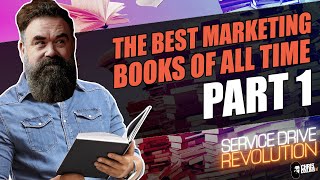
A recorded episode of Service Drive Revolution (hosts Chris Collins and Christian Lafferty) in which the hosts discuss marketing books and related media that they recommend to service-drive professionals. The episode includes light banter (jokes, TikTok talk), a listener voicemail asking how to buy a car dealership (answered with a high-level financing overview: assets/working capital/blue sky/flooring lines and likely need for partners), and a curated first-half list of marketing and influence titles and media to study (Culture Code by Clotaire Rapaille; The Ultimate Sales Machine by Chet Holmes; Influence by Robert Cialdini; The Letter Book by Robert Collier; books and ideas related to Andy Warhol and propaganda/poster design; Tom Peters; the documentary The Social Dilemma; Dan Kennedy’s marketing/direct-marketing works). Hosts preview a Part 2 with deeper/more abstract picks.
Chapters
Foreign.
Welcome everybody to Service Drive Revolution.
The show for anybody with a service drive. Let's face it, technicians are harder and harder to find. The customers are demanding a different experience. And your performance and profitability have never, ever been harder. So join the movement, the transformation, the revolution. Invite your friends because you deserve to have crazy results. We have an amazing show for you today. Please welcome Christian Lafferty, master pool player.
Yeah, no, not so much. Also below average bowler.
Just to let you know, today we're going to go through my favorite marketing books. Also answer your questions. We had our coaching meeting a few days ago. So this is for anybody who's in our coaching group every. What is it, A couple months?
Three months.
Every three months we plan like a virtual event. We used to do them in person, but because of the pandemic, we're not doing that. And we had a special guest on Michael Levine, the legend. Michael Levine was kind enough to come on. I lost count of how many F bombs.
More than 60.
I noticed around the office since then, everybody's swearing a lot more.
Right. It's weird.
I asked a few people via text that sent me texts like, hey, great meeting. He was unbelievable about the swearing. Nobody seemed to be bothered. I know, I've been getting texts. When are we going to put that up on On Demand? And I would say in the, in the next couple weeks those will all be chopped up and put up into On Demand like we usually do. Michael Levine's books, he's. He wrote the famous book Guerrilla pr. Yeah. Gorilla PR and then Broken Windows, Broken Business, which has been on the bestseller late list for, I think 13 years in a row and is a great book. We. Long before I ever became friends with Michael, I read this book and gave it to many people and bought many copies of this and handed it out. But on the, on the coaching.
Meeting, virtual meeting, whatever you call it, people were saying in the chat, like, what are your. What are the best marketing books?
Yeah.
And I literally locked up because there's not one. Like, if you want to study marketing and understand marketing, we got to go through a journey.
Yeah.
And so I kind of spent, I don't know, a couple hours going through the thousands of books that we have here. And I know some of them are at home. So the ones that I have at home, I printed out sheets so I can remember. But this is going to be a two parter. And I'm going to go through the books that I think will help you with marketing. But they're not just marketing books. There's going to be some surprises in there that are. That are completely different. And some of the books are bundles of books in different areas of marketing. And some things just apply to marketing, but they're not directly marketing. I'm also going to tell you some documentaries to watch and a video to watch. So it's going to be fun. It'll be a two parter. I would highly suggest that you have a pen and a piece of paper handy because when I go through the books, I will tell you the book and who the author is. But some of them you're going to write down, some of them you may not care about. You will get a sense for how eccentric I am and how many books I read in different areas that you would never imagine. Something I've never shared before, like, usually when I do these sort of things, I curate the list for the audience. I'm curating this list for the results. There's a big difference. So I'm not curating this list because I think you'll be able to download the book on Audible. Some of these books are out of print, some of them are hard to find, some of them are thousands of dollars. Like, you know, they're collectible. But it's the result that I want you to get. So this will be very relevant also for everybody coming out of the the coach meeting because we were talking about how to drive RO account psychology, your approach to marketing and how it's changing in the industry, that the service drive is becoming the focal point in everything and we're going to have to learn how to be good marketers. And so I'm going to help you with that. So two parter. It'll be fun. I think.
This will be very fun for me. I don't know if it'll be fun for everybody listening. I will try to. But if you want to get good at marketing, this will work.
I think that there's definitely a lesson to be learned. So first right out of the gate, just a little bit of a trivia question for you. What's the tallest building in la?
You can see it from here. It's the Intercontinental right there.
No, no, that's not.
So we're downtown la.
Mm. Mm.
You're not really working on relevancy to our people in the Midwest or the East Coast.
Yeah, that's true. You're right.
This is a local joke. This is not a local show, Christian. This is an international show. Yeah, people are listening to the show all over the world.
Right. But the Intercontinental whatever is not the Tallest building in la. It's the library. It's got the most stories.
If you're listening to this and not watching it, that was a standing ovation. Pretty funny.
Thank you. Good start.
Yeah, it's a great start.
Lots of jokes today. Saved them up.
Great start.
So what do you think? Should we talk about those comments? Yeah, I've been. I've been hitting it for a little while right now, so I think we're ready to go.
But what do you mean by hitting it?
Hitting it. Suggesting it for a few minutes. See, this is what happened. So now I'm a TikTok addict and I've got lingo. It's crazy. I'm talking like I know what I'm. I've got swag.
What is the girl we love on TikTok? What's her name?
The.
Feminist?
Yeah, her.
Yeah.
And you're saying that she left her job?
I think so. If I understood the TikToking right. Is there like a TikTok timeline? Is that too much alliteration?
I don't know. I don't know that much about TikTok.
Yeah, I don't sleep anymore. I just watch Tick Tock.
I'm thinking about doing bulldog motivation on there, like in the morning with my bulldogs. Like, do you like a positive quote or something? Every morning. But I haven't done it. But I think about doing it. Yeah, I haven't done it.
It's where it starts, is with the thought.
I did one for like a couple days and it was getting a bunch of views, but then I took it down. A little scared of the Tick Tock. But anyways, I would love. I know that we're trying to get her on the show, but if she really is in between jobs, we should talk to her. She's great at making videos.
Yeah, we could. We could do a thing.
She's funny. Should we do some questions from the audience or.
A question always.
I think we have time for a question. Remember, if you call in and submit a question and we play it on the air, we're going to send you service. Drive Revolution swag. A hat, T shirt, coffee mug. Yep, everything.
Love these voicemails. These are fun.
Yeah, it's fun. Now that people are calling in and listening to them, can we. Can we play one?
Hey, Chris. My name is Bam. I work over at the tailor dealership here in Bakersfield. I started watching your show to get a little more understanding about the service side of everything. I watched the episode where you talked about how you had became a GM and actually owned a couple stores. And question I had was, you know, aside from becoming a GM and going through dealer school, what else do you need to buy your own dealership? Who puts up the money? Does the manufacturer give loans for that? How do you do that? My store is like yours. I started as a detailer and climbed the ranks. I'm an F and I now doing pretty good at that. Hope to hear the answer on the show. Thank you, man.
Hey, Bam, thanks so much for the question. Great question. So when you, when you're buying a dealership, you, you have a couple different things that you're going to have to finance. So the first thing you're going to have to finance is just the basic assets of the business, which means the inventory and parts, the desks, whatever. Whether you're buying the building or not, you're, you're going to buy the assets, the computers, lifts in the service department, phone system, all of that. So.
There'S going to be an asset purchase. And with the asset purchase, you're going to have a working capital requirement. In the working capital, you're going to have your parts and payroll and lots of other things. Usually you can't finance that. Usually you got to come in with that money. And that money is.
I don't know, you're going to have to have probably, I would guess, 50% down on that more than anything. And then the next, the next thing you're going to have is what they call blue sky. And so let's say you have a Chevy dealership that is making a million dollars a year in profit. And let's say, I'm not a broker, but let's say Chevy dealerships are selling for five times or six times earnings. So you're going to pay five or six million dollars in blue sky. So you're gonna have a couple million in working capital and assets, and then you're gonna have 6 million, 5 million in blue sky. And then the next line of credit you're gonna have to have is used cars and new car inventory, which will be, you know, $10 million in a second. You can usually do that through a flooring line of credit. The, depending on how, how financially stable you are in the deal you make the used cars, you might have to have some cash down. You might not be able to floor all of them, but you don't have to start with a ton of used cars either. The new cars, usually the factory will let you floor them and you'll have a flooring line of credit with whoever the manufacturer Is so oftentimes you can get a bank to loan on the business to an extent, but somebody's going to have to come in with a pretty good chunk of change to make, to make it happen. And so oftentimes there's, there's dealer groups out there that will let you become a general manager and then buy the dealership from them and they will just retain a certain part of it. And there's also investors out there that, that will invest. In my experience, most banks don't like to touch first time dealers. And so you're going to need a partner or another dealer that will invest in you. So probably finding a dealer that wants to expand and wants talented people around and saving your money and then, you know, doing some sort of buyout over time is usually the best path for that.
I think it's the most common right now too. For those that don't come with a big nest egg to get into it, it's really about the only day in town. I mean, the, the days of getting a dealership off of a handshake and a smile are gone. I mean, it used to happen 50 years ago, but it's very different right now. Yeah.
And the joke was always like the quickest way to lose a million dollars is to buy a dealership. And so banks are very shy because there's a lot of moving parts and it's hard. So. Yeah, but good question. I hope that helps you. There's kind of three parts to it and somebody's got to come in with a pretty good chunk of change in order to make it go.
The big question I want to ask is why do you think blonde jokes are so short?
Why do you think blonde jokes are so short? I don't know.
So men can remember them.
So you thought it was a blonde joke, but nope, it was a man joke.
I like it.
Let's talk marketing books.
That's funny. Okay, first book that I would have you read if you wanted to understand marketing is a book called the Culture Code by Clotaire Rapael Rapell. Can you say that?
Nope.
Try it.
Clotaire Rapae.
Yeah, Culture Code. Now there's a bunch of books called Culture Code, so be careful. This is the one you want with Clotaire. The subtitle is an ingenious way to understand why people around the world live and buy as they do. And so kind of the story on him was he was a doctor that was pioneering maybe a way of getting, I think it was autistic kids to learn. And he was Neighbors with the president of Nestle, I think. And he said, hey, can you go to Japan and do a study and tell me why people there won't drink coffee? And he did his thing and came back and he said, because they're inspired by the English. You got to make candy and things for kids. That's coffee. And then the next generation will kind of a thing. They're into the Queen and tea. And then he did a thing for Chrysler in here where he helped him design a car. And Chrysler came to him and said, we know that our customers want gas mileage reliability and.
Gas mileage reliability and safety. Those three things. And then he helped him design a car that saved them, and it wasn't reliable. It got terrible gas mileage, and it was not safe. But I'll let you read the book, but that's a great one. And this is just about understanding the deeper psychology of what. What motivates people more than anything else.
Nice.
Will you set that over there?
I will, gladly.
Another one that I would do is the Ultimate Sales Machine by Chet Holmes. And there's some stuff in here on marketing and his system for presenting that that.
I think is helpful. But a great book also. But I would look at his stuff on that. Then this one. I was lucky enough to be in a mastermind with Cialdini for a while, but Robert Cialdini wrote a book called the Psychology of Persuasion. But the title of the book is Influence. Influence. And what I love about this book, and I think it'd be rare if somebody in the car business hadn't read this book, honestly.
Yeah, it's one of my top five favorites.
Yeah, sure. But what's great about it is it's just case study after case study after case study after case study. Yep, that's it. Like. And so they just mess with people. They try something this way, that way. What's your. Do you know what your favorite.
Story.
Is or your favorite takeaway is from this book?
The. The easiest one is about being a waiter or waitress. And you come out and you bring the check and you drop a mint for them. And then you walk away from the table and you come back and you bring two more and say, for you nice people, I'm going to give you a couple more mints. And then the tips went up by like 37% or something like that. Do you remember that? Huge.
Yeah, yeah. My favorite one, I think, is the piano store. So they have a piano store and they.
Take customers to the cheapest piano first, then the grand piano and Then they do it in reverse. They take them to the grand piano first and then the piano and their average sales are higher when they show them the big piano first, the grand piano. I thought that was.
That was unbelievable. So, influence.
Now, Robert Collier has written a bunch of good books, but this one's pretty good. It's called the Letter Book by Robert Collier. And he has a bunch of books on success. He wrote one of my. My top five books, Winning Through Intimidation. But his book, the. The Letter Book is pretty great. There's tons of examples in there.
And then this is where we. We're going to get a little. A little.
Sideways. I don't know if it's sideways. I don't know what. What people think or understand. But if you. If you talk about one of the most successful artists, and when we quantify successful, we're talking about sales and creating a machine.
Yeah.
Then Warhol kind of has to be on that list, mathematically.
He has to be on the list. Yeah.
And so he. He wrote a couple books. So this book called A. That's a first edition of that, for the longest time I had that thing wrapped in plastic. I don't know why I unwrapped it in plastic. And then this one is the Philosophy of Andy Warhol from A to B and Back again. And actually, if you look at this, he actually signed this.
What?
And drew his famous soup can.
Oh, that's crazy.
I don't know if you guys can see that.
How much did you pay for that book?
Which camera do you want me to go to?
A lot.
I don't think there's a lot of these out there where he actually drew a soup can.
It's his soup can in there. So did you pay more or less than you would for a Yugo?
I don't know. I don't know how much a Yugo is.
I don't even want to touch it.
The thing that you want to pay attention with, with Andy is.
His approach, his mindset, but also he's building a machine. Like, he was one of the first to kind of do screen prints and limited editions and that sort of thing. And he had a factory. And when you think about art, you think about originals. But.
He pioneered a different way of doing it, and less effort for more.
Revenue, I guess. Would you say?
Well, I think that's the other thing that's really unique about Warhol is that traditionally artists are not good at monetizing their art.
Yeah.
Like, he was special in that, that he had a business sense about him. In addition to, like, I don't know, everything is amazing that he does. I think it's very different, but. But he also had a marketing machine behind it that was kind of. It was presenting the story that he wanted to present in a lot of cases.
Yeah. And he pioneered for like, so coming up probably in the next one, Damien Hurst books.
He. He's gotta owe something to Andy, right, for that. Then just some books that I. That I like. I have a bunch of these. I have a whole section on my bookshelf of propaganda books. So this is propaganda front. Postcards from the era of world wars. And the reason why I like propaganda, like old German propaganda and Russian propaganda and American Propagand, is because there's a. There's a system to this. There's a look to propaganda. There's a color palette to it more than anything else. It's a lot of red, black, cream. There's a way people stand, a posture. It's. It's leadership in a way. And.
So it's Mark. It's marketing at a very, very high level when you're trying to get a country to do what you want. Right. This one. So that one's called the Propaganda Front.
This is by.
Hennessy and Ingalls.
There you go.
Hennessy and Ingalls.
This one is called the Design of Descent expanded Edition. Greed, Nationalism, Alternative Facts and Resonance by Milton Glazier and Mirko Illick. Let's give him a cool name. I L I C. Same thing. Just propaganda posters.
If you notice, too, like Shepherd Fairy is very influenced by propaganda posters. His palette is kind of that German, Russian red, black cream. But those are. Those are good to look at, especially if you're doing any sort of banners online or websites. It's good to look. To look at that.
The next one that I. That I have here is.
Whoa.
We'll do two more Tom Peters reimagine. So anything by Tom Peters is great, but this book is amazing and it's an easy read. It's the kind of book where you can just pick it up and turn to any page. Go ahead, just pick it up, turn it to a page and read what you see.
Architectural firms. Yet another stop on my speaking tour in 2001 brought me before members of SMPS, the Society for Marketing Professional Services. Members are concentrated in the architecture, engineering and construction business. What did I hear? The same Dan story, down to the dotting of the I's and crossing of the t's.
I can go on.
Yeah, keep going. That makes no sense.
Architecture is becoming a commodity. And SMPS executive told me winners will increasingly become turnkey facilities management providers. They won't provide just drawings or oversight of the construction process. They will provide all that, plus every iota of the service package. That could take the entire facility's headache out of the client's hands. In fact, my short SMPS RIF leads to a pop quiz. Who is the number one employer of architecture school graduates in the US in 2000? Tick, tick, tick. Your time is running out. And the answer is, according to my MSMPS colleagues, Accenture. PSF. Accenture wants to do for turnkey facilities management what EDS did for turnkey is management.
Made no sense. Did you understand what he was trying to say?
No.
Do you think it was your reading? Your delivery?
Because my ADD kicked in, like in sentence four.
Yeah, yeah. Doesn't mean it's not a great book, right?
Just a bad example. Possibly.
Yeah. But I did tell everybody that if you open to any page. So could you open to a different page and prove me right?
Yes.
Try it again.
Hold on. Let me look at your eyes. This page. Now we're getting somewhere.
Maybe just read one of the, like, the little quotes or whatever. Something salacious.
Yeah.
And then we'll make this one the last one. My last little nugget.
I like it. So buy in or bust. It's not just higher ups and end users you've got to sell to. No. Your customers also include fellow project team members and even people who report to you. Barking orders is out. Intellectual capital is in. Providers of intellectual capital are volunteers by definition. Now we're getting somewhere.
I like it.
I do too.
Okay, that reminds me of that. What was that documentary we watched on Netflix about social.
The social. The Social Dilemma.
You should watch that. If you haven't watched it, get Netflix. Social Dilemma. It'll scare you to death.
You may delete all of your social media after that.
Except for Christian's. Evidently going to be a Tick Tock star. Have you thought about doing your jokes on Tick Tock or. Your jokes aren't really for TikTok, right? They take too long.
Yeah, I think that the really long. The long ones might be. I mean, you got 30, 45 seconds for a TikTok joke, right? I don't know.
Could you just like, do the setup and then the long awkward pause and.
Then the punchline would be funny. Is to run it over five different TikTok jokes and never tell the punchline.
Funny to who?
Just me.
Okay, the. The last one that I would recommend. And I would recommend.
Consuming These kind of. One at a time. You're gonna go down an adventure. You could go down the Andy Warhol thing for, for, I don't know, months, easily any of this. So this one is gonna take you probably six months to a year. I.
I don't know if anybody's influenced me more than Dan Kennedy.
Maybe.
I don't know. I, I love him. He's grumpy, but he's, he's taught me more about marketing, I think, than anybody. I love his approach. I, I had somebody watching his videos the other day and they, they just hated him and I didn't understand. So if you don't like grumpy and people that are right to the point. He's not fluffy for sure. Do you remember who hated it?
I do.
Was it you?
No. Who? I thought it was great. It was a client.
A client. Why did I give it to a client?
You assigned it to a whole group of clients.
Oh, that's right. Somebody hated it in, in the coaching group that we were doing. Okay. It surprised me because I personally, I don't know, changed my life. But Dan Kennedy, any of his books. Here's, here's a couple that you can get to kind of dip your toe in the water. Marketing to the affluent. The ultimate sales letter. Attract new customers, boost your sales. And no bs Direct marketing, the ultimate, no holds barred, kick butt, take no prisoners. Direct marketing for non direct marketing businesses. That's the selling to the affluent one. Marketing to the affluent is a great, is a great book. He has some, some courses you can buy on on his website.
Influential Copywriting is probably his best course. I maybe watch that 10 times in my life. It's old, but it's great. I would buy it and support him if you're gonna do it. I think it's like 2500 bucks or something, but it's worth, it's worth it. So those are, those are the first half of my marketing books. Then we're going to get a little deeper, a little crazier, a little more abstract.
And then just some basic, some basic books also. Fun. Good show.
So much fun. It's good stuff.
So next time we'll go through the rest of my marketing books and we have tons of other fun stuff for you, but have a great week and we'll see you next time on Service Drive Revolution.
Thanks so much for watching this episode of Service Job Revolution. We're uploading new stuff every day, so make sure you subscribe and click the bell icon so you don't miss out. If you have a question you'd like us to answer on the show, call 8333-ASK SDR and we'll answer your question on the show. That's 8333-ASK SDR. For special deals on our books and training, head over to offers.chriscollinsinc.com now that's offers.chriscollinsInc.com I'm Chris Collins and I'll see you in the next video.







