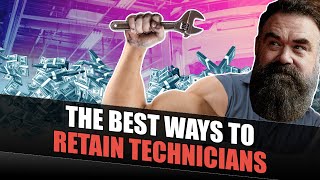
Chris Collins outlines five practical strategies to retain automotive technicians: (1) achieve a high effective labor rate so you can pay competitive wages (examples: $60/hr hires in Northern Canada; outbidding Texas oil fields), (2) invest in the break room and physical respect signals for technicians (an anecdote about a manager "Al" who renovated the break room), (3) train service advisors in customer processing and time management so they support, not drive away, technicians, (4) get deliberate about recruiting and selling your shop to candidates (always recruit, have a story), and (5) treat the shop as a production facility with a hierarchy of performance, posted metrics, quick parts/warranty processing, and daily huddles. The clip ends with a call-to-action to subscribe and a contact number for questions.
Chapters
Okay, let's talk about how you retain technicians. So number one is one that I talked about already. Having the ability to have a high effective labor rate. So it's in your pricing strategy. It's in the customer experience and systems and consistency, accountability, all of that. Because if you have the highest effective labor rate, an effective labor rate to.
You know, our experience has never had anything to do with the market.
Not that I've seen nothing to do with the market.
The ability to create a customer experience, consistency, and a pricing strategy.
Yep.
So having an effective labor rate that you can pay the technicians, the best ones, whatever it takes. Like, We've paid technicians 60 plus dollars in Northern Canada where you couldn't find technicians, and they came for $60.
In Texas in oil fields where, oh, we're losing all our techs to the oil fields. All of a sudden, we were paying more than the oil fields, and we had all the technicians we could handle. So it's a mindset more than anything else. Right. But you got to have the effective labor rate to be able to afford the technicians. If your effective labor rate is 80 bucks and you need to pay 35 for this technician, it doesn't work.
Right.
So you got to be able to achieve an effective labor number two.
Anywhere that I see that they suffer from retaining technicians. You can walk in the break room and tell how they feel about technicians. The lunchroom. Break room will tell you what you think about how important technicians are. Go to where the salespeople eat lunch, and then go to where the technicians eat lunch and tell me the difference.
Yep.
Hasn't been painted in 20 years. There's stuff in the refrigerator in that lunchroom that smells like death. Right. A microwave that doesn't work. Like, how much does it take to put a coat of paint, clean out a refrigerator and get a good microwave and put a Nintendo in there or something. Right. And a tv.
Yeah. I worked at this place once, and the general manager, actually probably the smartest thing that he ever did. He was an idiot overall, but.
Oh, was he?
What was his name? His name was Al. Hey, Al.
Al.
We'll just call him Al for right now.
Al the idiot.
We had an older shop, and he walked through the shop with me one day, and we're like, yeah, you know, we need to get this done, this done, and this. And he's like, no, we need to go fix the break room. So he went to the break room and he repainted it. He pulled out the stove and actually ended up with, like, a double oven. Like, Something you'd see in an ice house. Brand new refrigerator with the water filter and the ice maker and everything like that. And he's like.
When these guys are in the lunchroom, I want them to feel like they're at home and I want them to be happy. And what ended up happening is that on Saturdays, they made like breakfast for everybody, and then they actually just cooked in for lunch. And he. He had a. What do they call that when you can actually. A griddle? Like, he was cooking burgers and steaks and everything like that. He would personally come in and cook for the techs. Well, the morale of the technicians changed. And all I could think of is, man. So he's not worried about the shop, but he's worried about this first. And it was the right move because the technicians were really, really grateful that they had a place to work. And that was the stuff they talked about, about how their break room was better than anywhere else they'd ever been before.
Yeah, it matters. And so we're not just saying, just, hey, if you fix the break room, that. That fixes everything. And technicians don't want to stay there. What we're saying is the way your break room looks tells me how you feel about the technicians. It doesn't stop there.
Yep.
It starts with you putting a value and an importance on the technicians and not thinking about the shop as, you know, mushrooms. Just keep them in the dark and feed them.
Yeah, I like that philosophy.
You don't want to do the punchline to my joke?
No. Okay. Number three is train your advisors. There's nothing that runs technicians away quicker than advisors that don't know what they're doing, that are disorganized, confused, and writing 40 tickets a day, barely staying above water hurts. Like, put a system in place, have a plan for how many cars we're bringing in or trucks every day, and train your advisors how to process customers, time management, all of that. But well trained advisors will retain your technicians. I don't know how many times we've interviewed an advisor and said, how many technicians are coming with you? He's like, three for sure. Like, I love it when you're interviewing an advisor and you're like, so how many texts will follow you? And they're like, three. Right now they're already texting me look. Right?
Yeah. That's how you know you got somebody. It tells you that that's a good advisor. And then it also tells you the technicians are pretty good too, typically.
So you gotta keep the good advisors and train the ones that you have. Number four is get good at recruiting. Like I was kinda mentioning before is like the good technicians don't want, they don't want to leave where they're at. So you've got to be better. You've got to have a better story, a better plan and a better opportunity for them to jump. And so you got to go deep into the psychology. And when we in our course, the technician tree, how to recruit technicians. I don't know, there's maybe 20 ideas in there on how to get to technicians and aren't looking to jump because they're not. You got to go to where do they eat lunch? You got to have events. There's. You're always recruiting, always recruiting. The worst thing you can do is recruit when you need techs.
Yep. Yeah, you got to be doing that. That's a 365A year kind of job. Right. So I think the other thing that comes along with that too is, and you'd alluded to this, is that you've got to have the story of your store. It's either the story of you as the manager and leader of the department, the story of the shop and why it's better than every other shop. Like you got to be prepar during that interview. And one of the things that I've seen as probably a real big downfall is you work so hard, you get a technician come in for the interview and then you spend the time telling the technician how broken it is and how bad you need them. Well, who wants to come into that? Right. So you have to be able to. It's a little bit of a sale. Right. Like why work for you? I think the thing that I would say as a recruiter, you have to remember you're the prize at the end.
Yeah. You gotta, you gotta sell.
There's a sale that's done.
I think a lot of old time managers expect that it's like 20 years ago and the kids are going to come in and try to sell them and anymore for good technicians, you got to sell us.
Yeah. That. That power struggle, that power struggle.
What would you call that?
A.
It's a buyer's market.
Yeah. An employee's market or. Yeah, buyer's market.
Number five, how to retain technicians. Fix your parts department. No joking. Number five is have a hierarchy of performance and look at your shop as a production facility. So many times we go into a shop and the culture is terrible, the technicians are inefficient and nobody is talking about the thing that's important, which is production. If you, if you are posting the numbers in the shop all the time, you're talking about production every day, you're having little huddles with your technicians and getting them fired up and giving accolades and praise to the technicians that are the highest performers. You're going to attract technicians that are high performers. But you. I've seen this many times where somebody will go out and get a technician that's a high performer, but their culture in their shop is not production. And that technician won't even last two.
Weeks.
Because they get bored.
Yeah, you just, everything about your parts department, your warranty department, they don't get flagged on time. Like, it's just a disaster. And so you got to make production a priority. You gotta, you know, flag the numbers quick. Don't, you know, don't have a month's worth of warranty that hasn't been processed. Like, they need to get, they need to get flagged the next day, like right away. You need to be on top of that stuff. It's a production facility and, and all of those things add up to their mindset and their thoughts on production and what they're there to do.
Yep. The tick tock guy actually brought that up. Right. He's like, you guys are taking six hours away from me and my production. Like, they're aware. Producing, right?
Yeah, that's a tech with some goals. Yeah, he's there to make money. And he's like, yeah, 12 hours would be good, but it's missing six.
Yeah. So it should be 18.
Yeah, that's great. So first one is you got to have an effective labor rate and that's only going to get harder over time. You got to be able to pay the best. Number two is the break room tells me how you feel about your shop, how much you care. It's very clear. Number three is you got to have good advisors and train them. Number four is get good at recruiting. It's, it's a, it's a skill you got to develop. And number five is make sure your shop is a production facility. And there's a hierarchy of performance. You're posting a hierarchy of who's flagging the most hours, who's winning, have games behind it, but think of it as a production facility. Thanks so much for watching this clip of Service Driver Revolution. We're uploading new stuff every day, so make sure you subscribe and click the bell icon so you don't miss out. If you have a question you'd like us to answer on the show, call 8333 Ask SDR and we'll answer your question on the show. That's 8333 Ask SDR. For special deals on our books and training, head over to offers.chriscollinsinc.com that's offers.chriscollinsInc.com I'm Chris Collins and I'll see you in the next video.