The Business of Tattoos with Freddy Negrete - Part 1
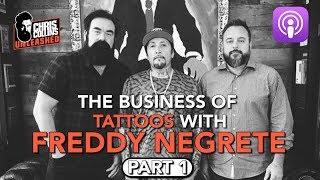
Interview (YouTube video) with Freddy Negrete discussing his rise from tattooing in California youth/prison programs (Tamarack) using improvised machines, to winning Tattoo Artist of the Year (1980) for a 1979 back piece, to working with Ed Hardy and helping popularize black-and-gray realism. Covers technical shifts (prison rotary machines influencing modern rotaries; single-needle/fine-line techniques), business details (charging ~$15–20 in apartment; shop rates $60–$80; artist split ~60/40; bringing home $200–300 a night; doing 4–6 tattoos a night), apprenticeship and mentorship under Ed Hardy, and publishing/technical secrets that spread the style.
Questions this video answers
1979
Tattoo Artist of the Year, 1980
21
About two years
Page 182
Chapters
Let's do it. Do it live. I can. I'll write it and we'll do it live.
It's one of the coolest looking bulldogs I've ever seen.
I can't read it. There's no. There's no words on it.
That's tomorrow, and that is it for us today. And we will leave you with a. I can't do it.
Do it live. Okay, we'll do it live. Welcome, everybody, to Unleashed. Every time. I love Intro C. How you doing, G man? I'm doing good, man. Today we are excited. We have the legendary Freddy Negretti, and he is.
You wouldn't say hall of fame, but a legend in the tattoo world. He's worked with Ed Hardy. He works at Shamrock now, and the author of a book, Smile Now, Cry Later, Guns, Gangs, and Tattoos. My Life in Black and Gray. And the COVID of this, Freddy, is amazing.
Thank you.
Did you design it or did the publisher do it?
Actually, my co author and I came up with the photo and then I did the font.
The font?
Yeah.
Wow, that's cool. Which is really cool. Yeah. You should see the picture in there of. If you scroll through gman, there's a picture in there of. Of a back tattoo he did early on with the Virgin Mary. And it's incredible. How many years ago was that that you did that one?
I did it in 1979. Wow.
That was way ahead of its time. Right, and way ahead of its time.
And then back then we had one tattoo convention a year, and so I won Tattoo Artist of the Year with it in 1980, so. And it was like a game changer kind of tattoo. You know, we introduced the Chicano look with the religious art, you know, the Virgin Mary and everything.
I had mixed two styles, the color style and the black and gray together in one tattoo.
And that was much like the Japanese style, you know, Japanese style. I have a colored dragon with gray water or whatever, and. And it was the first attempt.
Is that it right there?
That's it, yeah. By anybody to do color realism, that's a black and white picture.
But what page is that on there, G man, if you. If anybody gets his book, 182. So you go to page 183. 182. 182 is a picture of it. And. Yeah, maybe we'll put a picture up too, online, because it's amazing. Yeah, that's crazy. So how old were you when you did that?
Was 21.
And how long had you been tattooing at that point?
Professionally?
About Two years.
That's it?
Yeah, but I've been.
It's like a tattoo that somebody would. Had been doing it, like, 10 years. I know. It's insane.
You can't.
You're ahead of it, but there's ahead of your time. There's a face in the lower. Lower portion of his back and the eye on it. I mean, it looks like it's like looking at you. It's crazy how detailed detail it is. Yeah. So what, two years in, how. How do you get to that level? What was it that you were doing to push yourself for. To be so ahead artistically?
Well, I think it was the time before that, before I started tattooing professional. I was in Youth Authority, and I was in a program called Tamarack Program, and Tamarack Program was for hardcore yas, you know, so when they would decide to send you to Tamarack Program, there was, like, no more hope left for this guy, you know?
They were writing you off.
Is that what it was? Yeah, it's kind of like that. We were like the criminally insane, know, but. And first they would send us to prison. I think that was their attempt to, you know, do it. A scared straight thing, you know, let's send them to prison first. So we'd go to tracy prison for 90 days in the K wing, which was their lockup unit, you know, and they're. And it's all, you know, hardcore prisoner guys, you know. And then after that, we would go to this program called Tamarack. Tamarack was the oldest building being used by the state of California as an institution. It was built in the late 1800s, and it was an annex to this castle that was the first Youth Authority. And they made it as a lockup and a discipline area. So it was just this awesome looking place. It was all built out of granite, and all the cells had big iron doors with a little window with bars on it, you know, And. And. And there was two tiers, and it was dark in there, and it was just a really creepy place. But so the staff, you know, their.
Their policy towards us was one of leniency, you know, like, okay, you guys don't kill each other, and we'll kind of let you do what you want. So they never searched ourselves. They let us tattoo. They brought us pornography, you know. So all of a sudden, I was in probably the most unique situation ever in any California institution.
Recently, one of the staff members, he saw my book and stuff like that, and he called me at Shamrock. He goes, I'm retired now, but I don't Know if you remember me. But back in Tamarack, he goes, those were the days. You know, it was never, ever like that ever again. You guys were the toughest group that we ever saw in there, and. And somehow we all knew that you would make it as a tattoo artist, because actually, I even started tattooing some of the staff in there, too, you know, for. For more privileges. But we tattooed every day with these little homemade machines, you know, so. And that was for about two and a half years I was in there.
And so when you're tattooing with homemade, I mean, you're improvising, right, with the homemade machines and ink and that sort of thing. When you get out, is the quality of equipment make it a lot easier? Like, do you jump another level? Because.
Well, first of all, it's funny because these machines that we made in prison, they were rotary. There were motors that we took out of eight tracks, you know, our cassette players. And so they kind of had a post on it that spun, and we attached a needle bar to it, you know, and it made it come out. So. But now the machine of choice for just about all these young tattoo artists are rotary machines. So they took that. That model that we created in prison and made a professional tattoo machine out of it.
No kidding. Really?
Yeah.
And is that what you use still today?
You know.
I use coils, the old fashioned ones, because I think it's better for the work that I do, the. The black and gray smooth shading and all. But I do use a rotary for color because the rotaries, you know, they go. They have no. No give, you know, so they hit the skin a little bit harder. So if you can adjust your hand to a good. You can really put that color in good, you know, and solid work. Really, really good. So I use rotaries. You know, they have a. A good purpose, but these guys use rotaries for everything. And now they have these little cartridges, you know. So for me, I set up like five or six different machines. It's like having five different brushes, you know. And.
So now they have these cartridges with all the needle. Needle setups in the cartridges, and one machine just get a cartridge, and you got seven needles, take it out, boom, you got three needles, you know, so there's a tremendous amount of ingenuity going into the tattoo world right now because of its popularity, I would guess. And.
But still, that machine was. Originated in California prison. So when I did get out, though.
I made the. I made the switch. It was really easy for me. I like the professional machines. The coils. I was so eager to be a professional tattoo artist. So when they told, you know, Ed Hardy told me, you know, you're gonna have to make this switch. And I was like, yes, let's do it.
You know, so how do you go from coming out of prison to working for Ed Harney?
So when I. So when I got out, I immediately set up shop in my apartment and. And everybody wanted these tattoos, you know, and starting with all my homeboys. But I paroled to a different neighborhood. So there was a bunch of other people so that I was tattooing, and they would come to me and they'd say, hey, dude, there's a tattoo shop in East LA that's doing prison style work. And see, that was the thing. Everybody wanted their tattoos to look like they were done in prison, you know, because that's the only place that you could get them back then, you know. So when I got out and I was all covered with tattoos, people are like, oh, he's been to prison and prison is tough, you know, so he's got to be a tough guy to survive prison. So it just added to your machismo thing, you know, as a gang member.
So were you in a gang at that time?
Yeah, yeah.
And.
We can go into that in a little bit later, but it's all in the book.
A whole. That's a whole other subject.
So anyways, this tattoo shop, this guy, Good Time Charlie and Jack Rudy, they recognized that all these people wanted to get tattoos in east la. And when they set up shop there, they found out they don't want color. So for Charlie, it was like, that's half the tattoo, you know, so. But for Jack, you know, Jack grew up among Chicanos and a neighborhood and everything, so. And he knew the culture and he knew the style that people wanted. So he did really beautiful tattoos. And they look like they were done in prison, you know, so people would come to me and show me their tattoos from this tattoo shop. So I would, you know, tell them, okay, after I do a tattoo, go over there and show wo, you know, Good Time Charlie. So there was like a back and forth. Finally.
W is whitey, right?
Yeah.
So the gringo like me.
Yeah.
You know how many times I've been called Wo in my life? Oh, my God.
And that wo was, you know, Jack Rudy, he was white, but he grew up in. He was adopted by Mexican parents. And. And he was raised over there by the airport area. Ochentas is that. That was a Mexican neighborhood. So he. He knew the culture, but he was white, you Know, and so everybody called him Weddle. So anyways, they came to me and they said, hey, this guy, you know, Weddle wants to talk to you. You know, So I thought maybe they'll give me a job, you know, so. So I went in there with my folder of art, and I took a couple people that I tattooed. And, you know, when I met Wetto, you know, we both showed each other a lot of respect. We got along really well. He was impressed with my work. And then I looked at the wall, you know, and I saw some of my designs that were on their wall, you know, in the flash, and I was like, hey, dude, I drew that. And see, the thing is, when I was in Youth Authority, I worked in the print shop and. And we used to make stationary paper for people to write home on. And in the corner, I would put one of my tattoo designs, you know, and so. And we made thousands of designs, I mean, copies of these, and mailed them to all the prisons, you know, so those designs were everywhere, you know, and.
So then they end up on the wall in tattoo shops.
At the tattoo shop.
That's crazy.
And so he's like, you know what everybody tells me their cousin or their uncle or so. And so in prison, drew that, you know, And I go, I know, but I did do it. And I had the original in my. My folder of art, you know, and I showed him. So him and I got along really well. He didn't offer me the job, which I was hoping for. And I think largely because, you know, back then, at that time, tattooing, the tattoo shops and tattooing was controlled by bikers, pretty much our biker types, you know, there was no Latinos in. In the industry, and they weren't about to give, you know, Cholo Gangster a job as a tattoo artist, you know, and Good Time Charlie, him and I became really good friends, you know, later. But Good Time Charlie, he gave me the cold shoulder. He didn't even come to meet me or shake my hand or anything. And the other biker guys there, you know, so I was like. And I could see they had an uneasy relationship with the Hispanic community that they were in east la, you know, the work areas had bars, you know, and in order to get in there, it was an electric gate, you know, so that. That says the relationship was uneasy. And these cholo gangsters are crazy, you know, so, you know, and you had to work with just them. It's tough. So anyways, I went back to do my thing, you know, and not long after that, somebody came and said, hey, Weddell wants you to go to the shop. They want to give you a job. And I was like, whoa. So what had happened was Good Time Charlie became a Christian and he quit tattooing. And so Ed Hardy had discovered these guys at a tattoo convention and was amazed with this new style of black and gray. He called it black and gray realism. So when Good Time Charlie quit and he wanted to sell the shop, Ed Hardy didn't want it to fall into the wrong hands, and so he bought the shop. And Ed Hardy was not your biker type. He's really a genius. You know, he's an educated man, incredible artist. And.
And so he was like, Jack told him about me, and he goes, well, we got to get that guy in here, because he can relate to these.
People, you know, So a complete change in business model.
Totally, totally.
Kind of embrace. Really embracing the talent instead of, like, controlling the race separation.
Right. And not caring about the race separation. You know, it's about the art. It's about the art. And for Ed, it was more. More than just about the art. It was the fact that that's where I was from. And, and. And I knew the culture and I knew the art, and I actually learned in prison, you know, so give the.
People what they want, right?
Yes.
How long between the time you first met Gueto and then when he caught. When he offered you the job?
Yeah, just a couple of months.
Oh, so it's pretty quick.
Yeah, it was pretty quick. Yeah. So, I mean, I was surprised, you know, but I'm glad that I. I, you know, was able to stay out.
Because, you know, not much had changed for me. You know, I tattooed out of my apartment and stuff, but I was still a gangster, and I still had gangsters all around.
And is that how you were making your money, is being a gangster?
No, I was.
Yeah. I made a little money like that, but.
And then, you know, my girl had some money, you know, she worked, you know, so that's kind of how we do that, too. And then I made a little money doing tattoos. And how much would you charge for.
A tattoo like that?
When I was tattooing out of my apartment, I do a good sized tattoo for like, 15.
Were you just to do it?
I, you know, I didn't really even know what to charge. You know, it's so.
So $20 was a lot in the 70.
Yeah. Oh, yeah.
That's about what a hundred bucks is now.
You know, what did. So when you go in and you get the job, what do you learn about the business in charging? What. What Were they charging for a tattoo there?
So there, what I was doing for like 15, 20 bucks was like 60, 80 bucks. But Ed Hardy was already, you know, he had his private studio in San Francisco, his.
You know, a wealthy clientele. Because the people that I met were all business owners and professionals, lawyers, entertainers, and that you'd never know how to tattoo but would be covered with tattoos. A lot of them were masochists, you know.
Oh, they just like the pain.
Yeah.
Really?
So it wasn't about the art, it was about the pain.
It was about both.
Wow. But it was, it was the endorphins more than anything else.
I, I think so. I mean, you know, I didn't understand it when, when Ed described it to me, you know, like, and I remember when we, when we first opened up tattoo land and we built it.
You know, all our medical supplies and everything were donated by this man that owned a medical supply company. And, and he came and he's like. And he looked very, you know, like upright businessman, you know, in Chicano slang would be a ruko. He looked like a ruko to me, you know, like a professional guy, you know. And anyway, so Ed goes, you know, show Freddie your tattoo. So we went in the back room and he just stripped naked and he was covered everywhere. I mean, he even opened his butt cheeks, you know, and he had these little faces, you know, flying out of his ass and just.
Did you think that was funny?
Yeah, I didn't. I was like, oh, I've seen too much. You know, he's like, I've been in.
Prison and I haven't seen that.
That's Gary's next.
So what do you, what do you learn when you, when, what things did you learn when you go from doing it at home about the separation between artist and business and the money part and the mindset to that?
Well, first of all, as far, you know, as far as the art goes, you know, it was a kind of amazing for me. I mean, these people these days have to do long apprenticeships, you know. So Jack told me, look, Ed wants you to do a two week apprenticeship, you know, to learn this, the switch, you know. But my first day, I did a tattoo on myself with the professional machine, and it came out really good and I adjusted to that machine really well, you know, and the next day, I, I, I, I. Well, actually, these were two days before I got the job. I had to show him I could tattoo.
Where did you do that tattoo?
On my leg.
And you still have it?
Yes.
So every time you look at that. Does it remind you?
Yeah, it does.
Change in life, that trajectory.
It was one of those points in my life, was a huge change. It meant. It means so much, you know? So then. Then I brought a friend. The next day, he wanted me to tattoo somebody else. This is before I got the job, right. So I came down, I did a tattoo on myself. The next day, I brought this guy. And one of the things. In prison, we didn't always have stencils, and so, but we had a bunch of them, you know. But I had learned ways to do the tattoo with. Without having any stencil at all.
So, like, freehand, Is that what you would say?
I think it'd be more like freestyle. Freestyle, yeah. Because freehand is when you draw it on with a pen first.
Okay.
Yeah. So this I would just take off with the machine. So I had a way where all I. I'd start with a girl's eye, and I'd know exactly where to put the other eye and then where to put the nose and all, you know what I mean? So. So I did one of those, you know, for him, and he's like, oh, you're hired.
Because tattooing without a stencil was unsure.
Two week apprenticeship turned into two days.
No, no, no. So that was. That's when he gave me the job. So the next day, I was going to start my apprenticeship, but the other guy, the other biker guy that was there, I. He. He never said. Said hi to me or anything. He just looked at me with contempt whenever I. I felt like he was mad dogging me. But, you know, Chicano gangsters always think everybody's mad dog, you know.
So anyways, he quit the. The next day that I started.
So all of a sudden, they needed somebody to do tattoos right away, so.
I started the next day.
So. And then, yeah, it was a big. A really big change for me because, you know, we weren't at a loss for customers because when we got to work, there was a line of people waiting, and we would just tattoo straight the whole. The whole time, you know.
So how many would you do a day?
Usually like 4, 5, 6 tattoos, depending on the size, you know? But, I mean, I. And we would. We'd start, you know, both Jack and I were started at 6, but we would tattoo till 5 in the morning.
Jeez.
Sleep all day the next day, go to work, tattoo all night.
And what is the. What are you making at that point? Percentage wise? Is it like half or what do.
You get, 60, 40?
So you get 60.
So I was bringing home about 200 bucks, maybe 300 bucks a night.
Wow.
Back when, if you were making 300 bucks a week, you had a great job.
Yeah, no kidding. So that's life changing money.
Yes.
And you're that young. Does it go to your head or are you working so hard? You like. For me, when I started making money, I didn't have time to spend the money because I was like, oh, I got to make more money. Like, I just wanted to work harder. I was. I wasn't that. I never really enjoyed it.
Yeah, I started really liking the money, but there was a lot of partying involved, you know?
Did that affect your work?
I don't know if it. It did. If I did the wrong thing and I. I would learn. Like, somebody was telling me, hey, have you tried a Lovely. You know. And what's that? Lovely? You know, it's like PCP and weed mixed together.
And I remember. So I. I smoked it for the first time and just driving to work, you know, I. I felt like I was not going anywhere. It was the worst thing. When I got to work, I just couldn't tattoo. And then, you know, and I was in the back, you know, paranoid and stressing and, you know, I'm, like, freaking out. You know, this stuff is. And then I told my customer, I was like, you know what? I smoke some bad. You know, and I. I can't do this right now. And he was like, yes, you can. Come on. Yes, you can. He didn't care if I was up or not, you know, So I was like, all right, sit down. Let's do it. I don't. I can't remember how the tattoo came out, but just the fact that he had so much confidence in me, I. I felt a little bit better and I did it, But I knew better that I. I knew that PCP was not going to be my drug of choice.
Yes.
We gotta try that.
I did that this morning. You couldn't tell. I've never tried anything.
Oh, okay.
So. But yeah, that stuff always. Always cracks me up. So what did you learn from Ed Hardy about the. Because there's so much that goes into the tattoo thing. Like, you're. You're a counselor, a psychologist. You have to make people feel comfortable. Then you also have to. The thing that always amazes me about tattoo artists is somebody comes in and they have an idea, and then you have to take that idea and make it into something that they like. And there's. There's a lot of psychology going on there. So what was the basic philosophy at that young age that you learned about all of those different angles of the business.
But I think at that, you know, at that time, and I love that aspect of the business. I love hearing somebody's idea and seeing all their pictures and then putting it together for them, you know, and showing.
Them what's best, especially probably if it. If it represents a memory, Right?
Yeah, Whatever's special to them. That's my favorite part of the job is. Is to. To read that person, try to understand what they see, and then make it a reality for them, you know? You know, back then.
It was. It was more. These people just wanted these tattoos and wanted that style. We had more people that came in and just said, do whatever you want. I mean, like, practically everybody. So that was fun, too, you know. So, and Jack and I, we work, you know, next to each other, and we would sit there and create these elaborate tattoos, just drawing stuff out of our minds, you know, and just doing whatever we wanted to, you know. So.
The. What I learned from Ed, you know, I learned so much from him because when I finally did meet him, and so I guess I had been working already about three weeks, four weeks, and I was taking pictures of every. You know, Polaroids of everything I was doing. And then. And Jack Rudy was like, okay, Ed's gonna come down to finally meet you. And. And I go, what's his work like? You know, because no social media or anything. There's no way to see what his work was like. And Jack was like, ah, it's that color. You know.
Jack hated color, you know.
Yeah. Isn't there a prison element to his stuff? But it's. Well, it's more. Is it. How would you describe it?
Ed Hardy?
Yeah. Is it more sailor?
No, no, no. It. He. He. Well, let me say when he finally came and. And I was so happy to meet him, and then I. I showed him, you know, my little Polaroids of what I've been doing. He's like, this is so amazing. You know, he so turned on to it, and he goes, here's some of the stuff that I've been doing, you know? And then it was back piece after back piece after full body coverage, and I was like, oh, my God. And I had never seen Japanese style. You know, Ed Hardy introduced it to America. Really? The Japanese style. And so much of it was Japanese, you know, style. And. But he was taking the black and gray and mixing it in with his. His color pieces. But, I mean, you know, we did like my arm, you know, a tattoo here, here, here. Oh, I Got a space filled in with that, you know, kind of what they're doing today, you know, but to see the whole body as a whole canvas was just so amazing to me. And I. I was looking at Jack like, you know, color, come on. These are masterpieces. Ed Hardy was amazing. And not only that, he was just so smart, you know, so he's going, look at. We're gonna put. You know, his. His main thing was he wanted the world to see tattooing as a form of art, because it wasn't. And there was a real argument because I would show people my tattoos and they go, yeah, but it's not art. That's not art, people. Yes.
Yeah, I don't get that. It's a high form of art, just like graffiti. I mean, some of the best artists are tattoo artists, right?
Graffiti wasn't an art back then either.
No, but it is.
Yeah, it is. And. But I mean, so there was a real argument as to whether or not tattooing was an art form. And so Ed Hardy's objective was to get the world to see that tattooing is a beautiful form of art and it should be looked at as art. And for him, art, black and gray realism.
Was another level, you know, to. To put out there to show people, you know, how artistic, you know, tattooing could be. So.
And, you know, I remember when he was. He's going, okay, you know, Jack called it single needle or fine line, because he invented the. The single needle for the professional tattoo machine. And I called it joints, you know, so. Because I. You know, to me, it came from prison, you know, and it should be, you know, so that. That was my name for it. Jack's name was single needle, and Hardy's like, no, no, no, no. We're going to call it black and gray realism, you know, so he's giving a.
A name to it that transcends a little bit. He branded it, right?
Yeah, he branded it. Yeah, exactly. And. And that's the same thing he did with, you know, the tattooing that was being done at the time, which we now call traditional style. He named it traditional style, you know, so.
Ed Hardy was, like, this master at the helm, you know, just.
So was he, in a way, a master marketer?
Yes, very much so. Well, he's a millionaire now, you know.
And should be.
He should be more than a millionaire.
I think he's a multimillionaire. You know, I don't know if he's a billionaire or not, but, you know, he. He was. He was a genius. But so the way he Got it out there was. He was with publishing. His publishing company called Hardy Marks Publications, and his very first book came out before I even started tattooing. It was called the Tattooist. And, and it was some of his full back pieces and stuff like that. And, and, and the, the text was all about the tattoo is being an artist and what kind of artist he was. You know, it was an amazing book. But then he came out with the Tattoo Times.
Those, those books that he published back then are like holy books to tattoo artists today. Every shop.
Even back then, though, wouldn't those be in, like, they would spread across the country. Right. So people in tattoo shops in, like, Chicago would be trying to copy what you guys hear, right?
Exactly.
Because the fact that he was publishing it, you know, it gave a young tattoo artist in the middle America where they didn't have access to, because, let's face it, here in New York's pop culture. Right, right. And so everything, the, you know, a lot of a great art and lifestyle starts here or it spreads here. That's what he was doing is he was inspiring the whole tattoo community across the country. Right, yeah. That's what more people than copying what you guys were doing.
Exactly.
Yeah, yeah. People started doing the styles and it elevated the art form. They started taking it more serious, and that was genius.
That's the genius of Ed Hardy, you know, so he elevated the, the style and the technique.
You know.
One of his customers, Ed Hardy, had all the secrets. You know, back in the day, in the early 70s, you had two colors, red and green, and then they came out with yellow and brown, you know, but it was hard to find the right pigments that could be used for tattooing. You know, nobody just, nobody knew about that stuff, but Sailor Jerry and Ed Hardy did, you know, and we had so many colors and nobody else had them. I remember, I remember the day when he goes, Freddie, he came to LA and he's got a new color and he's called magenta.
So is he making those himself?
Yeah.
Wow.
Yeah. And, and so all these secrets that he had, you know, this doctor that he did this big tattoo on, you know, his name was Dr. Lemus and Dr. Lem was a dermatologist, and he wanted to use Ed Hardy's, our tattoo technique to solve pigmentation problems and scars, things like that. And he paid a lot of money, but Ed sold him all these, all this, these tattoo secrets.
As far as needle setups and, and machine types and color codes, you know, the codes that you need to get the right colors and.
And then Dr. Lemis felt like the whole tattoo world should have these secrets, and he published them, you know, in a journal, you know, so not only did they have what. What was being done by the best artists by way of ed Hardy's publications, Dr. Lemus gave the tattoo world the tools and the technique and the technology. Yeah, the technology that they needed to do this. This type of work.
And was he okay with him showing that he was mad?
Yes. You know, that the tattoo secrets, you know, were well kept. You know, nowadays, you know, there's this general sharing, you know, of. It's more information. Yeah. You know, and everybody loves each other and, you know, respects each other. You know, it wasn't like that back then. You know, it was very cutthroat. Everybody hated each other, and everybody wanted to keep their secrets, you know, to themselves.
And what were the. So what were the biggest secrets in that?
I think probably the color codes.
The color codes?
Yeah, to be able to get the. The right pigments that. That could be.
What do they call it?
Grilled or whatever reproduced. What's that called? You know, like a machine that. That crushes it down into fine powder.
Oh, mill.
Yeah. So the right pigments that were safe for the skin that could be milled down into a fine powder and what to use to mix that powder, you know, to. To make a workable ink or pigment that would go into the skin, you know, so.
So Ed Hardy comes down from San Francisco, and you have your Polaroids, and he's showing you his work. What. What advice did he give you after he saw your work and what did you feel like in that moment?
When I saw his work, I immediately said to myself, I, you know, and Jack taught me a lot, but, you know, we both knew little, you know.
And.
And I. I felt like, you know, what I need to learn. And it wasn't long after that that I talked to Ed, and I told him, no. Ed, I just think you're the most amazing tattoo artist I've ever seen, and I would really like to learn from you, you know, and I just. I just want to be your student. I just want you to be my mentor, you know, and I'll do whatever you ask, you know? So then I.
Started making trips to San Francisco, and I'd stay up there for a week or so, and he let me stay at his house. I'd go with him every day to a realistic tattoo studio.
He would set up clients for me, you know, to. To do my black and gray stuff, and I would watch him and Bob. Bob Roberts, you know, work. And, and I, I did. There's artwork that I did for Ed in his real. In my book there, you know, you know, I designed sheets of flash that were really different, you know, for that time period, you know, that he had at his Realistic tattoo studio. And I, I was always doing something. So when we let, we go to Realistic and I tattoo and I'd learn from him, then we go back to his house, eat dinner and I would go up to the room and I would just draw, you know, so I was, I was really into it, you know, as, you know, as far as.
You know, the, the, the business aspect of it. I always felt like all that was, you know, beyond me, really.
Do you feel that way today?
No. Oh no, no, no, no, not today.
Back then, you know, I just.
You just wanted to be an artist.
Because I saw such an efficient and intelligent man. You know, we'd wake up in the morning, we jump in his car and he go to this printer and he'd go to that place and he'd get this done and that done. Then we go to the shop and yeah, you know, his amazing clientele, you know, these fantastic people, you know, and just.
I guess it was so much, so much to see. I just never thought that I could be like that, you know.
Was, was there a big difference between the lifestyle you led in his lifestyle, like if you were out, you know, smoking weed and drinking when you stayed at his house for a week, was, was he like. He was probably more about the work or what did he party?
You know, Ed Hardy's had his, his party times, you know, too. And back then, what was the 70s, so, you know.
It was called the rich man's high, you know. Cocaine.
Yeah.
And only rich people could afford it, I guess. So he had his run ins with that and stuff, but from what I always saw, he was just.
An efficient man with a clear vision and the energy to. And the energy and the know how to make these things happen, you know.
And how much of that rubbed off.
On you back then? I don't think any of it.
No.
I just didn't see myself as being able to, to be like that, you know.
And so is it an image thing or what is it?
But it's one of those things that embedded in you and, you know, so.
A lot of the projects and things that I've done throughout my life, you know, from music, you know, now my art shows and all the different things.
I can always remember the example that he set for me and I remember it clearly. You know, just. And the way I tattoo. And I remember, you know, like.
Usually a tattoo artist, he'll be doing his tattoo and. And then he'll take a break or go smoke a cigarette or whatever, and the person's sitting in the chair, you know, like, where's my artist or what? You know, so, like.
I remember Ed, he drilled it into my head. It's like, you know, don't forget this hurts. So you sit down and you get the tattoo finished. You don't need breaks. Take a break when you're done, you know, think about the person.
Wow.
Take your time and do your best, but think about the, the fact that you're working on a person and it hurts. And, and, you know, things like that. That, that stuck with me, you know, so now when I sit down and tattoo, I just, unless I have to get up to go to the bathroom or something like that, you know.
You know, I get, I sit down and I get the person's tattoo done. You know, I don't talk to other people. I'm not involved in any other, you know, I try to make it seem like this person is paying me 200 bucks an hour. So he's getting my full undivided attention, you know, and, and my full focus, you know, so. And that's something that I learned from him. And, and.
It'S something that it's hard to, you know, teach other people that, you know, but.
I've tried.
Thank you for listening to part one of our amazing two part conversation with tattoo forefather and legend Freddie Negretti. Join us in part two as we delve deeper into the business components of tattoo artistry.
Thank you for listening to part one of our amazing two part conversation with tattoo forefather and legend Freddy Negretti. Join us in part two as we delve deeper into the business components of tattoo artistry.







