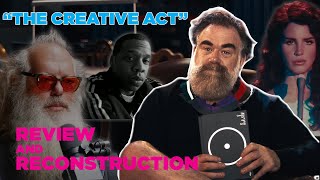
Chris Collins presents a spoken review and artistic reconstruction of Rick Rubin's The Creative Act. He frames Rubin as a highly influential music producer across genres, describes how he deconstructed the book's typographic elements (quotes, chapter titles, body text) to create a mixed-media artwork (dyed quote pages pink as a border, rearranged chapter titles into new sentences, used charcoal for smudging/blending), and connects the piece emotionally through an Avett Brothers song ('Weight of Lies') whose lyrics he incorporated into the work. The video closes with praise for Rubin, a mention of Neil Strauss's contribution, and an endorsement to read the book.
Chapters
Nobody knows Rick Rubin's new book, the Creative act, better than me. I've read the book, but also I've deconstructed it and made it into an art piece.
I don't know that anybody has had more influence on music than music producers. Rick Rubin. So Jay Z, 99 problems. That's Rick Rubin, Lana Del Rey, Paradise, Lady Gaga, Art Pop, from Adele all the way to Slayer. The range is incredible. And it's just all about the art. It isn't about the category that we try to put it in.
What's great about this book is it's the sort of book you can open up to any page and start reading, and it's relevant. One of my takeaways from the book is a creative act. Where is it? Where does it come from? How does it work? Creating something that is a deconstruction and reconstruction of the book is a tribute to the content in the book and to Rick's philosophy and the way that he looks at things. So when I first deconstructed the book, I noticed that there were clear design elements that were, like, specific for quotes, specific for chapter titles, and specific for the actual text of the book or long quotes. So what I did is I separated all those, and in the art piece, I actually dyed the pages that had quotes on them pink and made them a border on the outside of the painting. Then I took the chapter titles and I created my own sentences or my own sayings with those different chapter titles. Chapter one is everyone is a creator. Creativity is not a rare ability. It is not difficult to access. Creativity is a fundamental aspect of being human. It's our birthright, and it's for all of us. I would contend that great customer service or somebody that's really good in business, an incredible sommelier that has a different passion for wine and can tell stories and create experiences. Is an artist the same as any musician out there?
One of the first things that attracted me to him was his support of Transcendental Meditation and how he has, like, a real process and just his overall goal when he's working on a project is to create the best art possible, culture that he creates, even down to at his studio, Shangri La. Every time they, you know, flip to another artist, they repaint the whole thing. Never used charcoal before, but I felt like this was the right medium for it. What ended up being really fun is when you're working with charcoal, you can smudge it, erase it, use your fingers to blend it, and it ended up being a really fun experience. The malleability of Charcoal fits Rick Rubin really well.
Now, one of my favorite songs that Rick has produced is by the Avett Brothers. The song is Weight of Lies. I remember the first time I heard this song. I put it on and I was sitting on my couch reading the lyrics while I was listening to. To the record.
And this song just reminded me of my father. So I never had a real relationship with my father. And my father was. He was a rolling stone. I would hear about my dad being in Idaho or being in Alaska or being in different places, but he was always moving around. And it seemed like he moved when things got a little crazy or he got in some sort of trouble. So what I did is I took that original album of the Avett Brothers and I cut the lyrics out and used it as part of his shirt.
The weight of lies won't bring you down.
And follow you to every town because nothing happens here that doesn't happen there. So when you run, make sure you run to something and not away from. Because lies don't need an airplane to chase you down.
Now the book ends. The artwork is the point where all the elements come together. The universe, the prism of self, the magic of discipline and transmuting ideas to the flesh. And if these lead you into contradiction, into territories that seem unbridgeable and unknowable, that doesn't mean they aren't harmonious. Even in perceived chaos, there is order and pattern, a cosmic undercurrent running through all things, which no story is immense enough to contain.
The universe never explains why.
I'm really happy with how the art piece turned out. I. I want to give my deepest gratitude to Rick Rubin for creating this book. The Creative Act, A Way of Being. It's amazing. I would encourage everybody to. To buy it and really get, you know, really give it a read and a chance. Thanks to Neil Strauss for his contribution to this.
An amazing execution of a book and.
Of the lessons I think that Rick has learned so far in his journey.