The Top 5 Mistakes Parts Managers Make (Service Drive Revolution)
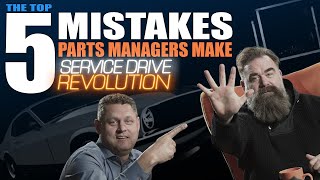
YouTube episode (Service Drive Revolution) hosted by Chris Collins with Jeremy. After light banter and industry news, the hosts answer audience questions (job search remote tactics; technician→advisor tips; scheduling shift meetings), then present the main segment enumerating the top five mistakes parts managers make: (1) not tracking lost sales, (2) refusing to go get parts promptly, (3) lacking a clear parts/runner system, (4) staying confined to the office instead of being visible in the shop, and (5) operating as a silo instead of integrating parts into customer experience and sales. Episode emphasizes customer experience, shop efficiency, inventory/fill-rate, and cultural collaboration.
Chapters
Foreign.
Welcome, everybody, to Service Driver Revolution. We have an exciting show for you today. We're going to talk about the top five mistakes that parts managers make. We're going to answer your questions, talk a little bit about some news in our industry. But first we need to understand, Jeremy, why you're wearing sunglasses.
Well, I'm just getting ready for the big show, Chris.
The big show. Are we going to wwf?
Absolutely.
Well, for the Aftermarket Entertainment Network.
No, the Wild Service Advisors Conference.
The Wild Service Advisors Conference. Where's that Vision?
Kansas City. We're heading to Kansas City next week.
We are headed to Kansas City?
Yes. In fact, I'm already getting texts from some of my former clients and students. Dan Demster.
Shout outs.
Yeah, shout out to Dan Dempster. My buddy Dan, Pennsylvania. He's going to be there. Traveling all the way from Pennsylvania, going to Kansas City. Dan is a student at heart and loves learning and runs a great shop there and does an awesome job. So getting ready for the big stage. The lights are bright.
You're doing two workshops.
Two workshops Friday and Saturday.
What are they called?
Maintenance Profit Master. How to sell maintenance on 20, 17, 18 and 19 vehicles. And then sales. Profit and production. How to turn your business into a profit generating machine.
Awesome.
Yeah, absolutely.
Very, very fun. So make sure you come. If you're going to Vision, make sure you come by and watch Jeremy's workshops. Say hello. Maybe we'll see you at the bar.
Absolutely.
What bar do you think we'll be hanging out at?
Obviously the Sheraton downstairs is always where the action is at.
Are we going to bring our own tequila? Because the thing that I'm running into in a lot of parts of our little country here is that they don't understand tequila.
Well, I don't know about tequila, but we're definitely going to be bringing our own moonshine.
Anything with a. So if you're listening to this and not watching it on YouTube, he just set a brown paper bag on the desk. So what is. You made moonshine? No one made this in your bathtub.
One of my customers did. They brought that into the shop this morning.
Oh, it looks like pee.
Yeah. You're gonna drink it?
I'm gonna drink pee.
Yes, absolutely.
What is that, a bumblebee in the bottom?
Stick of cinnamon right there.
Oh, yeah. A customer gave it to you?
Yeah. Shane Thomas.
Does the customer like you or is it an angry customer?
No, this is a.
How do we know this isn't. How do we know this isn't a pissed off customer?
I don't know, let's.
This could be poison.
Shall we? Give it.
Boys, are you down for trying some moonshine?
Russo's? No. And Michael's. What about Kosh?
Yeah, he doesn't like cinnamon, so let's see this. So this is in a mason jar?
Yeah.
While you're doing that, I was in. I went to Canada to do this new managers training. We launched for International Truck.
Okay.
And on the way up there, guess who was on my flight? By me?
I have no idea.
Famous Canadian Wayne Gretzky. No, more famous.
More famous than Gretzky.
Not Jordan Peterson? No, bro, we. I can't drink that much moonshine. He poured, like, literally, like half a cup.
You have to taste it.
Oh, that smells terrible.
What's it smell terrible about? It's kind of.
Will you. Will you hand this to Michael? Every Michael Lee from Rush was sitting.
Are you serious?
Yeah, super. Nice. So when we landed, he. We were. We were in first class when we landed. They came to try to get him off the plane first, and he refused. He was like, no, no, no. I'm just like everybody else. He. He was really nice, really sweet. I didn't have the heart to bring up the fact that Neil Pert died and all that.
Yeah.
But, man, people in Canada are so nice.
Actually smells pretty good.
So, you know, whatever the guys for International are doing up in Canada, like, they, they. It feels like they are years ahead of. Of us in the US as far as truck goes.
Okay.
Like, the mindset of the managers, their understanding of financials, they're embracing production in the shop.
Right.
Turning customers around quicker, the whole thing. I was really, really impressed with what that's. They have going up there. It was a great two days, just like, you know, working on stuff, sharing ideas. It was really, really fun. And then the, you know, the new course that.
That we launched, well, it's interesting too, because at Vision Kansas City, they brought back the heavy duty training, so now they're getting truck training, technical training, back to the independent world as well, because that market has somewhat been neglected. So it's good to see that grow. And so maybe we can learn a lot from the guys at International up there.
Yeah, for sure. We're gonna try this.
Cheers.
What did you think, Michael?
I'm trying it with you. Here we go. Cheers. Cheers.
Wow, that's really good.
The only purpose of moonshine is to drink to die. Like, you're not gonna sit around with a glass of moonshine and smoke a cigar.
Well, that depends on where you live.
It's like one Minute you're drinking moonshine, the next minute you're running down the street naked being chased by the cops.
That's actually good.
There's no in between. It's all downhill from here. Jeremy.
Shane Thomas, thank you so much. You and your wife make a great batch of moonshine. Anytime you want to bring somebody the shop, you are more than welcome. I won't trade it for an oil change though. So we just got it.
Was that the strategy there? You wanted to trade it?
Shane's a good guy. He's a great, great. So you didn't even try it.
I, I will. Don't worry.
I don't think he will. What do you guys think?
Here's. Here's what I want to talk about. Toyota steers 400 million to self driving startup Pony AI. Pony AI, which is jointly based in Silicon Valley and China has been testing robot taxis since 2018. The two companies announced a pilot program to test self driving cars on public roads in two Chinese cities, Beijing and Shanghai. The Japanese auto giant plans to invest 400 million in Pony, valuing the startup at $3 billion.
Do you think that Toyota, Pony and the CIA were actually involved in the delivery of the coronavirus?
I don't think that Toyota was hip to the fact that.
Getting driverless vehicles.
On the road faster could be a ploy to make this happen. It's safer.
It is.
Yeah. Well, to not have a driver or a woman driver behind the wheel is definitely safer. Studies have definitely proven that.
Are you buying into the coronavirus?
What would you say?
Like creating a major recession and stopping the economy?
Yeah, yeah.
And then the conspiracy theory of Trump releasing it.
Do you really still believe. There were a lot of comments about your theory on that.
I do believe that.
We'Re a show for service drives.
Yes.
And we got a lot of people that have nothing to do with service drives because of the headline of that video.
That's perfect. Bring it on.
What was the headline? Like the. Did Trump create the coronavirus or something like that and your theory was that it was the CIA?
Yep. Trump and the CIA made it happen.
So now I guess the. The.
But.
But here's part of China that it happened is where China has their facility that they test chemical warfare.
Okay.
And so there was a theory that that escaped from there and that's what created it. But I read an article where somebody formerly from the CIA or intelligence said that the characteristics of the virus aren't that of something that is man made.
Interesting. Time will tell. Then you have companies like this trying to Push their driverless taxi cab company. That's an interesting story, though. 400 million. I know Ford has invested a ton of money, like a billion dollars in creating a new company for ride sharing and all that. So this is interesting to see Toyota investing 400 million into a startup for self driving vehicles. We know it's coming. There's a lot of stuff that's going to shake our industry down. You know, there's.
How. How soon do you think that the self driving thing will happen?
Oh, well, I'm going to say this.
Smells like apple, this moonshine.
It actually is like apple cider. Yeah, it tastes like apple cider.
Wow. Like apple pie.
There you go. Yeah. Really?
So your customer made that in his bathtub?
I don't know where he made it. Would you like me to go?
Don't we want to know where he made it before we drink?
There's nothing floating in it. It's clear.
There was cinnamon floating in it.
Well, but there's. The liquid is clear. Wow. The things I do for this show. Amazing. I know, but I'm just. You're going back to this. I think drive driverless cars are definitely going to be your first.
But come on, you got to predict 2030. 2030?
Yep.
How many years is that for now?
10. That's nine years from now.
Is it 2021?
Pretty close.
No, it's 2020.
Well, it depends. Are you doing model years based off.
I know because I still almost write 2019 on everything now.
They'll be here. I think we'll have limited release in cities like LA and stuff in the next five years. And then definitely in 10 years it's going to happen.
You know who it affects the most is Uber, because once you have driverless cars, you don't really need Uber in their network of drivers. Right.
But then that means Uber has to invest in the asset, which they don't have to invest in right now because the drivers are investing in it. So they get all the revenue then if they own the asset.
I know if I had a driverless car, I wouldn't fly. I would just drive everywhere. I let the car drive me and I'd work or sleep or do whatever.
So our trip to Kansas City, you would just sleep in a car for two. How long would it take to drive to Kansas City?
Three days, 20 hours? Yeah.
You would just sleep in a car?
Yeah.
You play video games.
What would you do? Yeah, absolutely.
Work.
Work, you know, rest, everything.
Cars have WI Fi now. You could just.
You totally connect.
You can watch Netflix and Chill.
Yes. Yeah, absolutely. There's a lot of stuff that you.
Can do there that's fun. Okay, I know. I think what we should do next is summon up our buddy Don Rito.
Don Rito. Missed him.
And take some questions from the audience.
Absolutely.
What do you think?
Let's bring them on.
We got a lot of feedback on Don Rito. People are posting. Can we ask the puppet a question?
They should definitely be able to ask him a question.
So let's.
Dial up Don Rita. How's it going, Don?
Oh, it's going swimmingly, Chris, I gotta tell you.
Have you ever had moonshine?
Oh, yes, yes, absolutely. Every Tuesday, Wednesday, Thursday, Friday and Monday and Saturday.
You drink a lot of moonshine.
Everything that ends the cheapest option.
Any good questions this week from our listeners?
Oh, we have the best questions this week. You want me to read them?
Yeah. Let's remind everybody that if you submit a question on.
LinkedIn, YouTube, you can email info@chris collinsinc.com and your question makes it on the show. We will send you some swag.
Nice.
Which consists of some service Drive Revolution, T shirt hat, coffee mug, stickers, that sort of stuff.
No moonshine, though.
Okay, what's your first question?
Well, first of all, I can't believe you're not sending the moonshine. I mean, let's be honest. But here, let me get to the question.
Hello, Chris. I am 24 years old, single, and have no kids. I am looking to move into a dealership on the west coast. Coming from Ohio, what strategies or methods can I use to attack the job search from a thousand miles away?
Can't you, on Tinder, Jeremy, move the mileage out? Like, could you go a thousand miles on Tinder? Does anybody know?
I wouldn't know. I've been married for 21 years, sir.
Oh. Now, are we trying to get you a job or are you trying not to be single? Oh, you don't.
Job search.
A job search.
Job search.
So how do you get a job a thousand miles away?
I think that probably the best way is to send a nice cover letter with your results. So whatever your results are now, like, hey, I'm. I work in this service drive. I'm the top in csi, I'm the top in sales, and I'm looking to relocate.
No one's going to read a letter.
No.
No.
How would you do? Service managers are busy, so how would you do it?
Technology. Right? Make a video of your skills, talents and ability and get your own YouTube channel going and send it out to all the service Managers all across the west coast. Pick the city you want to be in and show them how you can actually help their dealership make more money. Go to the principal as well. Don't just stop at the service manager, but use technology. They'll watch a two minute video. They're not going to read a cover letter. Besides, postage is very expensive. Emails fast.
How do you get their emails?
Easy. The dark web.
How do you get their emails in the dark web?
Just go to the. What? Just go to the.
See, this moonshine is affecting you.
The dealership that you want to be at. Pick the car line you want. Go to the dealership that you want. Look at their website, call the dealership, find out who the principal is and the players that be and ask for their email address. You'll get it and then bug the hell out of them until they hire you. Took me six months to get hired onto my first dealership.
And that's how you did. It was a video?
No, we didn't have video back then, sir.
You did it.
Morse code.
I called every week and showed up once a week, every week for six months. Then the service manager finally got tired and said, the person you need to talk to is this person. And I said, great. What kind of car does he drive? And then I stalked him in the parking lot until he gave me a job.
Yeah, Nothing.
It works.
No, that does work. Okay, so Jeremy's idea is make a video and email it out. Mitt, would you call and follow up and say, hey, I sent you a video.
Yes.
I'm thinking about coming to your area. Watch it.
The hard part about phone calls though is you're just. They never answer the phone.
Phone. No. But if you left a voicemail.
Yeah, voicemail for sure. Absolutely.
Cool. Good one. Okay, what other questions we have?
We have another question From Andrew on YouTube. I am looking to change to an advisor from a technician. I am a customer service provider at hot. What tips do you have for me to be an awesome advisor slash writer?
Good, good one, good one. So the, the hardest part of a technician going from the shop to being a writer is that as a technician you kind of know what's wrong with the, with the car or the truck. And so you diagnose it and you end up killing the whole process. And so the thing that you have to do is not diagnose, but pretend like you don't know anything about anything and just get the information down without saying too much and talking too much because you're going to cost yourself diagnosis. You're Going to take shortcuts, and you're going to end up sabotaging the text when they get the ro because you've half diagnosed it on the fly, but you've never really hooked it up to anything. You, you know, you haven't really done it, and you lose that. That chance for the customers to pay or to claim warranty or whatever it is. But by diagnosing it in the drive.
Which is going to cost you hours per ro, effective labor rate and all that as well. Right.
So that's the hardest part, I think that I see is that you have to unlearn how to fix a car or truck and learn how to communicate with customers, make friends. And so the conversation needs to be more about them, their kids, their work. You know, really petting the dog, watch the pet the dog video on YouTube, really connecting with them on a deeper level. And not the car, the commodity, you know, that sort of thing.
Yeah. And I would say, I mean, if you're serious about it, make the leap. Just take the leap and go do it. I hate to see us losing a technician because there's a huge technician shortage right now in our field. However, if you do want to be a service advisor, go make the leap. Make it happen. Get a coach. We have some of the best coaches on the planet, and that will accelerate your career path and getting into the service advisor position that much faster.
Good, good one. Okay, next one. Don, what do you got?
We have another question from Lisa. Lisa writes, I listen to your podcast and have the on demand platform. I really love your training. We just love hearing that, don't we, Chris?
We do, absolutely.
I have a question, though. I know you answer questions sometimes on the podcast, so here goes. If you have a small dealership like me where there are separate ships for advisors, how do you do the meetings? I have three advisors. One comes in at 7, one at 7:30, and one at 8. They also leave in staggered shifts. I want to see what you think the best way to handle the morning shift meetings is. Do I wait for everyone to get there? I don't want to change everyone's schedules. Thanks, Lisa.
That's a good one. So in our on demand training in service manager University, we, we, you know, teach to have shift meetings or certain things that happen at those shift meetings, but it kind of sets the pace for the day, gets everything going. And, you know, we usually have games and those sort of fun things going on then that we announce and talk about. So my advice, Lisa, would be that I would change their schedule. I would have them all show up at 6:45 and then I would have one of them stay late and cover every third day. So on Monday, one of them stays until 6 o'. Clock, on Tuesday, another one, on Wednesday another one and they just rotate. But you're going to work a little bit longer, you're going to work an hour longer once every third day. But the leverage that you'll have and the momentum by having them all in a room all at one time, starting at one time will be way better. And the other thing that I would really pay attention to is are you then staggering the text in the shop? Because if your advisors are coming in at different times, but the shop is all starting at 7:30 or 8, I want those advisors there writing and loading the shop. So what I like to do is start the text an hour after the advisors so they've had a chance to write enough ros. Then when every tech gets there, they have work. Because technicians, if they start and they're looking for work for the first 30 minutes of their day, they never really get in a groove and they never really get momentum. They go get a breakfast burrito, they're drinking coffee, they're talking about this thing, and then that's kind of the pace of the day. So another benefit of having all the advisors start early at one time is that we're going to load the shop when the, when the tech start. They got plenty of work and we have momentum. So that's how, that's how I would do it is I would start them all early and then have them just rotate who stays late, have one of them stay late every third day. Great, great question.
Great question.
Good job, Don. Thank you so much. We're enjoying this with you. I not sure that it is okay with your parole officer for you to be drinking moonshine, but if you would like to partake on the side, you are free to join in.
Absolutely. Right on.
Well, I do appreciate, I do appreciate the invitation there, Chris. I, I, I do have a problem, as you know. And thank you for exacerbating it.
You're welcome.
Anything we can do to help further your career.
Yes.
Man, I don't know that Don. I don't know that Mr. Rizzo should be drinking this moonshine, but the top five mistakes that parts managers make. The top five mistakes parts managers make. Are you ready for this, Jeremy?
I am ready.
This is exciting stuff. It's going to hurt a lot of feelings, but it's all true. It's all very true.
And it's really important, because this is the, the crux of getting the car fixed and out the door on time. If you don't have the right parts at the right time, you can't hit your promise time. And that could suffer.
And I would say to that point, because you, you, you make a good point, is maybe we should appreciate parts more.
Yes, we should.
Maybe we should send parts more.
Love, are you saying we should share our bonuses with them?
Maybe we should share our bonuses. Maybe we should take them out to dinner. Maybe we should invite them to some meetings. Maybe we, you know, parts gets a bad rap that they're not that fun. But I find a lot of parts.
Staff are pretty fun, you know, the most.
When I think back on my career when I made the most amount of money, we had a really good kick ass parts department, a great parts manager, ran a tight ship, did everything right, and it made our lives a lot easier.
Had a strong culture.
Yes, absolutely. Yeah, you're right.
Okay. Number one, the top five mistakes that parts managers make, they don't track lost sales.
Interesting. They don't track lost sales. What do you mean by that?
So there's a, there's a couple things. Sometimes with parts managers, this is like talking about proficiency versus efficiency, which is a bunch of terms that consultants came up with and you know, is mind numbing. But when you ask a parts manager, do you track lost sales? They're always like, yeah. And then you go to their printout of lost sales and there's like three for the month. And you're like, you're not tracking lost sales. And then they want to debate what a lost sale is.
Right.
So what in your opinion would be a lost sale?
Well, anytime you give a quote and it doesn't sell, I could think of somebody calls for a price on heater hoses and they don't sell it. Maybe it's a wholesale account. That could be one where they're going aftermarket versus the manufacturer. Or you're just, you do the quote on the invoice and half of it doesn't sell, you gotta track those things that were quoted but didn't move.
So you're close. But if somebody calls in for a quote and you don't have it in stock.
Okay.
What we're trying to do is we're trying to get our fill rate up. Right.
Okay.
And so if, if three people called in for the same water pump in a month, that would show you that there's a trend starting.
So what you're saying is it's the parts manager's job or the parts department job to get ahead of the trends that the manufacturers give the parts departments. So instead.
But now let me tell you why parts managers don't do it, is because in a lot of systems, if you. If you hit something two or three times that it was a lost sale, it's going to order it.
Okay.
And they don't want to have to look at their order, their stock order. They want it to automatically go. So they won't look at it to see the trends.
Okay.
Because, you know, especially with a lot of manufacturers, it's set up that it will just automatically order. So they don't want it to automatically order something that they actually never sold and have it in stock.
Okay.
But I would say that that's the wrong way to look at it, and I probably would stock that part, but I at least would want to see it and I would go through my stock order and not be lazy about it. So anything that at the back counter we don't have, anything that somebody calls in for that we don't have, I would be dinging that as a lost sale and then looking at it every month.
That's awesome. That's very insightful. It's a new way to look at it.
The number two mistake that parts managers make is they won't go get the part.
Come on, you. You want them to go get a part for you?
Yeah, I want them to send somebody to go get the part. Today?
Today. Right now?
Right now. If somebody else has the part, go get it.
But that costs extra money.
I don't actually could end up costing less because if you got to overnight it.
Correct.
Depending on if it comes on the stock order or not. But most of the time they would rather overnight it than send somebody to go get it.
Okay.
And so in that scenario, like a lot of times, like, I can find a courier to get it. If you don't have somebody to go get it, there's, you know, you can find an retired off duty fireman that'll go pick up stuff for you for 10 bucks.
I have one for you. You can actually Uber the part to yourself.
Yeah, you can uber. That's a good one too. But get it today.
Yes.
That's the second one.
So how does that make the service department run better? So you're talking about bay efficiency, rack efficiency, tech efficiency. Because if the car's racked and it's there, we save time. If I can get that part installed today and the car's done, the job is done. We don't have to unrack it, re rack it, put it back into workflow. So you're talking about running a tighter, more streamlined dealership that's thinking outside of the shop.
Well, I don't care if it's a dealership, truck, car, independent, whatever it is. At the end of the day, what you're doing here is improving customer experience. So let's say you have a dealership with loan cars. The loan cars are going to come back quicker. Let's say you don't have loan cars in your in independent shop. The customer experience is going to be drastically improved. Because if they're paying for a rental car, they don't have their car. We can get it for them today or back to them tomorrow morning instead of it being another day. But if you want to order it and wait for it to come and it's in town somewhere, you're you cost us at least another day. But which the customer perceives as it took longer because it did. Right. So at the end of the day, it's more about the customer experience. But it also is just that mindset of being aggressive. If you're aggressive that way, you go pick it up, you better things happen.
Just wait till the big A delivers it same day for you.
The big A?
Well, Amazon.
Oh yeah, right, right.
Absolutely.
It's coming.
It is coming. Yes, sir. So I agree. Go get it. Go get those parts and get the cars moved out of your shop.
Number three is you don't have a real system of how you handle the shop.
Okay.
And so a lot of parts managers have done this thing where they have runners, they don't have runners and they don't understand kind of what you gotta, you gotta pick away. So you're either gonna have a bunch of high paid parts guys, right? Or you're gonna have one high paid parts guy and a bunch of runners. But the idea of runners was that you could have less of the high paid parts guys. You could have one sitting in a computer pulling the parts, ordering all that. But the runners are running it out to the shop.
Right.
And if you, if you're running a hybrid and you don't commit one way or the other, your expenses end up being too high and you end up not, not getting a result.
Right.
So the idea with the runners is that you can have one parts guy, they pull a ticket, the runners know to go find it where it is and run it to this tech in that stall. And so you can have those kids that are, you know, $15 an hour or Whatever minimum wage is in your. In your area. But I find that a lot of parts departments are running this hybrid, and they're not really being efficient one way or the other, so.
So really what you're talking about is creating a system within the system. So you've got the repair facility that we look at, lean processes and how to, you know, make our technicians more efficient and all that. And then just looking at the parts department, how they operate as a more efficient unit by creating a system that gives that.
Result is what you're looking for there.
Yeah. And I think a lot of parts managers are okay with there being a line of text at the back counter.
Where.
When I see a line of text at the back counter, I'm just watching production.
You know, Chris, I want to drink. When I see that.
Drink moonshine. Really, really strong. Moonshine was.
Well, you got to realize when a technician is standing around, that's $300 an hour just being wasted. We need to produce. We need to get those text back.
That's strong.
That's crazy. Yeah, we need to produce.
Got it. We have to produce. We got to get the technicians moving the most. The biggest expense we probably have is when a technician is standing there not doing anything. I think we're going to talk about that in one of the other episodes coming up soon in March. So get that system together. Make it work.
Number four mistakes that parts managers make is they don't get out of their office. They don't wander around, they don't go in the shop. They don't, you know, touch everybody. They're just sitting in their office running reports, checking emails in a cave somewhere.
Absolutely.
They're not up and about. Your role as a leader is to be up and about, to be seen, to have your presence felt, to be checking, knowing what everybody's doing, maybe, I don't know, spend more than half of your time out of your office.
Interesting. But they're the manager.
Well, we know where they are.
You do? Absolutely.
We know exactly where they are.
You know what's interesting about that is you can learn so much by going through the shop. And I think also you have to let go of what old ideas and old ways before you bring in new stuff. So I think we're really at this point in our industry and with the business that profitability is going to come from a new idea. So this is great. Go out, spend half your time seeing people get out in the shop, see what you can do differently and be open to new ideas. Because a lot of things we've never done it that way. We're not going to do it that way. That's not winter thinking.
Yeah, that's good. Number five is that the parts department becomes a silo. And what I mean by a silo is that you think of parts as just parts. You don't think of parts as a customer experience. And so from the customer's point of view, they are just getting a repair, they're getting back on the road, they're, they're solving a problem. They don't care that there's a bunch of different departments. It doesn't matter to them. And one way that I see that parts managers, when they really get this, they start selling a lot more accessories because they start going to the sales meetings, they start going to the advisor meetings, they're out in the service department talking to customers and they stop thinking about parts as their island that they have to protect with a moat around it. When they start thinking of it as a bigger part of the revenue of the entire shop of the dealership and going out and seeing how they can affect other departments and then you start selling more accessories.
Right. You know, and I think about it, what you just said from a service advisor standpoint, I'm guilty of not supporting the parts department too. It's. We take it from.
Yeah, so it's saying we need to invite them in too. It's on us as much.
Yeah, absolutely. And then it's very interesting that, and I wrote down this when you were talking. Parts procurement is a customer experience touch point. It's part of it. And if you don't have the right part at the right time, that can take away from that five star experience that we're trying to deliver to the customer.
Yeah, that fill rate. That's why I think the lost sales helps with that, that fill rate. When whenever there's a manager that wants to debate the lost sales thing because they don't want to look at their stock order, most of the time their fill rate is pretty low. So the fill rate is driven by being aggressive, being open, maybe stocking a couple things that you wouldn't normally do. But in the long run you're going to be ahead of it.
Well, absolutely too. And depending on where you're at, like you know, here in la, we have most of the major distribution centers here on the west coast, right here in Southern California. So it's easy to get most everything next day. So a lot of parts departments will fall back on that. Well, if you order by 4:30, we'll have it tomorrow. Well, what if we had it today? So if you're in an outlying area, that can be a huge competitive advantage if you grow your inventory and they're able to fill those orders right away and get those cars back on the road faster.
Yeah, I see too. On the, on the fifth one, on the silos. I see when parts managers start going to sales meetings and they start talking to the sales department, they start talking about accessories. Maybe they spiff and gamify accessories. They're selling LEDs on trucks, they're selling bed liners, you know, they're selling luggage racks, all that stuff.
The opportunities there. I remember when I had my shop in Flagstaff, this, this is about 15 years ago, I was going after fleet business and I had a guarantee that if your truck had a breakdown, I would do any repair within 48 hours, whether it was an engine, transmission or whatever. Because I knew that I could drive to LA and pick up any part. Well, I had a guy take me up on it and he needed a transmission and guess where the transmission was? Was here in la. So we drove from Flagstaff here, picked up the transmission, got it back in within 12 hours, had the car back on the road within 22 hours, hit our deadline and, and my guarantee was if we didn't meet the 48 hour deadline, your repair was free.
Oh, wow. Yeah, the, the thing about that last point and kind of to wrap all this up is I think a lot of times parts managers see themselves more as an accounting type role instead of a retail role.
Okay.
But the best managers are the ones that see that they're in the retail business, not in the, the number crunching business. I know parts is a lot of numbers and it, you know, it can get out of hand and you have to be able to manage that part of it very well. But at the end of the day, going forward, you got to think of yourself more as being in the retail business than an accountant.
Absolutely.
That's, that's the, the biggest one. Cool. Well, thanks you guys. This was service drive revolution. And we will see you again next time. We're going to have fun in Kansas City.
Yes, we are.
We'll report back to you on all the trouble.







