Thomas Doherty on "Down and Out in Paris and London" || Books That Changed My Life
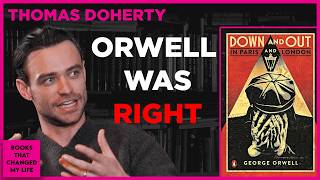
Actor Thomas Doherty credits George Orwell's Down and Out in Paris and London with shaping his worldview, especially after working as a maid and experiencing poverty. He discusses how the book taught him about choice and agency, and contrasts the myth of luck with the reality of hard work and finding leverage within systems.
Chapters
And did you tell your mom how much it meant to you?
Yeah, she knows. But she's just such a beautiful woman. So much grace. Um, I don't know why I'm getting emotional. This is mad.
Okay, now we're going to jump to the second season of Paradise.
Yes. Okay. Second season of Paradise. We're introduced to— God, it's crazy jumping from this. I'm sorry.
I'm so sorry. Okay. The big question. How did Down and Out in Paris and London by George Orwell change your life?
It made me—
Welcome to Books That Changed My Life, New York City Edition. We're pulling a John Krakauer and going into the wild, all the way to the concrete jungle. We're in the House of the Redeemer Library here in the heart of Manhattan, and we're joined by incredible actor Thomas Doherty, and he's here to talk about the book that changed his life, Down and Out in Paris and London by George Orwell.
Well, I was brought up very Catholic.
Oh, you did?
Yes.
So you understand guilt?
Riddled. This will be easy.
You're guilty already.
Yeah.
Oh, my mom is the best at guilt.
Yeah.
Well, I haven't seen you in a while.
Yes, I know. I'm getting to that age now as well. 39. And it used to be like, no, go live your life. And now it's like, where are you?
Like, if we called my mom right now and I was like, Mom, how are you doing? Well, you could just set the phone down and come back.
Well, I have a 101-year-old grandmother. She's Irish Catholic. Very Catholic. And she'd always go, oh, you're gorgeous. You're so beautiful. You're going to hell. And I feel like fucking hell.
It's 9:00 in the morning, woman. When I was a kid, I grew up a missionary kid. So my parents, my mom and my stepdad moved to Mexico to be missionaries. So from the time I was 4 and a half till I was 13, I lived in Mexico. I used to have these friends that I played with that were like my best friends, two brothers, and they were Catholic. And my mom one time, and I think I'm like 8 or 9, like I was young and very Christian, like, you got to be saved, you got to go to heaven, like the whole thing. And my mom told me they were going to hell. And I was like, but they believe in Jesus. And she had this whole theory that Catholics weren't actually saved because you went through the priest. It's a different system. They monetize different.
Of course.
Yeah. And I was so upset. I was trying to get my friends to convert.
Really? Yeah.
I was like, oh, that's how they get you now. So crazy. But I was so upset when I was a kid because my friends weren't going to go to hell and I thought they were Christians and it ends up it's a different monetary system.
Yeah.
So funny.
Yeah.
Where the church I went to is more an honor system to pay your tithes, where the Catholics are a little more organized. You got the priest in between.
Yeah.
It's just different. Yeah. The Mormons—
Wait, so would you speak to God directly? Is that what that is?
Yeah.
Okay. Whereas we have to go through—
And I think that was my mom's theory is like, Jesus died so you can go direct or something. I don't—
it's still not that airtight.
Even when you read it, like, first of all, who's met— who's had this conversation at dinner with God? Like, it's all theoretical and abstract. Yeah, but people are very convinced.
Yeah, I remember I used to— I went to church, so I grew up very Catholic, and I went to— I grew up— I went to Catholic primary school, elementary school, and then when we left, when we were 11, I went to a non-denominational school that was closer to my house, and everyone else went to St. Augustine's Catholic High School. And I remember I did musical theater growing up, and one of my oldest friends, Ronan Burns, he was there, and he— we were at a house party when we were 15 or 16 on a Saturday night, and I was like, I'll see you at Mass tomorrow. And he kind of like looked at me and laughed, and I was like, that's kind of odd. That's very weird. So anyway, I was in Mass that day and I was kind of like looking around for him. I couldn't see him anywhere. And I normally see him and I see his family. And so I was sitting there and I was listening to the priest talking about love and forgiveness. And then it clicked. He wasn't there because he just came out as gay. And obviously in the Catholic Church, it's not really welcomed in. And so I was sitting there with this in my head, like, oh, my best friend. Is wrong in the eyes of this man or these people that are saying love thy neighbor and all the rest of it. And since then, I went in this rabbit hole of trying to understand the theology, the organized religion, if there's anything to it, where it's derived from. And then it became like such a fascination of mine. Um, when I started to kind of get rid of that guilt, that iron fist that the Catholic Church holds over you, holds you in. So yeah, that's my Catholic story.
What is your, what is, what is your conclusion or what have you figured out?
This is where I look at my PR. No, I am. I think, I think a lot of it never kind of added up for me, even as a child. And I remember kind of coming back to church one day when I was younger. And, you know, they say the eulogy and they see— I don't know what you even call it, where the whole congregation says the same thing. I remember coming to church one day and it was different. And I was like, God, I've been coming to church for 15 years and it's changed. Like, what's changed in 2,000 years? And I started to really dive into the origins of of religion and then started to go into— because I'm fascinated with human psychology. I always say if I wasn't an actor— oh, you're the best. Thank you so much. I would say if I wasn't an actor, I'd love to do something in psychology. And so I started kind of looking into why humans want that. What was it? And what did I conclude from it? Eckhart Tolle said it best, I believe. When we talk about God, it's become such a muddy word. And he said that it's almost like all these different cultures and different societies, they're all pointing towards the same thing. They're all pointing towards God or the universe or the spirit or whatever, however you kind of see it. But what happens is, if you can imagine loads of kind of placards pointing towards this thing, God, that you can't define, that you don't know what it is, that you can't touch, it's not tangible, you can't even understand it, you can just— you just are it. But what happens, I feel like what makes most sense to me is that we've got all these placards pointing towards what God is. You've got Catholicism, Christianity, and Islam, and all these different religions. I think what humans do is they actually confuse the placard that's pointing towards God for God. And then that's when the humanity, the human condition jumps in and we get attached to these ideas as opposed to experiencing what God is as ourselves.
Hmm.
And so I'm not speaking from any moral high ground here. I mean, it's a constant practice. No, you know, there. But I think we have our experience.
It's interesting. That reminds me of just the thought that I have a lot of times when people talk about politics or anything is like most of what people are talking about is the symptom, not the cause. And that's kind of what you're saying is like the plaque is the symptom, but the real thing is bigger and you can't understand it really because it's too complex.
Yeah. Yeah.
We try to understand it. Yeah, that's fascinating.
And if you think about the human brain, it's constantly just— it's kind of there to survive. It's a survival, you know, our ego's survival. It wants to survive, wants to preserve.
Yeah, that's the basis of everything we do, right?
It's survival.
Survival and belonging.
Yeah. And so we want to understand, we want to know, because that fear of the unknown seems to plague play our species. Yeah.
For me, as a kid growing up in the church, the thing that always confused me is how miserable everybody was. And then there's just this whole thing of like, do this thing and you'll be happy. And it's like, no, you're miserable. And then it's like, well, you carry the suffering and the pain. And it's like, well, why do you die on the cross then? I got to die too? Like, slow death? Yeah, it never— even when I was little, why is he making me die? Yeah, like, it's so confusing. And then hell, like, you have— religion has nothing if you don't have hell forever.
Okay, well, even that is like a loophole, or not even a loophole, just a hole in the story. If you think about it like this, okay, so you had Lucifer, he was a fallen angel, so he's got beef with God. He doesn't like God, they don't like each other, and got the devil God wants us to do bad things on Earth. So if we do do bad things on Earth and we go to hell, he's not going to punish us for it. He's going to welcome us in.
We'd be VIP.
So it sounds like a good time.
Yeah, it is really funny. There's also versions of that that, you know, I remember— do you know who Angus Fletcher is?
Who?
Angus Fletcher. He's written some great books, but he's He's really an expert on storytelling and mythology and how your brain processes stories. And he was explaining to me like that there's actually like some pretty strong theories out there that God and the devil are kind of one in the same, or that the devil is actually the one in charge, which, you know, I mean, it's funny because everybody has, everybody has a different take, right? I remember when my When my grandfather died, I was sad because he didn't believe in God. And I don't know, I just mentioned to somebody who worked for me that I was kind of close with that I don't think he'd go to heaven if that system is real. And he wrote me this letter and he said, you'll be able to pull your grandfather up into heaven. And I was like, huh? And he was Mormon. And in their church, they believe you can pull your family members up when you're already there. Yeah. And I was like, whoa, everybody's got a different— Catholics have purgatory. They believe you can pull them up. The one I grew up in is like, it's black or white. You're on your own. Yeah.
Or eternity.
It's so funny. And it's so funny how people believe their thing and that that's the only way and you can't really move them off of that.
No.
Where I'm always like, people say don't talk politics and religion, and I'm like, why? You could change my mind if it makes sense. But most of the time, the people that are saying that are just so locked into something, they don't really want to talk about it. They don't want to be questioned. They're just, if you don't believe this, then you're that kind of a thing.
Yeah. I mean, like, honestly, for me, what's definitely changed— I mean, no one wants to sit and listen to an actor preach about anything, really, you know? And so for the last kind of little while, I realized that, okay, one, I'm no cornerstone for advice on life. So everything that I say these days now is definitely derived from my own experience. So if I ever talk about, like, fear or any delusions or egoic behaviors. It's all my own experiences, you know. And that's kind of a vulnerable place, especially when you've got 3, 4 cameras pointing at you.
But 7—
7, Jesus Christ.
No, it's a handheld.
No, like, um, no hiding.
No, but I think it's funny that, um, that you feel that way because I think acting is based on the understanding of human behavior and going into other areas that you wouldn't normally go. You have to act out something else that you aren't. And so in order to be good at that, you have to understand it. So you have to have a certain empathy. Even if, like, say, an actor plays a bad guy that they would never be, a murderer or a villain, you develop a certain empathy for people, because most of the time people don't just become that. Have you ever seen that documentary on HBO called Crazy Not Insane?
No.
So this lady, she was going to college and somehow, I forget how, but she ended up studying for a court case, a serial killer. And then she ended up over her kind of career becoming the expert of serial killers. And one of the things she says is like, I don't condone this behavior, but she She says, I can draw you a graph. And all of the people that I've studied that were the worst murderers, that the abuse that they suffered as kids is in direct correlation with the violence of their crimes.
Yeah.
And she tells a story about this one serial killer who his mom would throw boiling water on his back when he was 3, and then she would whip him. People, whatever you believe in, in the human condition, most of the time those people are an outcome of something. They weren't born that way.
Yeah, absolutely.
And so when you're acting, you have to have an empathy and an understanding. And I think also you could tell me you have to bypass judgment, because if you were just judging the character you were going to play, you wouldn't be able to be that character. And one of the probably one of the best tools for understanding humans is putting judgment aside and really trying to understand.
Yeah, that's the only way you can understand.
So I would contend that you probably understand it more than the average person just because it's what you do.
Yeah, maybe. I mean, yeah, maybe than the average person, I suppose. Christoph Waltz did an amazing thing once. He was on a talk show, and the talk show host— it was after Inglourious Basterds, and he did he played the SS guy. Have you seen Inglourious Basterds? And he was on a talk show host, and the talk show host was like, so what was it like playing this evil, horrible person? And Christoph Waltz seemed quite bemused by the question. He was like, what do you mean? Because Christoph Waltz— and I mean, any bad person in the world has to believe that they're doing the right thing. And so, for Christoph Waltz to be able to play this monster, actually had to tap in and believe that this character genuinely thought that he was doing the right thing. And going back to what you were saying about how we eventually get to a spot, that gives me a lot of relief because if I ever find myself in a bad place or a dark place— this is why I love psychology so much. You can trace it back almost like a map to, to something.
I always say you trace it back to birth.
Yeah, there's—
well, I mean, yeah, of course there was a birth of that, that thing, that condition, right? Like whenever I, uh, make a mistake, like there, there's kind of two ways you can, you can look at life. You can look at life that you have agency and you have control, or you can look at it passive and believe something else is in control, right? You can externalize control or you internalize control. There's a term in psychology called locus of control.
What's it called?
Locus of control. There was a doctor, Dr. Rauder, that kind of discovered it when he was studying personality, that in people's personalities, they either are kind of aimed at or they have a default setting of owning responsibility or externalizing responsibility. So people would externalize externalize responsibility to God, like it's fate, right? God gets blamed for a lot of stuff, or your genetics, or the way you grew up, or the government, whatever it is you can externalize. Or you can internalize and believe that your actions, your mindset, your behaviors create your destiny in a sense, right? Like, you kind of have a choice, and most people externalize. So the majority of people externalize.
Why do you think that is?
Well, we're conditioned very young. When we're young, we don't have control, right? There's a point where we are dependent on our parents for everything, and then just some people never come out of that. And usually the poorer you are and the more learned helplessness you have, the only way to survive is to believe that it's something else. It's just a natural way of coping, of getting by. Like when something happens naturally, it's easier to say, well, it was fate or it was luck, that sort of thing, right?
Yeah. I think one thing I've definitely learned is that responsibility Like, in terms of the conversation of free will, do you believe in free will?
I don't know. I don't. I don't.
I don't.
I believe that you create the life that you want and like—
But the desire to even if you like go into that, the desire to, for example, you want to go to the gym and you want to get really fit and like look good. Yes, you choose to do that, but the decision and the thought process and the feeling to even want that, to have that desire, isn't even your own. And what created all of these kind of internal narratives that got you to that place were caused by something else. So I do believe that there's a ripple effect. That goes on your entire life that relinquishes you not of responsibility, but it does relinquish you of some power. You don't, you don't actually ultimately have any power.
Would you agree that people that are more intentional and focused on an outcome and work really hard at it are more likely to get closer, achieve that outcome than people that are passive.
Yeah, definitely.
And so then how does free will play into that?
Because I always believe that— I mean, we were talking about being Catholic and stuff earlier on, and I remember the very example I gave going to the gym. It was the start of my career. I think I was 18. I was like, I want to get really fit because I was always a really skinny kid. So I was like, I want to get like muscly. I remember being in the gym and crying in the gym that my dad and my brother didn't have the drive and the desire that I did. And it wasn't their fault because they just didn't have it. But I just had it. And I think I had it because of life experiences and a lot of different things that have happened in my life that led me to want to do that, which they didn't experience that. And in my head, I mean, they didn't give a— they didn't care, obviously. But this is my own kind of internalized—
well, yeah, for me, there were a few moments in my life that made me want to be successful and not poor that were from shame and being embarrassed. And just deciding, like, this isn't for me. Like, I don't want this. And so that drive, that fire definitely made me different than others. But I was also running from something.
Yeah.
Because when you start to achieve success, you realize that success is just one part of life, but it isn't fulfillment or happiness or being authentic. It plays a role in it. And it's easier to be happy if you have resources, but it doesn't define you in a way. But that shame in those moments changed me from the rest of the people that I was around and my friends and family at the time. Right. So there was something that happened that made you want to be different than your brother and father. Was there a moment?
No, it wasn't a conscious decision to want to be different. I wanted to— I mean, I think I succumbed to societal standards and pressures of, you want to be an actor, you want to be this, this is how you have to look. So it wasn't an act. I did— it wasn't like, oh, I don't want to be like you. It was more, I want to be like this. This is rewarded in society. Don't you want to be rewarded? Obviously not, because you're not pursuing it.
I know it was like confused thinking in my head, but you were sad for them.
But I was sad for them because I deemed this as what you should do. This is success. This is what— and they didn't have that desire. But I couldn't claim the desire in that hard, or even the desire to work hard, I believe, isn't your own. And so then a full round circle is where I am right now in life, is to surrender to God, to surrender to the universe, to surrender, to know that my— I don't believe that, again, to quote Eckhart Tolle, you've heard the expression Life's a dance and you're the dancer. Well, he flips it. He says, no, no, life's the dancer and you're the dance. So life is dancing through us as opposed to us having this.
It's beautiful.
Yeah, it's really beautiful. And it's terrifying. It's terrifying for the ego because like we were saying, the ego's whole aim is to survive and power. And I think that's why men get angry so a lot more than women, because underneath anger is sadness. But that's a very vulnerable space to be in, and anger is charged and it's powerful.
Um, have you learned to be vulnerable?
Yeah, I mean, you have to be, especially as an actor. Um, but then there's also— it's kind of working out. That's why I'm definitely in a much better— I'm in a great place with that, actually. I've done this for 10 years, and coming into the industry, of course, you want to do well on screen, and you want to do well on stage, you want to do well in auditions and things, but a huge chunk of it is figuring out where you are in this world, figuring out in the world of the acting world.
I was saying something to you about tracing things back to birth. So when you talk about locus of control, whether you externalize it or internalize it, if you internalize responsibility and you believe you have agency in your outcome, let's say, and I'm just going to use an abstract example. If you're in a neighborhood and you get mugged, the problem started when you went into that neighborhood. And so if you can trace the beginning of where things went wrong, you learn and it becomes a feedback loop where instead of externalizing control and holding on to it like it's something bad that happened to you or you're cursed or you have bad luck, you can figure out ways over time to just get better at the thing.
Yeah.
And so that's tracing it back to birth. If you trace your mistakes back to birth and own the responsibility for it instead of saying, well, it's the guy, he's a criminal, versus saying, I shouldn't have been there.
Well, yeah, that's, I guess, yeah, that's empowering.
But I mean, again, it's extreme because most people have a hard time with that.
Yeah. I mean, I also don't want to sit here and kind of— I'm in a very privileged position, you know, so make good money. I get to do what I love to do. I get to live in New York City. I get to experiences like this.
Yeah, but there's certain things that you've figured out or understand that would help others from your experience.
Yeah, that's well, so only just my experience.
Yeah, it's not judgment. It's just you're sharing like, hey, this is what I've figured out for me. Yeah, but that with my set of experience, you've watched other people and it's helped you.
Yeah, no, exactly.
Yes. That's how we learn.
Yeah.
Because I don't know, we're all trying to figure it out. We're not pretending like we know.
Then we get to our deathbed and we're like, I don't know what was that.
We're here to talk about this book, George Orwell's first book, Down and Out in Paris and London. But I'm curious, what is your relationship with books?
With books in general, um, you know, I, I, I, I do like to read a classic. I want to be able— I want to read more.
Um, are you a fast reader or slow?
I mean, a really slow reader. So that's the thing. And I read a lot of scripts and like, so it's almost like it does start to feel like work. But with George Orwell, with all of his books it doesn't feel like work. It's this beautiful escapism into a time in the world where we didn't have phones, iPhones, and we didn't have social medias, and the world sounded different. And I love that. I love that so much. He's my favorite author.
He is?
By far. Yeah, by far.
Was it easy to pick this book?
Yeah. Oh, yeah. Straight away. I mean, they said 3 originally. And so I had two— well, I know I had two other ones. I had a book called From Thriving to Surviving. It's a Peter Walker one. It's about complex post-traumatic stress disorder. That's an amazing book. Everyone should get that book. It's fascinating. And it lets you understand yourself more. And what I found is the more that I understand myself, the more that I accept my foibles, the more I can then understand other people. And the more you understand other people, other people, then that's where compassion can come into play. And it was never intended. I never intended to, you know, it wasn't some martyrdom where I wanted to save the world or get, you know, but it worked out that way. And so a book like like that is incredibly beneficial to anyone. And then the other one would have been The Power of Now by Eckhart Tolle, which I've read that cover to cover. And I was like, I don't want to say that.
Do you know how many people— that's the number 2 book.
I know. I literally said that too.
It's like probably 25 times that's been the number 2 book.
I'll show you the email after this. I was literally like, but I feel like everyone does that, so I need to find another one.
So funny.
But again, that marriage of the spirituality and that life energy in the universe coupled with this psychological analysis, that marriage is pretty potent. And for a long time, I was living in LA when I was 20, and I was having a hard time, and I read the Power of Now. And then I got, like, fixated on it. I got obsessive about spirituality. I was listening to Sadhguru all the time and Mooji. I mean, I mean, constantly, all day. And I realize now I was just trying to spiritually bypass because my ultimate aim was I want to be nothing. I don't want to exist. I want to be nothing. Not that I don't want to exist, but— and I kept coming back to this. Nothingness, nothingness. And because if you're nothing, you can't be hurt, you know. So I was trying to spiritually bypass, um, which is a dangerous, dangerous world to, to get into. And I can imagine it can correlate a lot with kind of these extremists, religious sects.
That's so, that's so interesting because, you know, the more common way of coping with that is control. People that don't want to be hurt want to control everything. But the being nothing is the opposite end of that spectrum. But the same thing, right?
They just meet. Yeah. Yeah.
Because a lot of people, then they have to control everything. They have to, you know, if they lose control, then there's the chance they get hurt. And that's unsettling.
Yeah.
But the be nothing is just another way around that. So then what did you figure out in your journey with that? Like, how did you work through that?
The spiritual bypass of all?
Yeah. Well, if you don't want to be hurt and you're trying to be nothing so you can't be hurt at some point, You have to face that, right?
Oh, I see what you mean. Yeah. I mean, it's that torturous uncomfortability of the party and the spirituality and the girls and the drink and the drugs and did all of that stuff and really kind of wore myself out with escapist tactics where then it came to a real low point. And I was like, well, you've done everything else. It's time to do the big one, which is turning back in on myself and really figuring out what's causing this pain, what's causing these behaviors, what's causing this dysfunctional thinking. And it was hard.
Was it hard to just be still?
Oh, so hard.
So that's what— that's where everything played a part, is it kept you busy.
Exactly.
But as soon as you were still, you're looking for something else.
Yeah. Yeah.
So how did you finally kind of confront that?
And I didn't have a choice. Why didn't you have a choice? Nothing specifically happened, but it was— I was just fed up.
Tired.
I was tired. I was so tired. And everything that I'd learned from all these other escapist things, if something new kind of popped up, I could trace— I knew what it was. And once you know what it is that you're doing, once you know that you're trying to escape, that you're trying to avoid, you're fucked. That's— you can't do it anymore. You can't escape. So you have to face, you have to confront. And again, I'm not speaking from any high ground. It's definitely a constant practice and there's up days and down days and things. But I feel very secure that I know, I do know that the only way To live a happy life for me is to be able to validate myself. I live my whole life constantly being validated externally, from a child in circumstances to then coming into Hollywood, which is either the best place or the worst place for someone that has an inability to self-validate.
Because when you're validated externally, it doesn't match how you actually feel inside.
There's no substance to it. There's no— you can't develop. You're in a constant state of survival. You know, you're looking for all these people to basically give you permission to be alive, to live, you know. And so it's like exhausting. And you're constantly, you're just constantly, you know, it's like eating sugar all the time for energy. And yes, nothing specifically really happened. I was just fed up of being fed up. I was tired of being tired. And I realized that that was the real crux of it, that I wasn't developing as a human being. I wasn't growing, really. I was just surviving. And you look at some horrible things and you sit with some horrible emotions and it's really painful. It's a really painful experience. But wow, it's the most beautiful thing in the world.
Do you just absorb? You just let it happen? You just absorb it?
Yeah, you got to. And then again, that goes back to the surrender. I have surrender tattooed on my arm. Just that surrender, that there's something greater than you. There's something more than you. That you also are that thing. And I believe that the only division in this world with anything— I think we're all connected. And again, I know that rationally, in a very intellectual level, and I can experience that sometimes. But I know that we're all— everything is connected. But the only thing that's not connected is our ego. And so I think once you kind of see that and you introduce some humility into your life and into your world, then the ego starts to quiet down a little bit. And then you get to connect. Yeah, it's really beautiful. A beautiful thing. And everyone's different, you know, everyone's had their own experiences. And I still have all of my shit that I have to kind of look at. But I'm just, I'm happy with the foundation that I have, that knowing. That no one in the world can ever make you happy. No one can ever give you joy. Yeah, they will, it could be fleeting, but that rudimentary self-worth, you can only give it to yourself from within yourself. Not with a drink, not with a drug, not with distractions. So yeah.
In those moments where you were just facing it So I'm assuming, but you tell me, you're aware of the fact that you could distract yourself with other stuff. So you're trying to just sit with yourself and sit with those feelings and face them, right?
Yeah.
Without allowing yourself to get addicted or distracted by anything else. Drugs, gurus, whatever. How do you go through that? Is it exercise?
Is it—
well, I do protecting yourself. What happens in the hardest part of that?
It's funny, like, what I, what I found is I was constantly trying to, like, fix all these hundreds of little things, these little relationships, these shameful moments. And, you know, I was trying to, like, coordinate it all and fix it all and control it all. Um, And then I started doing Transcendental Meditation. So I'll do that in the morning.
The best.
The best.
I've never told anybody about that that didn't just come back and just be like, yeah. And it's a really hard thing to explain.
Yeah. I always tell people that there's classes all the time, so I don't want to tell you.
Did you do the little fruit handkerchief thing?
At the start of it where they burn stuff.
Yeah, then they give you the fruit.
I forgot about that. I did it in Australia.
Well, you told me like the day before, he goes, you gotta bring a handkerchief. I'm like, where do I get a handkerchief? Like, I go to Nordstrom's and I'm like, I need a handkerchief.
I forgot about that part of it. And they sing the song. That's been a real life changer for me because you're not trying to do anything. You know, you're, you're not trying to achieve a certain state. You do sometimes.
Well, I'll tell you, my experience with TM is because what happens is you're given a mantra and the mantra isn't really a word. It doesn't really make sense. But you say this mantra over and over again and you do it for 20 minutes in the morning and 20 minutes in the afternoon. But what happens— and Paul McCartney has a great video explaining this. But when you say your mantra and other thoughts creep in, there's no pressure. You just go back to the mantra. And what happens over time is you're training your mind to be more aligned and be in the moment. And so in the rest of your life, you end up having an easier time being in the moment and being present. Yeah. And there's some magic in that because you're not fighting.
There's no friction. Yeah, I think a lot of our— arguably all of our pain is actually that friction with what is, you know. And I think with Transcendental, no matter— like, I mean, sometimes I'll be sitting, I'll be sweating, and my head's just going absolutely insane, and I'm anxious, and it's a horrible experience, arguably. But it's about— with the mantra, you always have something to go back to. And so you start to learn to accept what is, which is the most common sense approach because it is, but it's hard, but it's really, really hard. I mean, the hardest thing in the world, I think, for humans to do is nothing. Yeah, which doesn't really make sense. We're not doing anything. Yeah, you should want to do nothing, but it's so hard for us to just do nothing, you know. So TR's been— TR?
TM.
TM's been amazing for me for that.
One other thing that I got out of TM is that there's something in that process, and I don't quite understand it, and I've never heard anybody explain it, but for me, it made me less performative. It made me more in touch with my subconscious in the sense of I was just more authentic. I was more honest about how I was feeling or what was going on. And I don't know why that happened, but it just like was I don't know, it was life-changing in that way where I was just more authentic to myself, less performative, less trying to please. I don't know, like, there's this idea of the mask. Have you ever heard that? Like, my friend Andrew Bustamante explains it like you have 3 masks. You have the mask that everybody sees, then you have a second mask that only your close friends see, and then you have the mask nobody sees. And the further away those masks are, I think the less authentic you are to yourself.
Yeah.
Because you're always performing, trying to put on this mask, but you're back here and it's so far apart. There's something about TM that just brings all that where it's not— I mean, it's one mask, not three. I think it's just more authentic to who you are. And I don't know, I don't think I saw that Till like 6 months after doing it. Like, it took a while. Yeah, there's a lot going on there that you don't understand.
But then that's the brain again. It wants to understand. That's the mind that's constantly trying to like—
Yeah, I think in those situations you just got to let go.
And so it's all about letting go. Yeah, let go and let God, you know. And I think with what you're saying, yeah, I've experienced that as well, especially the performative thing. Because I think the desire to have to perform, we believe that we, we believe we have to perform. We have to. I believed that I had to be this certain type of person for this group of friends or this sect in society, because if not, then I'll be abandoned, you know, because then it goes back to, okay, well, why do you feel that? Because I can't validate myself. So I'm constantly leeching off of people and people's energies to justify my own existence. And with TM, like you're saying, that brings all of these masks together. So you start to become a much more authentic self because you accept yourself. Because when you're in TM, all the worst things in the world come up in your head, but you've made a commitment to go back to this mantra, to not indulge in it, and to just let it be. And when you breathe through it after time, I used to say 6 months or so, You just start to accept it. And then when you start to accept the things, then you can change. And then we start to change, then you can do all your apologies.
It was interesting when I did TM, the guy at the end, like after the 4 sessions where they teach you, he said, do you smoke? And I was like, no. And he goes, you drink? I'm like, yes. He goes, you'll quit all that. I'm like, really? But it kind of like you just get— there's just order in the chaos because you're not trying to escape. It's not a religion. It's just literally a mantra in devoting time to yourself. I think the most powerful part of it is that you're making yourself a priority for 40 minutes a day and you're spending this time with yourself alone. That's the magic of it. You know, like I tell my mom what I was doing and I told her like, I'm doing TM. She's like, oh, you're going to hell. I'm like, there's no— you could be a Christian, you could be Muslim, you could be whatever. It has nothing to do with that.
It's just you. My favorite, one of my favorite quotes is there's a monk that said everyone should meditate 15 minutes a day, but if you're too busy and you don't have time, you should meditate for an hour. I love that.
Is that why your grandma says you're going to hell? Because you're doing TM? I don't know why she She's worried about you.
Yeah, she might be right. But like we've established, it's going to be more fun down there.
Yeah. VIP.
Yeah.
The velvet rope. Okay, so when did this come into your life, this book?
So I was 17 years old. I was going into my last year of high school, but I knew I wanted to do I know I wanted to do acting. I knew I wanted to be on stage or on screen. I was 11 years old and I watched Titanic. I remember saying, I could do that, like watching DiCaprio, which is adorable when you look back. But at the time, that was absolutely like how I felt. And that feeling from 11 years old of I could do this has never changed, has never faltered. I mean, I've had times of 8 months, 9 months, I think, 10 months. Not working. But I was never anxious and never worried because I have that feeling from 11 years old has stayed with me the whole time. And I particularly love it because the age where I had that feeling was so young, it wasn't really ego-centric, you know, it was definitely more like a purity and a childlike wonder that I had, but it was, it was like a knowing.
What, how old were you?
11.
11?
Yeah.
You remember the moment?
I remember the moment.
What was going on?
I was sitting in my living room with my family. Titanic was on. DiCaprio was— it was during the day. I think it was, it was pre- kind of— then the whole—
are you watching it on—
no, no, I was watching on a TV.
But was it a VHS or was it I think it was one.
No, it was a VHS. I can remember the VHS cover. God, I remember VHSs.
We had to rewind.
Yeah.
Got in trouble when you take it back and it wasn't rewound. Then somebody invented a machine that would rewind really quick. Imagine that poor guy.
We used to have this closet under the staircase and it was just full of open wall and the wall was just like completely full of it.
So is there a point in the movie where—
yeah, it was just pre— kind of the bit where they do the flying jack, just before that. And I don't know what it was, you know.
Did you bend in place?
No, not really. I mean, I was as a child, but I didn't really know what it was I was doing, you know. I was kind of just kicking about the stage, and it was something for me to do. My mum sent me— the guy Ronan that I was talking about, he went, um, he was really into that from a young age, so I kind of tagged along. But even after that moment of seeing Titanic and having that feeling, I'd always— it wasn't until I was maybe 17 where I was like, okay, this is what I'm going to do. But I always remember that feeling. So anyway, I was in high school. I was going into my last year. I'd known what I wanted to do. And so I decided to leave school and go into musical theater for 3 years at college. I thought, you know, I love the combination of acting and singing and dancing. I think individually they're so powerful. Throw them all together with, like, a Stephen Sondheim or a really good musical theater writer, and it's just magic, you know? So I left school, but I had a couple of months before college started, and I needed money for college. And so I had a friend at high school whose dad owned a bunch of hotels. And I said, is there any chance I can get a job? He was like, yeah, I've got a job for you. So I rocked up to the hotel, and I was— the job was a maid. And everyone else that was working there was— there were maybe 5 middle-aged Polish cleaners and this 17-year-old Scottish guy. And they never really spoke to me and they never really spoke English. And they'd always laugh at me. I was always like, why are they laughing? They're constantly laughing. And after maybe a couple of weeks, I said to one of the eldest women, the kind of the madam of the cleaners. I was like, why do you guys always laugh? She's like, it's hilarious that we have this 17-year-old boy changing beds and cleaning bedrooms and cleaning toilets and things. So I was doing that job and I was up at 6 o'clock and I was doing the breakfast shifts. And then I would get— it was like an old beautiful, one of these beautiful old Edinburgh townhouses that they'd converted into a hotel. So there's no elevators or anything. These just gorgeous big staircases. And so I'd get all my sheets at the beginning of the day and I'd lug them up the stairs. And bearing in mind, I was 17 in Scotland and it was during the Edinburgh Fringe Festival. So the city was just a big party. So I was hungover, constantly dragging these things up, and I'd set little timers on my phone. When I'd go into a room to clean it, I'd lie down on the beds and sleep for like 2 or 3 minutes at a time. And so I was doing all of this, this work. And my mum suggested to me, she was like, have you ever read Down on a Night in Paris and London? I said no. So she gave me the book and I just fell deeply in love with it. I might have read it about 5 or 6 times. And but for that time in my life, I had all these aspirations to be a successful actor and kind of sow some seeds into the world. And reading this book really kind of romanticized struggle and hardship. And I just, yeah, I fell in love with it. I fell in love with it.
So for the audience, like, create, like, draw correlations which did not exist.
I mean, I was like, I was like, this is a quite intense book on poverty. Um, but yeah, it helps, you know. And it— the way I love George Orwell, the way that he writes, he can turn absolute depravity and destitute, any destitute situation into this beautiful, like I say, romanticized world that you can really indulge in. And it really helped me reshape my situations or my hardships. I mean, it's not hardship, but trust me, working in a hotel at 17 years old as a maid, it's rough.
How much were you making?
Oh my God, I think I was making $4.50 an hour.
Yeah.
So I was making no money.
So if somebody hasn't read the book, just kind of explain to them briefly what the book's about.
Yeah. So it's kind of like an autobiography. Autobiography. Autobiographical.
Didn't Orwell work in—
there we go.
Hotels.
He did. Yeah. He was a dishwasher.
Yeah. Yeah.
So he— yeah, that's okay.
Yeah.
So this is basically— he was a plunger in Paris. So basically it follows this. Man, and he starts off in Paris living in just abject poverty. I mean, roaches on the roof, roaches on the floor, no food, no money. If you're lucky, you can rub enough money together to get a loaf of bread and some margarine and some wine and cigarettes. Always cigarettes. Always left enough money for cigarettes. And it kind of just follows his journey through the the struggle. Um, and then he gets friendly with a, with an ex-Russian military man, and the pair of them kind of dot around Paris just trying to look for work, look for, look for money. Um, and this is late 1920s, early 1930s, so post-First World War, uh, leading up to the second. And then his travels take him— he's an Englishman living in Paris, and he gets a job to teach back in London. But the family now don't need him for that first month. So then he becomes destitute in London as well. And when he goes to London, oftentimes I'll stop reading. Because London actually— I used to live in London for a while. It's very heavy. So I kind of— it's not as romanticized for me, London. So I'll sometimes stop when he gets to— when he goes back to London. And I think when he gets to London, it's a lot more autobiographical. Why can I not say that word?
You're saying it fine, actually.
Autobiographical. Yeah. And so it gets a little bit darker, you know, but I enjoy the Paris fiction of it all, you know. And I think as well, being from the UK, I know the UK a little better. I know there's not much left to the imagination, but with Paris, it's You know, it's Paris.
Romantic.
Yeah.
Yeah. So, and also Orwell kind of like flirted with socialism, like hugely.
I mean, he went to go fight against Franco and everything.
Yeah. And then he was a little disenchanted by it and he wrote Animal Farm and like there's a lot of undertones of that in there. Yeah.
I mean, he's— I, I, he, he read a— wrote a book called, uh, Keep the Aspidistra Flying. And that's very kind of— he's always had this fascination with this socialist causes and money. In that, in his other book, he refers to the money god and how he refuses to be a slave to this money god.
But it does always kind of conclude that it always is funny to me because when people say that, they're usually the biggest slaves to it.
Yeah, it always is, you know, and that becomes their identity. It's really interesting for me to see people getting into spirituality, and I did it as well. Spirituality and meditation is all about relinquishing control, surrendering to something higher and greater than yourself. But the ego will come in the back door and then it'll start to identify with, with the spirituality, which completely defeats the purpose. You know, it's all about people start to identify with not being identified with anything. And with him, I feel like, yeah, with the whole money thing, there's that friction against it. And I understand the impulse.
But yeah, there's something about like being poor. Like if you've been poor, like it's different. It's a different experience.
Yeah. I mean, I remember when I first started out, so I finished college and I was working in a restaurant. And I wanted to move down to London, but I didn't have the money to live in London at the time. So I was working up in Edinburgh, staying at home with my family. And then on my days off, I'd get the plane down first thing in the morning. But I mean, I'd finish work at like 2 o'clock in the morning. Cleaning wax. Have you ever cleaned wax off a glass?
No.
This restaurant decided that it'd be a good idea to put candles in these beautiful little glass containers, and then you had to clean it up to clean the wax off the glass. So I'd finish about 2 o'clock, and then I'd get a flight about 6 o'clock in the morning, get down to London about 8, and then kind of just float around the city. And again, I would pick up this book for when he was in London. You'd float around, you didn't have any money in your pocket, but you had these meetings and you had auditions and you were sofa surfing. And then I didn't have Again, I didn't have a lot of money to get on a plane back up, so I get the night bus a lot of the time, and it was a 10-hour bus up, get into Edinburgh about 9 o'clock in the morning, and I'd start work at 11 back in the hotel. And I loved it. I loved it so much. You know, there's something, there's something so freeing You know, and you do, you're forced to relinquish a lot of control because you don't have a choice. You know, you don't have any control. You don't have any, any, you don't have any choice, you know. And so, yeah, some of my happiest times were working in the hotel without any money, getting the night bus home. Well, the night bus didn't even go fully home. The night bus would take me halfway home. And then I would walk down the street and it was this long, long road that never seemed to get any closer. And it was just completely silent. And my imagination would go crazy. And I was thinking about people jumping out of bushes and kidnapping me and all the rest of it. So I'd sometimes run home. And then I started to beat the system. I used to have these little scooters, you know, the ones that— So I used to get my dad to drop me off at the top of the street. Where I'd hide the scooter in the bush and then get on the bus and go to work so that when I finish my shift, I can just get robbed. Really dangerous. Sorry, what was your question?
No, we're just talking about the book. Let's go into it.
I've had so many books of these. I've had maybe 3 or 4.
Oh, yeah. Do you highlight or?
I don't know. No, no, I don't. One thing I will say about this book is a lot of it kind of jumps into French a lot of the time. So a lot of them—
How's your French?
Terrible. I can't speak French at all. And I started to, maybe the second time around of reading it, third time around, I would start to Google what they were saying. And then I stopped because I loved this idea that there was a secret in the book that I would never know. I'd never know what they were saying. And I enjoyed that. I do enjoy that.
This first one that we highlighted here is just the interest in people. The Paris slums are a gathering place for eccentric people, people who have fallen into solidarity, half-mad grooves of life and given up trying to be normal or decent. Poverty frees them from ordinary standards of behavior, just as money frees people from work. Some of the lodgers in our hotel lived lives that were curious beyond words. So my question from that is, when you were cleaning hotel rooms, what did you learn about people? Like, what they do in the room?
I don't know.
There was never any kind of dead bodies or dead bodies, cocaine on the dresser.
There was never anything.
Can you imagine cleaning rooms in Vegas?
Oh, God. Yeah, there was never— yeah, there was never— there was never anything that really kind of stood out to me. I think I learned more from doing the shifts, the breakfast shifts, because first thing in the morning, a lot of people jet-lagged, a lot of Americans coming in for the Fringe Festival. And that's kind of— you see people at their most unaware, unperformative. I mean, I have a lot of grace. I give a lot of grace for the time of the morning and stuff. But it was interesting to see how people kind of conduct themselves when they don't think that people are engaged with them.
How are Americans different? American laughing. I'm afraid of Americans. I mean, I always just have this image of Americans, like, are the worst tourists with the camera and so loud.
And you know what? I've kind of been on a bit of a journey with the American. Growing up in Scotland, everyone kind of— I mean, Americans are the stereotype, like you're saying, loud and obnoxious and not the brightest. And so you can't buy into that whole thing. And even when I came out to America for the first time, Scotland, we're very kind of patriotic, very proud people.
And yeah, a little more buttoned up and proper.
Yeah. And my factoid is always America's 3 times— my high school I went to is 3 times older than America, you know. So it's a very kind of ingrained, well-established culture, you know, and there's something nice about that, kind of about that, quite grounding, feels quite grounded. And I remember coming out to America the first time and being very rooted in that. And then over time, I started to start to miss home. And then over time, as I started to go home more, that patriotism, that strong identity with being Scottish, that defining factor of who I was, it started to loosen ever so slightly. And as it started to loosen, I started to see what it was I was trying to defend constantly or project. And actually, the thoughts started to— I started to feel lighter when I was in America. And then I would go home and I would feel this weight that we can— we call grounding a lot of the time. But I don't think it is grounding. You heard of tall poppy syndrome? Mm-hmm. There's a lot of tall poppy syndrome going on in Scotland, whereas I mean, the farmer wants poppies all to be neatly in a row. And if poppy grows too high, it gets cut.
So the idea is don't get too high on yourself, don't get too proud, don't get too loud, don't get too successful, don't stick out.
Don't stick out. And I actually started to feel the grounding was more oppression and it started to feel quite oppressive. And then I started to see the kind of nervous system of Scottish people. Not every Scottish person, I love you all, but it was very dysregulated, very up, very on. And it also doesn't facilitate, for me, it didn't facilitate grounds for creativity and expression. And my curiosity definitely diminished a lot. It was kind of like, stay down, keep quiet, don't And with America, I started to fall in love with America. I started to fall in love with Americans. I started to fall in love with the American accent, even acting. I don't like to act in a Scottish accent because I feel like when you have a thought or a feeling, Americans' jaws are very loose. It's quite loose. And so these feelings and these thoughts kind of come out. Whereas with Scottish, I feel like you have a thought, a thought and a feeling, and it's coming out, and then it starts, and then it needs to be articulated, and that feels like a break from, like, the pure original thought. So yeah, I love America. I love Americans.
That's interesting. There's a governor there.
Yeah, that's what it feels like. It really does.
Like a resistor.
Yeah.
That lines it up? A resistor. And I was going to say, how do you think that's connected to, you know, in America there's a lot of innovation.
Well, that's it.
Like we're, we're fixed, you know, we're, we're very creative and we've— whether it's software or, you know, medical, whatever it is, like it's a very innovative society. With its problems for sure. But that creativity does lead to innovation in solving problems.
Absolutely. I mean, I was working with Helen Mirren, actually. She said it. I was in Russia with her. And again, I was still kind of trenched in with this whole I'm Scottish thing. And I tried to— I was younger, I was maybe 20, and I tried to kind of connect with Dame Helen Mirren while we were lying in bed together in the TV show, not in real life. And she— I tried to connect with her, like, on the British thing. The Scottish are all American. And she was like, no, I love America. You come to America with an idea. Everyone's like, how are we going to make this happen? Whereas back home, it's, why is this not going to work? You know, so that mentality is different. And I mean, the reasons for it, why they're like that, there are different reasons for that. But I think if you take that principle on its purest form, it's a beautiful, beautiful place to live in.
Yeah. And inside, and probably the ideal thing is in the middle because it can be a— we can be a little too— yeah, I think more, I think more, I mean, we could be bleeding up more.
I think more leaning that way, but definitely, yeah, you find balance.
Yeah.
So balanced. Life's balance.
People are fascinating.
So fascinating.
Americans are fascinating.
So fascinating.
Okay, the next one. My question to you is, what is Orwell saying here? It is altogether curious, your first contact with poverty. You have thought so much about poverty. It is the thing you have feared all of your life, the thing you knew would happen to you sooner or later, and it is also utterly different. You thought it would be quite simple, and it is extraordinarily complicated.
Let me read that again. What is he saying here? I mean, I think it's, I think it's, uh, I think this is the autobiography part of it, you know. I think this is from his own experience.
I mean, you're familiar with Maslow's hierarchy of needs, right?
Yeah.
The thing with poverty is you're kind of— you're just survival.
Yeah. Yeah.
There isn't a lot of room for—
there's no room.
Transcendence.
No. Or even to, like, sit how we're sitting now and talking now and how we think. You know, it's hand to mouth.
And that's all-consuming.
Absolutely. Yeah. I mean, with my experience, like, run-ins with no money, that's it. I think there's something quite liberating. There's definitely a privilege in being able to think and talk and read and try and expand your mind and your thinking. Um, but that's— there comes a curse with that as well, where the thing where when I didn't have any money, all I was thinking about was just getting money, you know. So you're not— then you're definitely tethered to reality a lot more, and so your brain doesn't wander so much, you know. You don't have— it's so much— that's it, it's simple. It's hard.
Get money.
But it's like the intention is simple.
The life experience of not having money is grueling, but surplus creates another set of problems.
But then exactly. And so, I mean, it's what would you rather have? I think definitely would rather have money. But there is that again, I'm going back to the word. It's my favorite word. Is you just, you surrender to your experience. And I think it was some of the happiest times in my life because I knew my— I, I didn't have these any— and he talks about this in here as well. You don't have any extravagant plans, you don't have any kind of wishful thinkings, or you don't fantasize about things. And you also paradoxically don't feel like you're missing anything. Yeah. It's almost like when you have more, you want more.
That's the next one here on page 20 is exactly that. So for when you are approaching poverty, you make one discovery which outweighs some of the others. Your discovery— oh, you discover boredom and mean complications of the beginning of hunger, but you also discover the great redeeming feature of poverty, the fact it annihilates violates the future. He's like, now.
Yeah, it does. And I can't speak to hunger. I've never, never thankfully ever had to experience that. But yeah, it's very— takes you into the present moment, and you do, you, you can enjoy life a little more. I don't know, it's such a very, very, very strange concept to even Well, it's always funny to me when people say that because you wouldn't go back. But I would never go back.
You would do anything not to go back. Some people would kill themselves if they had to go back. Yeah, they would rather die miserable. Yeah, but it's still like you have this, like, you know, there's this, like, nostalgic feeling about it, but you wouldn't go back.
It kind of reminds me of—
Can you imagine asking asking somebody to drive you up to the top of the hill to hide a scooter right now and sleep on a bus and then go to work.
Yeah.
And have no money at the end of it and have still—
and have nothing. Yeah. No, but like the money that I had, I worked for a month. I think I've had $500 in my bank account and I've never felt more rich in my life. And I knew my means. So there was no extravagance. It was like, I can't wait to go to a restaurant. I can't wait for someone to serve me. He talks about this as well. And here, I remember going back to the bar that I was working and order a drink. And that, like, feeling is greater than a feeling that I get now if I bought a car. Do you know what I mean?
Yeah. You know what's funny about that experience is the American experience is different.
Oh, really?
So the American experience isn't the $500 in the bank account. It's you get a credit card and then you go to that fancy dinner and now you owe it. But for me, the first fancy dinner I went to was on a credit card. It wasn't money I had.
Oh, no, David. Okay.
So you're jumping ahead of where you should be, in a sense. You don't deserve it yet, but the credit card allows you to do the thing.
And then 2008 happens.
And then you owe it. You still owe it and you can't afford it.
Yeah.
And so you learn that lesson really quick, but they'll give you a credit card.
That's crazy.
That's the American way, too. It's funny because when you were saying that, my first experience of going to a nice dinner on my own was a credit card. It wasn't cash.
How did that feel?
Felt great.
Felt great.
But it felt terrible a month later when you're like, credit card. Oh no, I got a statement and I got to pay this off.
Yeah.
And there's interest and like, you never seem to pay it off.
That's how they get you. Yeah. Yeah.
That's the American way.
I love that you mentioned nostalgia. I think having no money does kind of remind— it is. It's like you're living as a teenager. And you have to make the best of situations. You know, you're forced to make the best of situations. And you're forced to try and utilize what's already around, you know. So, for example, I didn't have any money right now. Central Park's right there. I mean, for a start, I wouldn't be living in New York. But, you know, you'd use like Central Park. And then there might be like this, oh, let's go sightseeing, we'll do this. Or, you know, you look for free things. Things to do.
Uh, you might go join a protest.
Yeah, fuck it, why not?
They give you a free sign. Yeah.
And so you're, you're, you're, you're definitely kind of a lot more ingrained in the world, in society, whereas like now— and then I take the subway home, for example— there's no— like, there's a car outside, and so you're just kind of—
and the car's late and you're pissed.
Yeah, and you're furious. Yeah, exactly. It's, it's a very, very, um, It's a very kind of interesting juxtaposition that's constantly going on with it. But I think the nostalgia element of being a teenager, you too don't have any money, and they're the best years of your life for the most part for people. So there's this purity, this like survival. You're almost kind of forced back to your roots of who you are. You don't live up here so much, you live in here a lot more. Yeah, but then with that comes a lot of hardship and pain, you know, so you're constantly going back and forward. And I wouldn't—
like you said, more money, more problems. Biggie Smalls, right?
There you go. He was buying on— he knew exactly what was up.
Yeah, it is, it is funny the things that bother you. Like, I, uh, I remember years ago, my, my best friend, we were on his jet, so, you know, we're on a jet and you order food different on a private jet.
I've never been on one.
Oh, okay. Well, it's nice. You pull right up.
I'm better.
You just get in. Well, just time. It just saves you so much time. Yeah, that's the best part of it is you just drive up to it, go, it waits for you. So it's not like, oh, my flight's at 11. No, it's there when I'm ready. You text the pilot and you're like, hey, we're coming. So you can go do a meeting and come back the same day. It's very convenient. But anyways, we're on this flight. We had ordered food.
I don't know.
His assistant had called me a couple of days before, and I'm like, I want eggs and whatever.
I hate when they do that. I'm like, I don't know what I want to eat in 3 days. Sorry, carry on.
So we have our food, but there's no utensils, and we're already up in the air. Like, and we have nothing to eat the food with. And he's so pissed.
He's pissed.
And I'm like, this is a funny problem to have. It is a really funny problem to have.
Louis CK does a really funny bit about Wi-Fi on planes and how people are just so ungrateful and so quickly they're like pissed. And he does this thing, I'll send it to you. And he talks about how he's sitting on this plane in They have Wi-Fi. It's a new thing. And then after about 10 minutes, the announcement comes on and says, apologies, but the Wi-Fi is out. And the person beside him goes, it's bullshit. He's like, you're 35,000 feet in the air going 500 miles an hour, defying gravity, and you're pissed about this thing that you didn't even know about 15 minutes ago. It's really, really funny. And again, Ricky Gervais as well says it. He's like, how quickly we can just become spoiled and like accustomed to this way of life. He remembers when he started to get really famous, he was going through an airport and he had a greeter and they'd take him through and he was, oh God, he was all embarrassed and skipping people in the security line and all the rest of it. And then the next time he comes around, he's like, where the fuck's my greeter? Yeah.
No, it's funny. I like to think that I care about people and I'm very polite or whatever, but a driver's late, I'm mad. I got to wait for a table at a restaurant. I'm like, I don't want to stand here. It's just funny.
One thing I've started to do is 5 stars for every Uber, no matter how bad it is. It's nice. It's one nice thing.
Yeah.
I don't know why I told you that.
Right. Well, I pretty much do the same thing too. Yeah. What happens in LA all the time is you get in an Uber and it's not the same person and the person can't even speak English. And I still can't bring myself not to give them 5 stars, but I know they're not the real person and I'm probably helping the Chinese government take over America or something. But it is what it is. Okay, let's go to page 80.
Yeah.
I'm curious about your experience working in hotels, which is going to scare everybody watching this. Dirtiness is inherent in hotels and restaurants because sound food is sacrificed to punctuality and smartness. The hotel employee is too busy getting food ready to remember that it is meant to be eaten. A meal is simply something to him, just as a man dying of cancer is simply a case to the doctor.
Hotels aren't that clean. I mean, I was 17 years old, hungover, cleaning your bedroom, so. Um, it is. It's that, like, he said it perfectly. It's definitely—
so the next one is the same thing. It says, fool, why do you wash the plate? Wipe it on your trousers. Who cares about the customer? They don't know what's going on. What is restaurant work? You are carving a chicken and it falls on the floor. You apologize, you bow, you go out, and in 5 minutes you come back by another door with the same chicken. That is restaurant work.
I mean, I mean, this is obviously the late 1920s in Paris, so health and safety regulation wasn't really there. But I mean, for cleaning, there's definitely, there's definitely days where I wouldn't necessarily change the sheets.
Really?
Sometimes I would just check them out. I would give it a wipe. Um, which is quite bad.
Then the next one on 165. It seems to me that when you take a man's money away, he's fit for nothing from the moment. No, not necessarily. If you set yourself to it, you can live the same life, rich or poor. You can still keep on with your books and your ideas. You just got to say to yourself, I'm a free man in here. He tapped his forehead. And you're all right. I always, I always find this funny, just kind of like the kind of that nostalgic feeling of, oh, when I was suffering and I slept on the floor of my manager's office, or I slept in my car or whatever. I don't want to go back to that. There's no way.
No.
And anybody that tries to make the correlation for me, it's like, no, I was running from that sacrifice was meant so that doesn't happen.
Yeah.
I mean, I think Orwell has this, like, he's struggling with that.
I think for me, for sure, I was definitely— I knew where I wanted to go, you know? So I had a goal. This wasn't my life. So I think that allows me to romanticize about it a lot more, and I couldn't actually indulge in it. And I could enjoy it a lot more, kind of indulge in the idea that I'm like, this is— I'm hard done to, like, my life's hard, I've got to graft, I've got to grind. I actually loved it. I really, like, indulged in that idea because ultimately there was a greater goal that I had in mind. So that made it a lot easier. But I mean, there's times— the thing I love so much about him in this book, because I've just told you, I mean, I indulged in it, but I also had this angle where he doesn't have an angle. There's no— it kind of is open plan. I mean, existence is existence, and it's a very harsh, hard existence, and yet still there's beauty and hope in it. And it reminds me we always, always, always, always have a choice. And that's what TM's really helped me with. We always have a choice, especially in the political sphere right now with all this information and all these bad things happening. One thing that can never be taken away from you, if you're connected with yourself and you're in touch with your humanity, you will always, always have a choice. And I think what this book really helped me with when I didn't have any money, when I was working as a maid, as it gave me so much hope and it gave me the choice to either I see my life like this or I see it like this. And that's what George Orwell gave me. And I love him for it.
Okay, let's go to 1984. I find this fascinating.
Oh no, we're in London.
Okay, you got it? Yeah, you can read this one.
A man receiving charity practically always hates his benefactor is a fixed characteristic of human nature. Yeah, I don't think that's his applicable these days. I think back then in the '20s and '30s, I think there was a lot more honor. I mean, he even talks about— because I remember the first time I read it, he was like, oh, but I have to go into this bistro because I want to sit down, you know, because I've been walking the streets for so long. I have to go into the bistro, but if I go into the bistro, then I have to buy a shot of espresso, and the shot of espresso costs this much, and then people are going to ask, and then I don't have a button here. And I just feel like that's also— I'd love— I think there was a lot more honor in man back then, specifically males. Um, yes, there was loads of other unsavory characteristics that men had back then, but I think the men held themselves to a standard. And so charity in that mindset does feel kind of maybe patronizing, uh, less than. You will start to resent that. Whereas I feel like these days, with whatever the way that the world's going, it's actually kind of— people have become a lot more exploitative And that honor doesn't necessarily exist. That doesn't exist with a lot of people. And so it's about how can I get as much?
Yeah, there's more of an entitlement. Yeah, people become—
yeah, I deserve, I deserve this.
Yeah, yeah. Which is worse, which is way worse.
You know, there's something quite charming about a refusal of charity because you don't want to be— you don't want to be a charity case. Whereas now, if it's kind of, how can I mean, like, I feel like everyone's trying to manipulate ways to get things. So I mean, especially in LA, Jesus, you get into an Uber and someone's like, what do you do? You're like, I'm an actor. Then they try to be your friend. I'm like, dude, I'm no help to you. I'm not a good friend.
I need no friends. Yeah, it is. The human nature is funny with that.
How do you feel about that? About back, back, man back in the '20s versus man in New York City or Los Angeles? And we are kind of in a bubble as well.
I can't speak for you, but LA and New York, yeah, it's a bubble for sure. The Midwest is different. Um, I mean, I think it's a part of a bigger thing in the, in the sense of like, I don't know if you experienced this, but Like, I had friends when I was young, and when I started to do good, I thought they would be happy for me. And it was exactly the opposite. They were trying to pull me back. And so you start getting the, oh, you've changed, you're different. And because you want to pay for dinner, you want to take them out, or you want to go to this event, and you'll, you know, because you're mirroring their failure.
Maybe that's how it is. Yeah, perceived failures.
Yeah. And it's the, it's the same sort of thing as like there's this ingrained thing I think in us as humans is like there's nothing more rewarding than doing something and then seeing it accomplished. Like having a project or having some, you know, some sort of mission that you on your own or you with a group of people go and accomplish this mission, or even if you fail at the mission, the struggle of trying to do something and having a passion and an intention feeds your soul. It's the great part of being a human. When you're asking for the handout, and it kind of goes back to the external control versus the internal control, is, you know, it's the kill the rich thing. It's like if I'm externalizing control, then the reason why you have something is because you got lucky, not because you worked hard. And like, I never meet anybody that's successful that it happened by accident. Like, I've even known people that inherited a lot of money and blew it.
Yeah.
You know, like if you've accomplished something over time and you're successful, people over the years, it's because you figured out something and you've paid a price and you've done something that nobody else did or hasn't figured out. And that usually comes from a desire to learn and figure it out. Hard work, commitment to it. You probably pay a price to get there, but it's easy to judge. So it's easy to say, oh, they got lucky, or they were in the right place at the right time. But that's usually never the full story in that way. But as humans, to feel good about ourselves, it's easier for me to say, well, he got lucky versus he worked hard. And it's back to kind of what we were talking about earlier. It's treating the symptom, not the cause. We just see the success. And also the flip side of that is like in LA, I know a lot of people that are successful that are miserable, miserable, absolutely miserable. And I think in a lot of ways, I was headed to that in the sense that I was running from something. And so a lot of people get addicted to success, but they can't sit alone with themselves for a second because you're trying to fill that void. Yeah. Their addictions are— I mean, it's so funny when you see a guy outside of an AA meeting chain smoking.
Yeah.
It's like, I'm not sure which is worse. You just traded one for the other. And that's the human experience is like we just trade one thing for the other and the other one that we're getting over was worse and it ruined us. But this next one's okay. So I don't know. It's complicated. Yeah, we're funny as people, but I find the entitlement is the worst part of all of this is like you have somebody in your family that's struggling and you help them out and then you help them out again. And then third time you're like, hey, what's going on? I can't keep helping you out. And they're like, why not? And it's like, hey, man, I'm working my ass off on the weekends when you're doing whatever. I'm working. I don't know how many times in my life people are like, you work all the time. It's like, yeah, I work all the time. I'm always working. That's how it is. And you're not. And so now you feel entitled that because I have it, I should give it to you. But at some point, you got to start feeling your fingers. I helped you out the first time. I helped you out the second time. But how long is this going on? At what point are you going to accept responsibility?
Yeah.
And I don't know, a little bit of that goes back to the Jesus parable of you can give a man fish, and feed them once, or you can teach them how to fish. Why don't you want to learn how to fish? Well, they don't want to learn how to fish. They just want you to give them a fish. It's also interesting when you're in a conversation with somebody and they're not asking you how you fish. Like, I have a lot of experience in business and nobody asks me about that.
Really?
No. Like, even people that pay me to spend time with me, never ask me the real questions that would help them. They want to talk about all kinds of other stuff, or they want to have a shot of tequila with me, or they want to smoke a cigar. But it's like, when I'm with somebody who's done something I have, I want to know, how does real estate work? How does marketing work? Like, what is it like to own a radio station? Where's the money? Like, how does it flow? Like, I want to understand.
See, that sounds like self- self-esteem. It seems like— sounds like you have good self-esteem. Maybe. Because I think a lot of the time people— I just put on experience— anytime I've kind of berated or tried to take someone down, it's always because I— because I mean, it's envy.
Yeah.
You know, and it's because I don't believe that I can, or I'm worth it, or I'm enough to be able to achieve that. And that's a very perilous place to be. And so you want to try and take back some power from that. And it's like almost like a desperate grab to be like, nah, you suck, or you're lucky, you know. But I always go back, I'm like, well, yeah, I worked really hard to get myself in lucky positions.
Well, I also think, like, I think self-esteem is a big part of it. And when I was younger, I was jealous, and like, I, you know, I thought people got lucky and I wasn't, and I grew up poor, so I was, you know, in this class system kind of in a way. But I think when you start to figure stuff out is you start to learn that things are a system. And I'll just give you an example of, like, people would say Matt Damon and Ben Affleck are lucky, but if you really pay attention to their story, they got passed over. Nobody wanted them to do anything. So they sat down and they said, let's write a movie that an A-list actor couldn't say no to because they would win an award for it. And then we'll get to be in our movie. We'll create our own opportunity. That's not luck. That's a system. That's saying, where is the leverage in the system? Well, every A-list actor wants to read a script that they can see themselves winning an Oscar, right? So if you can write that script, then you have the leverage to be in that thing, right? Or Stallone. It would have been easy for Stallone to sell Rocky, but he's like, no. I'm writing this because I want to star in it, so I'll do it for nothing if I can star in it. But I don't want the money. This is a part of a bigger thing. It's a system. I'm trying to find the leverage in the system. And so as you get older, you figure out that people are where they are because they figured out how to find the leverage in a system. Where are the vulnerabilities? Where can I put the most pressure and get the most out of it? Right. In any business, in any career, that's what it is. But I think you have to get past the self-esteem to start to see that, because you can't see that when you're in yourself. No, you have to get out of yourself and just pay attention to what's really going on. But most people exist in this treating the symptoms and not really understanding the grand strategy of things in a way. The people that are really successful are playing a different game. They're finding the leverage. Does that make sense?
Yeah, no, absolutely.
But it's rare that anybody really wants to talk about where the leverage is. Like, how does this thing make money? Right.
Is that not kind of by design as well?
Yeah, because you can't let everybody in.
Yeah, exactly.
It's hard to get in.
I read a thing about people that are like obsessive about politics but don't actually actively do anything. We all know those people. There's so many of them where they're like so staunch about one political ideology and they'll tweet about it and they'll Instagram it and their whole news feeds, all that. But they don't actively do anything. They don't stand. They don't, you know, and the psychology behind all of that is that people people who feel powerless in their life behave and conduct themselves in this way to give themselves some kind of pseudo-authority, some pseudo-power for themselves. It's like self-delusion to feel enough. How do you cut that out? You have to cultivate that feeling enough within yourself. So simple, but so hard to do.
So hard. Okay, go to the very last tab and you read this one. I think this brings it all together.
Yes. You want me to read this one?
Yeah.
Okay. Still, I can point to one or two things I've definitely learned by being high up. I shall never again think that all tramps are drunken scoundrels, nor expect a beggar to be grateful when I give him a penny, nor be surprised if men out of work, lack energy, nor subscribe to the Salvation Army, nor pawn my clothes, nor refuse a handbill, nor enjoy a meal at a smart restaurant. That's a beginning.
Yeah.
And that's what it does as well, I believe. I believe. For a short time. For a very, very short time. And then like we're saying about the guy on the plane or your cutlery, your utensils, or the late Uber driver. The late Uber driver. That shit goes away so quick. And so I refuse for any— I refuse now for any hard ships or having to graft and work like that and experience that to be in vain. 'Cause I did, I noticed it myself. I was saying all of this stuff as well. I'll always tip, I'll always do this, I'll never be— And then you get a little bit of success, you get a little bit more success, a little bit more success. And then you forget all of these things. And so, again, reading this book is so grounding for me. Because it takes you back to that. It's a reminder. And the only way that you can stay true to this, never forgetting almost, is by experiencing it, experiencing it and utilizing it to get closer to you, who you are. Because I feel like the ultimate thing in human helps is compassion. Even the worst, worst of us, I think it's compassion. And I think we're so far away from that because we're also scared. And I think this anger and this fear and this lashing out and this escapism is all just fear. And, and that's why I'm forever grateful for TM, because it's brought me back my humanity. It's brought me back in touch with my humanity. And from that, compassion flourishes.
Yeah, we need more love, more compassion in this world.
For sure.
That should be our default setting.
It should be. It is. I believe it is. But then this thing gets involved. And we get scared. We want to protect our shit. It's all just shit. It's all just shit, man.
Okay, the big question. How did Down and Out in Paris and London by George Orwell change your life?
It made me really I don't know why I'm getting emotional. This is mad.
There's a lot connected to it.
So much connected to it. You know, in my formative years, you know, developing in a time period, you know, I think it's so much nostalgia involved in it. But where I was in my life at the time. And who gave me it as well, you know, my mom gave me it.
Yeah, I was going to ask you, did you tell your mom how much it meant to you?
Yeah, she knows. But she's just such a beautiful woman. So much grace, you know. And I think the person that gave me the book And she gave me the book at such a perfect time in my life. And it helped me, and it continues to help me, and it allows me to find the choice and everything. And I don't— I'm not— I'm no longer victim to circumstance. It's given me the choice to see beauty in everything if I want to. And then just all the nostalgia within it. And I guess for so long I thought about people, someone doing it, turn it into a film, but they'd ruin it. It's so perfect.
What if you did it?
I would never go near it.
Couldn't touch it.
I could not touch it. I'd ruin it.
It works as a book.
Works as a book. It's a perfect book. And yeah, I mean, it's such a big question. I should have definitely prepared for how it changed my life. But I think it, um, yeah, with my mother, the time in my life, and my experience. And also the person that gave me the book was my mother, who's just the most beautiful woman, so much grace. So much compassion, so much hope. And I believe it's a book about hope, you know, and about choice. And she'll always choose the right thing. You know, she doesn't think in terms of, well, they did that to me, so I can do that. She didn't justify it. She believes that there's been right and wrong. And she's just the most beautiful, gracious woman. And she gave me the perfect time in my life where I wasn't quite down and out in Edinburgh, but, you know, it was a struggle and it was a craft, and it brought me a lot of comfort and a lot of joy in my— in reading it, but also in my experience. And the way that he writes just opened up a whole new way of writing and vocabulary that I would never come across. And it's a simple book. Reminds me to be simple in this hectic, rushing, constant get more, more, more, more, bigger, bigger, bigger, better, better, better. Just this destitute depravity. And finding that beauty and that joy is such a gift.
Great answer.
It's good.
Okay, now we're going to jump to Paradise.
Oh, Paradise. Yeah. Wow, that was crazy, man. I got really emotional there.
Yeah, I think because of your mom, right?
Yeah, my mom.
Yeah, it's special.
So special.
It's beautiful.
I think if someone else had given me the book, it wouldn't have.
Has she given you other books at times?
Yeah, every book she's given me.
She's like the doctor writing the prescription. Yeah, take this.
Yeah. See what other— what I love, I'd be up to like 5 o'clock in the morning reading it, was I Am Pilgrim. You ever read that one? No. By Terry someone. He's got another one out, but read I Am Pilgrim. It's very good. It's kind of like a perfect time to read it right now with Middle East and— I'll let you read it.
I Am Pilgrim.
I Am Pilgrim. The first one I had was all white. There's no picture on it. It was just all white book and it had the writing here and it's ruined, ripped to shit. It's all covered, it's fucked. But even the words together are like so beautiful. Okay, Paradise. What's your favorite book?
So the one that I would pick would be How to Win Friends and Influence People by Dale Carnegie.
Okay.
When I was really young, I came across that book and I was in a situation where I was right, but I was losing and I was trying to figure it out. And I mean, just what I learned from that book is the way that you get ahead is by understanding other people and understanding their perspective and meeting it there, not imposing your perspective, and that people, you know, nobody's self-aware enough to know that they're wrong. Or like, you know, he starts out with this great story about this cold-blooded killer, and he'd killed a cop. He was in a gunfight, like, you know, terrible guy. And he wrote a letter saying like, I'm the kindest, sweetest guy, kind of a thing. And, you know, people just aren't aware. And I needed that at that moment because I was I expected people to do what they said they were going to do. I expected things to be the way they were supposed to be, and I was working hard, and that just isn't how it works. It's just not reality.
Yeah.
So that would be my first one.
Okay.
And then there's a bunch after that. I was 20-something when I read that.
Okay. Okay. I read.
Okay. Tell me about the second season of Paradise.
Yes. Okay. Second season of Paradise, we're introduced to A couple new characters, Annie, played by Cillian Woodley. We start outside the bunker, season 2. And Annie's surviving in this post-apocalyptic world. God, it's crazy jumping from this. I'm sorry.
I'm so sorry. Now I wish I would have started with this.
And she meets Link, who I play, and he's part of a group of guys, there's 6 of us altogether, called the Cancer Cowboys, and we're basically introduced as pretty ominous, but through time we realize that we're actually the good guys, and we have a much greater plan, a greater goal, which is actually to get to the bunker. And along the way, I mean, things happen, of course, I'm trying to think. There's no spoilers, is there? Okay. I have a baby with Annie. I have a son. Or no, a daughter.
It's clearly special.
Yeah.
What do you name her?
Annie.
Annie.
And yeah, I mean, it's incredible. The show is absolutely incredible. Dan Fogelman. Man's a genius. Sterling K. Brown, man is a genius and incredibly inspiring. I find I keep meaning to get to message him, but he's an example of someone who is so full of life and love and vivacious and expressive. Amazing, amazing, amazing at what he does and really practices what he preaches. And I find that quite rare. These days. And he kind of through and through feels like that. And yeah, I'm very inspired as an actor with him, but also as a person, you know? And working with Julianne Nicholson, incredible. And you had Sarah, right? Yeah.
What's she like to work with?
No, she's awesome. She's lovely. She's so fun. Very like this beautiful childlike wonder still exists inside of her.
She's got that kind of glow.
Yeah, yeah, yeah.
Mischievous.
Yeah, very cheeky. Yeah, I got on very well with Sarah and Nicole. And yeah, just an amazing cast. Incredible experience, honestly, and seeing how the caliber of actor that I was around, even James Marsden, I didn't work with him, but he'd be on set, but just watching how they all conducted themselves and how they've moved through life and the set and approach to work. Was really, really humbling because I always felt like I had to perform. I'm an actor here, but they were very kind of nonchalant, very kind of— they had nothing to prove. I always felt like I was having to prove something. And so this is a beautiful kind of new experience for me, like, which ties in with the validation thing. I'm enough. I don't have to I don't have to show you how wonderful I am, you know? And being okay and being content. And they're all like that, and they move that way, and it's very inspiring.
That's fun.
Yeah, man.
What was your favorite part of the season? Season 2?
I mean, the whole thing was— I could find something that I loved in everything. I think being from Edinburgh, Scotland, small-town mentalities. I think the first day driving onto the Paramount lot, and you go under the arches and Hollywood signs in the background, and that was a really, really special moment. And I thought, I did think that I would be a lot more kind of like, look at me, fucking, I'm proud of myself. But what actually happened, which I was really grateful for, was that it felt— it didn't feel like I had got here at that moment. It felt like I was filled with so much love and gratitude for everyone in my life that has been in my life, good or bad experiences that I've had, good or bad, that's led me to this point. I mean, we could talk for hours about what we were kind of started off with, about how— talking about free will and all the rest of it. I didn't— I don't believe that I whatever that is, got me there. Something greater, be it the universe or just greater community, family, you know. And that's the feeling I got, and I loved it, and it freed me up so much. So that was a beautiful experience. Working with Sheilagh Moodley is otherworldly for sure. I mean, I've never seen an actor drop into a character like that. So quickly, effortlessly, quietly. And the vulnerability and trust that she shows on set. I mean, the first scene that we did, I don't know if you've seen it, but it's a very intimate scene where it's the first time that these two characters have shown intimacy with each other, and they're touching, and it's been years since they've touched the opposite sex or had that tenderness and that compassion and that vulnerability. You're trying to survive in this world, lawless world. So you're putting up all these masks, all these boundaries, all these walls to protect yourself. all comes down, and there's a really beautiful— it's really beautifully shot. It's this long shot, maybe like 5 minutes, 6 minutes long. And it was the first scene that I did the whole show, and it was my first scene with her. And I was like, fuck, you gotta be joking me. Like, I've looked up to this actor for years and years, and this is what I'm gonna have to do? And so the first take, I was just watching her, I was just taken aback. And I eventually locked in, and you don't have to try acting when you're working with such good actors. Julianne Nicholson as well. You don't have to try. All you have to be is open and present. And they're so good. A really good actor will bring stuff out of you. So, yeah.
That's incredible.
Yeah, man, it's amazing. It's fun. It's rough. So fun.
Just be in the moment.
Just being in the moment. Forced to be in the moment. And— almost like you want to respect this other person that you're working with. You want to be there for them because they deserve that. They earned that.
That's great. I love that. Well, we appreciate you doing this. It's been an incredible conversation. I could talk to you all day.
I know, dude. You too. Honestly, it's awesome. I'll be out in LA. So, yeah, honestly, where are you?
Our library is downtown, so we have a library there.
Sick. I need to pop down.
If you want to look at some books.
Yeah, dude, absolutely.
20,000 books in there. There's like art, photography, psychology.
I'll get your number, man. Absolutely.
I can show you some psychology stuff that would inspire you.
I would love that.
We are so excited to announce the Books That Changed My Life website. We made a way for you to show your book and that you love books. Hats, tees, hoodies— check it out, link in the description. Everybody needs a self-help hat.







