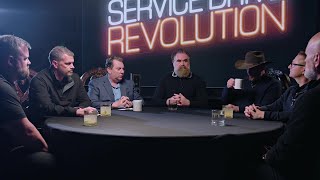
Chris Collins explores what separates top and bottom performers in service departments. The discussion centers on locus of control and how mindset shapes whether technicians blame circumstances or take ownership of their results.
Chapters
Okay, so the, the subject at hand that I was really curious to get your guys's thoughts on because I'm always thinking this way, right. Like I'm always thinking, what's the gap between the person that's doing better than me and me? Or the, you know, what is it that I'm doing that's working versus the person who's doing something that isn't working? Like what are the, what are the gaps? And most of the time the first part is mindset. So it's just your general.
Sense of yourself, your sense of your surroundings and your view of full potential, your view of what's possible.
Right.
And then it's the actions that come from that. So it's driven by your general sense of things, but then the actions that come out of that, the behaviors in a sense. Right. So you guys are in a lot of stores and you see the difference in managers and advisors and techs and shop foremen and first of all, let's just start with that question. Do you think there really is a difference between the position and the outcome? Like if somebody's a low performing tech and they're a low performing manager, is it the same mindset that gets them.
There, it gets them to move forward.
Or gets them to be an underperformer?
I mean, is it the same across?
Definitely. I think the mindset is different between a top performer and a not and a, a non top performer.
And the position doesn't matter.
Doesn't matter. It's still the same. It's still a service department, it's still a technician. Like it's, the job's still the same. Brand to brand, like that plays no factor in it.
If I'm a tech and I, and I have poor time management and I make excuses of why I can't be 100% productive and I become a manager, I'm going to have poor time management and I'm going to make excuses of why I can't be profitable. I think it's, it's all mindset.
And that same mindset would make excuses for why you can't flag hours if you're a tech or why you can't, you know, perform as an advisor, get CSI or whatever it is. Right.
Definitely think it's a choice.
They're making the choice either way, one way or the other, whether they want to be low or whether they want to be high or whether, you know, whatever. It's definitely a choice. I agree with that 100%.
Yeah, it comes back internalizing that control.
Yes.
Yeah, that's what I was going to say. It's locus of control. Any way you want to slice it, they're going to externalize it in one spot. They're going to externalize it. You know, the position doesn't matter.
Explain to them what locus of control is just because there'll be people listening that don't know.
Yeah. So locus of control. There's two. Two options. One is external, which is where I give control to everything going on to some external force. So if I'm not successful, it's because of the advisor, can't sell any. If I'm a tech, let's say the advisor can't sell anything or they're taking too long for approvals, or my manager this, or the parts department this.
The other option would be internal locus of control, where my first thing is, all right, what am I doing? What can I do differently? I take control. I take ownership. How can I better use my time? What can I do to be more efficient on this thing? How can I communicate better with my advisor to ensure that I get a quick response on whatever? How does my paperwork look? Am I getting the right estimate, the right information to the advisor for him to get an approval quickly? That's always way more effective than externalizing control.
I bet if you took a survey of them, I bet you'd find all of them blaming kind of the same thing. Car counts down, the weather is really bad.
Well, how many times do we do coaching calls with our clients and they want to talk about RO count, but the RO value is off, right? Like if I'm at a $150 ELR and everybody in my comp is at 190, $200, like, let's fix that first.
Or yeah, like a Land rover store at 1.5 hours per hour. And they're like, we need more customers.
And you're like, and every time I.
Drive a Land Rover, I know that they.
But it is funny, they even out to that point. Like, they don't talk about the R account being lower. They're like, like, well, what happened last month? And like, oh, we had some bad storms or, you know, it's been cold or people have been on vacation, like all the things. And they're trying to say that our accounts down, but it's not that thing anyway. Like, it's just a funny thing that's.
Or, you know, whatever month you're doing, the April's a weird month. Like, what.
What does that mean?
I don't even know what that means.
Isn't it funny where sometimes the excuses actually create traffic? Like, oh, there was a freeze. And you're like, yeah, they're coming in on tow trucks.