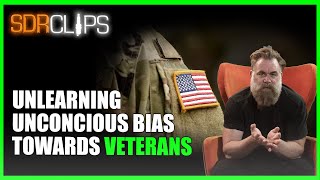
A short YouTube discussion (hosted by Chris Collins) about hiring veterans for the automotive industry. The video outlines a technician shortage and high early-career attrition, describes efforts to recruit military personnel, and presents speaker B's view that unconscious bias and poor resume/ATS parsing cause many veterans to be overlooked. Speaker B recommends simple fixes (human review of military service keywords, broadening assessment beyond literal job titles, and focusing on transferable kinesthetic and leadership skills). The clip ends with a standard channel call-to-action.
Chapters
So just to like.
In, in your experience and kind of speaking to that, like on. There's a side of the automotive industry that like, I think now the stats are we're losing five technicians for five to one. So five technicians, they're leaving the industry or reach, you know, retiring or getting promoted out of the shop. But even the younger kids coming in, the industry's doing such a bad job of retaining them that there's over a 50%.
Attrition that like the first two years they leave even after they've gone to a vocational school and learned how to be a tech. And so we have tried to recruit military and the.
The thing that happens is they, they're in such high demand that you really can't even get a call back. And a lot of them opt to go into aviation. They opt to go into other or there's other industries that are just better at recruiting the soldiers that, that have a kinesthetic aptitude and they want to be, you know, tax or they want to work with their hands. We lose them more toward to other industries, especially aviation.
How, how would you approach that? Or what is, what is the, you know, I don't know if there's a magic pill, but what is the steps that need to, to happen in order to tap that, that market where we would, we would pay for their school, you know, we would provide them with, with a really good job and income and security.
But they don't seem to be available, I guess, in a sense.
Yeah. And it's, you know, I don't know if you, you know, you buy a new car, right, Chris, you'd say, you buy a new, I don't know, Ford Mustang, right? You get it tricked out like I did. You know, you get whatever you get, okay? And you gotta, you gotta, you never know that you didn't go drive it for the first time out on the highway. You know, how many of those cars you're gonna see, like a bunch of them. Because it's like, you're like, I didn't even know there's so many cars. I thought no one had a car like this. And everybody's got a car like that.
We have what's, you know, it's essentially we have unconscious bias. Everybody has it, I have it, you have it, everybody has it. We don't talk about it a lot as it pertains to our US military, but there's a lot of unconscious bias out there that's limiting them from being able to hire. And I'm going to give you a solution to your problem. And it isn't as hard as you think. And it's. I think I know what it means for somebody to be in the military because they were in the military.
You don't know what it was like. You don't know what it was like. Again from the person that was in admin role who never saw combat, who, you know, traveled around and was at three different duty stations and got out. They still sacrifice for all the reasons that I just mentioned. They gave up their rights, they gave up their freedom. They would have gone to war if they'd come to you to ask them to and they wouldn't had a choice because they turned that over. Right.
That's what we mean when we say thanks for your service, thanks for the sacrifice. You give up your period of time that you took away from all the rights that you actually defend and that you're going to go back and you know, one of my favorite, I was a combat journalist and, and one of my favorite photos of all time is of a National Guardsman and they're surrounding a guy who's burning the American flag during the Vietnam War. And I say the difference between our country and a non free country is the direction those weapons are pointed. Because those weapons were pointed towards the crowd to protect his right to desecrate the thing that they were defending in a communist country. Those have been pointed towards that person who's burning the floor slack. So when you're saying thanks for your service, that's it. But when we look at it again, I said they don't know how to look at military resumes. I don't mean that they don't learn, they can't learn to read and write and look and see what's on the resume and find mechanic and people with kinesthetic ability. But they're not thinking about that. Every person that comes out of the military went through boot camp. Every one of them, especially Marines, had first aid training, combat training, leadership training. They have learned how to use the M249 Golf, M16A2 service record. They've learned how to be good with their hands, to tie knots, to repel.
Just because they don't have mechanic on their resume doesn't mean they can't learn it. And a lot of those people that are coming off active duty, 75% of them don't have jobs that align to the civilian world. So you got an infantry guy who's coming off active duty after four years. He's not thinking about a career in mechanics any more. Than I was a career in sales. When I didn't know my lens of my lens before I went in the military was I was a foster care kid who worked his way through three years of college, who was a bartender and a waiter. I didn't know anything about corporate America. And if I had somebody that got a hold of me with a tool set and taught me trade, I could have learned. I love working with my hands. I love building things. But again, no one looked at me and thought, oh, Marine combat journalist, I'm going to, you know, that's the guy. I'm going to put my mechanic shop. Because they don't know. They don't think to think outside the box. And you know how we are this day and age. Everything's AI. AI is going to take over the world. I'm telling you, if you use an AI to scan your resumes and you're looking for words, you're passing over a tremendous resource in our US Military. And what I would say is take those keyword searches and look for only six words. Army, Navy, Marine Corps, Coast Guard, Air Force, and Space Force. If they pop up on the resume, they immediately get pulled over to a hiring manager so they can look at that resume and see because otherwise they don't even make it through the application process because they go into some daggone computer system somewhere. So again, it's not as complicated as people make it, but you have to give the human thing to say, what is this person's story?
Who is this individual? And even though they don't have it right now, I bet they have the aptitude to learn it.
Thanks so much for watching this clip of Service Driving Revolution. We're uploading new stuff every day, so make sure you subscribe and click the bell icon so you don't miss out. If you have a question you'd like us to answer on the show, call 8333 Ask SDR and we'll answer your question on the show. That's 8333 Ask SDR. For special deals on our books and training, head over to offers.chriscollinsinc.com now that's offers.chriscollinsInc.com I'm Chris Collins and I'll see you in the next video sa.