What is Love? Angourie Rice Has the Answer || Books That Changed My Life
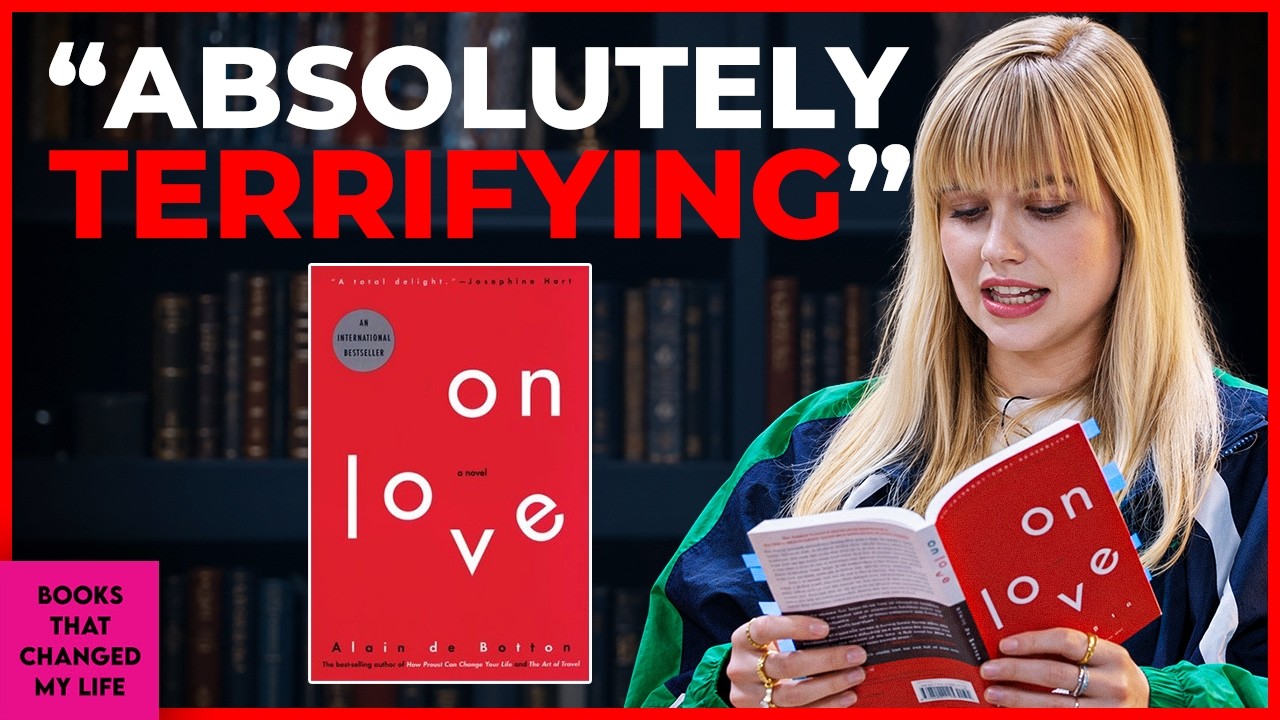
In this episode of the "Books That Changed My Life" series, host Chris Collins interviews actress and author Angourie Rice about Alain de Botton's book On Love (originally Essays in Love). Angourie explains how the book reshaped her understanding of love just before filming her rom‑com Finding Emily, describing it as a philosophical dissection of a boy‑meets‑girl story that blends narrative with analytical commentary. The conversation weaves through several themes: love as a repeated act of vulnerability, the tension between romantic idealisation and the reality of heartbreak, the role of narrative in assigning meaning to chance encounters, and how beauty, perfection, and societal standards influence attraction. They also explore how social media validation intersects with genuine love, the paradox of stoicism versus emotional openness, and the ways in which Angourie's personal experiences—first love at 17‑18, family dynamics, and professional life—inform her interpretation of the book. The interview concludes with Angourie reflecting on the cyclical nature of love, the lessons she draws from the text for her upcoming film, and the enduring relevance of de Botton’s insights.
Chapters
Classically beautiful women should be left to men without imagination. Oh, isn't that so good? We are incredibly powerful in ascribing meaning to things. Do you think, like, true love is dangerous? Real deep love asks you to be vulnerable over and over and over again. That is absolutely terrifying. Is it better to have loved and lost or to never have loved at all? I got to go to work and pretend to be in love every day. Isn't that the greatest thing ever? However brave, the Stoic was in the end a coward at the point of perhaps The highest reality at the moment of love.
So how did On Love change your life?
Well, it changed my life in that—
I'm Chris Collins, and you're watching Books That Changed My Life. What is love? If you can't answer that right now, don't worry, because this episode we're getting to the bottom of it. We're joined by actress, book lover, and board-certified love doctor, Angori Rice. She's here to talk about the book that changed her life, On Love, So in 60 seconds, explain to me, what is love?
Oh, like, from my perspective, what is love? Uh, love is an overwhelming emotional feeling that you have about something or someone or several things and several people. Overwhelming emotion, I would say.
Okay.
And gratitude was the other thought that came to mind. Like gratitude that this thing or this idea exists. That's love. Is it? To be grateful?
Gratitude makes sense because, yeah, it feels good.
Yeah. When I think about the people that I love and the things that I love, I just think, wow, how lucky am I?
So how did On Love by Alain de Botton change your life?
Well, it changed my life in that I read it right before I was going to film a rom-com, and I sort of read it in preparation to tell a story about love, and it changed my perspective on love. It felt like this book reached into my brain and pulled out, like, everything I'd ever felt about love and relationships and wrote it all out and said, this is how you feel and this is why.
So it confirmed how you felt about love?
It did. And I think it also changed my perspective in clarifying things, I think. Yeah.
What did it clarify?
I think sometimes love and relationships— and he talks about it in here— it feels singular and like completely like nobody will ever understand. And I felt understood by this book.
Did somebody introduce it to you or did you find it?
Yes. So the director of the film, Finding Emily is the film, and the director, Alicia MacDonald, said— I asked her, I was like, is there anything I should read or watch or listen to before making this movie? And she said About Love by bell hooks and On Love by Alain de Botton, which the UK title is Essays in Love, which I think is also interesting. And so I read both of those, and this one really stuck with me.
Do you remember the first time you fell in love? Yes.
And it was, um, it was like, it was magical. It was so magical.
How old were you?
18. 17, 18.
Yeah.
What's that face? Do you think that's young, old to fall in love? I don't know.
I, I initially thought I was old, but then maybe I'm Maybe I'm, you know, who knows? There's no right or wrong.
When was the first time you fell in love?
I want to say I was like 7.
Wow.
I took her on a date. I remember I paid with change, like, you know, coins. Yeah, we were on a budget.
Yeah, I mean, hey, that won't stop you from loving.
Yeah. So then did love— did your first love end up being your first Heartbreak.
It was mostly sad, and that was heartbreaking, that it was just like, we are not meant to be together.
Isn't that inherently the problem with love, is that love only exists because of heartbreak?
Um, I mean, do we think that way about, like, platonic love as well? Like, does my love for my family only exist because of the threat that it might go away?
Well, I think, like, love for your family is safer. You're putting yourself out there more. You're more vulnerable when they're not family.
Yeah.
Because you have, you know, blood is thicker than water, they say.
They do say that.
When you get out and fall in love in the water, it's different.
Yeah.
It's riskier.
It is risky.
Do you love being in love?
I do. Yeah.
Yeah, that's a beautiful thing, I think.
Is there anybody who doesn't?
Oh yeah, there's people— well, you know, there's people that, uh, are so scared of love that they put on this barrier like a shell. They try to keep people away by being unapproachable or—
It's true.
Unattractive.
To really be in love, I can't imagine not loving it. Although I was talking to a friend about this recently, and she was saying that she is in one of the most loving, healthy relationships of her life right now, and it is terrifying the level of vulnerability that is being asked of her to truly be in this loving partnership with someone. And I thought that was interesting too, that love, real deep, deep love asks you to be vulnerable over and over and over again. And that is Absolutely terrifying. So I, I do understand that fear even within a safe and secure love.
Yeah. One other thing I've noticed about that that you just made me kind of think of is that a lot of times people that have never experienced a healthy, loving relationship, when they get it, they sabotage it because they don't feel they're worthy of it. So how you feel about yourself is projected into the relationship. And so if you don't have a good relationship with yourself, it's hard for you to accept the love of others. And love in the way we're talking about only exists between 2 people. It's not a solo game. Yeah, it's a collaboration.
And he talks about that in here too, about wanting to become Your best self for the person you love. And I think about that too in terms of like putting your best foot forward, yes, to impress that person, but also to be like— I think a lot about being the healthiest kind of mentally and like most emotionally evolved I can possibly be in order to like bring the best to a relationship. Yeah.
Yeah. Do you think that that's the ideal outcome, is if you're in a relationship that requires you to bring a lot to the table? Because then you have to be your best self. You grow.
I guess I would think that hopefully in a true loving partnership, that the other person pushes you to grow and to be your best self, and you want to do that for that person.
So you want a fixer-upper?
No. No, no.
Have you ever tried to fix somebody?
Uh, have I ever tried to fix somebody? Oh, probably.
Yeah, I would think we all have, probably. Okay, for somebody who hasn't read On Love, just explain what the book's about.
It's a novel. It says so right here. It's a novel, and it is quite simply a philosophical look at a love story. It is a simple Boy meets girl love story, and he breaks it down from beginning all the way to the end, a philosophical look at love.
How would you describe the style?
I would describe it as, uh, it is a very unusual style. It's told in chapters, and each chapter has points that are numbered. It's almost like dot points, but they're actually numbered. And so we'll, we'll get a bit of plot, and then we'll get a bit of sort of musings on what just happened sort of internally for the character. So I think I would describe it as maybe, I don't know, is manifesto the wrong word? Or like a— it feels like somebody was given the assignment to write a love story and at the same time was told to analyze their own love story in a paper for their literature class. And did both in one.
That's a great explanation. And so we have the narrator, and then the love interest is Chloe, right? And their relationship, basically.
Yep.
And you know the author was 23 when he wrote this?
I know.
Can you imagine?
Isn't that infuriating?
It's inspiring, too.
It is inspiring. It's so inspiring that he was 23.
Since you've read the book, have you given it to anybody? Or recommended it?
Yeah.
To who?
I gave it to my sister, and I gave her my exact same copy, and she said it was interesting seeing what I had underlined because she thought maybe I would underline gray.
Okay, let's get into it. Let's get into love.
Glasses on.
Glasses on. Okay, the first tab there.
From within love, we conceal the haphazard nature of our lives behind a purpose— purposive veil. That's a good word, purposive. We insist that the meeting with our Redeemer, objectively haphazard and hence unlikely, has been pre-written in a scroll slowly unwinding in the sky. We invent a destiny to spare ourselves the anxiety that would arise from acknowledging that the little sense there is in our lives is merely created by ourselves, that there is no scroll, and hence no preordained face awaiting, and that whom we may or may not be meeting on airplanes has no sense beyond what we choose to attribute to it. In short, the anxiety that no one has written our story or assured our loves. I love that. But I bet everyone you get on the podcast, you get them to read a quote and they just go, oh, isn't that so good?
What does it mean to you?
We are incredibly powerful in ascribing meaning to things. And when we think about the stories we tell, we think about the rom-com genre, we think about love songs. We think about all these ideas around fate and destiny, and this is my one person, and of course it happened like this. We talk about love at first sight. Do you believe in love at first sight? I believe love at first sight only exists because once that love is successful, we go back and tell the story and say, as soon as I saw that person, I loved them. And I think the story is just as meaningful as whatever truth went through your head at that moment in time. So I love it. It kind of, it gives us an incredible, like, power over our own stories and also acknowledges our just complete futility as humans. Like, we have no control.
Yeah. In a sense, we've watched too many Disney movies.
Yeah. We tell ourselves these stories. And of course, and he goes into this later on, oh, is this a spoiler? But he goes into the actual probability of meeting this girl on this flight, 'cause they meet on an airplane. And he says, it felt preordained that we met. And then he goes into the mathematical probability that they met. And it's funny when you break it down like that, 'cause it is just chance. But what makes it meaningful is that we Add the meaning to it. I like that.
That's well said. Did you tab something before that?
Uh, yes. Very similarly, we attribute to events a narrative logic they could not inherently have possessed. So I like that idea that, yes.
The next one, the question I have for you is, does this way of thinking about love set a person up for failure?
Every fall into love involves the triumph of hope over self-knowledge. We fall in love hoping we won't find in another what we know is in ourselves— all the cowardice, weakness, laziness, dishonesty, compromise, and stupidity. We throw a cordon of love around the chosen one and decide that everything within it will somehow be free of our faults. We locate inside another a perfection that eludes us within ourselves, and through our union with the beloved, hope to maintain Against all evidence of self-knowledge, a precarious faith in our species. I love that. I'm going to say that after every quote. Um, what was your question again?
Does, does that description of love set us up for failure?
No, I don't think so.
You are in love with love. You passed the test. Okay, the next one on, on 28.
Silence and clumsiness could, of course, be taken as rather pitiful proof of desire. It being easy enough to seduce someone toward whom one feels indifferent, the clumsiest seducers could generously be deemed the most genuine. Not to find the right words is paradoxically often the best proof that the right words are meant. I love that you highlighted this. 'Cause that last sentence there, I just finished filming a movie. And what I did as a wrap gift was I decided to write a quote for people, like on a card, 'cause I've found exactly this. Sometimes I don't know what to say, and I think other writers say it better. So I kind of compiled a list of quotes and assigned each person a quote. And this was one of them that I gave to someone, 'cause I didn't know what to say. So I kind of said, yes, not to find the right words paradoxically is often the best proof that the right words are meant. I gave someone that quote because I didn't know what else to say.
And so like, if, if we're kind of like trying to interpret this, the worst pickup line is actually the best pickup line. Am I getting that right?
I think the idea behind it is like, How much do you care about something? I think the more you care about something, the harder it is to let go of inhibitions. I think if you don't care about something, it's easy. And then caring about things can sometimes feel really hard. It means that there's pressure, that you want it to be right, that you want someone to feel happy, that you want the project to be good, or you want to deliver the best performance, you know, all of these kinds of things. So to me, this quote is about Value and meaning. Yeah.
Yeah. And that's great.
Hopefully being genuine will always trump everything else. Yeah, I hope.
There's usually a Marxist moment in every relationship, the moment when it becomes clear that love is reciprocated. The way it is resolved depends on the balance between self-love and self-hatred.
I like what it goes on to say that, that, that— and I think he talks about this in this chapter— that it's this idea of like this push and pull of if somebody loves me, then they love all of my faults. And does that mean that they are imperfect now because they see me and they love me? And does that mean, are they worth loving because they love me and I'm not perfect? So should I love them because they love me? It's kind of this like circle.
What do you think about that?
I think it goes back to what you're saying about like, yeah, so self-love, the balance of self-love and self-hatred, and hopefully not self-hatred.
But I mean, in my experience, those things in somebody else I find attractive. When you're in love, you see their flaws as attractive. So I don't really take it that way. Because love kind of, I don't know, is blind in a way. Like you I don't know, there's a part here coming up that kind of addresses that a little bit too.
Okay.
Like, do you ever think like you're overlooking somebody's flaws?
I would hope not, that there's not an overlooking. Or maybe there's like a— instead of overlooking, it's like a care, like a— because we all have flaws, and I would hope that the people who love me don't necessarily overlook my flaws and ignore them. But care for me in the way that I am flawed. Does that make sense?
Yeah. I think also, wouldn't we put flaws on a hierarchy? Like, being dishonest, can't overlook that.
Of course.
You're nerdy, that's cute.
Like, you know what I mean?
There's a scale.
Yeah. And I guess what other people see as a flaw, I mean—
But there are non-negotiables.
Yeah.
I, I—
and do you think there are— those non-negotiables are universal, or They differ from person to person.
Oh, they differ, differ, because some people have no boundaries.
I think it's a lot easier to recognize patterns in other people than it is to recognize patterns in yourself, isn't it?
Yeah.
Like, I'm sure if I were to recognize patterns in my friends and loved ones, they can recognize patterns in me too.
Yeah, that's the benefit of having good friends. They'll tell you.
Yes, exactly.
So this next one, the chapter is called Love or Liberalism. You want to read that one?
Sure. We may well ask why the viciousness witnessed between lovers would not be tolerated anywhere outside conditions of open enmity. Then, to build bridges between shoes and nations, we may ask why countries that have no language of community or citizenship usually leave their members isolated but unmolested. And yet why countries that talk most of love, kinship, and brotherhood routinely end up slaughtering great swaths of their populations. It's funny, like, with this snapshot with these quotes, a large percentage of this book does feel like novel, and most of these quotes feel like nonfiction. It's a really interesting mix.
So what does that mean to you?
Yeah, I guess how people negotiate And this sort of like negotiation between love and fighting and conflict happens on a micro scale with 2 people over a pair of shoes, and also then across the whole world, I guess.
Well, yeah, love can be very controlling and can, can also be dangerous.
But do you think like true love is dangerous, or is it only dangerous for the 2 people who— like, what do you mean by that?
Well, love can become very possessive and controlling and destructive too.
Is it still love if it's like that?
You tell me. The people in it would describe it that way. They would say they love the other person. From the outside, it would look like it's an unhealthy addiction. But inside of the relationship, those people usually tend to be very confident that they're in love. Even though they're destroying each other.
Yeah, I guess it's what love means to each individual person and what they're willing to—
I feel like you haven't thought about the downsides of love, how dangerous love can be.
Well, maybe because to me, if it starts to get dangerous and horrible, maybe it's not love anymore.
You're too good of a person, I think.
Too good of a person? Uh-oh.
Okay, this is the one I was referencing earlier about beauty on page 70.
The most interesting faces generally oscillate between charm and crookedness. There is a tyranny about perfection, a certain tedium even, something that asserts itself with all the dogmatism of a scientific formula. The more tempting kind of beauty has only a few angles from which it may be glimpsed, and then not in all lights and at all times. It flirts dangerously with ugliness. It takes risks with itself. It does not side comfortably with mathematical rules of proportion. It draws its appeal from precisely those details that also lend themselves to ugliness. As Proust once said, classically beautiful women should be left to men without imagination.
That's funny.
And it's paired with, like, these bizarre illustrations of this illusion where one line looks longer than the other, but they're actually the same length. Growing up, we had a book of illusions, and these were both in there and fascinated me. And then the rabbit that also looks like a duck, depending which way you look at it. And then this—
Teeth.
The teeth, the gap tooth versus no gap tooth. I find that fascinating.
Well, I think the idea of perfection and certain beauty standards create this scenario where you're more in love with an idea than a person.
Yes.
And the person is actually who you want to fall in love with. And so perfection is an odd thing. It's not perfection, really, at the end of the day, isn't attractive.
Yes, absolutely. I think also because, um, I wonder too, it makes me think about like how facing perfection would feel about yourself, make you feel about yourself. Like if you are attracted to perfection or are interested in that and think that my partner should be perfect, how would it feel standing next to somebody who's perfect all the time?
Yeah.
It would feel exhausting and not good.
Yeah, very superficial too, I think.
Yeah.
You want them to be attractive, but your idea of beauty and my idea of beauty might be something different, and that's what makes the world great.
Yeah. Yes. Oh, but I like this quote, sorry, on the same page that kind of has a very similar sentiment. Did I love Chloe because she was beautiful, or was she beautiful because I loved her? This is something that has stuck with me since I read this book. I love that idea that the thing that you love becomes beautiful to you because you love it.
Yeah, it's a con— it's like a confirmation.
Yes. And that the idea of like beauty and love, like it, it's actually this kind of circular motion rather than I love this thing because it's beautiful. It's this, I see the beauty in this thing because I love it.
And kind of another part of that, if we just want to keep going with that thought, is when you start telling everybody that you're in love, you fall more in love.
Yes.
Because confessing or having a testimony does the same sort of thing as it gets you deeper into it.
And coming back to the same idea of stories confirm how we feel, like we tell a story of falling in love and then we believe it must have been fated because we told it that way.
So this is on 99. Perhaps it is true that we do not really exist until there is someone there to see us. existing, that we cannot properly speak until there is someone there who can understand what we are saying. That is, in essence, we are not wholly alive until we are loved.
I mean, just taking the first bit of this, when I was 10, I took ethics class at school and, um, I was a very philosophical child and I was fascinated with this idea that what is behind a closed door does not exist until you see it. Sort of the Schrödinger's cat kind of idea.
Okay.
And if a tree falls in the wood and nobody hears it and sees it, did it even fall? So I was fascinated by this idea as a child that like, I don't know, maybe it's like kind of egocentric or selfish, but that in a way like, you are creating the world around you as you see it. And yeah, that he goes on to say, yeah, we are not wholly alive until we are loved. I mean, it's a bit— it's a big thing to say, isn't it?
Well, I think at the, at the core of all of us, all humans, we want to be accepted. We want validation. We want to feel like we're a part of something. That only happens By others, right?
I think for myself in particular, like, I, I really struggle to spend extended stretches of time on my own. This is something I've learned about myself. And when I've been traveling and working, especially on location, and I don't know anybody, I have to see somebody every day and talk to somebody every day. Otherwise, I end up feeling like Very, very strange. And I think, yes, it's about defining who we are in relation to other people and also being seen and understood.
Now, don't you kind of think that this starts— and he's not touching on this— but the love of a parent is the beginning of us feeling like we belong?
I hope so. I, I mean, for me, for me, it's that is the case. And I know that, you know, there are people can have very, very difficult relationships with their parents where maybe they don't have that feeling, you know.
But most of the time that kind of messes us up.
Yeah.
If we, if we don't have that nurturing.
But yes, I do. I, I am very close with my parents. So I, yeah, that is part of it. And I sometimes in interviews people say, when do you, when you feel most like yourself, you know, when you're, when you're not working? And really when I feel most like myself is surrounded by people I love. So that connects back to what he's saying here. We are not wholly alive until we are loved.
Yeah, makes sense. That first time at 18 when you fell in love, you probably felt very alive, right?
I did feel very alive, yes.
Yeah.
I'm also kind of hesitant to, like, put my foot down and say, like, if you don't experience romantic love, You're not gonna feel alive. I don't think that's what he's saying here, but like, to remember—
We are not fully alive until we are loved. That's exactly what he's saying.
Is it linked to romantic love?
Well, that's what I'm saying is that I don't think he's— he's not touching on family.
Yeah.
But I think that that matters.
I agree.
We learn how to love from the example that is set before us from our family most of the time.
Isn't there something how, like, in English we have one word for love and there are other languages that have several, several words for love, and each love kind of means a different thing? So it's so interesting, you know, reading this in English, like, we're not wholly alive until we are loved. Loved by who? Loved in what way? Or is it just as simple as until we are loved? By the world, by one person, by A pet. I don't know.
Yeah. What about somebody who has a lot of followers on social media that all love and like their stuff, but they feel very alone in their daily life?
Well, that's interesting, isn't it? And I mean, this was written in the '90s, pre-social media. And I think that's interesting because is to be truly loved, to be truly seen. And in terms of what you put out onto social media, you do have control over that, um, and you don't always have control over what the people who love you see, I think. Does that make sense?
Yeah.
I mean, I do think—
It does, it does, uh, sort of play out sometimes, or I've seen people who are very vulnerable and messy, and then that attracts other people that are vulnerable and messy, and they validate that.
Mm-hmm.
But they're still alone because the people that they're getting the love from actually have no relationship with them except for the superficial virtual reality of social media. But there's no substance to it. Like, I find social media likes an interesting thing because they're strangers.
Yeah.
Or comments or any of that. It's like—
I know.
You wouldn't say that about me if you were sitting here.
I turned off my comments on Instagram and my friend messaged me. She was like, are you okay? What happened? I was like, I'm fine. I just turned it off because I just It was a double-edged sword. It wasn't like I was reading it, but I would see it. And if I saw it, something nice would make me feel happy and something mean would make me feel sad. And I thought, wait a second, why is this affecting me? I don't know these people. I'm actually going to take that away and then I don't have to worry about it.
And so I think that's very healthy. And I think if you allow the negativity to affect you or you allow the adoration to affect you, neither one are real.
Yes.
You can feel great about yourself and it's not real, and you could feel bad about yourself and it's not real, and you're missing the true human connection, right?
Yes. I remember my mum telling me when I did a, I did a play a couple of years ago, and she said, don't read reviews, which is very smart, of course, don't read reviews. But she said, she said, if you believe the good reviews, you have to believe the bad ones too. I think it's a very similar idea. Very wise. She's a wise woman who reads Alain de Botton.
Yeah, your parents did a good job.
Oh, thank you. Yet ordinary terrorists have a distinct advantage over romantic terrorists: the fact that their demands, however outrageous, do not include the most outrageous demand of all, the demand to be loved. You must love me, says the romantic terrorist. I will force you to love me by sulking at you or making you feel jealous. But then comes the paradox, for if love is returned, it is at once considered tainted, and the romantic terrorist must complain, If I have only forced you to love me, then I cannot accept this love, for it was not spontaneously given.
Have you ever had a relationship where the person was a love terrorist?
What a leading question.
And what was their name?
Um, I definitely understand and do relate to what he is describing here, this kind of negotiation of, please love me, or please do this thing for me, but you're only doing this thing because I really want you to, and now I wanted you to do it Because you actually wanted to without me reminding you.
Yeah.
I think that comes in all—
Shapes and sizes.
Shapes and sizes.
Yeah.
And it's a constant negotiation of what is important to you might not be important to your partner, but it becomes important to your partner because it's important to you. And you do have to accept that sometimes you just have differing ideas of what's important. And that is okay.
But it is normal to want you to want me.
Yeah.
The famous Cheap Trick song.
What I really like is that she says that often people with their first novel, they, they want to do something surprising, engineer a surprising narrative. He did the reverse. He wrote a love story, the most predictable love story. But did it in a surprising way. And I think that's interesting going into this book. I had this optimism that it would all work out for them.
Boy meets girl, little turmoil in the middle.
Happily ever after.
They meet each other at the airport and get back together and live happily ever after.
And I don't think it's a spoiler to say that they don't end up together. Because it charts a whole relationship, and we know this going in. It is beginning to end, and I think it's important to talk about the end as well. But still, when I was reading it and I got to page 160 and I thought, there's only 30 pages to go and it's not looking good, I was still optimistic that they would work it out, which I think maybe says something about me.
Story.
One does not get angry with a donkey for not being able to sing, for the donkey's constitution never gave it a chance to do anything but snort. Similarly, one cannot blame a lover for loving or not loving, for it is a matter beyond their choice and hence responsibility. Though what makes rejection in love harder to bear than donkeys who can never sing Is that one did once see the lover loving. One finds it easier not to blame the donkey for not singing because it never sang, but the lover loved, perhaps only a short while ago, which makes the reality of the claim, I cannot love you anymore, all the harder to digest.
I want you— I want your thoughts because I have issues with this. Oh.
Issues. I think this speaks to a question that I am fascinated in beyond this book, and sort of it's a theme that I try and seek out in other books that I read, is that, is it better to know what you have lost? Is it better to have loved and lost or to never have loved at all? Is essentially the question. It talks about this, you know, in terms of love, knowing what you've lost, and that is It makes it harder to bear. And there are a couple of, stay with me here, kind of apocalyptic fiction novels that I've read that sort of take place after the apocalypse. And there's this kind of distinction between people who remember what the world was like before and people who don't, who was kind of born into the new world. And that same tension of, is it more painful to know what What's gone? Is it easier to just never know? So I find this question really interesting, but I want to know what your issue with it is.
Well, earlier we talk about it not being fate or chance, but here we're, we're kind of like saying that it's like we have no control of it.
Oh yes, Ray says the lover cannot Um, what does he say? One cannot blame the lover for love, for loving or not loving. It is a matter beyond their choice and hence responsibility.
I don't agree with that. We're contradicting what we agreed to earlier in the book.
But was he saying it's chance that lovers meet?
Well, he's saying it's not a fairy tale.
It's not a fairy tale.
And it's not fate.
Right. But even if it's not fate, if it's a coincidence, do you think there's an inevitability of love?
Well, I think the way that love sounds in a novel and the way that it really happens are a little different in the sense that I'm not going to allow myself to fall in love with somebody until we've hit some qualifiers, and then it's on me to set that relationship up for success. So I'm going to get out of it what I put into it. And why would I invest time in something I didn't want to work? So I think that we hold a little bit of the responsibility for who we allow ourselves to fall in love with and then what we bring to the relationship and what care and effort we put into it. It doesn't happen in a vacuum. Where this feels like it's like, I fell out of love.
I fell out of love and I can't help that.
Yeah. And it's like, well, that started when you fell in love, didn't it? Don't you want to draft the kind of person that—
So you think you can help falling in love and you can help falling out of love, don't you?
I mean, don't you know early on that the person's right or wrong for you if you're really paying attention?
In my, in my life, I feel that I have, out of my control, fallen out of love.
Can you, can you, without putting a picture of him up, explain?
It was just surprising.
That one day you just weren't into him anymore?
I, I don't know what it was. To this day, I don't know what it was, because I— maybe I do believe this, that it is kind of a matter beyond one's choice to love or not love. Maybe I do believe that, and maybe that's where we differ.
Yeah, I stand corrected.
No, you don't stand corrected. It's true for you. Can we have different things be true for each of us?
Yeah, but if it happens for you, then it's, it's real. But just Something that I haven't experienced.
Do you think it's better to have loved and lost? Like, do you think the pain is worth it, or do you think it's better to— to— like, what do you think about him saying this making the reality harder to digest, that you knew what you had?
Well, I think love is a beautiful thing, and it matters a lot. And I certainly love my significant other very deeply. But I also think that I've learned From the heartbreak, what type of person, what I need to bring. Like, there's a lesson every time. And if I'm not getting better at it, then I'm— yeah, I'm going to get broken, my heart broken over and over again.
So each step is a—
you have to protect your heart a little bit, don't you? You can't just throw it on the floor.
That's true. Yeah. But the external world did not follow my inner moods. The buildings that had provided the backdrop to my love story, and that I had animated with feelings derived from it, now stubbornly refused to change their appearance so as to reflect my inner state. This refusal of change was a reminder that the world was an entity that would spin on regardless of whether I was in love or out of it, happy or unhappy, alive or dead. It could not be expected to change its expressions according to my moods, nor would the great blocks of stones that formed the streets of the city take time to consider my love story. I love that. We are small things in the face of the world. And I like this too, that this kind of, you know, we see in movies, the character goes through something sad and it's raining. You know, they hit their low point and there's a storm.
Okay, this is the end.
This is the end. Okay. Moreover, for all the sacrifices demanded by the Stoic life, was there not something cowardly within it? At the heart of Stoicism lay the desire to disappoint oneself before someone else had the chance to do so. Stoicism was a crude defense against the dangers of the affections of others. Dangers that would take more endurance than a life in the desert to be able to face. In calling for a monastic existence free of emotional turmoil, Stoicism was simply trying to deny the legitimacy of certain potentially painful yet fundamental human needs. However brave, the Stoic was in the end a coward at the point of perhaps the highest reality, at the moment of love. I think this feels very connected to me because I was, as I was talking about sort of loneliness and travel and spending a lot of time on your own for work, you know, for me it's about vulnerability.
So is this, so the Stoic is not vulnerable. The Stoic is buttoned up.
Yes.
And doesn't let their emotions get in the way of logic. And so what we're saying here is that the stoic is a coward.
Yeah. And I think that is—
Someone that's in love with being in love has to agree with that.
I think I do agree with that. I agree with it for myself because—
You're willing to be vulnerable.
Well, to me, it is. Yes. What is scary is to be vulnerable and to ask. I mean, I think about the times where I've said to myself, I will be stoic and I can do this on my And I don't need help. And it requires immense vulnerability to turn around and say, actually, maybe I do need help, or maybe I do need comfort or another person. So—
And that's courageous.
And that is courageous.
Yeah.
This book ends with him saying, I had once again begun to fall.
Right back on the horse.
Isn't that great? Go through this whole thing, you intellectualize it all, you learn every single thing that there is to know about love, when it fails, how to communicate, what to do, what not to do. Then at the very end, we're right back where we started in the optimistic stage of life and love.
Full circle.
Full circle. I just love it.
Except we've learned something.
We've learned something.
We're better than we were in the beginning.
We were.
It's good. Thank you for introducing us to this book. We'd never read it. So it's great. We love when there's a book like this that comes into our life that we wouldn't have heard of otherwise.
Thank you so much for giving me the opportunity to talk about it. I love this book and it means a lot to me. And I think it's something I will continue to read throughout my life. So it's a joy to get the opportunity to talk about something.
So tell me about what you're working on.
So I've got a movie coming out called Finding Emily. It's a rom-com set in Manchester, filmed in Manchester, and much like this book— I mean, I read this book in preparation to make Finding Emily. And much like this book, it perfectly balances, I think, interrogating the rom-com and paying homage to it at the same time. It is a love story, and it is also an interrogation of How we move through love stories and how we tell them. So, yeah.
Was it hard for you, the part?
I got to go to work and pretend to be in love every day. Isn't that the greatest thing ever? I was in love with the story, in love with all the people working on it. I just— in love with the city of Manchester. It just felt like the most magical experience. And I do feel that It comes through on the, on the screen.
Well, we can't wait to see it. Thank you for doing this. We appreciate it.
Thank you so much. Thanks.
We are so excited to announce the Books That Changed My Life website. We made a way for you to show your book pride and that you love books. Hats, tees, hoodies. Check it out. Link in the description. Everybody needs a self-help hat.







