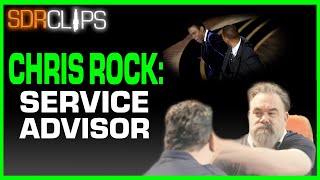
A short conversational video (Chris Collins with a second speaker) reflecting on the Will Smith–Chris Rock Oscars incident as a metaphor for leadership and customer service. The speakers contrast reacting-to-violence/insult with pausing to understand underlying causes, arguing that empathy, listening, and emotional control—exemplified by Chris Rock’s response—are crucial skills for service advisors and managers when handling upset customers or employees.
Chapters
Did you watch the Will Smith Chris Rock thing?
Not live, but I saw it afterwards.
Yeah, I didn't either. I have no interest in that show.
Oscars are not my cup of tea.
It's like a beauty pageant, basically. Fixed. Seems like it's fixed. So it's interesting. In the office, when we talked about it, most everybody kind of felt like it was staged, like it was fake. A lot of people feel like it was made up.
Yeah, I never thought that once, but I think.
I personally think it's more fun if we pretend like it wasn't. Like we don't know, right? Yeah, I don't know that we'll ever know, but it might be more fun just to pretend like it isn't and think about it from. From that perspective. So what was. What was your thought on it? Like, what was your reaction or your take? Wow.
So I think the big thing is.
That.
What I did is first, I was in a little bit of shock that the whole thing happened, and then the second is, like, trying to think about, like, what would somebody have to do to make me hit somebody?
Like, how far would they have to go? Yeah.
Like, what is that thing that would hit that button that says, okay, throw all logic out the window and you get up and you smack somebody?
Do you. Do you feel like at times like the subject of kids or wife or girlfriend or whatever are off limits to a certain point?
Yeah, for sure.
Yeah. That's an interesting take. Yeah, I think.
I think most people's initial reaction, too, is to punch back. Right. So, like, if somebody hits you, your initial reaction is to fight back.
Yeah, almost like when people do that thing where you put your hand up and you start to push on them and they push back. It's a natural reaction.
Yeah, it really is. So I think that.
The interesting thing about it and how it applies to us is what impressed me about the whole thing. Like, if you put aside, like, whether it should have happened or if he was right to do it or whatever, and you. You just kind of put that aside and you just think about Chris Rock's reaction. The thing that blew me away and really impressed me is when Will hits him, there's this kind of instant empathy in the sense that he. He was, like, trying to understand what was happening, but he was seeing Will more as the. The outcome of something else. He wasn't reacting to the. To the. The violence. He was, to me, trying to understand what had caused it and why is this person affected so much. And, yeah, I was just blown away by. By what A gentleman and how well he handled it in that sense. And after. So he, he was quiet after, didn't say anything bad about Will, didn't want him arrested. Like, he just was trying to understand it. I think in his first stand up back, he even said, like, I'm still processing it. And I think that for us, a lot of times, especially with advisors and customers, but this transcends that, honestly. But with advisors and customers, when I've been in a position of authority, like a general manager, and I get a customer complaint, most of the time the failure was that the advisor was reacting to the moment and was trying to impress on the customer why we were right. We were trying to be right instead of listening in, trying to win. And so a lot of times when customers are frustrated or they're, they're overreacting to something and you're like, well, you know, why are you overreacting to this thing? It's just a car or whatever it is. I've heard advisors say that, well, it's just a car. You're crazy. And, you know, calling customers crazy or customers have high expectations. I had somebody tell me the other day, like, oh, our customers here, they have really high expectations. And I always think when customers have high expectations, that's the best scenario, because if you meet those expectations, you have a loyalty, but you also have a bubble in what you can charge because you can charge more in those situations also. So you have price elasticity in a sense. But.
Just thinking about when things go wrong and customers are upset, do. Do we. Do we try to see past their initial reaction and show empathy and try to understand why they feel the way they do, or are we reacting to the violence or the aggression? And I, I think that it, it was, it was really kind of touching the way that Chris Rock kind of handled himself like a leader in that situation. And he took the punch and then he, he. Even after when Will was screaming at him, take my wife's name out of your mouth or whatever, he's like, yeah, yeah, okay, I understand. Like, he wasn't, he wasn't engaging him in the sense of going toe to toe, which, you know, if you think about Chris Rock and if you watch, like videos online or if you've ever seen him live, he can take hecklers and dice them like he is. I mean, he's one of the greatest.
Yeah.
Quick and witty and well trained. And in the moment, right. You got to think like, he came from Saturday Night Live. Like, he, he's used to acting in the moment very Very quickly. But in that situation, he didn't, he didn't act quickly. He, he tried to understand the situation for what it was and he, he didn't, he didn't do anything that would provoke that. And so a lot of you, you know, managers listening, like a lot of times when you have a customer that's complaining about something, you're thinking, like, this was easy, like, all I had to do is listen to the customer and they're fine. Right. And so as a service advisor, think about that. Like, how much are you listening? How much empathy are you showing? Are you really trying to understand your customers? And then even take it a step further? How much better would your ros be in the descriptions? And how, how more efficient would the technicians be if they had better descriptions? If you really tried to understand customers instead of reacting or shortcutting or judging in the moment?
That's so great. Yeah, I think it's awesome that you thought about it from the service advisor perspective, because I immediately went into, like.
How Chris Rock reacted was a lesson in leadership completely. So I was thinking about. So as a leader, let's say you're running a service department and, and you've got a really, really upset employee that comes to you. And your first instinct, like you were just saying with the advisor and the customers, is that you want to be like, no, no, it's not really how it is. But the truth is, is that when you have somebody coming to you in a certain emotional state, it's really about that one thing. There's a buildup. And if you want even wanted to say that it's a story. And recognizing as a leader that your customers, your employees, other managers, everyone's got a story to tell. And, and it's not necessarily for us to say what's right or wrong, but to hear the story and then take people in for the story that they are, you are way better of a leader. And the other thing that hit me like a ton of bricks is I've always thought that leaders that have the best control of their emotions are the ones that you want to follow. People that aren't going to go too high, not going to go too low, but stay the course are the ones that really increase followership.
Yeah. Because once you've reacted to somebody, then you're giving them control and you can't take it back.
Yeah.
You're way better to do like Chris Rock and just hold it back and not give, not give anything, just absorb. And then, you know, you're, you're going to be way more effective in whatever your response is because it's not an automatic reaction. It's not out of emotion. So. No, I agree with that, too. Yeah, it's like, it's a huge leadership thing in the sense of.
He show. He showed a lot of leadership in that. Like, I was impressed. Like, you just look at his face. Like, it's just instant. Like, whoa. Like, I don't know how close they are. I've heard that they're friends, but just his, like, whoa, this guy's having a hard time. Like, wow. Not like, I'm gonna get you back. How dare you do that to me? Like, it's real classy. I thought it was very classy. Thanks so much for watching this clip of Service Driver Revolution. We're uploading new stuff every day, so make sure you subscribe and click the bell icon so you don't miss out. If you have a question you'd like us to answer on the show, call 8333 Ask SDR and we'll answer your question on the show. That's 8333-ASK SDR. For special deals on our books and training, head over to offers.chris collins inc.com that's offers.chriscollinsinc.com I'm Chris Collins, and I'll see you in the next video.