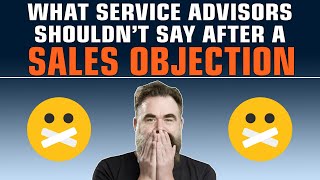
A short discussion (podcast/YouTube clip) hosted by Chris Collins covering the five worst things service advisors say after a customer objects. The five examples are: (1) asking 'Why?' which pressures the customer; (2) trying to validate or downplay declined items (seeking agreement); (3) fear-based appeals (e.g., 'Do you love your kids?'); (4) immediately offering discounts ('What if I gave you a discount?'); and (5) blaming the parts department for customer objections. The speakers explain why each harms credibility or the customer relationship and recommend better approaches (e.g., asking informative questions earlier during write-up, presenting best price up front).
Chapters
Okay, now let's talk about the five dumbest things advisors say after getting no.
Okay, so let's frame this for the audience so they understand what we're talking about. You've done your job up at this point. You've made a great presentation. And then the customer just stonewalled you and flat out said no. And I want to talk about your reaction. The reaction. Right.
What do you do once you get no?
You've had this happen. You've been on site, you've traveled, you've been to other dealerships. What's the dumbest thing you've heard an advisor say to a customer at this point? What do you think the number one.
Thing is after they hear no?
After they hear no? Yes.
Oh, man, I don't know.
Well, the first one on the list is why? So they ask the customer why now, logical.
But that's funny.
We talked about gen Y and Y and Y, so why is that a dumb thing to say? Well, it's because it puts the customer right on the point. And you put them a lot of pressure on them at that point when they say no. And think about the generation. We just talked about generational demographics and the different type of people that we're dealing with, certain age groups. When they say no, that's it. No means no. And I could damage the relationship if I keep going further. And I point that question to you at why? The reason I say this is number one on the list is because it creates a lot of negative emotions in the customer. We want to go beyond that first. No, but in a way that's not attacking or putting the customer on the spot. Does that make sense?
Yep.
So if you came in and let's say I quoted you $15,000 for a lift on your Jeep, you know that we're giving away the glad for 1500. 15,000. Oh, and you told me no, you're not going to do it today. Right. So good. Let's do just quick role playing. Chris, would be 15,000. We can have that on Friday. Does that work for you?
Why is it you guys that live out in the desert that have nudist colonies always want to roll? Role play. What is it about that swingers.
The only time we get action, man.
Okay, what am I supposed to do? Tell me what I do.
Tell me. No. Okay, you're not gonna do that.
So why no? Why no?
Why don't you want to do it, Chris?
So do you see how attacking and. And to the point it is?
Yeah, it's very adversarial.
Yes, very adversarial.
So that's even just in the role play. It felt weird.
See, role playing feels good, doesn't it?
There you go.
Number two on our list of the five dumbest things that service advisors say after a customer says no.
Is they try to validate and get an agreement with the customer and they say, well, the other things that you declined weren't that bad anyways. So it wasn't that bad. Have you ever seen that happen?
Yeah.
What does that do?
It makes me want to kill them.
Like really?
Yeah.
That's a really strong emotion.
No, but it's. Yeah. It's so ridiculous.
So why do you think service advisors say that?
Why?
I don't know. At the heart of it, they don't believe or they're insecure.
Insecure. Right there. That's it. They need to have the customer like them. Yes. So their acceptance from the customer, their self worth is predicated on the customer accepting them.
It comes from the same place as some advisors that won't ask.
Right?
Right.
Yeah.
Because they want the customer to like them. And they think by letting the customer leave in a car that's going to break down and they're going to have to come back or that's going to leave them broken down on the side of the road, that that's better, right?
Yeah, absolutely.
Than telling them the truth.
I agree. So maybe the customer approves something they said no to, the other stuff and then the advisor agree, you know, tries to get an agreement or alignment with the customer and says, well, those struts, they weren't really that bad, we can do it next time. What they're really trying to do is set their next sale up of what they're doing is completely discrediting their credibility because you should never ask for something you don't 100% believe in. And if you back off of that much and that statement just completely kills your credibility. So get that out of your language and don't say that ever again. So that's two out of five. What do you think the fourth one is?
Third one, I can't count today.
Chris just gave me this look like, are you a moron? No. Third one.
I have no idea.
Let's go to number three.
Number three.
Oh, there was an advisor at one of the BMW dealerships that I used to work at and he sold on fear. This one is based in fear. So when a customer says no, one of the dumbest things I've heard advisors say is, do you love your kids?
So think about that, that's right up.
There with, well what do you want to do? Slide into a school bus full of kids and kill them?
That's right up there. So do you love your kids? Mr. Johnson? You need to do the breaks today. Do you love your kids? Okay, that's just, just don't go there. Don't sell in fear like that. That's fear based selling. That just does not work. Right.
That's terrible.
It is. So that's the, the third one I hear there. Do you love your kids? And if they don't have kids, that's an even worse question there at all. Can we move to number four now?
Number four.
What if I gave you a discount?
Now this goes back, I think one of the episodes we had a while ago we talked about discounting the diagnostic to save a sale. This is in the same mindset there. Why should we not offer a discount at this point in the sales process? So we've made our presentation, we've asked the customer to buy, they say no. And now we're going to try to throw the life ring out there. Save the sale by offering what a discount. What does that question or that statement send to the customer? What message am I sending?
Well, we're devaluing ourselves.
Absolutely. Could it possibly send the message to the customer that our normal pricing is too expensive anyways? Absolutely.
We discount a lot.
We discount a lot. Right. What if I gave you a discount? So yes, my opinion on this and I'd love to hear your take on this, I've always built my pricing in a way that I always have my best pricing on, on the ticket for the customer. So whenever they pull that discount card out and they ask me for the discount, I always come back with Kris, I've already given you the best price that I possibly can. The fee for the service would be X. And then you ask the closing question, can we move ahead with it?
Yeah, I think there too asking more questions like just going right to discount. Like ask questions.
Absolutely.
You want to know like, you know the answer might be while I'm selling the car, like, you know, you don't know what it is.
Absolutely. If you did your job in the beginning, you would know what it was.
Yeah.
Get that information when you do the write up. So that's number four. What if I gave you a discount? Now the fifth dumbest thing advisors say after, no.
It'S the parts department fault.
He's got to do the parts thing.
I got to drag in the parts thing.
Really? This is the four dumbest things.
It's the four dumbest things that advisors say after.
Oh, that's funny.
There we go.
Parts department. Thank you so much for watching this clip of Service Drive Revolution. Now you can catch the full episode on YouTube, iTunes, or Spotify or wherever you consume your podcast. If you have any questions, go ahead and post them in the comments below. Make sure you subscribe and hit the bell icon so you're notified when we post new episodes. I'm Chris Collins and you can find me on Facebook and Instagram at Chris Bulldog Collins and I'll see you again on the next episode.