Will Manufacturers Cut Dealers Out of the Equation with Prof. Daniel A. Crane
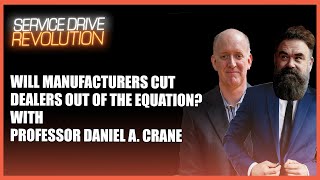
A recorded interview (Service Drive Revolution) where Chris Collins speaks with Prof. Daniel A. Crane about the shift toward direct-to-consumer vehicle sales driven by Tesla and EVs. They cover how historical dealer-protection laws function, Tesla’s state-level strategies and exemptions, why EV economics undermine the traditional dealer model, how legacy automakers (GM, Ford) and the UAW are re-evaluating positions, and the need for negotiated legal change to allow flexibility in distribution and service.
Chapters
Welcome everybody to Service Drive Revolution. Today you get to be a fly on the wall for a conversation between myself and Professor Daniel Crane, who is an expert on consumer law and a writer for Automotive News. Now what we're talking about is the changes in our industry and how Tesla kind of created the crack in the dam going direct to consumer. But now manufacturers are actually turning their backs on the dealer body and so is UAW and siding with Tesla in the hopes of going to direct to consumer themselves. It's a fascinating conversation. It's insight into the future and where we're headed and a must listen all that coming up on Service Drive Revolution.
I'm really excited today to have a guest that wrote an article in Automotive News.
Sort of recently that actually got me to subscribe to Automotive News. I haven't read much in Automotive News in a while that, you know, my subscription is, has been lapsed for years, but I actually subscribed to be able to print this article. And it's Professor Daniel Crane. He's a law professor at the University of Michigan who's been researching and advocating on the direct sales issue since 2014. And he teaches contracts antitrust, antitrust and intellectual property and litigation and regulation. He's an author of several books on antitrust and I'm really excited to be talking to him today. Hello, Daniel. How are you?
I'm well, Chris. Thanks for having me on the show. Appreciate it.
Is is teaching law as fun as it looks like?
I think it's the best job in the world for me at least. It's a lot of fun. A lot of bright students who are learning about the world in complicated ways. And I learn new things every year from teaching them.
Oh, I bet. So what is your take on the younger kids in your class compared to generations before?
So I think.
The current generation, they're very bright.
They know a lot about the world. They're also very fragile in many ways. I think we as a society are raising kids with just more needs, I think, than would have been true 20 or 30 years ago or more. Willingness to sort of share their vulnerability and ask for help. So that's just a difference I've seen in the course of teaching.
That's. Yeah. And it's all the parents fault, right?
Well, I'm a parent, so I'm sure I'm doing it wrong as well. But I think we as a society are maybe not making people as resilient when they're young as we once did.
Yeah, it's a little easier and we want them to have everything we didn't have, I guess, is the theory there. So let's talk about direct to consumer sales. So the situation, and kind of help me explain this to everybody who doesn't understand, is for the longest time in the United States, with the exception of, I believe one state which was New York.
You could not, if you were a manufacturer of automobiles, you could not sell direct to consumers. You had to have a dealer in between that transaction. And there's different laws in all 50 states, but for the most part, all of the states kind of had their version of that. And then along comes Tesla. And how did Tesla maneuver that they could sell direct to consumer? Were they saying that because they were electric, the laws didn't apply to them?
Right. So when Tesla came along in 2014, they, as you said, started fighting for the state by state battle to be allowed to do it. And that's really ongoing still. So about half the states, roughly depending on your account, it makes some provision for direct sales, whether by just EV companies or by everyone. And half the states still have, or roughly half the states restrict that. What Tesla was able to argue in some states was that the original dealer protection laws did not apply at all to a company that wasn't using dealers at all. So here we have to step back historically and realize that when these laws came into effect in the mid 20th century, they were not about protecting consumers, they were, they were protecting dealers from the big three. The idea was that the big three were much more powerful than these kind of mom and pop dealers and took unfair advantage of them, including by opening their own showrooms and sort of undercutting their own franchise dealers. Tesla argued in Massachusetts, for example, before the Massachusetts Supreme Court. Well, that rationale does not apply to us because we're not going to abuse dealers. We're not using dealers at all. And so I think Tesla was successful in some states in getting exemptions for EV sales or exemptions for companies that don't use dealers at all. In other states there were legislative or administrative decisions didn't apply to Tesla. And still, though in many states there is still a prohibition on the books, like my home state of Michigan in principle, that says you have to sell and service only through dealers.
And if we go back in time, the kind of, the way that I understand it is Elon Musk, when, when he thought about jumping into this and he wasn't actually the founder of Tesla, right, He bought Tesla and then kind of over time became the founder. He says he's the founder, but actually it was founded by, by a couple other guys. But he, he was given advice by Toyota when he asked them, like if you had this to do over again, what would you do different? And they said we wouldn't have dealers.
Right. And so he, he was kind of, he started off with advice from one of the largest car companies.
In the world saying that if we had to do it over again, we wouldn't have dealers. Right. Have you heard that story?
Yeah, I hadn't heard the Toyota story. I've certainly heard he got advice from people in the car industry that it would not work for EVs in particular. And so I mean, what Tesla has publicly said is although it may work, it has worked for a long time for there to be sales through franchise dealers. There are particular reason why EV sales are different. And so for example, at some hearings before the Federal Trade Commission in 2000, was it 16 or 17? Tesla offered a list of reasons why EV sales are different. For example, the dealers tend to work on a model where they make very little margins on new car sales, but they make up to 30% margins on service. Now that works okay when you're selling a car really to get it back into the dealership for service, but when you have EVs where there's a much smaller service component and, and lots of the services over the year updates, it just doesn't work economically for the dealers to sell EVs in the same way. If you want to see the best evidence of this, 150 Cadillac dealers just quit the GM line as opposed to transitioning to EV sales. And there's quite a bit of evidence that the traditional dealership model, although it may work okay for internal combustion sales, just is not optimized for EV sales.
Yeah, and so this gives Tesla an advantage in the marketplace because they're holding on to their, their margins. Right. So they're not sharing with dealers. So they also don't have unions and they also don't have the same issues of, you know, having inventory sitting on the ground and having to incentivize to move that inventory. Whereas a Ford might have a bunch of a different model just sitting there. Tesla pretty much is making the vehicles as they are ordered, so they're cutting out that other layer.
That's another big point that Tesla emphasized why dealership distribution doesn't work. So as you said, Chris, they're not building inventory and then selling to the dealers to try to push to people who walk into the showroom. They're a custom, basically build to order system. And so if you think about a new technology. A person who goes into a showroom, Tesla's found, will almost never buy a Tesla the first or second time they come in. They need to be educated, they need to be taught. What's the battery life like, what's supercharging like, what's the performance in cold weather. All these questions they have about the new technology the dealership model right now is based on. What's the one thing a dealer will always tell you when you're in the showroom? What would it take for you to drive out in the car today? They don't want to let you go because they're working on a commission model. Right. They don't have the structure to sort of educate you over time and be patient for you to come back. That's another reason that Tesla thinks it's vital. And now Rivian is saying the same thing, that they will operate not on a dealer commission model, but the company itself will sell you the car, no haggle price, and that their burden is to educate you as a consumer, to persuade you that you want to come to the company.
Yeah. Okay, now we get to the point. The article that you wrote for Automotive News that I read, and the title is Time has Come for a Grand Bargain on direct vehicle sales to customers. And so I've been in a couple meetings with executives at, you know, bigger, bigger brands, one, one German brand and one American brand, where the conversation is, Chris, what do we do with our dealer body? Because they, they are slow to change, they don't, they don't want to train their people. You know, their showrooms and their systems are terrible. And so there's this disconnect where the manufacturers are looking at Tesla. And you know, I posed this question yesterday on this panel I was on. I said, would you rather have your salespeople selling cars or Amazon's AI?
And the answer is Amazon's AI. Right. So Tesla is set up to take advantage of all kinds of different aspects of the system that they're selling in online because they can use AI, they can market in a different way, they can have a one to one relationship with a consumer. Where the traditional manufacturers like Toyota, Ford, gm, Honda.
Just their advertising is a mess. Right. They'll have national advertising, then they'll have regional and then they'll have local advertising that the dealers do. And just keeping consistency and message and all that is impossible to police for them and websites and, you know, salespeople and follow up and you know, the, the automotive industry hasn't been great at the basics and executing, just calling people back, greeting people in a nice way, making people feel comfortable and not like they're getting ripped off, like the industry is failed in a lot of that. And so now we're seeing that the manufacturers, although the conversations have happened in private now in public, are, are, are flipping that script and saying no, we kind of like the direct to consumer model and maybe these laws should change. Right?
Yeah. So it's interesting in the early years of Tesla coming to the market through direct sales, GM especially, but also Ford were in some sense the kind of puppet masters behind the dealers, giving political weight to opposing allowing Tesla to sell direct. For example, in 2014, when Tesla managed to cut a deal with the dealers in Ohio to have three stores in Ohio, GM writes this letter to Governor John Kasich that basically says, look, this is unfair to allow Tesla to special deal. If you think about it, Tesla was eating GM's lunch, I mean, starting to in 2014 and obviously now its market cap is more than Ford and GMs combined. And so I think the strategy from GMs perspective was let's slow Tesla down by denying them the opportunity to sell direct, which we know is vital to their model of business. And if we can make them sell through dealers, we can actually keep them out of lots of states or slow them down. I think that was a miscalculation because eventually what GM needed was not to say Tesla can't do it, but we can do it too. Now, even in Michigan in the last few months, I've kind of seen a bit of an indication that Ford and GM are willing to switch a little bit, their emphasis from let's stop direct sales to let's make sure that it's available to everyone. GM has publicly said that they think that their dealer network can still be a competitive advantage to them in EV sales, but they need more flexibility than the current system of dealer laws allows them. They need to be able to do some Internet sales, as you said, Chris, they need to be able to work with computer algorithms. They need to be able to have some flexibility on how prices are set, how over the year updates are done and so forth. And so the problem really I think, that GM and Ford and other legacy companies are facing now is that the existing dealer laws are a straight jacket. And what they need is competitive flexibility to match not just Tesla now. They need to be able to match Rivian, Lordstown, Lucid, Bollinger, Nikola, all this just the domestic ones and a whole new crop of foreign EV companies coming to market as well. In some sense the politics are shifting and I hope they shift soon. Where GM and Ford have gone from being, let's back the dealers in blocking Tesla to GM and Ford saying, hey, we need to be able to do this ourselves, so what's the bargain we can strike politically that gives us that flexibility.
Yeah. And it's interesting how ineffective that that strategy was for them early on. Like say for example in Texas, like I would go to Dallas a lot, I would see more, more Teslas in Dallas where they couldn't sell, then you would in Los Angeles because it was kind of a rebellious thing in a way. Right. Or you know, you want what you can't have. And so, you know, people, people were buying Teslas there in huge quantities, but.
Could never stop people from buying the Tesla because you could always buy a Tesla from a truck or if you really wanted, you could, like in Michigan you could go to Ohio and buy one and bring it back to Michigan. They couldn't stop you from registering it, so they never actually stopped sales. What they could do is slow it down. Right. And deny access to lots of people and then creating convenience because it's not just sales, it's service. In Michigan there still are no text, no Tesla service centers because for the longest time that was illegal. And so that means if you're a Tesla owner in Michigan, you have to drive down to Ohio, by the way, bringing all the jobs to Ohio, Ohio, all the tax revenues to Ohio and inconvenience to Michigan residents. It's terrible policy. But again, this was what Ford and GM backed for a while because at least it had the effect of slowing Tesla down.
So how do you think this affects the legacy model and the dealerships as a whole? Let me kind of paint a picture of the current situation. So the current situation is you have a lot of consolidation in the dealership world where the bigger companies are buying the single point, mom and pop type owners. You also have a business model that's five or six departments. So you have a new car sales department, used finance and insurance, service parts and maybe a body shop. So if you have a body shop, it's six or it's five and the customers have to experience each one of those departments in a different way. But it's one customer, right? So you have this, this consumer that's changed, their expectations have changed, but you have this disconnect now. You have the, on the service side where I, where I function mostly they lose. The dealerships lose 80% of their clients to independent shops. So they start off with Home field advantage, they sell them the car. But 80% of the clients, if they don't have to go there for warranty work, would rather go somewhere else so that we don't capitalize on the service model. Most of the dealers or general managers that run car dealerships come from the sales department. So service and parts is an afterthought, even though service and parts is becoming more of a focus and more, you know, more important than ever. So as this evolves, you know, if you're a person who owns a dealership that came up through the sales department and you wake up every day and you judge, you know, how good of a human you are by how many cars you sell, because that's your measurement of success. And the model's changing to more of a service forward model where I could see that service advisors maybe are assigned a database of 300 customers and they sell them cars, they service the cars, they manage a portfolio of customers, and the customer has one, you know, point of interaction with, with the brand, not a bunch of different ones. Not a salesperson, a manager, finance, and, you know, all the hoops we make customers jump through. How do you see this evolving over the, over the next 10 years?
Yeah, it's a great question. And I don't have the expertise to know how the dealership model needs to evolve to keep up with the times. I do think that the starting point needs to be that the state laws that prohibit flexibility need to be changed so that a GM or a Ford or Toyota or anyone else can talk to their dealers about, okay, what division of labor makes sense for us, what are the jobs that the national company should be doing in selling and servicing cars? Again, there'll be a lot more point of contact between the EV owner and the manufacturer.
Right.
Because of lots of the software and over the year, update stuff and performance monitoring. Right. So one of the things that Rivian has said is that they want to be able to allow customers to opt into Rivian constantly monitoring the performance of your car and telling you, like, maybe your car needs to be serviced or you change some setting. Right. And so there needs to be more flexibility for there to be a direct relationship between the manufacturer and the customer. But again, it's not that the dealerships will have no role to play. These cars still need to be serviced. And so do all these car companies want to have the same level of service centers throughout the country that the dealerships can offer? Probably not. And so that needs to be a conversation is the point I would make. It's not that anyone in a legislature can figure out right now with this big change in how cars are sold and serviced, how to specify that in a statute. That needs to be discussion between the car companies and their dealers to figure out a division of labor responsibility and how compensation for that happens. That actually makes sense given the very different ways that EVs will be sold and serviced.
Who wins in this is the consumer.
I hope so. I mean, my goal is certainly to empower the consumer. I also think that one of the big. I'm working with a bunch of environmental organizations right now that are very interested in transitioning to EVs more quickly in order to reduce carbon emissions. And so groups like the Sierra Club think that it should be a priority to change these state laws to allow just for again for companies to have more flexibility as to how cars are sold and serviced so that EVs have actually a chance to grow market penetration. I think in the long run the dealers could still profit from this. They just need to figure out, they need to accept that the business model going forward is not the business model going past and to figure out how can we as dealers add value to the manufacturer to service customers in this new world.
Now one other part of your article that I found very interesting is not only did GM and Ford switch sides and say beyond just Tesla, we believe that, you know, we want the right to sell direct to consumer uaw, the union also switched sides. What are your thoughts on that?
Well, in the Michigan example in particular, where UAW came out against the bill, it was because the bill was going to codify a settlement between the state of Michigan and Tesla that would allow Tesla to do direct sales, but basically no one else. And I think there, the concern really was the UAW's concern, Tesla's not unionized. If we're to give Tesla a special advantage, that's bad for union workers, right? I think more generally the UAW.
In my experience at least, is tracking what the legacy manufacturers want. And I think what the legacy manufacturers want really is the flexibility in this new environment to compete. And there are some states right now that have basically exceptions for EV sales by EV only companies. That is to say, if you're Tesla, if you're Rivian or you're lucid, then maybe you can sell direct, but no one else can. And that's not fair to the legacies, right? That means that Ford and GM are now straight jacketed and can't compete on equal playing terms with Tesla and Rivian. And so I think the UAW would Not want that. I can't speak for them, but I don't know why they would. What I would want is a level playing field law that says any manufacturer that sells EVs at least has the right to experiment and come up with models that they think will work. And then we're test those in the market to see which models of distribution and service actually work. And I think in the long run, that's what the UAW should be bargaining for.
In your observation, is the UAW gaining or losing influence? You know.
Take the influence they had 10 years ago versus now. Are they more or less relevant in the marketplace?
So, yeah, I mean, I'm not an expert certainly on labor, but my perception is that by virtue, for example, of not being unionized at Tesla and Tesla obviously growing in importance and all these new EV companies coming along, the uaw.
From my perspective, they need to focus on obtaining influence in the new companies as opposed to just necessarily latching onto Ford or gm. I mean, the stock market's not a perfect predictor of things, but the stock market is telling us that Tesla has already won. Tesla at one point was valued more than the top five competitor legacy companies combined in terms of market capitalization. Now, again, there's lots of noise in stock and so forth, but the prediction that the market is making is that the new technology companies are going to win in the long run, and frankly, that GM and Ford may be on their way out now. That's not my hope, certainly. And I think there's still a role for GM and Ford to be innovative, and they're certainly trying to be innovative. I'm saying in terms of labor's interest, don't hitch your saddle to a single horse. You need to figure out how you're going to particip the gig economy going forward, including with all the new companies coming along.
Yeah. And so if you're sitting at the negotiating table with GM or Ford, they're opening the conversation with, hey, Tesla is taking a bunch of market share and they don't have unions, so we got pensions, we got all of, you know, all of these things that we're carrying with us that we have to fund that add to the cost of production, that makes us less competitive in the marketplace, right?
Yeah, absolutely. And I think if you're the uaw, even though you need to be thinking about your relationship with the new companies, you also don't want to see laws in place that they're going to straightjacket Ford and GM and Chrysler and whoever else from being competitive in EV sales. Right. You don't want.
The GM EV Hummer not to be successful in the market. Right.
And I really think that if, I mean, Tesla already is selling direct most places. Right. And GM cannot do that. And that is a distinct competitive disadvantage to gm. And the answer is not we'll stop Tesla from doing it. The answer is let GM do it, too. And that's what I think labor should be pressing for.
Yeah.
There'S an unfair advantage, which Elon's a really smart guy, but he's created that scenario. But there's a lot of people in this country that depend on the legacy brands. You know, a lot of my friends and people that I care about very deeply that depend on that model still working. And so it's a. It gets a little scary sometimes when you think about it. Also, like reading about Apple coming out with a car. And I've said for a long time, and you know, Daniel, it's an interesting thing, like, nobody wants to ever have this conversation with me. Like, everybody always just kind of tries to shut me up when I try to talk about it. But I've said for a long time that we've gone from 18 million new cars in the US down to 14, and that kind of dwindles. Now. You get Apple, Tesla, and they come in and they take 2 million of that. You're talking about a huge cut in, in margins profit, volume for the big manufacturers.
Absolutely. This is why, again, and I don't mean to be too hard on gm, but I think in the early days of Tesla, when their whole gambit was, let's insist on playing by the old rules on distribution, that was a mistake. I mean, instead of saying in 2014 to John Casage, stop Tesla from selling direct, they should have said, all right, if Tesla's going to sell direct, give us that right, too. The problem is that would mean confronting the dealers in a battle to the death. That's what they didn't want to do. But really, from the dealer perspective, you can't expect that we're to go on with the same model we've had for 70 years, forever. There are new circumstances in the world, new technological, social and economic circumstances in the world. And so this is my editorial in Automotive News was to say, everyone needs to come to the bargaining table together and there needs to be a big compromise about the law. What we're going to allow going forward, and it can't just be as the dealers have usually said, because we've done it this way for 70 years. That's the way we keep doing it for EVs, it just doesn't make any sense. So change is coming and everyone needs to figure out how in the new world they can be protected, not how we're to go back to what we've been doing in the past.
Now, as far as the laws are written, and I don't understand how complicated they are from state to state. But could GM and Ford decide that their EVs they would sell direct to consumer? They can't.
Not in most states. Certainly not in Michigan, where I live. They could not do that right now. I mean, frankly, right now, the way it's written, even Tesla needs kind of a special interpretation from the attorney General to be able to sell direct. So they could not do that. They cannot sell direct, and it would take a change in the law for them to be able to do that.
So do you think that they will start going after that state by state?
I hope so. I hope that they will make the decision to.
I've had some conversations with individuals at Ford and gm and obviously these are huge organizations with lots of different people making policy. But there clearly are people in those organizations who are hearing the message and saying, look, we need for our company to start changing our tune in terms of policy and saying, we're not trying to stop direct sales anymore. What we're trying to do is talk about how we can do it as well. In some ways, we have the flexibility to do more things direct than we've had to in the past. So there are clearly people in those companies who understand this. And I'm just hopeful that the message comes through to the company as a whole that this is in their interest to do it now. Right. The longer they wait, Tesla, Rivian, lucid, they're going to be selling direct. I'm quite confident they're going to be selling direct by hook or by crook. The question is, will Ford and GM be able to do that as well? And the longer that they play the backstop game of, well, let's stop Tesla from doing it, the less capital they will have to say, all right, let's do it ourselves as well. They need to have a proactive strategy now of talking to their dealers about not just opposing this, but coming up with a new package of ideas that will allow for flexibility going forward.
Yeah, yeah, it's going to be interesting. Well, I enjoyed your article, Daniel. I'll be looking for more. We, you know, things change. We would love to have you back, but I really appreciate you taking the time. Is there, Are there any books that you've written that would, would help anybody in the automotive industry that you would recommend.
So I don't think my book so much, but my, my website, profdancrane.com I have a little tab there on direct distribution. I do lots of other things as well. But I have a tab there on direct distribution that sort of collects some of the op EDS and the academic articles I've written on this topic. And so that's a good place to sort of get resources on my opinion. Obviously, there are people in the world who have different opinions than mine, but if you sort of want to know what I think about it, what I've researched and written about it, profdancrane.com is the place to go.
And we'll put that in the description also so you can just click on it. Well, thank you so much, Daniel, and hopefully we talk again soon.
Thank you, Kristen. A pleasure. Take care.
Thanks so much for watching this episode of Service Job Revolution. We're uploading new stuff every day, so make sure you subscribe and click the bell icon so you don't miss out. If you have a question you'd like us to answer on the show, call 8333-ASK SDR and we'll answer your question on the show. That's 8333 Ask SDR. For special deals on our books and training, head over to offers.chris collinsinc.com now that's offers.chris collins inc.com I'm Chris Collins, and I'll see you in the next video.







