How to Build a $1 Million Business (Without Selling Your Time)
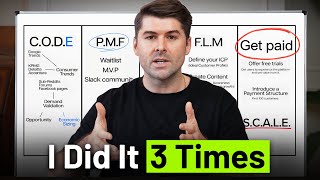
In this 45‑minute presentation Chris Donnelly walks aspiring founders through a repeatable system for launching a company that scales to $1 million in revenue without turning the founder into a glorified freelancer. He begins by warning against “time‑for‑money” businesses and then introduces the CODE framework (Consumer trends, Opportunity, Demand validation, Economic sizing) as a strategic lens for picking a high‑growth sector. He shows how to spot macro consumer shifts (e.g., the rise of ChatGPT), translate them into concrete opportunities, and validate demand through community signals such as Reddit threads, waitlists, and early‑stage feedback. Donnelly demonstrates the importance of building a minimal viable product (MVP) quickly, using a waitlist to collect feedback, and iterating toward product‑market fit. A large portion of the talk is devoted to founder‑led personal branding: creating high‑value lead magnets, educating an ideal‑customer‑profile (ICP) audience on platforms like LinkedIn, and converting that audience into early users. He stresses that acquisition, delight, and repeatable sales volume – not complex features – are the engine that drives a business from the first 100 paying customers to $1 million turnover. The talk concludes with a call to repeat the core sales‑outreach loop and hints at a follow‑up on scaling from $1 M to $10 M.
Chapters
There has never been a better time to build a business. Americans are opening more new businesses this year than last year, according to the Census Bureau. I built my first business from my university bedroom through to $10 million turnover. And to prove to myself that it wasn't luck, I went on to do it 2 more times with 2 separate businesses. I'm gonna show you today how to think strategically about launching a business from $0 to $1 million turnover. I have done this 3 separate times. I've built 3 businesses that have gone north of $10 million turnover, and this is the exact system I use. So I'm gonna map out exactly how you think about your product, your sales, your people, your process, and your finances. Before I get into the system, I just want to remind people the thing we are trying to avoid. We're trying to avoid a situation where you create a new job for yourself by starting a company. The amount of friends that I have who've started companies and become like glorified freelancers who really struggle to take holiday, just trading their time for money, is enormous. And I want you to think that the things that are going to set you free is strategically thinking about the product. So asynchronous delivery, recurring revenue, high margin, easy distribution, solution. You don't want to set yourself up in a business that's difficult. So let's get into it. So how do we get started thinking about the business we want to start, the sector we want to go into? I've developed a framework called CODE, and I want you to think about this when you're starting to plan what sector and what business you want to create. So the first part of CODE is consumer trends. This is really important for you to think about, which is I want you to study the consumer trends of right now. I want you to think about the change in technology and the change in demand and the change of how consumers are acting every single day, because it's in those moments, and it's in studying those trends where you will find the gold. And so an easy place to start, you could look at KPMG, Deloitte, Accenture, who pay thousands of people every single year to create incredible consumer reports on how consumers have changed behaviors. They're buying new things, they're using new technology. Another way is Google Trends. You just want to try and spot small micro changes that you can build and wrap a business around. And I'll give you a really good example of this from recently. So I saw that in the last couple of years, the majority of people have stopped using Google and are now using ChatGPT to find things. And so most people are sleeping on the idea, but the way we buy products, the way we buy services, has shifted forever. And so I thought to myself, well, that's going to impact businesses enormously by the fact that they won't be found if they don't appear in ChatGPT. And so I started a new business just 100 days ago which helps businesses get found in ChatGPT. And that is a perfect example of finding a consumer trend that's huge, that's scalable, that I can deliver a product to. And to get yourself in the right headspace to think like that, think about some of the big moments in history in technology where this has happened previously. Famously, Jeff Bezos, 1994, he saw 2,000-3,000% increase in internet usage, and he said, I need to build a business on the internet. You can think about 2008 when the App Store happened and businesses forever changed. And so I want you to go and study. I want you to go and think, where can I build a business where there is a rising tide? Because the last thing in the world I want you to do after watching this video is start a business in a sector that is slow or stagnant. I want you to start a business in something that's already got a natural lift. The second part of CODE is opportunity. So think about why your solution is quite clearly going to solve an opportunity for a business or an individual. And so to carry on the example from before, my opportunity is that businesses in general, their number one stated problem or challenge is the acquisition of new customers, getting new customers to their business. And so what I am solving with my new product Searchable is I am helping businesses to find new customers, and I'm managing to wrap my business around this new trend of ChatGPT for discovering products. And so immediately I'm able to look at two things here. I'm able to look at the clear business opportunity and problem that they have, which is customer acquisition, and the fact that we are sitting on the very top of a consumer trend that's massively increasing, which is the rise in all of us using ChatGPT. And this brings us on to D, which stands for demand validation. And so I just want to introduce the idea to you. Of a pre-validated idea first and foremost, which is you looking at subreddits, you know, forums, Facebook pages, and looking at customers already discussing a topic, already talking about their pains, their challenges. You know, you have creators posting videos about these different things. And what you're doing is you're seeing that the demand already exists, the pain point is already there. And so your job as a business and as a business owner is to insert the narrative of your company on top of this pre-validated topic. And so a great example of that is Tom Blomfield from Monzo. He launched Monzo, the digital bank, and he played very heavily on the fact that consumers hated foreign exchange rates when taking out money from cash points when they were on holiday. It's actually a tiny, tiny part of banking, but he was able to capture this preexisting, pre-validated demand from his consumer. And when he launched his advertising and his marketing, that's what he focused on. So this brings us to E, which stands for economic sizing, which is the exercise of working out how big the opportunity is. And so what you want to do when you're starting a new business is think about building in a space that is big enough that if you capture only a fraction of the market, you can still build a big business. And so TAM, which is the phrase that's used for determining the size of a market, is the total addressable market, which is the total amount of customers that your product or service can help. So when we were building our business Lottie years ago, which was a care home marketplace, we looked at a core equation, which was the total potential customers times the total revenue per customer. And by doing that equation, you can quite quickly work out what is the ceiling of capturing this entire opportunity. And then you can work out if we captured 1, 2, 3, 4% of this market, how big could our business be? And so when we were building Lottie, the equation that we looked at was how many care homes are there in the UK and the US, which were our target markets, and how much an individual would spend on a care home. And so we looked at about 60,000 care homes between those two geographies and an average of £3,500 spent per month to be in a care home, which equated to roughly £2 billion in fees. And obviously that's our customers' fees. And so we would look to take a small cut of that to make an introduction. Now, that is how you think about sizing your market. And so when you look at Code, I want you to think about rising tide. I want you to think about pain points. I want you to think about, can I validate this idea? And is this idea big enough that if I captured just a small fraction of the market, I'm going to build a big business for myself. Before I go on to creating the actual plan with you, I just want to draw your attention to the number one failing I think when thinking about starting a business is almost overplanning at the start. I have seen people waste forever creating business plans. I want you to write it down. It shouldn't take you more than half an hour once you're on a sector. Once you've found a sector you actually like, I think putting together a micro plan should take about half an hour. So the more important thing that you should think about and you should do every single day is try and prove whether you can get to 100 customers buying your product. I know that super simplified, but you can overanalyze everything in life. I want you to use code as an indicative way of thinking about the business that you can start. Once you've actually decided on the business, I want you to execute and execute every single day until you have 100 customers. Once you have 100 paying customers, I'm telling you now, that is a business to go all in on. So the next place that everyone jumps to is like sales and marketing. They ask, how do you get customers? How do you grow? How do you scale? And on my channels, number one question I get is, how do you get customers? But I want to draw you back to a much more important part about business and marketing, which is product-market fit. And when I talk about product-market fit, I am talking about the idea that a customer, when using or experiencing your product, has a highly valuable experience. And before we even talk about marketing, social media, events, ads, whatever, we have to get that thing to be highly valuable so that the customer pays X and the value they receive is many multiples above X. So what does this mean for you specifically? How do you find product-market fit? I'm going to talk a little bit about launching my recent business Searchable and how we found product-market fit, and you can use that as an example of thinking about how you can launch your business. And so what we did first and foremost is that before we even thought about launching our product, we launched a waitlist, and the waitlist was based around what we just discussed in the CODE framework, which was we had determined there was a massive consumer trend happening. A massive consumer trend was changing. People were no longer using Google, they were now using ChatGPT. We made a waitlist saying, please sign up to our waitlist if you're interested in using our product that helps you get ranked in ChatGPT. And now the important thing, ladies and gentlemen, about a waitlist is that the vast majority of people that you try and sell to— if you're selling to people, maybe 10, 20% of people are going to sign up to actually buy a product. But if you're giving them a waitlist with future value, you get 50, 60, 70% of people who are signing up to a waitlist and then saying, I'm looking forward to this product coming. And so if we're ever launching, that's the first thing you do. And by doing that, immediately you're getting feedback from people. And so with Searchable, we had the waitlist, we had hundreds of people signing up. And you might be asking at this stage, how did we get those people to sign up? And I'm going to talk to you specifically about how to build a founder-led personal brand shortly. And that's how you're going to drive traffic to the waitlist. But for now, I just want you to focus very specifically on the waitlist and why we do it. So we do it to get immediate customer feedback on what we're building. We released our initial product, we got people's feedback, we then released a prototype. The prototype was a slimmed-down, you know, in business terms they call it an MVP, which is a minimal viable product, which is the smallest version of the product that you can build that will add value to your consumer. And so we released a visibility report that showed a brand where it appeared in ChatGPT, and that was a free product. And we started a Slack community alongside our product to ask people what they thought. Within a month, we had a very, very limited product. We had 120 people in our Slack group and we had a few thousand people on the waitlist, which immediately allowed us to continue to deliver small value every single day to those customers and build what they wanted within the product. And so this is to remind you that launching a product is never perfect. Like, you are launching a small version of your product to ascertain what customers think of your product so that they give you feedback and tell you what to build in your product. And I'll just tell you a quick story about how Tom Blomfield once invested in my business Lottie years ago, which was I went to him, I pitched him, you know, we had this great conversation about how he could invest in Lottie. And he turned to me and he said, Chris, I love business. I love what you're doing, and I will invest in the company. I'll invest £100,000. However, my one request is that you launch the business in 2 weeks' time. And I was sitting there thinking to myself, there's no way I could launch this business in 2 weeks' time. I barely have a business here to launch. And he said, what part of the business can you launch in 2 weeks' time? And importantly, we got a tiny version of Care Home Comparison live in 14 days. It was super budget. But what happened off the back of that, everyone, was that we had thousands of people saying, this is what we want to see more of. Can you include this, this, and this? And so we had thousands of customers every single day now asking us to improve certain parts of the website, like to add fees, care home fees to an individual care home, to add a link that you could click through to the care home website. The lesson here for everyone to take away is that by launching the MVP, which the most basic small part of the product that you can build, the key is that you're trying to get people to ask for additional features, to ask for, you know, you to build more features because this is where a lot of people go wrong. They think that building a waitlist and doing marketing and doing product are all very separate things, but they're actually not. What you're doing by building a waitlist is you're getting early customers to help you build out the product. A perfect example of this is recently I worked at Lovable, and Lovable before it launched was actually called GBT Engineer. And what they did with GBT Engineer was so intelligent is they launched the very basic version of Lovable and thousands of customers used it. And every single day the customers kept saying, oh, it'd be amazing if I could do headers, it'd be amazing if I could change the copy and the content on the backend. And that's how you build a product roadmap. That is how you find product-market fit, which is far more important than anything else that we will talk about today, is getting those first 100 customers to use some form of product and give you feedback about it. So I think one of the biggest misconceptions people have about marketing, about product, about waitlist is that they are things that happen one after the other. Whereas in reality, when you're actually building a business, you are doing these things in parallel, continuously, in loops. You generate some customers to your waitlist, you exchange trust with them by capturing their email and giving them value, and then you talk to them about how you can develop a product or develop a feature that helps them. And simultaneously, you are acquiring more and more customers. So what I want to do at this stage is I want to move on to talking about how you can acquire customers, how you can build that waitlist properly, how you can develop an audience of people, because that becomes such an important and valuable part of your business, is the ability to take attention attention and take an audience and point it towards your product. So at this stage now, you have a handful of customers that are giving you feedback, that have signed up to your waitlist, and you are starting to develop this MVP. As we said before, the most important thing now you can do as a founder is draw attention to the business and draw attention to that MVP, because ultimately you need more and more and more people using that product to give you more feedback to develop the product. And so in marketing— and I've done digital marketing now for 16 years there are so many different avenues that you could pursue. You could do anything from advertisement to sponsorship to events. You could do takeovers, you know, billboards. There is a million different things that you could do from a marketing perspective. However, as a startup and as a new business, I think that the most valuable, the most scalable, and the most cost-effective way of marketing your business is founder-led marketing. And this is something that I have practiced now for many years. I've built an audience of 3 million people. I get something insane like 20 to 40 million views a week on my content, and it is so valuable because when you build a product or an MVP, you can push that out to your audience and you can get those early 100, 200, 300, or a couple thousand people using the product. And that is worth so much, I can't even quantify it. So you're probably thinking, how do I build a founder-led personal brand? Well, the thing I want you to think about first and foremost is that it has a lot to do with the business that you're building. It has a lot to do with the type of customer you're trying to attract. And so there is this term called ICP, which is ideal customer profile. And so ideally, that is what you're targeting. You're trying to create content so that your ICP are interested in reading that content, because that gives you the opportunity to then bring them from your LinkedIn or your Instagram through to your product or to your waitlist. And so right now, for example, I am building Searchable, so I want to connect with marketing managers from brands, and I want to connect with founders. So the content that I'm making on my social media is about scaling brands, it's about marketing, it's about how to do SEO, it's about how to appear in ChatGPT, because that content is the sort of content that founders and marketers are interested So you need to sit there and you need to think, what is my ICP interested in reading and learning about? And then a founder-led personal brand from my experience is about educating your audience. It's about giving people value. And so my biggest takeaway when I started building my personal brand was that I wanted to leave the customer and the viewer with education that would help them go from step 1 to step 2, from A to B. Like I wanna give you a roadmap to achieve the thing you're interested in. So a lot of my content over the last few years has been like how to, you you know, how to build a personal brand, how to do SEO, how to do digital marketing. And by creating that content, I build trust with my audience. My audience follow me. And when I come to the point where I launch a waitlist, for example, for something like Searchable, I have thousands of people who I've built trust with who will sign up to that and show their interest in a tool like that. And so when I come to launching a new business, I have almost my own launchpad. And that's what I want you to think about, is that it is one of those things that time after time it compounds. And so once you've got your topics and your ICP, it's then about creating content. And so I want to give you a breakdown of the different types of content you can make across the different channels. And so it depends again on the ICP, but for example, with myself, marketing managers, they spend an enormous amount of time on LinkedIn. And so LinkedIn has been an area that I have focused very heavily on over the last few years. Now, if you're creating content on LinkedIn, you want to be creating, you know, awareness type posts, which are the sort of posts that are easy to like, easy to engage with, and have a very clear and easily understandable message. So a lot of people do things like billboards or quotes, or they do personal story about their growth or, you know, challenges that they've had, things that are very easy to resonate with. And that type of traction and awareness that you get from those posts is how you start to initially build an audience. Now, I would consider that broadly the top of the funnel. That's how you are capturing people for the first time. The type of content that's gonna build the type of audience that's gonna sign up to new products is education content. And so you need to find a way of creating content that educates your audience member. And so you can see from from my cheat sheets or my carousels, a lot of that content is specifically teaching people how to do marketing and how to build personal brand. And interestingly, social media these days is about understanding what formats work best and what type of content works best. And so I'm going to give you a perfect example of a recent piece of content I did for Searchable that led to lots of different signups to our waitlist and into our product. So first and foremost, I created a lead magnet, and a lead magnet is a piece of content. It's a playbook. Book, it's a framework, it's something that's going to help the customer. So you could do a Notion dashboard, you could do a PDF playbook, you could do a, you know, carousel step-by-step guide. But it's the sort of thing that you want someone to read, enjoy, and then want to download or want to be sent that thing or want to get access. And so there is an additional step to getting hold of that piece of information. And so the example I wanted to point to is last week I released a free visibility report from Search which meant that the copy and the content itself was high value. Someone got access to a free report specifically based on their business. So immediately you get a lot of people interested in that. And at the end of the video and at the end of my copy, I always put at the bottom, comment searchable and I will send you a link to sign up for free. So what you're doing there is you're creating a high-value piece of content that's educational, that shows someone how to achieve something— in my case, a visibility report. And what I've done instead is I've actually given them access to my product with a free visibility report. And everyone who wanted to get hold of it commented searchable, which meant that I created a bit of a viral mechanism on that video and on that post that sent those posts to getting tens of thousands and hundreds of thousands of views. And so when you're thinking about your own business, I want you to think long and hard about how you create lead magnets that deliver value to your consumers and that people would exchange their email for, because ultimately you want to get people's email so that you can build trust and build value with that person over time. Because don't forget, it takes customers 5 to 7 experiences of a product typically before they buy. And so that is why it's so important to capture people's details, because if you're just appearing on social media, that might be the first time, the second time, the third time, who knows. But if you have their email, you consistently send updates and education to them over a time frame, building trust and therefore building the likelihood that that person is going to sign up and become customer. So as a recap, the motion that you're trying to create on an ongoing basis is founder-led personal brand at the top, which is garnering traffic and awareness and so forth. And you're offering lead magnets, which are playbooks, they are step-by-step guides, or they are small tools or a small variation of your product. And those are aimed at capturing the email. And then what we do is we send people continuous value nonstop, week after week, educating people on our on our process and how we help them. And the hope is that those people convert over time into using our product. Now, I have run this playbook 100 times. I have run it across every single business that I have ever owned. And the key for everyone on this video is to just break down how you can create a high-quality lead magnet that's going to capture value for your consumer that they're going to want to trade their email for. And that is honestly half the battle to creating a really successful founder-led personal brand. So at this stage, you have a clear idea of the business you want to build, the sector that you're in. You have a clear idea of how to generate traffic on the, on the front end and how to take that traffic and direct that towards your business. Now, importantly, you need to get to a point now where you have paying customers, and you get paying customers by either delighting customers who have already tried the product or offering new customers a really, really good deal. So when I was first building my agency, I would offer great clients to do like low-cost work for them. I even offered to do free work for some dream clients. Got to the point where I delivering crazy value for them, and then introduce fees. And the same if you're building a SaaS product, often you want to provide people with a free trial. And so you get people using the platform, obsessed with the platform, getting loads of value from the platform, and then introduce a payment structure for using the tool. And importantly, this is where you really start to see whether people like the product and whether they think that the value matches the amount that they pay for it. And so importantly, when we are building Searchable, we have just started to experience We've got lots of people who've been using the free tool who were unwilling to pay and use the tool moving forward. But then equally, a huge amount of the audience using the tool on the free trial have now converted to paying and are getting that value exchange. Once you've got your first 100 customers paying and using your service or your tool, that is when you can start thinking about the next step. Here is how do I scale this up and turn this product or this service into a proper business? So this is the part of the video that you're probably not going to like to hear. But it's also the harsh truth, which is at that point, once you've got paying customers, your job becomes consistent repetition of the good behaviours. And so what do I mean by that? I mean, you cannot imagine how much volume is required, and how much effort and repetition of the same thing is required to build a great business. There are very few business owners I know, by the way, who are always excited, or always enamoured with their product. Most great business owners that I know are doing the same thing again and again and again are now brutally consistent. And so at this stage in the business, you have got paying customers, you need to repeat the cycle of acquiring customers, turning customers into paying customers, and getting them to be delighted by the product and the service that you're delivering to them. And then doing that on repeat again and again and again. And it's true that nowadays, when building a business with the levels of, you know, personal brand and so forth that I have, scaling a business comes relatively really easily. However, when I first started my business, Verb, when I was at university, it took me about 3 years to get to $1 million turnover, and I was repeating the same thing again and again and again, which was reaching out to clients, posting content, trying to win people over, trying to deliver an amazing service that would lead to my customer maybe introducing me to another customer. And that repetition is what got me to making, you know, $80,000, $90,000 a month, which is about $1 million a year. So most of the people I speak to about their businesses who haven't got to $1 million turnover they point to the fact that they're struggling. You know, there must be complexity, they must add to their product, they must add a new service. And most of the time, I would honestly say maybe 99% of the time, my advice is make more sales calls, send more emails, talk to more of your customers, and just repeat that level of volume continuously. Because that is the answer to getting more customers. If you speak to more customers, you are likely to win more customers. If you deliver great work for more customers, they are more likely to buy more work from you. And it's one of those things that as you get more experienced in business, you realize, but you very rarely grow from acquiring loads and loads and loads of new customers. You actually grow through your existing customers spending more with you and growing with you. And so from the point of getting paying customers through to about a million turnover is a game of volume. And if you're not there yet, you need to do more and more work on acquiring customers and delighting your customer. So if you enjoyed this video, you have to check out my next video where I show you play by play, working through the quadrants, how you take a business from $1 million turnover through to $10 million turnover.