Resilience Roundtable: AI & the Future of Education - PART 2
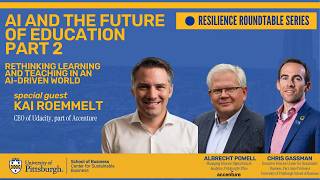
In this Resilience Roundtable hosted by the University of Pittsburgh’s Center for Sustainable Business, host Chris Gassman, Accenture managing director Albert Powell, and Udacity CEO Kai Rommelt discuss how artificial intelligence is reshaping education. The conversation covers the rapid shortening of skill half‑life, the promise of AI‑driven personalization, the proliferation of learning pathways (continuous reskilling, bootcamps, traditional universities) and the blurring line between credentials and degrees. They explore how AI tutors can emulate one‑to‑one tutoring, the role of human mentors, cohort‑based support, and the need for frequent content updates given a 3‑year skill half‑life. The panel debates the strengths of online versus brick‑and‑mortar formats, the formats of digital courses (video, interactive labs, capstone projects), and how AI can democratize high‑quality instruction for underserved K‑12 communities. They also envision future university models—flexible, multi‑year degrees, co‑degree partnerships, and the integration of micro‑credentials. Finally, they touch on academic integrity in an AI‑enabled world and the evolving expectations of employers regarding credentials versus demonstrated skills.
Chapters
All right. Welcome, everybody. Give it just a moment for the digital doors to come in. But while we do, go ahead and start kicking things off here. Hi, everyone. Welcome to another edition of our monthly resilience roundtable. I'm Chris Gassman. The executive director of the Pitt Center for Sustainable Business and your host for today's conversation. The Resilience Roundtable is an executive forum where we bring together luminaries, other thought leaders, executives from around the world and around the region to talk about and tackle some of the most compelling and impactful issues of our day. And yeah, do go ahead as folks are joining, make sure as we're introducing ourselves up here, do chime in and introduce yourselves in the chat. We'd love to hear where everybody's coming in from. And the topics that we're going to focus on in these conversations in general in the Resilience Roundtables, so far we've discussed how humans and AI need to work together in the future, energy transformation, and how today we're continuing the discussion from from December on how AI will impact the world of education. I've been saying we a lot. So in addition to all of you in the digital audience today, joining on stage in the fishbowl here will be my co-host Albert Powell, managing director at Accenture, who leads their Pittsburgh office. He's also an adjunct member of our faculty, although I think we've changed that name now. But if nothing else, an executive in residence here at Pitt. And on the board of the Pitt Center for Responsible Data Science. We also have as our special guest today Kai Rommelt, who brings an incredibly unique perspective as a CEO of Udacity, one of the world's leading innovative digital learning platforms. This should be a fun and engaging conversation around the, the future of education. And I do mean as a conversation. So as folks are joining, please, again, if you hear resources that might be of interest for folks, go ahead and share those in the chat. If you do have Q&A questions, I will encourage folks to use the Q&A feature because that is where we're going to prioritize looking for questions. Before we really dive into the topic, just so that folks have a frame of reference for who we are, what— where are we coming from in this? I want to share a little bit about the, the Resilience Roundtables and those sponsoring it. So the Center for Sustainable Business at the University of Pittsburgh, you know, our mission is to partner with organizations to innovate and implement resilience strategies to overcome societal, technological, environmental, and economic disruptions. We've been experiencing those a lot of the years of late. Uh, and so with the rapidly changing world, organizations need to become more ambidextrous, nimble. They need to be resilient in the face of change. And the Pitt Center for Sustainable Business offers a set of diagnostic tools to help assess your organization, to identify, prioritize, and develop a roadmap to be more resilient, as well as a series of executive development programs to equip leaders to embrace disruptions as opportunities. We're also sponsored in this effort by Accenture, one of the world's leading professional services companies, helping businesses to deliver on the promise of technology and human ingenuity. With services spanning strategy, consulting, technology, and operations, Accenture helps businesses thrive and reinvent themselves in this rapidly changing world while acting as responsible leaders. So the goal is to improve the way the world works and lives. And as a reminder, we've been talking about organizations, and as a reminder that the points of views expressed in today's roundtables by our speakers is their own point of view and not necessarily that of their organizations. So with that as prelude, I think it's time to dive into the discussion. So education has been about preparing people for the future, but now it's changing. With what that future even looks like, right? So, Kai, let's start with you. As the CEO of the world's leading digital learning platforms, one of them, what do you see as the future of learning?
Thank you very much, Chris, and thanks for having me here. And thank you to all the sponsors that are supporting the event. I think there's a number of big trends that we're seeing. I think for many years we've seen the trend towards skills and the focus on skills. Within skills, what we're seeing is that the half-life of skills tends to be rapidly decreasing and becoming shorter and shorter, and especially when it comes to technology. I think the second big trend that we're seeing is that with new technologies like artificial intelligence, it allows us to personalize learning a lot more and really individualize it based on learning styles, learning needs, and pre-existing skills. I think the third trend that I would highlight is that generally we're seeing a much broader variety of how learning happens and where learning modules— what do I mean with that? I think if we go back 50 years, you had the traditional university model that was pretty dominant, and that's how you learned. You learned at the beginning of your career, and then you went off to work in real life. And now we're seeing all forms of continuous education, reskilling during your career, even moving back and forth, back to university, back into life, but also not only universities, but many other forms of learning and credentialing have started in the world through bootcamps, through institutions like, like the one that I lead. And so I think we're just seeing a lot more variety in how learning happens.
Great, great. Some really impactful trends there. And it's funny, sitting in the classroom, you know, the traditional classroom and having taught at Accenture, you know, both virtual and in-person classes, I see those trends happening. I see them evolving every day. And gosh, the whole structure of learning, I think, is going to change. I think we're going to have an opportunity now to tailor learning to an individual much more impactfully. So, you know, instead of going, whether it's elementary school, university, or, you know, increasing skills, instead of this shotgun approach to whatever the curriculum is, I mean, I think what I hear you saying is, you know, in the future world, we're going to be able to tailor to who you are, what you need, how you learn, and probably in a fraction of the amount of time, be able to skill you on the things you need to be skilled on and maybe not on some of the things that you already know. Right? Is that sort of one of the things that you're seeing and how we change that? And do these online platforms, you know, like Udacity, is that one of the things they're predicated on? And then the follow-up question is going to be, you know, how do brick-and-mortar universities keep up with that, or can they not?
Let me take many, many steps back from that and think about like how did How did education happen thousands of years ago? And where— or, you know, you go to medieval times, right? Typically, education was preserved for— in cloisters or for sons and daughters of kings that would get the education. And typically they had a one-to-one tutor. So what does a one-to-one tutor do? A one-to-one tutor understands What does my subject already know? And what are the things that I want to teach? And how, what are the learning styles that that student really thrives after, right? Like somebody might need a lot of practical exercise. Somebody else might need more theory. Somebody else might need more of a social context. So what, what we're seeing now is with the technologies that we have is we can assess much more easily in a context of where everyone is, where their knowledge is. And now we can also train to it. And this is where artificial intelligence comes in, because now I can adjust all of this on the fly, where I have a situation when I have a classroom and I'm standing in front of a group and I have 30 students in the class or have 50 or 100 students. I can't do that. I can't do that for 100 students. With the technologies that are able and accessible today, I can do that now. And so I think it's less of a question of can a university do that or not? I think many different institutions can do it. And I think the technology and the tools that are at our disposal now allow us to transition that type of training. So I think that's one thing is that it enables universities to do it. But it also means there's other institutions that might have other forms and other pathways that are also able to do it. And I personally believe that what we're going to see is that the lines between alternative credentials and how they, how they work and universities are going to become a bit more blurry, where leading universities will, will also get more creative on the forms of how they teach and how they, how they educate students.
Interesting. On that last point, you know, one of the, one of the traditional I guess, benefits of, you know, a brick-and-mortar university like the University of Pittsburgh, right? You go to their MBA program and you've got a piece of paper, right? You've got a credential. You've got a degree that's recognized, you know, globally. And there's two parts to sort of my thinking here. One is, you know, online, you know, you take a bunch of online courses. You can take, frankly, a lot of Pitt courses, right? And other university courses, listen to their lectures and things like that and gain the knowledge. But you don't get the piece of paper, right, or the credential. So one of the things is, as I hire at Accenture, I think a lot about what do I value the most? Is it that piece of paper? Or, gosh, if there was a way that I could see that a person had a set of skills and was able to demonstrate them, and they did all this learning online themselves, but again, didn't have that credential. I'm wondering, part one is, do we see what companies value changing from that perspective, number one? And number two, I understand now that some of the digital platforms like Udacity now actually provide a credential and provide that piece of paper. So sort of what are your thoughts on both aspects of that?
So I'm going to split my answer in two aspects. So one, I think when you mention the credential, I think what is a credential, right? A credential is a certification that a trusted institution says this person has that set of skills, so, or has a certain set of skills. I think generally every reputable institution should be able to pass out credentials and say reliably, these are— this is the set of skills that this person has. At the same time, what we're seeing is that if we look at a lot of the big tech companies, right, like there's, there's much more ways to enter these companies, um, where the companies look at what are things that you've actually already done, what is— what are impacts that you have, what are things that you've already, uh, achieved in your life. So they look at practical experience, they look at things that you've you've achieved, and they hire based on that. So I think in a world where we don't have that level of information and it's much harder to assess what skills someone has, this is absolutely critical. I don't think it's an absolute requirement in the world today because we're seeing organizations have other ways of hiring, other ways of finding talent, be it through hackathons and other ways of where they identify talent and hire talent. And I think that doesn't, from my perspective, it doesn't make credentials irrelevant, but it just means that we shouldn't think that just because you get a credential, because I think that world of saying like, oh, I'm going to ask kids to spend hundreds of thousands of dollars just to get a piece of paper that says they have a set of skills. Well, guess what? In the world today, if you can prove that you've got the skills and There are ways to prove that now pretty easily. You can get the jobs without the piece of paper, which means that puts the pressure on the university that you need to, you need to be able to show what value you're giving to your students other than just a piece of paper.
Got it. Well, that, that brings up another interesting question. When, when we think of the physical and digital world of learning, Again, a lot of courses are now available online. But when I think about sitting in the classroom at the Katz Business School, for example, and teaching there, there is such a level of engagement and camaraderie from the people that are sitting in the room there. And I couldn't imagine going through especially like an MBA program, all virtually, because I feel like that physical connection engaging with students is so incredibly important. And I guess I follow that up with the undergrad. I think for a lot of students, the transition from high school to university is as much about learning content as it is about learning how to be an adult. So what are your perspectives on sort of how digital learning can replace that, can augment that. And I know we talked a little bit before about, you know, gosh, we're a little privileged here. I live in Pittsburgh and, you know, I've got, you know, 5 of the leading universities in the country within, you know, a 30-minute drive of my house. But not everybody has that opportunity. And I think that's a very impactful way that I think what what Udacity is doing and these other digital platforms is going to open up learning to a whole much broader suite of people. Is that sort of your thinking as well?
So first of all, I'm a product of higher education. I went to university for a total of, I think, 10 years. And I think I've gained a lot of relevant skills that helped me to succeed in my career through my higher education. And I certainly believe that there's a, there's a place for that. And there's, there's a role for that to play. Nevertheless, and just maybe let me share the founding story of Udacity, which, which was really born out from higher education when Sebastian Thrun, machine learning professor in Stanford, took his machine learning class online. They thought they're going to have 500, 1,000 students signing up. They had 160,000 students signing up from all over the world for that class. I think more than 190 countries where people were signing up from. They, they let these kids take the final exam in the class, and in the top 400 people finishing the test, there was not a single Stanford student. I think the The best Stanford student came in like 403rd place. So what we, what we have to recognize is that higher education, the way that we run it today, is a system that's not accessible to everyone. And that is not because of cost, because of physical location, or because of the entry exams that don't allow people in. But there's a ton of people that could thrive if they get that level of education and that level of training. And then they can go ahead and leverage and utilize that. That was the idea under which Udacity was born. Originally, Sebastian's idea was to say, like, we don't need higher education anymore, higher education is dead, we only go this. Like, at Udacity, we've now gone like a bit of a 180 from that because I do believe in higher education. Well, we've now added credentials and degrees on top of the training that we offer. But the idea is that we want it to be accessible to everyone. At Udacity, we've trained the first self-driving, female self-driving car engineer in Saudi Arabia. We've trained hundreds of thousands of people in places like Egypt that now have access to international technology jobs. And again, think of the case of a single mother in rural Egypt she has no way of accessing any of the top institutions that we're talking about. And quite frankly, sure, would she love the campus feeling and enjoy being on a campus and having the social aspects of it and going to a football game on campus? I'm not sure she likes football, maybe she prefers soccer, but the general experience, I'm sure she'd like it. But the fact is that it's absolutely out of reach. And it's absolutely impossible. And even if we would say we make it free for her to attend, then still you would have the aspect that she might have to take care of her children, of her elderly parents. And even physically, she might just not be able to go, or because of cultural challenges in the environment that she lives in. And so I think it's our responsibility as leaders in education to really make that access possible and democratize education. And I know this is a very heavily used term, but allow many more people to get level to this kind of training.
That, yeah, that, God, that's a hugely different perspective. I think even in the States here, I mean, you talk about the mom in Egypt, but even here in the US, right? Again, I think about the number of us that live within an hour of an hour of a university and the number of us that don't and how difficult it is to, you know, get to a brick-and-mortar campus from, you know, rural whatever, South Dakota.
In other words, we don't even have to go as far as that. I used to be chairman of the board of a university in California, and we had situations where we had people that— and it was a heavily vocational-focused institution, but where we have people that live in the, in the wrong neighborhood in LA, and at certain times of the day, the traffic is so heavy that even just within LA, it becomes, it becomes unviable to get to campus.
Fair. No, great point. Great point.
And I also have to say, there is, if we look at, if we look at an on-campus experience, there's varying degrees of how important it is to be in the room. And so I am, I studied business, I studied strategy. So if you have someone, you know, if you have a mediocre lecture on Porter's Five Forces, I think it's much more valuable to actually have a great online session on it by someone who's incredibly well-versed in it. So I think we see, and I think this is what, and this is what I've seen with University of Phoenix and other players in the online space, that even in situations where you have, where you have an on-campus experience, you often get situations when, when you have both options available, that students start picking and choosing. There's certain classes that they will go to a class for because they know I'm getting something in that classroom that I'm not going to get online. And there's a certain experience that typically that's when it comes to social learning, and being with others and having experimental type of experiences. But then there's other classes where they say, you know what, I can just watch that video and then that's good enough.
So, Kai, can you expand a little bit more on that last point? Because we actually did— one of the questions that we received in advance of the webinar was around that idea of like, is there stuff that just by the subject matters intrinsically more, this is going to be more the in-person experience? So it's sounding like it's more the modality of like, I'm learning by doing and less I'm learning calculus or I'm learning English or I'm learning paint. It sounds like it's more the modality of learning that you're talking about.
Yeah, I agree. I don't think it's necessarily the subject. I think it's more about what you do and how you do it. I think there's also a difference of— and obviously we've come very far in online learning. I mean, if I think of the early days of online learning is where Many institutions thought online learning is I just put a camera in the classroom and I just, and I just film it. But, but a great online program obviously leverages all the technologies and makes it super highly interactive in an online form and leverages the strength of that technology. But I think it's really about how inspiring is, is the professor in the classroom, like how much does he draw people in, or she, and how much How much am I really interacting with other people? So I think it's more the how than the what.
I think this is putting a lot more pressure for, you know, the classroom learning for really outstanding, not just knowledge content professors, but good storytellers, good presenters, dynamic individuals, because I think you're right. I think students are going to start having choices. And if they've got somebody that, you know, maybe they're a Nobel Prize winner, which can be great, but they've taught the exact same lecture for the last 15 years and it's dry and boring, that may be tough. Or somebody that's really passionate and excited that can weave a good story and engage the students and make them excited and interested. So I think almost the reviews of professors is going to be much more important for the brick-and-mortar universities.
And it's also about how do I draw in people at different levels? Because let's take the Nobel Prize winner, right? Like, if you, if you teach to the top of the class, you might lose people at the bottom of the class. If you teach to the bottom of the class, you're going to lose the people at the top of the class. So how do I, how do I draw people in of all different levels, and that, that kind of they all feel this the same type of engagement?
So, okay, that's interesting. One of my other alma maters one of the other institutions around here, happens to be doing a little bit more of that or experimenting with that kind of personalization, right? Like using assistive intelligence to say, hey, let's, let's build an ecosystem of agents to help you figure these things out and go at your pace and help you figure out the subject matter. So as the brick-and-mortar institutions start trying to do more of that and trying to develop more of those capabilities, that's online native educational platforms like Udacity are doing. Is there anything intrinsically human about particular disciplines or topics that are like, you know, this topic probably needs to stay something that we experience with each other, there's just something about it that we need to learn from other people in person?
I think it's a good question, and I don't have a I don't have a strong answer yet of like certain topics need to be online because I haven't seen it. And I have seen that even topics that, that are very hands-on can through simulations, through, through ways of kind of— we even have seen in medical education, we've seen highly complex operations that can be taught in distance ways. So I don't think— I think we'll see and we'll learn a lot more about these things over time. And again, I think— I don't think it's topic-specific. I think it's more about like this, as I said, the how experience and about the efficiency experience. I mean, one thing, and this is something that Albrecht mentioned earlier, Good content. First of all, we live in a time where content is abundantly available everywhere, and good content is available. And this is what I like when I talk to some of our B2B customers. I'm saying like, hey, look, you can absolutely— all the skills that we teach you, um, and I'm, you know, all the skills we teach you, you can find online in places. You can find good content about that. But the difference is What is the least amount of content you need to consume to learn a skill? Because we've all, we've all been there. We've all had some repairs at home that we've done. We've fixed the AC machine that we have somewhere, or I mean, and again, it can be more or less advanced in what we did, or we can try to change a car battery and we go through YouTube video after YouTube video and then it's not the right model or kind of it's It's one video is bad or someone actually does something wrong in the video. And ultimately that will lead to break your car. So you'll eventually, you'll get there. But it's, but it's, you need to spend a serious amount of time watching the wrong content until you get that content, because ultimately you might watch 3 hours of YouTube videos. But actually what solves your problem is 3 minutes of that. It's just 3 minutes. And if you had been able to be pointed to the right 3 minutes, in the first place, it would have saved you tons of time. And I think the responsibility of what we need to do as institutions is we need to create that environment where people only have to consume 3 minutes of content to get to that result. And I think that's our responsibility. What's the least amount of time people need to spend to learn a skill?
Can, can you share a little bit about the sort of these online platforms? What, what type of learning they are? Are these, are these all videos? Are these hands-on? Are these like CBT type training? And, and the reason I ask is because again, I think different people learn differently. And I'm going to pick on our daughter, um, Kelsey, who just finished her residency as a doctor. But when she was in, uh, in medical school, they had two paths. They had the traditional lecture path where they would sit in a classroom and, and learn the content. And a, a somewhat radical at the time path of practical hands-on learning. And basically they would walk in a room and there would be either a, a, a person lying on a table describing their symptoms and they had to figure out what was going on. And it was very hands-on, right? Or they would have a cadaver and they'd start going in and, and it was all learning by doing. And Kelsey cannot do textbook learning. It just, it's not in her DNA. So she loved this program and they had to figure things out on the fly. And again, it was very hands-on and, and that was a way that, that, that she learned effectively. So when we look at these digital platforms, because the traditional classroom can do both, right? But how do these digital platforms work? What type of— how do we present the materials to students?
So first of all, I think you're making an excellent point. And as we're thinking about what's the answer for what's great online versus great in person, this might not be the same for everyone. Like, people might— and this is what I meant initially in the opening statement when I talked about personalized learning. Where, again, think about that medieval teacher teaching a prince or a princess. They would understand what kind of learning does the student respond to and how do I need to learn? And I think we, what we'll see probably over the next couple of years is that, that we will, as institutions, need to have elements in our training that understand exactly what works for this student versus that student. And how do I need to, how do I need to build that? And maybe we have an— look, I know every, every company in the industry claims that they're fully there with AI learning, but like this true power hasn't been developed yet. No one has it yet where you have a, where you have a true AI tutor that understands exactly every response that the student has. And how much content they pick up from what they learn and how that differs in different contexts. And that then goes through their, their studying experience with them. And then as it goes ahead, tailors the programming that the student consumes. So, for example, in the case of your daughter, that would heavily rotate then towards practical experience. Versus, versus other things. And there might be, there might be others where it's exactly the reverse, right, that are much more textbook-focused or video-focused. So if you look at the online platforms, I think there's not a one solution that everyone has. And again, speaking for Udacity, Udacity is focused on technology training that is typically, yeah, very hands-on keyboard-based. So our philosophy is people need to do. And so the way that our programs work, it's, it's a mixture of video, text, interactive elements that people do. Then, and then every course has a capstone project that's really kind of very significant hand-off-keyboard, hand-on-keyboard type of work that then gets graded by actual human mentors. So we have a little bit like adjunct faculty, um, uh, that would grade papers and give feedback on, on the work that people do. But it's very focused on the practical aspect, on seeing that can people apply the, the technical skills that we've, we've taught them. So that's a big part of the, the focus and the pedagogy that we have behind Udacity. Again, other providers have other ways. There's a lot of companies that you find that are heavily video-focused or heavily text-focused For us, it's the practical aspect that we focus on.
Kai, can you expand on that last bit a little bit there that you mentioned human mentor there in the role? Because I think, you know, Albrecht, from your experience, I know the work that you do as an executive in residence, there's a lot of engagement and mentoring students in better ways to think about an engagement with a consulting field project course or any other type of activity and helping them think through things. And that mentor-mentee relationship is a very classic to the brick-and-mortar experience. And so I think conceptually people, at least, you know, there's the presumption that like, oh, an online thing is just me interacting with a screen and there isn't a human on the other side of it that is dynamically engaging me. It's maybe a bot that looks like a human, but it's— there's not a person there that I'm learning from. But it sounds like that may not always be the case.
Yeah. So we have a combination of different tools that we use. So as if you sign up through the website, it's generally a self-paced program, then you have an AI instructor that will help you and can guide you through. And then as you, as you do your projects, that will go to a mentor that will then guide you and help you in that work. What we also do for large programs, especially with, with governments where we do population upskilling or some programs in companies that we do, is where we, we might run a program as a what we call a cohort. So it's effectively still the self-paced program, but we layer a, uh, we layer a cohort structure on top of it where students start at the same time and then have regular check-in points with, um, uh, with a mentor, as we call them, um, that would help them move along together, move forward. We can build a community around it, um, which, as you can imagine, this typically helps more people to get to the finishing line of the programs as you create that level of structure and rigor that you would also see in universities. The other thing that we offer is what we call accelerators. Those are effectively one-to-one or one-to-many sessions where, where people can get additional help and support if they want to have that relationship. Again, ultimately that comes down to scalability and cost question. I think at some point we will see that more and more of those aspects, probably not all of them, but more and more of those aspects will be covered by artificial intelligence. Just because that allows that to scale more and it allows access for more people to that kind of individualized support.
Awesome. Albert, I don't know if you have any thoughts on that mentoring experience as far as like what, what might stay or what might be the enduring thing like as a mentor if somebody's seeking to become a better mentor? What are the things that they should focus more on that are less likely to be eroded?
Yeah, I mean, I think that the concept of mentoring, it's so critical because we all need support, help, encouragement, guidance, share the experience, right, that may have been there from the past. What I find interesting is I've been demoing some some AI-based mentoring solutions that are just now starting to emerge. And they're pretty interesting. They provide a lot of depth. I mean, think about having a conversation with a ChatGPT-type tool. They're pretty personal. They're pretty engaging. And you get a lot out of it. I think as we start putting the human face to some of these AI tools, that's going to get a little interesting. And that leads into a whole other social dynamic of where AI is going. But I think there's room for both, right? Because I know my time's precious, but I love being on campus. I love mentoring students. I think they get a lot out of that and that real-world experience that you don't get from an AI bot. But if I'm taking a course and I need help in how to learn how to build agentic models or how to code in Python, and I'm struggling with something, and I have a mentor, an AI tutor that can look at what I've done and says, you know, here's where you're struggling. Let me educate you on these couple of things and help expand you there. So it's an incredibly fast-paced, evolving space. One more thought, and then, yeah, I know we need to go to— I want to go out to our folks in the audience. And please post questions in the chat. The chat. Kai, I'm thinking about how courses in these digital platforms are kept up to date. Because I know, like, I teach an executive analytics and AI course. And I'm getting ready to teach this coming summer. And I look at what I taught last year. And it's like, snap, I got to update, like, like a quarter or a third of my, my materials because things just have changed. They've evolved, right? These great big concepts that I talked about, you know, a year ago, it's like, yeah, everybody knows that now. So, like, I've got a lot of work to do here to keep these updated. How do these online platforms— is there a, a human that's overseeing each course and they're responsible for making sure it's kept up to date? Is there an AI bot that keeps it up to date automatically now and, and it's a self-learning tool? Like, how does that work?
I think you're making a great point. And I think if you look at online platforms for learning and there's, there's all kinds of models that, that you can find, you have, you have models that are marketplaces where effectively anyone can create a course and then that course gets put online and that course gets sold. Those, those have a relatively small amount of control of the, on the courses, and the, the responsibility for updating lies with the author. That's not part of the online learning company. So you get that, you get a— while it— this is, this is a great model to get lots of variety out there quickly if you have a good author base, but again, you have a lack of control on quality and how quickly things get updated because you don't own, you don't control the courses. There's, there's other models that are completely generating courses through artificial intelligence, very cheap to produce. You get lots of courses quickly, but obviously through hallucination, through issues like quality control becomes a challenge because because it's— we all know the challenges today that come with, with artificially— artificial intelligence generated content. So you would have to put a pretty substantial quality control layer on top of it if you wanted to control it. The model that we use is that we produce all content in-house, so we own all of our content. Um, that is great because you have fantastic quality control, you have great standards, you have the same pedagogy along amongst all courses. The downside of it is that we spend about half of all of our content costs, all of the content expenses that we have are just updating content. And I remember back in my higher education days, we typically, many courses we had on like 3-year cycles of renewing them and refreshing them. That doesn't work in this world, like especially, and it's interesting, IBM had a study out there a couple of years ago where they said the half-life of skills a skill has now come down to 3.5 years. In the AI world, it's a totally different game. Like, if we have a course that's 6 months old, we get complaints from our students that this course is out of date. So the— and this is, I think, a big challenge when it comes to technology skills for universities, because universities are normally not used to that kind of update cycles, which I mean, we have a couple of universities that we work with where, where we provide content, we provide courses that are then being utilized in the university, which I think, and regardless of whether that's Udacity or whether there are other partners, but I think it's a smart approach to look at areas where the skills just move so quickly. And if you're saying like, that's not necessarily my core focus as a university, that particular area of, of type of content, are there partners out there that can help me, um, get it so, so I, I don't have to completely revamp and relearn on, on how I do content. There's, there's other areas of studies where, I mean, quite frankly, if you do art history, and I'm not an art history major, no offense to anyone, but that's, that probably doesn't change as quickly as if you go how the latest AI, Agentic AI courses. There's probably a difference in speed here.
So one of the questions that came in when folks were registering was around the use of AI. And you talked a little bit about weaving that into updating courses and curriculums and such. What's your philosophy at Udacity and for these programs around the use of AI quote unquote, in the classroom. So if somebody needs to write a paper, you know, it's one of the things that we deal with in the physical classroom. It's like, you know, you get a prompt and students go home and put it in ChatGPT and print out their paper and turn it in and they're done, right? But there's tools that can detect that and then there's tools that update it to make it more human so it doesn't detect it. And there's tools that, you know, do detect that and so forth. So it's a big debate. Some professors, it's like they won't let people use AI at all. And they'll fail them if they find they use it. Others, you know, want you to use it, but use it responsibly, right? So what's the thinking with, with Udacity, with the digital platforms? Because, you know, I'm assuming that as you're taking an online class, if you have something practical, hands-on, some students are going to have the online tool right next to them and then they do the cut and paste.
So I think we are in a slightly privileged position here as Udacity. But, and I'll tell you just now why I think so. I think generally speaking, this arms race between cheating and detecting cheating is probably something that's gone, like, I mean, that's probably been there for hundreds of years. And I remember in my university days when eventually you had these little pagers and you had, like, I mean, people use all kinds of tricks. That eventually kind of faculty caught up with, and then they didn't work anymore. And so I think it's something that's always been there. Of course, artificial intelligence can drive that a lot, but I do think we'll also see ways of detecting it. Generally, in the company, we have an AI-first approach, and we— like, I want our teams to work with AI and have as many as I AI tools used as possible. Why am I saying that we are privileged? We're privileged because we teach technology skills. Our students know very well, and it's very— and that's why we have very, very few issues with cheating, is because if you claim that you have certain hard technology skills and you go into a work context where you're now supposed to apply them, it's going to show very quickly if you don't have those skills. Like, it's, it's, um, so there's, uh, that's why our students don't really cheat much because it doesn't, it doesn't gain them anything, um, and there's, there's no value in it. What we do see is we have, we have some programs where we teach high school kids, um, and because that's then part of ministries of education and kind of more formal there, we typically together with the ministries have some, some stricter ways that we are, we're making sure the kids are monitored more strongly. What we also, we do have, we do have assessments. So quite frankly, you know what, if you, if you cheat on your practical part and then later in the assessments, you don't know the answer, you're also in trouble. So I do think it's a challenge. I think it's a challenge that we need to take serious and that we need to monitor. But at the end of the day, as I said, there are ways to counter that as well.
So, Kai, building on that last bit a little bit, we actually got a question in around the opportunity in there because you mentioned high school. Michael was asking a bit about the role from kindergarten onwards, not just thinking in the higher ed space, but like holistically across the education value chain, you know, what the opportunities for online learning providers might be, with caveats and contour in there around— we've all just come out of, you know, learning experiences during COVID and how screen time or lack of interpersonal experiences for young developing humans, right? So trade-offs and thoughts in there, but just any thinking around the role the unmet needs of underserved communities that organizations like Udacity might be able to play in that kind of K-12 education space?
So I think, first of all, for underserved communities, AI can be the biggest leveler of the playing field that we've seen in generations because we can now go ahead and, you know, we can, we can make the practices of the greatest educators in the world Through Agents, we can make that available. We can make that available to places anywhere in the world that couldn't afford or couldn't get these kind of teachers before. And we have, I mean, we all, we live in a massive teacher shortage. So I think that's, in that way, it's great. I think it's important that especially these communities embrace the technology and really use it as a as a strength. I see it, I mean, my kids are elementary school age right now, and I see how, how they use the technology and how they use it much more natural than, than, than we do already. And I think it's, it's, it's great because again, like, they, as, as you use, as you learn the technology and as you learn, you also learn about where is it right, where is it wrong, where the weaknesses And the only way to learn it is by being exposed to it and by being and trying things out and by testing it.
Makes sense. Albert, I think one of the other ones that we had a question coming about was, and to the point around Accenture and re:Inventor, the need for education beyond just content subject matter expertise on like, okay, so how do you lead change? Right, like how do we focus on like a better world? You call it sustainable development, changemaker skills, what have you, like that, that ability to envision this, this better audacious vision that we have of a place we want to get to. And how do we not just, here's a proposal, here's what you need to do, great, best of luck in getting there. But as far as like teaching those, those change leadership opportunities, is that something that is, has to be the in-person? Is there a role for the online, what are you seeing from the workspace perspective as you all lead reinvention?
Yeah, you bring up a great point, Chris. One of the challenges that I see with our clients, with the business world out there is, you know, we have so much technology horsepower today, almost unlimited. We have access to all of this data, all this information. That's out there. And one of the things that I think we need more of is people to be able to think and envision what the world is going to be like, envision what does it mean to reinvent, right? You know, I go back to the, you know, Kodak days. They actually invented the digital camera, right? They owned the physical film market. They didn't want to lose that market share. They didn't have the vision of where the world's gonna be. And you look at what's happening with retail today and malls closing and things like that. So I think somehow one of the biggest gaps in education is teaching people to sort of think about the art of the possible, the North Star, the things that nobody's thinking about. We have AI, we have Agentic, it's like, what do we do with it, right? You know, we have all these use cases that we're using today, But, you know, who'd have thought, and this happened, you know, years ago, closed-circuit TV cameras at airports, right? They look at the airplanes at the gates. They used it for security. Somebody came up with the idea of, you know, hey, if we mine that data and we look at how the fuel truck comes in and the baggage truck comes in and the maintenance trucks come in, we can optimize that so there's not congestion. And they reduced aircraft on ground time by like 30%. That was worth millions to sell that dark data, that video imagery to the airlines and help them figure out how to manage their planes better. So I think whether it's, you know, through digital tools, I think are going to be an important part of that to teach the skills. But there's something about the experience and the inspiring people to think out of the box, to think of the North Star, to think of the things that nobody's thinking about. And I think that's where the human, the classroom, the inspiring teacher is still really important in people's educations. I mean, I don't think that the digital world, the online world is going to replace brick and mortar, but I do think it's going to augment it significantly.
Yeah. Yeah, from the center side, that is, I think when we engage folks who are very future-focused, there is some audacious future that they're really inspired about, and whether that's something that they picked up from an instructor or some opportunity that they say, here's a lived experience that I have, and like, there could be such a better way, and I'm just really excited about this better future that I, I can help bring into reality. So to Deborah and Mike, thank you for, for throwing in those questions. I think we are coming almost up on time, but we probably have enough time to bring in like one or two more questions as folks have. But like, as folks are typing those in, Yeah, Kai, curious, and Albrecht, given the shoes that you have in both worlds, what's the role for brick-and-mortar educational institutions in this space? And recognizing that there's very different ones across the spectrum, right? Not all of them are R1 research institutions. Some of them are trade schools, some of what have you. I think you've identified a lot of unmet need that's just out there already. Right, that online platforms are helping folks who don't have access to higher ed to gain access to it. As more of, of those current students that we do have maybe migrate to other online options, and some of that funding that has been coming to our research to subsidize the research, are there other things that— other roles that universities could play, or educational institutions could play if more students are moving to, to online education instead of brick-and-mortar types of institutions?
I think the first thing that I would, I would say is I think it's, it's important as what you just described as a brick-and-mortar institution just to break out of that mind prison. Like, it doesn't matter if you're like, you're not brick-and-mortar or you're online. Like, I think the future is many different things combining. And I think we have to move away from that model of saying, yeah, there's like this rigid structure and the brick-and-mortar university needs to be that rigid structure, needs to be in that place. And physics, that's, that needs, we need to move away from that. We need to forget about this. And I think as an, as an institution, so, for example, as, as I'm, I'm thinking about learning and credentialing, Like, you know, it doesn't need to be a fixed, like, 2-year, 4-year degree and then you're done. Like, you can also— why can't a degree stretch over 10 years, over 20 years, where people show over time they take a course every year and after 10 years, after 20 years, I certify, yeah, now you've got everything together for, for that credential and for that, for that degree. Why can you not cooperate with all kinds of other providers? I mean, we're actually, to be honest, we're We're about to launch a co-degree with one of the leading research universities in the world, where we bring those things together. I think, I think we need to move away from that rigid structure and think about what we're really here for, is providing those skills to people and helping them find jobs, get jobs, proceed in their careers. And I think we need to be a lot more flexible about it.
Kai, great way to start winding us down. Gosh, this has been an unbelievable session. This is one of the big passions that I have— AI, data, information, and education. And I'm so excited to have you here with us today, Kai, and learn more about Udacity and what y'all are doing. I think you're truly a pioneer and a game changer. And the experience and what you've built is amazing. Now I'm trying to figure out in my classes how I start leveraging some of what we've talked about here today, that more of the digital world into my brick-and-mortar classrooms, and haven't quite cracked that nut yet. Hey, the world is changing, right? And we've got to change with it, and we've got to think about all aspects of what we do, whether it's education or supply chain or customer service differently. And that's what this forum is all about. And Chris, one of the things you and I talk a lot about is as the world is changing, geopolitical events, increasing customer demands, we've all got to be more nimble, more resilient, more agile in how we deal with the changes that are going on out there. And that's what Accenture does. We focus on reinvention, help companies reinvent themselves for the future, This I love, that delivering on the promise of technology and human ingenuity. You know, we look to help our clients stand out from the crowd and be more nimble in the face of change. And Chris, I know that the Pitt Center for Sustainable Business, I mean, it's such a great organization. You got the best of academia, you got the best of research, you've got partners like us and other industries involved. I'm excited to be a part of it. Could you share just a bit more about what what the Center does, and then we'll wrap up.
Sure, happy to, Albrecht. Thank you. Always a pleasure collaborating with you and the rest of the EIR teams and other partner organizations like Accenture. So this has been an amazing session. Really excited about it, and not just about educational change in the classrooms, but what does that mean for businesses, for families. At the center, we focus in on helping organizations to innovate and implement actionable resilience strategies, right, to address these complex business challenges, organizational challenges that they're facing. And so to make that a little bit more tactical or a little bit more tangible, there are 4 main offerings that we go through with people on that. So that's first up is the Resilient Organizational Architecture Diagnostic, a ROAD tool, right? So that helps folks develop their own actionable insights to enable them to really figure out their implementation plan, their momentum plan. Where do they need strategic intervention in order to build the resilience they need internally in order to lead through these disruptions that they're facing in society? Second is our Executive Development Program. We were just talking about the kind of human mentoring and coaching and engagement. That some folks need depending on their learning needs. And so on topics challenging resilience, we do have a number of different offerings on that to help with understanding and techniques to thrive through these different types of existential disruptions and come out with actual action plans. Third, we do have our own advisory work that we do, not in the stratosphere engagements that Albert, you and team tend to engage folks on, but much more in combination with folks in faculty and staff and student sides, really helping cultivating new ideas there, again around organizational resilience. And then finally bringing, like this digital convening of folks, a community of practice, bringing folks together in different ways and different combinations for action-oriented leaders and experts from private, public, academic, and social sectors to discuss, to collaborate, and build capacity to again really thrive through existential disruptions like energy transition, artificial and human intelligence integration, and more. So just on that note of convenings, if you'd like to discuss these topics and others, please do reach out to Kai, Albrecht, myself. We're more than happy to engage any and each of you. And if you'd like to join us at one of the next convenings that the center is organizing, the big one for the semester is the Spring '26 Forum. On April 6th, April 2nd, where we'll be getting into managing uncertainties and disruptions. In between now and then, you do come out to the area coffee chats. We've been doing the monthly over at the porch, and the next one up is on Wednesday, next Wednesday, the 11th. And obviously we look forward to seeing you all at our next Resilience Roundtable in March. Thank you, everybody. Take care, all.
Thanks, everyone. Take care.
Bye.
More from Chris
Hybrid Intelligence - Integrating human and artificial intelligence for Strategic Advantage