Resilience Strategies for the Housing Innovation Alliance
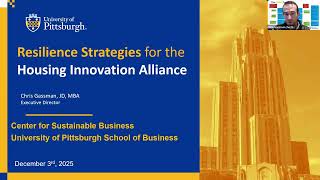
Dennis Stagwell and Chris Gassman discuss findings from the Housing Innovation Summit and strategies for 2026. The ROAD framework helps organizations plan under chaotic ambiguity through three concurrent vectors. The network needs organizational ambidexterity, shared governance across alliances, and intentional AI integration to evolve competencies.
Chapters
Hi everyone. I'm Dennis Stagwell, president of the Housing Innovation Alliance. I'm excited to bring you some exciting, some interesting follow on content to our Housing Innovation Summit, which we held in Pittsburgh May 19, the 21st. Earlier this year at this summit we had a unique partnership with the University of Pittsburgh, which included the School of Engineering and the School of Business. And within that specifically, we held a series of working sessions with the center of Sustainable Business to take a deep dive into their proprietary road framework that's based on Pitt native research and pulled on global scholarship. Today we're bringing back faculty and Executive Director Chris Gassman, who you would have met at the summit, to take us through the findings from those workshops, learn from the insights that we captured from talking across the network, and provide you with a few actionable strategies that you can leverage in your business as we plan for 2026. So with that, I'm excited to bring Chris into the conversation and let him run with it from here.
Awesome. Thank you, Dennis. Appreciate and team. You will hear Dennis and I tag team this as we go through it. So like Dennis mentioned, Chris Gassman, director over at the center for Sustainable Business at the University of Pittsburgh School of Business and really looking forward to teeing up in what we saw from the results at the summit with you all back in May, looking into where you all have capabilities as well as where some gaps for some prioritized efforts should be and then closing out with helping identify three or five no regrets, robust actions that you should be able to focus on here for 2026. All right, so just to put you back in the mindset, put you back wheel through time, that journey so far when we were at the summit, the concerns that we heard from attendees loud and clear was this focus on affordability. How are we going to do that? There was a lot of uncertainty that people were navigating, trying to lead their own companies through concerns about labor costs, stagnation, little pockets of innovation and excitement around just again, a lot of uncertainty around things. In a world of uncertainty, the ways of planning that you've relied on, that you've grown up with, that work in a lot of other situations aren't sufficient for planning through the kind of chaotic ambiguity that folks were flagging that they were experiencing. Right? We call that more of a wicked problem or more of a wicked world. And that kind of wicked world means that the ground underneath you right now, the way that you currently create value, your existing domain of business, your strategic area for focus, your strategic arena for creating value, creating revenue is more uncertain. It feels more like sand than firm, firm ground. And so rather than doing the classic innovation approach that we've advocated at business schools for ages of either build additional capabilities or do work with additional customers in a wicked world with this level of uncertainty, you need to move past the adjacencies and really find true new opportunities, new capabilities, new customers. What are the problems that you are uniquely positioned to solve? That means really stretching and transforming and evolving in order to get there. It's risky for sure, but given the level of uncertainty that you all are facing, this is the strategic direction that the network needs to go in. And so in that kind of a world, and these are again the kinds of problems that we've studied here at the School of Business, it's really focused around again, teeing up those different types of disruptions that you're facing, the different types of uncertainties, and the different types of tools or frameworks or ways of thinking that you would need in that. Right? So just a quick recap for folks, things that we talked about in May, again, the types of uncertainties, the middle three, we spent a lot of time in various activities and exercises going through the mindsets underlying paradigms and the key techniques, right? At the end of the day, many of you are either sole proprietor, one person, ban show, doing really great things on your own or with a small nimble team, or you're a large enterprise level type of corporation. So organizational structure may be an option within your choice. Again, our focus today is that and recapping what we talked about in May is that the organizational structure is your choice, the type of uncertainty that you're experiencing, the level of disruption that you're experiencing is unfortunately not a choice. And so these things that maybe more enterprise level organizations have started to tease at being capable at, everyone else is needing to build up capabilities around as well. And so just to recap quickly what those are, and again, why we're talking about this is because depending on that type of disruption you're experiencing, it's going to shift where you need to focus your strategic attention, where you're going to focus on in order to create value, in order to capture value for the firm. And so again, that first type of uncertainty we talked about was like volatility, right? This would be very comparable for those single departments or single business domain types of firms that you really learned from the past there. The second type of volatility that we talked about, the se second type of uncertainty or disruption is more the known unknowns you're on the receiving end of the disruption that somebody else is creating. So you see that more at the industry level, like when automobiles were disrupted or retail was disrupted, or entertainment was disrupted, there was one or small number of companies that were causing disruption and everyone else was scrambling to figure it out. And there are different things that you can do in that kind of a situation. We worked through a bit of them at the tabletops. These were the AI exercises that we did as a group here. In these situations, you're trying to figure out your adjacencies, new capabilities, new customers. The big part that everyone was really struggling with was like, all right, what do we do in chaotic ambiguity when we don't know? These are the unknown unknowns. We have to learn from the future. We have to try and think about what's the future that we want to create and how do we bring that into reality. And these are all those exercises with the sticky notes. And moving into this opportunity quadrant is what this road framework really helps organizations focus on. So it's building up that resilient architecture of your organization to get into that opportunity quadrant. So what is that road framework? Again, just to recap here, it's a way of saying both the forest and the trees at the same time. So it's three concurrent ways of looking at the organizations. For the physics friends, it's three different vectors of looking at the organization concurrently. So you see the systems perspective while also being able to see the details. Right? And so the five point process that we walk through with different organizations on this front, first, just again to tackle that top level, make sure folks get that really to translate it from academia. The first vector is really focused around profiting through disruption, right? Who are you? What is the problem that you're seeking to solve? Right. How are you leading through this? The second one is recognizing that there are likely capabilities that you don't yet have in house and who are you going to team with in order to, to acquire those capabilities. And we're talking with a housing innovation alliance with the network here. So this one should be fairly intuitive. This is the group that you're all going to naturally, anyway, right. The last one is recognizing that evolving array of competencies that you have internally within the organization. What are you doing to evolve both your human capabilities as well as your integrating your artificial intelligence into the work that you're doing alongside that human work, right? So to break that down, just those five points in a little bit more detail, right? So starting with who are you? What's the core values, your vision with A big hair, audacious goal, your North Star and the competencies that are distinctive to you, your core competencies. Next, is the kind of problem that you're seeking to solve really coming at us from a design thinking perspective, a human centered design being focused on the unmet needs of underserved markets and having the kind of leadership in place where you're fostering and encouraging folks to think differently. And if it doesn't work out, that's fine. They're not to get fired, they're not going to get slapped down, right? How do we foster that kind of divergent thinking? How do we foster that kind of divergent experimentation? Once you get those experiments up and going, being able to finally move into that opportunity quadrant with them, right? Standing up new entrepreneurial ventures in parallel to the existing ventures, being able to think modularly about them and think, or ambidexterity you might call it, about them and be able to flex back and forth of, hey, the new ventures figured something out that the existing ventures could benefit from and the new ventures might benefit now that they're a little bit more mature from some of the processes that the existing ventures already have in place. Having that layer of leadership above that can flex capabilities back and forth. And again, being intentional from identifying the kinds of capabilities that you need and how many of them are you developing in house versus how many of them are you partnering with others around that bridge to these the next two vectors. So many of you have probably already seen somebody who's gone through a merger or acquisition. It's not the easiest way to do it. You may have also tried things for joint ventures, doable, but also a bit more clunky, not, not the easiest. So when you think about more the ways that you can partner or team with the folks in and around your ecosystem to really figure out how do we solve this problem in a way that we are uniquely positioned to solve? That's where you start getting into these alliances, right? And then it's really a question of how are you setting up those alliances? Are you coming at it with everything that you have to the bargaining table, and are you engaging in all of the different ways that you can, or are you really just being very transactional and very material about this? And then finally, once you have those alliances up and going, how are you maintaining them? What are those leading indicators that you can focus on? The final one in there is again your. The competencies within your organization, right? Whether those are the evolving array of human competencies or the ways that you're Integrating system intelligence, artificial intelligence across your value chain intentionally. So that's the quick recap on the framework, the recap on what we heard from you all back in May. Again, we did share out at the time the large group framing the aggregate. This is a cut down below that, looking at a few sub segments where we had a large number of respondents, a large number of participants within each loop. So we were able to put together some mutually exclusive, collectively exhaustive segments of the housing Innovation alliance of the housing industry. First group, architects, engineers, builders and developers, specifically buildings who are within off site ones that are doing building products that are more emerging products, you're more established building products, your capital folks, your consultants, your off site solutions had to have another grouping, just a little bit of a catch all, and then finally your software folks. So if you see the numbers on the cross, they correspond to the numbers on the side. So we want to make sure that we're flagging for everybody. Hey, as you are thinking about these areas of capabilities, who's already identified that they themselves have well developed capabilities on these fronts, right? So here who you can look to, to try and learn from, try and emulate, or try and partner with is you're building out those capabilities that you need in here. Again, at the end of the day, you're going to want to have all of these capabilities that we've talked about in order to create that resilient value, in order to move really successfully into that opportunity quadrant. So take it one by one on those five points. Right? So in terms of identity, folks were fairly well developed in their capabilities across the board. One thing that we noted that wasn't really called out well, was this a vision that had inherited this transformative goal? Where's that North Star that evokes that necessitates evolution of the organization of the companies in it beyond just little changes around the fringes? Right. Second, again around design thinking, what is the problem that we're seeking to solve? Right. Again, lots of folks had different capabilities around there and a lot of folks were more focused again on like hey, we were trying to solve affordability, right? Trying to clear the market on this. In terms of great, once we've gotten those things going, how are we at intentionally standing things up? How are we being ambidextrous and flexing resources across our entrepreneurial ventures and our existing ventures? There was opportunity to be more strategic, more intentional on that front. And then finally again, in terms of engaging your network, lots of different folks were engaging in different pieces, had different strengths across there in particular, the architects, engineers, folks in capital tended to have good pockets of capabilities across both those needed for setting up alliances as well as in executing the alliance, engaging in it, maintaining it once it was up in place. The final one in terms of thinking around, hey, how are we doing about the intelligence within our ecosystem, within, within us, ourselves, our own organizations, whether that's on the human side or on the AI side. Again, that was an area where most folks flagged, yeah, we have some development opportunities here. We some need for evolving on that front. Some prioritized focus call out. Again, folks in capital that had flagged some bit of capabilities across there, but again, a consistent bit. There's an opportunity for everybody. So in terms of pulling all of that together, you'll see in red there a few of the areas that we thought, hey, these might be some, some strategically important areas for some priority focus. Right. And that maps. That tracks with what we saw at the aggregate level as well. So what does that mean? What did we really find and where is the alliance today? What progress is in process one. After sitting down with you all at the summit in May and in subsequent conversations with individuals and Dennis's team, it did become really clear to us that you actually do have a big audacious goal. This may not be treating as such. Right. So you do have a goal, one that is shared. You do have one that fulfills unmet needs in ways that make business sense for you. Right. And you have one that requires each company, each participant in this alliance network and the network as a whole to transform. Not just a tweak around the edges, but like we've got to find different ways of doing this in order to solve the problem that we are uniquely positioned to solve. Right. And that gets back to the idea of achieving market rates, affordability. Right. So again, I know Dennis, you and team have been tag teaming on figuring these things out around, hey, how do we talk about this? What are you doing? Ways that really resonate with folks. I think you shared a couple of framings before on ways that might work on that. I don't know if you want to share any points now around the kind of framing that you've heard from in terms of, you know, more attainable housing, best performing and elevate health margins or healthy margins, if I'm probably paraphrasing horribly there.
No, no, I mean, you nailed it, Chris. I mean, one of the things that we've been looking at since the inception of our organization has really been refined through this process and that is, yeah, how do we drive market rate attainability within, with the scale and reach of the audience that we work with. A big part of that today is kind of simplified in saying, how do we elevate the consumer experience, deliver housing that performs and maintain healthy margins across the value chain? So you did a nice job kind of distilling, distilling what we've talked about. And I think a lot of what we learned through what you just walked through is who is ready to truly own that transformation that needs to take place within their organization. And I think one of the nice things where the data will lean a little bit in some ways is we're the tip of the spear within the industry. So many of the folks have already put their hand in, if you will, so to speak. And organizationally, we are acting as an extension of their internal teams to affect some of this transformation. So I think the other piece of it is, if I look at that change management readiness. So really understanding the both the capacity and capability to lead both their internal organization and their external talent pools through that process and journey. So a lot of this is, as you said, it's informing our programming, it's talking to us about the strategy behind our stakeholder engagement, and it's also really shaping our communication models through everything that we do throughout the course of the year to achieve those objectives.
Awesome. That's what we like to hear, right? If it's just a vision on paper and then everybody forgets about it and then moves on with their daily life, that's not really going to help you. But if it's helping inform the actions that you're taking, the decisions that you're making, that's the kind of intentional North Star that trying to transform it into North Star that we're looking for. Right? So continuing on on that front in order to really make headway on that, in order to really pull forward. There were three key things that we found that would be helpful for the network to really achieve that transformative goal. The first one was building up that ambidexterity that we talked about, being strategically intentional about the siloing of your entrepreneurial efforts and your current lines of business, your current ways of creating value, building up some ability across there to help with facilitating the learning of the capabilities between those different ventures. The second was around that shared decision making. I always remember the paint example that your keynotes provided at the summit. Being able to cascade through that game of telephone, having all the right vision and values articulated throughout that so that everyone stays aligned throughout that conversation. And it's easy to have those diffuse conversations across all the nodes in there. So thinking again around governance, bringing all the right types of smart power and alignment together. The third one really was that internal side of things right around job rotations, getting folks within organizations to try different work in order for different people within the organization to trust each other more, to innovate with each other more, and being more intentional about how you're integrating assistive intelligence across the value chain. So, Dennis, I know that the alliance hasn't been sitting on your laurels for the past six months. You've had a number of initiatives, a number of programs that you've been working at since the summit. And I think a good handful of them are starting to chip away at each of these, starting to make progress on each of those. Any points on there or programs you might want to highlight?
You know, absolutely. I, I think if you look at the broader crowd accelerated innovation platform that we've created, there's a number of examples in the programs not only that we, we announced at the summit back in May, but that we've seen progress through. I think if you look at opportunities around the housing innovation challenge. So I think that ticks a lot of the boxes actually around here where we've, we've kind of created a safe space for builders, product manufacturers and universities to experiment and explore as it relates to new solutions within housing. It's connecting different talent pools around, solving, solving that problem and it's helping to create the right incentive structures not only for the industry players, but then also as we're communicating to the local marketplace and the local jurisdiction and the policymakers. What is some of the legislative support that we need to affect the change that's being asked around this market rate affordability. So I think, I think the challenge is just one great example. We have the work that we're doing with the team at Kitson and Partners on Babcock Ranch's innovation neighborhood, again, on a larger scale, a bit of an innovation sandbox opportunity. Several hundred residential units will be built with a number of large production home builders and all of the stakeholders really across the housing value chain to look at how we drive down to total cost of housing, not just the first cost. And I think again that that conversation allows us in, that modularity allows us to kind of separate out and focus on what can be done here in this moment, but then what can also be scaled. So aligning incentives across those value chain players to see how this could not only exist in one moment, but exist into perpetuity and Then bringing the right folks into the conversation throughout the process from within the various organizations. You know, when I, when I look at it, I talked a bit about, you know, we have this within our organization. When I think about that modularity piece, we have this conversation around how do you balance being a legacy business that has a very successful product offering with the introduction of a transformational business model or solution. And I think this kind of idea of a skunk works or setting up someone that has an organization that has the freedom to move fast, fail fast and push forward is really important to, again, that's how we in many ways look to serve our constituents and our network members. I think the biggest one we talk about on the shared decision making is really those incentive structures and the data tools that allow you to make decisions and provide transparency through that shared decision making, which I think is incredibly important. We're seeing a lot more of that which kind of feeds into your piece on AI. But for us, we've talked about this before, it's making sure that we're focusing on the habit of what we can do with the data and the technology, not the hype around it that we're hearing in the marketplace today. And then I think on the last piece, you know, it's, it's really putting an emphasis on people in process first and then we will follow in and allow that to lead us into the appropriate solution. Because sometimes, and I heard this great saying just the other day, sometimes the most value can be added by taking something away versus introducing something new. So I think, you know, as you mentioned, there's a number of great programs that we're working on that it's informing kind of for our long term, our long term plan. But then also just if you look at the kind of the short term, quick hit initiatives, things like this webinar or even contents around our road trips, which each road trip becomes a unique experience that allows us to embrace bits and pieces of each of these transformative goals that you outlined.
Awesome. Thank you, Dennis. And flagging for folks. Again, while a lot of work has been done, I'm sure there's more that we saw that folks can do to bake this into their individual organizations. So again, we want to make sure that you're thinking about here as you're getting ready, planning for where your focus areas are for Q1 or for all of 20, 26 and beyond. Start thinking about what actions should the alliance take, should the individual participants within the alliance, just to recap, right. Those different areas of existing capabilities, recognizing that this was six months ago. You might assess yourself differently. By all means, feel free to go ahead and use the tool. Again, more than welcome to It's a research back publicly available. Read anytime and you'll get your own personalized results back quickly. The folks on here that again, you might lean into thinking about those different areas that you can help with. Think who you might engage. Think if there are programs that Dennis mentioned, like, hey, I haven't really been participating in that as much. You know, want to get more active in that, take on more of a leading role or a piloting role, right? So when you're pausing there to take a step back, think about on your own, you know, right now. Go ahead, pause the webinar, pause the recording as you're thinking through it. What are five actions that you can take within your own organization that help prepare you for 2026? Right. And really, again, thinking beyond that, given the chaotic ambiguity that you're navigating, the uncertainty, what are those no regrets kinds of options? Think back through the strategic planning exercises that we went through, using your assistive intelligence friends and others to really think, hey, how can I do this? What are some things that'll work for us? Go ahead and give it a digital pause for folks who click. Assuming folks have come back for this part, really, again, think about who are the folks in the network, in the alliance who can help you on those actions that you teed up and if it be helpful for you for facilitating any of those introductions. I know Dennis and I were happy to help both on facilitating those introductions and as well as providing any feedback or coaching or guidance or engagement around the ideas that you have on there. So feel free to reach out to both of us. More than happy to engage with anybody in the network around this. You all are doing really great work solving important problems. I want to make sure that we're able to help you accelerate on this work as much as possible. So in terms of next steps, right? So really look at how like you're doing with that overarching vision, with a transformative goal. How are you integrating these priorities into your decision making for 2026? Who is doing what and on what kind of timeline, what's happening over the next 30, 60, 90 days and what's happening beyond that? What kind of resources do people need? And much of this you can do on your own. Much of this maybe you do with others in the network or you turn to a big four consulting organization that no one got fired for bringing in. Or if you want, feel free to Continue to engage in the deep relationship with the University of Pittsburgh and the different centers and teams here. Right through public private partnerships. If you wanted to engage us over at the center, there's more that we could be doing similar to this or otherwise in terms of executive development, whether that's around specific topics like energy transition, AI, or specifically for your organization bringing this kind of work in house or if you had a specific business model. We've had a lot of folks that have engaged us around trying to commercialize some new transformative idea like we think there's a market for this. Hey, can you all help us kick the tires on it? Or really engaging with your organization in more of a census approach? We've been able to shine the spotlight on a few parts of the mural, but we found that a lot more value comes up, really true value comes up when we do a much more robust look at things in order to clear away any false positives that you might have. Again, for any of these questions or referrals, do reach out to myself, reach out to Dennis. More than happy to help on any of it. Dennis, any closing thoughts before we bid ado for folks?
No, I think you did a great job laying it out, Kristen. I think number one, it's about creating those connections to help people get further faster, right? I think so. The fact that we're able to kind of create the connections within the network based off the skill sets and the opportunities that you laid out, I think two, making yourself available as an advisor to kind of think through this as they're working into their plan. And I'd also add as we kind of think about integrating these priority actions at 2026 planning, in addition to the programming we've already talked about and that we will continue to share with our network, bring ideas to us if there's things that you're working on that we can help support as extensions of your relationship with us. Let's look at that and look at opportunities to integrate new market engagement activities, new tools, new advisory work that again could help to round out your efforts and where the power of many is going to accelerate the opportunity versus the power of one. So just want to offer that introduction or that opportunity for folks to introduce ideas to us as well.
Awesome. Thank you Dennis, for the time as always. And thank you to the alliance, the network, for continuing to engage on this and actually work towards toward market rates, affordability and attaining that kind of housing stock for everybody.
Yeah, thanks a lot, Chris. Really appreciate your time.
More from Chris
Hybrid Intelligence - Integrating human and artificial intelligence for Strategic Advantage