Resilience Roundtable: Leading Amid Energy Uncertainty & Chaotic Ambiguity
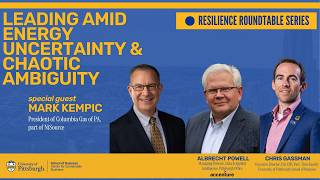
The session is a virtual executive roundtable hosted by Chris Gassman (University of Pittsburgh Center for Sustainable Business) with co‑host Albert Powell (Accenture) and guest Mark Kempick (President, Columbia Gas Pennsylvania; COO, NYSORRS). The conversation centers on the convergence of multiple, simultaneous energy disruptions – sharply rising electricity rates due to retiring coal plants, exploding demand from electrification and AI‑driven data centers, and political opposition to natural‑gas use. Kempick explains how natural gas remains a critical, lower‑carbon bridge fuel, but must be managed through integrated electric‑gas planning, distributed energy resources, and new gas‑centric technologies (hydrogen blending, renewable natural gas, gas‑fuel cells, linear generators). The panel discusses practical strategies for data‑center power (ring‑fencing existing customers, BYONCE – “bring your own renewable energy”, residential credit programs), affordability metrics (wallet‑share monitoring, pipe‑replacement ROI, methane‑leak reduction), and the challenges of capital‑intensive utility investment, stranded‑asset recovery, and regulatory/antitrust limits on collaboration. Participants also explore models for cross‑industry consortia, the role of renewables as a complementary portfolio element (including the need for thermal generation for black‑start capability), and the broader shift toward an energy‑revolution that blends technology, policy, and resilient business practices.
Chapters
All right, everyone. I'll give it a minute here for the digital doors to open as everybody starts trickling in. See the attendee number going up. We'll get started here in just a second. All right, that's looking like it's stabilizing out as folks are coming in from Zoom, or coming in from LinkedIn into Zoom. So we'll go ahead and get started here. Hello everyone, welcome to another edition of our monthly resilience roundtable. I'm Chris Gassman, the executive director for the Pitt Center for Sustainable Business and your host for today's session. The Resilience Roundtable is an executive forum where we bring together luminaries, executives, thought leaders from around the region, around the world to talk about and tackle some of the most compelling and impactful issues of our day. We focus on topics such as how humans and AI need to work together in the future, focused on energy transformation. And today we're going to be digging further into that, that energy conversation given disruptions of late that folks have been experiencing and thinking about it from the leadership perspective. So with me today is my co-host Albert Powell, Managing Director at Accenture, who leads their Pittsburgh office. He's also adjunct faculty and executive in residence and on the board for the School of Business here at Pitt. We also have our special guest today, Mark Kempick, President of Columbia Gas Pennsylvania and COO of NYSORRS, who brings an incredibly unique perspective on the energy sector. So really looking forward to getting into that, and this should be a fun and engaging discussion. Before we dive into the topic itself, just would be remiss if I didn't remark on those who helped make today's session possible. So I want to share that the Resilience Roundtable is sponsored by University of Pittsburgh Center for Sustainable Business, and where our mission is to partner with organizations to innovate and implement resilience strategies to overcome societal, technological, and environmental disruptions, right? So with how rapidly the world is changing, organizations need to be more ambidextrous. They need more resilience in the face of these changes, and The center offers a set of diagnostic tools to assess where those opportunities are, and a lot of executive development and cohorts in order to help people build up their skills on those fronts. So excited about working with the companies that we do on those fronts. Also sponsored by Accenture, one of the world's leading professional services companies helping businesses and Really loved the mission update. To deliver on the promise of technology and human ingenuity. So with services spanning strategy, consulting, technology, and operations, Accenture helps businesses thrive and reinvent themselves in the rapidly changing world while acting as responsible leaders. Their goal is to improve the way the world works and lives. So again, thank you to our organizational sponsors who help make this possible. On the note of organizations, as a reminder, the views expressed here today by the folks on the roundtable are the views of the speakers and their own points of view, not necessarily of their respective organizations. Okay, with that preamble, let's dig into our topic. Marco, I'll throw it over to you here. I know that we've been talking back and forth here in the lead-up to this a number of times. And first there was the stuff going on in Europe around energy disruptions. Then there was stuff in South America. Then there was stuff over in the Mediterranean, Central Asia. And while I was out of town down in Puerto Rico, which had 6 months of outages to be dealing with, and talking about the energy crises that they're experiencing there and the disruptions and how resilient organizations need to be there. Pittsburgh region and the Great Lakes had over a million customers facing disruptions from energy here just this past weekend, and some are still facing that. So hopefully folks are joining us from places that are safe. With all of that going on and trying to lead through any and all of those things and any number of other ones that we didn't touch on or I didn't mention, how are you finding this moment, Mark? What's catching your eye in terms of disruptions and how organizations need to lead through that?
So thanks, Chris. First off, I want to thank you for inviting me to participate today. It's really an honor to be on this podcast. So a little backstory first off before I jump into the issues. So I've been working in the utility industry for about 40 years, and I've seen a lot of ups and downs, a lot of disruptions in the utility industry. But the thing that we're faced with today is substantially different than what we've seen before, because in the past you might have seen one issue like a storm that you're talking about. You might have seen regulatory policy on one particular issue go up or down. But right now we're seeing some major life-changing events all happening simultaneously. It's really an equation with multiple variables that we all have to work through. So I'll give you a couple of examples of what we're faced with. First, you've seen it probably at home. All the viewers here have probably seen at home, electricity rates have been sharply increasing. Why? Because a lot of coal-fired power plants had reached the end of their useful lives and they haven't had enough replacement generation because of a lot of policy issues where they're asking, rightfully so, asking to be more environmentally conscious and directing people more towards solar and wind. But the bottom line is electricity prices have been increasing sharply because the supply has gone down. It's a simple economics— supply is reduced, Demand goes up and your prices will go up. In addition to the supply side being impacted negatively, the— in addition to all that reduced generating capacity, more electricity is needed. Everybody has their smartphones. Everybody's using a lot of electricity. There's a push for electrification across the United States, and that's even before you get to the data center electricity needs. So the demand side is increasing dramatically. I mean, just to put a statistic out there, one data center could use as much electricity as the city of Pittsburgh. So what took, what it took my friends over at Duquesne Light 120 years to produce, in 5 years they might be required to produce that same amount of electricity. So it's really a sea change on the electric generation side and the electric demand side. But then you add to that the third factor. There are a lot of states, not Pennsylvania, A lot of states are really opposed to the use of natural gas for environmental reasons. I'm a proponent of natural gas. I'm a true believer that it should be one of the tools in the toolbox, as we'll talk about today. But this further strains the electric side because natural gas is used for electric generation, and we believe natural gas should be continued to be used for electric generation, as well as for home heating and cooking purposes. But the bottom line is when you get these three, each of the three issues together, each of which is a major issue in and of itself, you have unprecedented risk and unprecedented issues to deal with. That's what we're going to talk about here today, how we lead through these major disruptors that are all happening at once.
Awesome. Thank— go ahead, Albrecht.
Yeah, I'm sorry, I got to ask, what— why are folks opposed to natural gas?
Yeah.
I mean, I thought that was actually one of the more environmentally friendly when you consider, you know, coal mining and nuclear, the pros and cons, everything. But that was surprising to me.
Yeah. Well, it is environmentally friendly when compared to coal, when compared to oil, when compared to a lot of the other fossil fuels. It still does emit NOx and SOx as well as carbon dioxide. And the methane itself is a greenhouse gas. So we've been taking a lot of efforts to make sure the gas stays in the pipeline, through accelerated leak repair, accelerated pipeline replacement to make sure that the gas gets to where it needs to be used in the customer's house or their business. But it is, to your point, much more environmentally friendly than coal or some of the other options. But everything does have an environmental impact. Even solar and wind. I think we talked before, I have an undergraduate degree in solar heating and cooling. Even solar heating and cooling, even wind power has environmental impacts. So the The point is you have to look at each option, do a cost-benefit analysis, and weigh your options and have a comprehensive solution so that people can be ensured of reliable and resilient service.
We've already got a number of bits throwing in here in the chat, so thank you to folks who are joining. Do go ahead, those joining us, feel free to continue introducing yourselves in the chat, and we do have the Q&A feature enabled for folks, so go ahead and throw those over there because helps us prioritize and address folks' questions in there. There is the upvote option for everybody to be able to address questions in there and for, again, audience to be able to engage on those questions as well. So one bit I know, Mark, that's often a conversation across energy movers, producers, is from the user side in there, that prosumer idea. Right? Like, can consumers also be their own producers, have distributed resources that can also help, right, with a lot of the volatility that a more centrally planned system might be experiencing? That might also help, again, with the disruptions that we were just talking about. What are— what are challenges that businesses need to think through in that? Like, yes, we can change policy landscape. So like, given within the policy landscape that we have, what are some things that— to think through on that distributed energy resources side?
So I'm frankly a huge fan of distributed energy resources. The challenge we have right now is really for 100 and some years, the electric and gas distribution companies have sort of risen up on their own. And we don't do a full integrated planning between electric companies and gas companies, or even frankly between electric companies and other electric companies. So I have been working with my counterparts over at FirstEnergy and Duquesne Light. Hopefully I'm allowed to use specific names of companies in there. And My goal would be to use a more integrated resource plan that spanned the electric and gas systems. I contend that there will be certain bottlenecks on the electric side. So instead of them spending a lot of money to put a, a large generator or to put more transmission lines or distribution lines, perhaps some of the newer gas technology, maybe a small combined cycle, or maybe a linear generator, or maybe a fuel cell, could be used instead of upgrading the electric side of things by installing new transmission or distribution. So I'm a huge fan of that, but frankly, it's just been a challenge because the way utilities are regulated is individually rather than comprehensively. We even see this on the generation side when it comes to, when it comes to the construction of new generation. It's an extremely capital-intensive process. And right now in Pennsylvania, electricity generation is not regulated, so it's left to the market forces to develop. So there's really no centralized planning per se on the electric generation. And I contend that's what led to some of the problems with generation not being built and the sharp price increases that we've seen.
Well, Albert, in your experience, because all that I keep hearing is the data center platforms themselves, or sorry, the AI platforms themselves, the Anthropics, the OpenAIs, they're like, hey, we need more data centers, we need more data centers, or the people utilizing them like, hey, I need data built out, I need to build a tool myself. How much, when folks are looking at the technology innovations that they're using to reinvent themselves, how much are folks thinking about energy proactively versus how much is it like, well, what do you mean that we're going to be offline or this is going to take 15 more months than we thought it was? Be like, what, when do I need to start becoming a chief energy officer on top of being a chief technology officer?
It's much more the latter than the former. So the demands— we'll separate the artificial intelligence, the data centers into one bucket, and then we'll go base— we'll start off though with the residential, commercial, and what I'll say the traditional industrial customers. They've enjoyed flipping a light switch and seeing the electricity flow or using electricity or natural gas for the process heat for so many decades that it has become sort of just an expectation, a reasonable expectation. Expectation. You always have electricity. Oh, you always have gas. The data centers come in, and again, they're asking for so much power. It's unprecedented. Even during the Industrial Revolution, you weren't seeing these large demands when we had steel mills being, being created. We're seeing something that we've never seen before on the electric side. And yes, that does impact the gas side as well. But what we have to do is we have to get education out there. We have to set expectations because you don't want people thinking that they can just call their electric company up and ask for 3 gigawatts and have it come to their doorstep in 6 months. It takes long planning and efforts must be taken to protect the residential, commercial, and existing industrial customers. Little ad for our sister company in Indiana. We've just done a, a deal that's public now. With a data center, what we've done is two things. Number one, we ring-fenced the existing customers so that they will not be negatively impacted by any increased cost associated with the data center coming on, because that is a very big concern in the marketplace. But in addition, the electric company, our sister electric company, offered a billion-dollar credit to residential customers that'll be flowed out over the upcoming 5 years or so. To their bills as part of this transaction with the data center. You'll see more of that, I think, across the country. I know there was an executive order from the federal government that talked about how data centers needed to bring their own energy. And they're even joking, they're going to call it BYONCE, Bring Your Own Renewable Energy, is the acronym that they're coming up with so that the data centers know that they have to bring their own energy to the particular state in which they want to operate.
Yeah, yeah. Just adding on to that, Mark and Chris, you know, what we're seeing is sort of from two perspectives. From the, you know, the large AI companies, they know very well what they're doing. They know that these data centers and the draw that they have on the energy grid, and, you know, I'll be honest, some are— everybody's out for, you know, their bottom line, right? Let's be frank. That's how companies seem to be rewarded today. But there's also, and some are just sort of plowing ahead, if you will. But we're also starting to see, as was in the news recently with what's happening with the Pentagon and AI, there's a public relations factor, I think, to this as well, because these companies have got competing technologies and frankly, they're all pretty good, right? They all do things a little bit differently, but these AI companies are all pretty good. Some are floating to the top as, you know, doing good or being more responsible. You know, others frankly may not be. So I think that that's something we're seeing from some of the big AI players is they're looking at energy, they're realizing the impact on the consumers, on the neighborhoods, on the environment, on the energy companies. And they're taking that into account and they're trying to do the right thing, right? They're trying to bring their own energy sources or at least augment it or at least offset it in a very public and frankly high-profile way. And I think they're going to win, frankly. Consumers, the consumer demand for this, they don't see it. The use and eyes that are on doing these AI chats, it's the light switch. You know, Mark, the internet, AI right now for an individual consumer, it is, it's a light switch. You expect it to be on and you don't really think about what it takes to get there. Mark, I had a question for you sort of around technology and how are you or how is the industry leveraging, you know, next-gen technologies, you know, such as AI? Because you're seeing it on both sides, right? You're there, a consumer of your services. But, you know, I think there's an opportunity for, you know, AI for Agentic to actually help improve operations, help satisfy customer needs, drive down costs, maybe predict reliability. What are you or what are you seeing in the industry to help where technology is helping drive what you do every day?
So there's two real sides to it. So number one are some of the emerging technologies in the gas industry and also on the electric side as well that are impacting our planning process. But then number two are some of the technologies inside the company that we use for planning purposes. So first on the technology side for the demand side. So there are new gas-using technologies, things like gas-powered heat pumps that get up to 150, 1-5-0% efficiency if you use renewable natural gas. There are new technologies around capturing biomass fuel, capturing gas from landfills that we are looking into so that we can actually take that energy out of the landfill, clean it up, put it in our pipes, and then serve customers at a lower greenhouse gas footprint than we can with using even relatively clean natural gas as it is. We're also experimenting right here in Pennsylvania in our operating center in Manaca, PA with the hydrogen blending. So what we're doing is we're blending up to 20% hydrogen with natural gas, and that further helps reduce the footprint. The question there was whether that's going to cause customers to change, change out their heating equipment because of the different properties of hydrogen, but we're not seeing it. We're seeing, and we have an operation set up where you can see up to 20% hydrogen blended with natural gas using regular old-fashioned existing residential appliances. Then we are also seeing things like gas fuel cells for commercial and industrial and even residential use that are giving customers a different option on how they can use natural gas. Beautiful thing about these fuel cells, no NOx, no SOx. They convert natural gas over to electricity using a chemical process, which I find fascinating. And the only byproduct is carbon dioxide. So the manufacturer of those claims that they're helping the force of America breathe their carbon dioxide. Also, new technology on the gas-consuming side that is of interest to electric companies are linear generators. Again, another company relocated its manufacturing to Pittsburgh because Pittsburgh is really the epicenter of energy in the United States. And they're going to make linear generators that combust gas at low temperatures. So you likewise don't have the NOx or SOx particulates and you have a very clean form of electricity generation. So lots of great, exciting things on the actual gas consumption side. On the gas planning side inside the company, while we don't use AI right now, we use a lot of software when we're planning our system, predictive analytics. We have a large data analytics department and it's necessary because we are focused on reliability and resilience, two slightly different things. But we're focused on making sure that every last penny of our customers' hard-earned money goes towards reducing the most risk we can reduce on the system. Little example of that is our system. Some of the bigger risks are things like leaking pipes. We have pipes in the system that have been providing natural gas service since maybe the 1930s. Now, these have really provided a lot of people with a lot of good service, but it's time to replace those. The question is, you can't replace them all at once. How do you figure out which one you need to replace? We put all of our data into some data analytics, maybe a little bit of AI goes in there every now and then, but it's basically just a risk calculation based upon that particular piece of pipe. We can determine when that pipe will likely fail, when it should be replaced. We obviously want to replace it before it fails. So the tools help us look at our investments from a risk reduction perspective and from a customer reliability perspective so that we can be assured that we don't spend any unnecessary money replacing something that still has life left into it. A lot of other tools on the planning side that we use as well to predict customers' future gas-consuming needs, as well as to help us contract for the right amount of gas to purchase for customers. But in a nutshell, that's really how technology is used.
Mark, how do you balance the dynamics of, you know, consumers want lower prices, right? You've got infrastructure repairs that, you know, to be honest, they're not sexy. It's like, you know, shoring up the foundation in your basement. And then, you know, like the hydrogen adds, I mean, there's got to be a huge R&D cost associated with that. How do you, how do you find the balance between those and how do you, how do you help consumers understand that? Because, you know, if I think about a house, I want the new super duper showerhead that's got the, you know, all the water coming at you from 17 directions, but I don't have the pipes to fix it. Yeah. Fixing the pipes actually has a bigger return because that's going to enable me to do all these things, but it's not cool and fun.
Right. And so you hit on a major, major disruptor that's going on right now, and that is the affordability issue. It started on the electric side and now it's coming, you know, to the gas side as well. The challenge with that is what's affordable to you might not be affordable to me or vice versa. So nobody's really in true agreement with what the definition of affordability is, but it's something that we all need to tackle. From Columbia's perspective, we have been replacing a lot of pipe and it is outrageously expensive to replace pipe. So yes, we have increased our gas distribution costs a lot over the past 15 years that we've been aggressively replacing pipe. But what we look at every year is what portion of the customer's wallet is consumed paying their overall gas bill. So the interesting thing is, over the past 15 years, two things have happened. Number one, because Pennsylvania is producing so much natural gas, the wellhead price of the actual gas commodity has dropped dramatically. That provided us with an opportunity to replace a lot more pipe without increasing the customer's total bill because the total bill is made up of both the gas commodity portion as well as the distribution portion that we provide. In addition to lower wellhead prices, we've also seen that the energy efficiency has been improving dramatically on furnaces, ranges, just everything. So that our customers' consumption, even if they don't modify their behavior, has dropped from about 132,000 cubic feet a year down to about 80,000 cubic— MCF a year, or 80,000 cubic feet a year. So it's dropped down a lot. Collectively, these two things have come together. And so that we look back over 20 years ago, And our customers today, even after we've invested billions and billions of dollars into our system, customers today are paying the same portion of their wallet share that they were paying 20 years ago. So that's one of the things that we're constantly looking out for is whether customers are paying, after you adjust for inflation, the same rate that they always have been paying. And for us, it's true. They are. Other things, bread, ground meat, I can't talk to those. Can't talk to those because those have risen a lot more than inflation. And now with what we're seeing with world geopolitical issues, gasoline is really skyrocketing. And, you know, we're not tied to the gasoline rates, but it's all at a certain level interrelated. So prices are going up. But our goal is to make sure that we stay within the same wallet share that the customers have experienced historically.
So I'll just take a little PSA moment. We've had a number of good Q&A questions coming in through the Q&A feature, so we just encourage participants to continue using that. I think on the technology front, one that we might be able to draw from there, Mark and Albert, would be something from a bit more of an international experience. So looking also around the world, we don't need to have to reinvent our energy endeavors. Data centers in places like Finland are required to reuse the heat that they generate, right, to share that what is a byproduct of their process out and heat the neighboring community. And so far here in the US, we're focused more on like, hey, how much water can we bring in to cool that and compound that process in that way rather than sharing out the heat as a Heating as Service for anybody that might be around a data center. As folks that move molecules and are familiar with that kind of heating space and heating challenge of customers, whether they're residential or commercial, is there anything like that from a microgrid or anything else like that that we should be thinking differently around how we partner with data centers as they build out and the kind of energy they're using or the kind of thermal energy they might be producing?
Yeah.
Chris?
Oh yeah, sorry, go ahead, Albert.
I can start on that just from some real experiences and then Mark, would love to hear your thoughts. One of the things that, that we're going to go back to the term sustainability, right? Which, you know, has some interesting connotations right now of what's going on in Washington. But so many companies are starting to, or have been and are continuing to look at sustainable initiatives not as, you know, good for the environment, which it is, not as, you know, good for the planet, which it is, but actually as a return on investment. And like, there's a company here in Pittsburgh called Pitt Ohio, and we went out and we toured them. And, you know, they've put up, they've gone all in on sustainable. They've got their own, you know, wind turbines on campus. They've turned over to all natural gas. Fork trucks, they, waterless toilets, you know, recycled furniture in the buildings. And that's all goodness, right? And they market that as goodness. But what they've been able to do is reduce their costs.
Yeah.
In year 1, in year 2. Yeah. No, it's more expensive, right? Because they've got to build all this infrastructure and stuff. But over 10 years, their energy costs are down, their consumables costs are down, their, the health of their employees has risen. The satisfaction of employees has risen, right? So I, I think what we're going to see is the same thing around like data centers, right? Right now it's all about bringing the water in to cool these things. They're going to realize like it's expensive and we have to fight with the, you know, the, the, the, the regulatory bodies that are, you know, managing water flow in the rivers and, and, and usage and things like that, especially in drought areas. So I think, I think we're coming, I think there's a huge opportunity for these folks to sit and start looking at that and saying, just like they're doing in Finland. How do we start recapturing this heat? How do we use that to heat our buildings? How do we use that to generate electricity or energy or drive turbines or things? But I think that's all coming, right? And that's a huge business opportunity.
Yep. Yeah. One person's waste is another person's treasure, right? So.
Yep.
Exactly. I could just add on to that and then respond at the same time to one of the questions in the group chat. So first off, you know, I think it's a great idea. This is what I was referring to with like my efforts to try to start spreading inter-utility planning, that concept, to more companies, because I think ultimately you need to do that. Yes, there are a lot of regulatory concerns with that. Yes, there are even antitrust concerns with doing that. But, you know, I, you know, we need to start down that path. They might not have those in Finland, those same types of state regulatory regulatory or antitrust concerns, but we need to really address that because I think that's where you're going to unlock the greatest value across the entire supply chain. But responding to the question in the chat about, does methane leak detection and mitigation investments have a standalone ROI? Yes. As an example there, we started on an aggressive methane detection, leak repair, and pipeline replacement program in 2007. Since that time, we've reduced the number of methane leaks by about 70 to 75%. That means we don't have to go out and repair the leaks. That means we don't have to expend the money to, uh, dig up the ground, fix the leak, pave over it. So yes, there is a return on investment in addition to the sustainability of not allowing that methane to emit into the atmosphere. So without a doubt, it's a good observation. There is an ROI.
On that. Yeah, it's just lost product, right? So at the end of the day, you want that to make it to the customer for their use. One related question that we had in there from an energy perspective was— I think, Mark, you'd started to talk about this a little bit from the hydrogen perspective, and Albrecht, from new technologies and people's willingness to adopt the new thing. You know, there's still a lot, at least here in the Pennsylvania region, right? We're getting a lot of our geologic gas from fracking, right? From hydraulic fracturing. And that tends to have a lot of its own resource use. So from a business perspective, but also a community impact, community health, what have you. How soon are we to see a migration to a hydrogen-fueled economy, right? Or what are some things, whether or not we're putting percentages or year turns on those, what are some robust actions that we could be taking that say, hey, this, if we take these steps, that sets us up for a hydrogen future economy. And if, even if we don't make it there soon, it's still better than where we are right now. What are some of those kind of like leadership thinking on there?
So we were really, as an industry and as a country, moving very quickly towards a more hydrogen-based economy. We had the hydrogen hubs where there's a lot of activity on that. Till about a year and a half or 2 years ago. And there was a change in the federal administration, as everybody knows, and hydrogen was not viewed as a panacea, but as a very expensive alternative. It is expensive. There's no doubt about it, but it does come with some benefits. So I would say that we're stalled. In fact, our pilot program— I mean, we've reached a point with our pilot program where we've identified that there are no major impediments from a mechanical, you know, customer appliance perspective that will prevent it. But right now it's the economics because there's just not enough federal support for that fledgling industry to get it over the hump and to make it more mainstream. We haven't given up on that. We haven't given up on renewable natural gas either. All those options, I think once we get past this initial thrust, they become much more commonplace. The cost of producing them will go down dramatically. Just any other technology, it's always the same. You start off with the new technology, it's going to be expensive, but then as it becomes more widely adopted, the use of it drives the price down.
Yeah.
Mark, we, we, we talked You talked earlier a little bit about, and that's exciting to see some of these new technologies. I want to go back for a minute to something you said earlier around disruptions. And what do you sense is the greatest disruptor or the top 2 or 3 that you're having to deal with in the business and industry? You know, I think about things like, you know, regulatory affairs. Aging infrastructure and having to deal with that, weather, geopolitical events, you know, me digging up for a tree in the backyard and hitting a pipe. And, you know, that just happened in our neighborhood not too long ago. Like, how do you categorize those and what are the ones that are most impactful to you and the industry?
Yeah, that's a lot there. I mean, starting off with the little PSA, call 811 before you dig, even if it's for a mailbox. The number one cause of gas-related incidents, and by incidents I mean fires, major gas leaks, worse, houses exploding, is because people fail to call 811 and they dig through a gas line and gas goes into a house and the house catches on fire. So please call 811. But that's not a major disruptor. It's big. It's our biggest risk that the gas industry as a whole across the United States faces. But that's not the biggest disruptor because that's something we've been dealing with for 50, 60, 80 years. There's more focus on it now. So we've really reduced that risk. But it is still something that people need to know. They have to call 811. Probably the bigger issue is, uh, the bigger disruptor for my particular sister company in another operating state is the focus on electrification without regard to the impact on the environment or the impact on a customer's costs. So again, I'm a true believer in an all of the above, or stated another way, using every tool in the toolbox. I'm old enough to remember the reduce, reuse, recycle. And as you mentioned, Pitt, Ohio does a great job with that. I do that in my family life as well. But other Policymakers don't often agree with that so much that they can take things to logical— illogical extremes. For instance, instead of using new gas technology like a fuel cell, they would prohibit the onsite use of a fuel cell and instead require a business to get electricity from the PJM grid which is 40% driven by natural gas, and it's also driven or generated by some coal generation that's still in PJM. And yes, there's solar and there's wind, but the majority is really driven by natural gas and frankly some nuclear. My point is carbon molecules don't stop at state lines. So just like when it comes to planning has to go horizontally and you have to basically include things like waste heat, things like electric and gas convergence. You have to look at all those things. The state policy should look more regionally. How we do that on a state-by-state basis, I don't know yet, but we have to look broader because the reality is carbon molecules do not stop at the state line. So it's better to use something on site that will only produce carbon dioxide than it would be to produce— to import electricity that is generated potentially by coal or some other less friendly source of generation. I haven't even begun to talk about the line losses associated with generating electricity from far distances, but that's another efficiency that you have to look at when you're determining whether you want to generate electricity on site using new technology versus using traditional PJM grid electricity. So loaded question. There's a lot going on there.
Yeah, that's great. Thank you.
Well, you guys are teeing up a lot of different places where we could go with this. The— trying to think about, you know, those disruptions in there. I'd be curious Mark, to the extent that you're thinking around stranded assets, right, especially as a publicly owned company, you know, those are things that, you know, come up in investor conversations, what have you. So it may not necessarily be like, how does Columbia Gas think about it? Just in your experience, again, like navigating in the energy space, what are those, how do you navigate, how do you lead through of, Hey, I need to generate returns, but it also takes investing in physical assets in the first place so that I can have a business that creates returns and navigating the uncertainty of what kind of energy are people going to need going forward and how do I make the case to make those kinds of investments?
Yeah, that's a very complicated question. I will do my best to distill it to a short time. So start off with electric and gas companies all have an obligation to serve customers.
Mm-hmm.
Point number 2 is electric and gas companies are some of the most capital-intensive industries on the face of the earth. On the gas side of things, it's easily $1 to $2 million per mile of pipe to install. So the fact that you are capital-intensive and that your, your requirements are a lot and you have the obligation to serve customers, you have to ensure that every investment you make is necessary for the safe, reliable service to those customers. You can't overinvest because it could be stranded, as you're saying. You could not get recovered for it. And you definitely do not want to underinvest because you would not be meeting your state obligation to provide safe and reliable service to customers. So this is what I was talking earlier about planning. We do our planning on a risk basis to make sure that our customers will always have gas. I'm very pleased to say the gas system, because it's underground, is very resilient. And because it's not subject to the same weather impacts as the electric overlying, uh, power cables are, we go through events like this past week without any outages. Now, we do have outages. I think the stat is basically 1 out of 115 customers a year can expect to be out of service on the gas side. For electric customers, I believe the stat— I'm not criticizing electric company, they have different challenges— I think it's 1 in 1. It's a much different metric. So, and electrical outages, again, because their wires are exposed, they will have more outages. But both the electric and gas companies do have to plan so that customers can be assured high reliability when they flip that switch and a high resilience that they will, they will survive through storms and through other natural, natural impacts. Now, when it comes to stranded costs, The state regulatory commissions have long had a compact with regulated utilities, and they basically said, because you, you are given this opportunity to provide service to customers, but you also have the concurrent obligation to serve those customers, we will give you an opportunity to earn a fair rate of return and recovery of the cost associated with those customers. They do this sometimes over a 55-year basis. But even after certain assets have been retired, certain states have methodologies for allowing the investors to recover a reasonable amount of money that was deemed necessary to continue to provide service to those customers. So for instance, 12 years ago, when Pennsylvania went towards unregulated generation, Utilities had invested billions of dollars across the state on electric generation, but the state law that required customer electric choice had a provision in that permitted recovery of those stranded costs that were deemed non-economic because we went to a market-based, market-based perspective. So there are regulatory tools and there are regulatory cases out there that say that utilities should continue to plan Plan reasonably, obviously. You need to support your obligation to serve. You need to make sure that you're providing safe service, but you can't overinvest because that would not be within the regulatory compact.
Sure.
So, Albert, I'd be curious from your experience in different sectors, especially since you've worked on federal contracts or other public sector contracts and engagements. The challenge that Mark mentioned around antitrust, right, collaborating with your competition. So like, you know, there's going to be lots of red line that you don't want to get into. All right. There's a swim lane you want to stay within. What have been some successful models that you've seen leaders take when there is a need from the customer for the industry to coordinate with each other, to collaborate with each other, but not for it to be like, oh, we're going to collude and price fix and what have you. What are some possible ways that you've seen industries look at reinventing themselves and doing that in an above-board way? Like, who do you need to get at the table? How do you— how do teams lead those kinds of conversations? Because a lot of what Mark has been teeing up is like, we need to reinvent this, but like, it's not just one utility needing to reinvent things.
Yeah, I got to thank you, Chris, for the reinvention plugs here. You've been a great support. Because we just rolled out our new moniker of Reinvent Invention Services. So appreciate that. No, look, antitrust collusion is something that, you know, we all have to think about. But there's also the ability to do common good. And I use two examples. One is in the pharma industry. You know, we all know that in pharmaceuticals, the time and money it takes to develop a molecule for our next blockbuster drug is staggering, right? It's what leads to the high cost of drugs. And that's another discussion for maybe another roundtable at another time. But one of the things that has happened is all of the major pharma companies have come together in a level of partnership with a company called BioXcellerate. And what they do is they take data, research data, from many of the different pharma companies, bring them in. The data is generally anonymized, and they bring the data together and they do good things with them. So maybe 3 companies are doing similar molecule research. They bring them together, they're able to advance that by years, right? By bringing different together and then get that data back out to everyone. Does that mean maybe there's a bigger competition for a drug because 2 companies now come up with at the same time? Maybe. Does that get that drug to market 5 years faster? Yes. Does that now allow them both to get profits? Maybe not as much as 5 years from now if they did it by themselves, but get profits faster? Yes. Right? So we're starting to see more, call them consortiums, calling, call it, you know, organizations coming together to try and drive good across an industry. And another one example is in aerospace and defense. I help run an aerospace and defense roundtable with all of the largest A&D companies. So think Lockheed, Boeing, Raytheon, L3Harris, and several others. And we bring them together to talk about things like data and analytics is one of the areas that I obviously focus on. And what are the best practices? How are we using AI? How are we using AI responsibly? How are we, you know, aligning that with the Pentagon's directives around responsible use of data and so forth? And everybody comes together. It's an agreement not to collude, not share any, you know, confidential information. But we've been able to come up with some very impactful ways to help defend our country with this roundtable concept by sharing some of the knowledge, insights, and best practices that we all have. So I think that's happening in different industries, but those are just two that have been very effective.
Nice. Mark, I'd be curious from your experience, how much do those kinds of venues already exist? In my experience and from what I've heard from other folks in the space, if you go and ask your ABC utility, "Hey, I would like to try and do this new innovative thing. Could you help me do this?" most utilities say, "We'd love to help you, Chris. We're constrained by what the PUC has allowed us to be able to do. Sorry, we can't help you." You go to the PUC and say, "Hey, I'd love to do this innovative thing." "You know, I'd love to help you with that. We're constrained by what the legislators have ordained that we do." You go to the legislature, they say, "Hey, I'd love to do that. I don't know what the companies are able to do, so I don't want to get out over their skis." And those are just, you know, 3 examples, let alone, again, investor or other types of stakeholder concerns that might be in there, right? So whether it's, you know, a movement towards— and I think you mentioned earlier the idea around integrated energy system management or integrated resource planning. That's one model that's out there. Like, what are other venues? What are our ways that are viable, or is this just a conversation that isn't happening amid the energy organizations and needs to happen?
So when Aubrey was talking, it reminded me of two old, old, old quotes. Number one is that communication is the currency of a corporation, and I think you can expand that quote out to say it's the currency of the community, right? And we do need to have more effective communication on those very issues that you described. We've run into this ourselves where my legal rights as a company that's established by the legislature, so to speak, a public utility is defined by a statute in Pennsylvania. I cannot sell electricity if I wanted to. I cannot generate electricity I can only do what's expressly permitted by the state law, and that law varies slightly in every one of the states. So when it comes to geothermal, it comes to those types of really cool things, have to get a law changed. How do you get a law changed? Education as well as communication. And it takes a very long time. So we need to continue those discussions. Those discussions are happening, but With anything with legislation, it does take a long, long time. So, so we are working on those and I'm blocking now. I had a second quote that I wanted to share with you and I'm blocking it. It'll come to me in a second. But we need to continue to have the discussions as we move forward because it's only with those types of discussions that are happening now just not ramped up enough that we'll get to the point we need to get to.
Sure.
I know we're getting close to end of time, so not done quite yet, but just plugs for folks. If you haven't yet thrown your questions into the Q&A, by all means do. We have an active one. I'll endeavor to continue. If you see questions in there that you would prefer to get answered, we try and prioritize the ones that have been upvoted. So go ahead and encourage folks to check those out. And thank you to Dr. DeMarco and Chris Ramadan for throwing in a lot of very good pointed questions, and also Alex in there as well. But, you know, one thing in there, the one question that was in there earlier was to what extent might we be disrupting ourselves from an energy perspective, right? And if we are getting better at exporting LNG, And if energy is a commodity market, if gas is a commodity market, what is what we're putting into the global ecosystem? How is that putting pressure on domestic energy prices for domestic customers? I know that's not exactly the business that you are in, Mark, or Albrecht, but just from the extent that each of you work in spaces tuned into what's going on on the global scene. That was one question that folks had, just thinking around, hey, Pennsylvania is active in the LNG space. How much of that— how much are we shooting ourselves in the feet by sending more gas elsewhere? We're making it more expensive domestically.
Yeah, I guess I'll start off there. First off, as you well pointed out, my company is in the distribution business. We're not in the fracking business. We don't even transport gas across state lines. So just wanted to clarify that for the record there. Having said that, I'm really impressed with the state of Pennsylvania that went from basically, I think, the 10th largest gas producer years ago to now the second largest gas producer. I might have a different perspective than you do. I think that what's happening, what happened in Venezuela, what's happening in Iran, Iraq, I think it reflects the fact that we're in a global economy. And so I would be hesitant to put any artificial limits on natural gas exports. We have seen a little bit of an increase, but that increase does not necessarily translate to higher bills for customers because most utilities like Columbia, Pennsylvania, have gas hedging programs under which we purchase gas at predetermined increments to keep volatility out of the gas prices. We also have a lot of storage in Pennsylvania. Where we buy gas in the summer when it's cheap, then give it to customers in the winter when it's traditionally more expensive on the market. Or in instances like this where you see a temporary spike, we take gas out of storage and give it to customers. So the market in Pennsylvania, I think, is solid. We haven't seen a resurgence of people going back to drilling like we did in 2007, 2008. Maybe the international conflicts might cause more of that. Again, haven't seen that yet, but that's a likely potential outcome of what's happening.
Albert, if there are any questions that you see in the chat, by all means, or in the Q&A, I want to make sure that we give space to address any one of them. One that did come up in there about advocating for innovation. I know that, Mark, you and I have had a number of conversations around like, hey, what kind of groups can we bring together of executives to help foster more of those conversations, bring in the legislatures, bring in the regulators in there as well. So if folks are interested in engaging on those, we will be having an executive roundtable here on campus coming up here on April 15th. Some of the folks in the chat, in the audience with us, will also be joining there as well. So excited for that conversation. But anything else, Albert, from the Q&A in there? I mean, there are lots of different questions in there that we could address in there. I'm curious where any of the rest of them were. Mark, for your side, any last question that you want to make sure that we address in there?
No, I think the last one might be, and Mark, maybe you can close out on this. I mean, obviously there's a big push for renewables, right? And you can't fault that, right? You know, the stuff under the ground, you know, eventually it's going to run out. But I think we've got a long time to go there. What is, you know, with battery technology advancing, with, you know, solar seeming to be somewhat viable, windmills being viable, you said at the beginning that they've all got challenges, right? They've all got environmental impacts. There's cost impacts. The cost to make a lithium battery is, you know, the impact is pretty severe. What do you see? And maybe you can put some closing thoughts around this and then Chris and I can close out. But what do you see as the impact of renewables? Do you view that as a competitor in the industry? Do you view that as a collaboration? It's got to be tough in the role that you play.
Yeah, I'm a huge fan of renewables. As I said earlier, I was back— I grew up in the reduce, reuse, recycle. My parents had me wear sweat clothes in the house because they turned the gas thermostat down to about 64 degrees all the time. So I grew up and I live, and like I said, I have a degree in solar heating and cooling. I am a true believer in all the above strategy that includes renewables so much that we actually went to the Pennsylvania Commission and asked for and got approval to offer residential energy efficiency programs to customers so that we can help especially those low-income customers insulate their homes to drastically reduce the amount of gas that they use, to upgrade their appliances so that they have higher efficiency appliances when they might not be able to afford it. And we've expanded this program to include non-low-income residential customers as well so that they too can reduce their consumption. So a lot of it, again, goes towards looking at things holistically. I'm a huge fan of renewables. When we talk about resiliency, though, we talk about the electric side of things. One thing I didn't mention, but I think Chris might have mentioned, alluded to this, without trying to speak too much on the electric side, and Chris can probably correct me if I'm wrong, we need black start capability. So when we have an outage on the grid, like we did this weekend in certain parts of Pittsburgh, or God forbid, when we had the big outage in 2000, I think it was '03 with FirstEnergy. You need thermal generation, i.e., nuclear, natural gas, oil, coal to be able to kickstart the grid so that you can get it up and running. Renewables alone can't do that. They need that thermal generation. So it has to be a partnership. It has to be a portfolio of generating assets in order to provide that resiliency and the ability to bring the system back on quickly after an outage, you need to have a truly all the tools in the toolbox approach, meaning natural gas generation at a certain point. Again, having said that, I'm a true believer in using natural gas sparingly and making sure that you get every last piece of value out of every molecule of natural gas that you use. That's why we're big proponents of energy efficiency programs.
Mark, thank you. This was, I think, one of the most informative and insightful and impactful roundtables that we've had. And I know I've got a new appreciation for energy and natural gas and what you all do to keep, you know, my family warm, especially all the disruptions, you know, geopolitical and regulatory and consumer demands. And I'm really excited about some of the new advancements that we've heard. From you today. So it almost seems like we always talk about the technology revolution, which is certainly real, but I think we're at the cusp of an energy revolution as well.
We are.
You've shared tremendous insights on that. You know, Chris, one of the things you and I talk a lot about is in this ever-changing and dynamic world, businesses have got to be more nimble and resilient. How we deal with technology, how we deal with geopolitical, how we increase customer demands and so forth. And, you know, Mark, you shared a lot about how you're doing that and how the energy industry is addressing that. So I think that fits right in, you know, Chris, with what you and I both do every day. I mean, we do this reinvention thing and trying to help companies reinvent together, help them stand out and be more nimble and change. And so do you at the Center for Sustainable Business or Operational Resilience. Do you want to close out with just a few of your thoughts and maybe just a minute about what all the center does?
Yep, can do. All right, well, thank you, Albrecht, for that. And Mark, thank you for the conversation. This is really honed in on the kinds of societal-level disruptions that we work on here that have been teed up from our work on the Road Framework. We're excited about— we've talked about AI, the AI-powered platform and research that we've been doing on organizations and their resilience capability from that. We've also had a lot of conversations of late with different organizations around helping them upskill their people to think more effectively through these disrupted times, because that needs different leadership and different thinking and different analytical abilities than a classic SWOT analysis or otherwise might be able to provide. So whether it's from the research that we've done around ROAD, the executive development programs, or advisory services, or the community of practice like the Sustainable Business Commons, forum coming up on April 2nd. Folks have been really engaging with us around resilience of late, and we're excited about that. If folks have really enjoyed today's conversation, by all means let us know. We'd be more than happy to organize future discussions with you all. Please reach out to Mark, myself, Albrecht, and otherwise join us here at the Center for the next occasion, which again will be the forum happening April 2nd. If you need info for that, we'll make sure to send it out as part of the follow-up. But otherwise, thank you all, and we look forward to seeing you at the next resilience roundtable. See you. Thank you. Thanks, everybody.
More from Chris

Hybrid Intelligence - Integrating human and artificial intelligence for Strategic Advantage