Resilience Roundtable: AI & the Future of Education
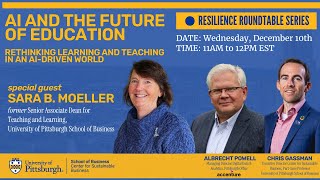
The Resilience Roundtable hosted by Chris Gassman (Pitt Center for Sustainable Business) brought together co‑host Albert Kahl (Accenture) and guest Sarah Moeller (former Senior Associate Dean, University of Pittsburgh School of Business) to explore how artificial intelligence is reshaping education. The conversation began with excitement about AI as an efficiency tool that can free up time for deeper learning and knowledge creation. Participants highlighted the promise of tailored, personalized learning and experiential projects that let students apply concepts in real‑world contexts. Concerns were raised about conflating information with knowledge, over‑reliance on AI, hallucinations, and loss of critical thinking. The panel debated the evolving role of faculty, academic freedom, and how AI should be a partner rather than a replacement, emphasizing the need to teach students how to learn and to evaluate AI outputs. They discussed the rapidly expanding AI tool ecosystem, the importance of accountability, and the ethical guardrails needed for corporate and academic use. The discussion moved to the future of higher‑education models, contrasting brick‑and‑mortar experiences with online/AI‑driven pathways, the impact on graduate education, and the business model of universities, including cost‑saving potentials and market segmentation. Lifelong learning and the role of universities in curating trustworthy AI tools were highlighted. Finally, Gassman described the Pitt Center for Sustainable Business’s diagnostic, executive development, advisory, and community‑of‑practice services that help organizations build resilience and reinvent in the face of AI, energy transition, and other disruptions.
Chapters
Hi all. Welcome to the round table. We're going to give it just a few seconds here to let the digital door open and let everybody join through the webinar. Today we see the attendee count creeping up. Let's stabilize this here in a few seconds. Right, looks like we are good to go. Start this off with a brief little welcome. Thank you everybody for joining today. Hi everyone. Welcome to another edition of our monthly Resilience Roundtable. I'm Chris Gassman, Executive Director for the Pitt center for Sustainable Business and your host for today's session. The Resilience Roundtable is an executive forum where we bring together different luminaries executives to talk about and tackle some of the most compelling and most impactful issues of the day. We very importantly disagree agreeably, right? This is a conversation space. Having candid discussions about conversations aren't happening elsewhere. We focused previously on topics such as how humans and AI need to work together in the future. We've also tackled energy transition and today we have an incredible and exciting, very relevant session on how AI will impact the world of education, both learning and teaching. With me today is my co host Albert Kahl, Managing Director at Accenture, who helps lead their AI and data practice. He's also an adjunct faculty with us here and executive in residence here at Pitt and on the board of the Pitt center for Responsible Data Science. We also are continuing our trial tradition of having past luminary leaders. So our special guest joining us today, Sarah Moeller, who is the former Senior Associate Dean at the University of Pittsburgh School of Business. So we should have a fun and engaging conversation on this. Before we jump into the topic itself. Just wanted to share that the Resilience Roundtable is sponsored by by one University of Pittsburgh School of Business center for Sustainable Business. So we're our purpose, our reason for being right is to partner with organizations to help them innovate and implement resilience strategies to overcome these market level, societal, technological, environmental, economic disruptions that people are increasingly experiencing and with how rapidly the world is changing. Organizations need to be more ambidextrous to thrive through disruptions. So the center offers a set of diagnostic tools as well as helping your organization assess, identify and prioritize your efforts in order to develop a roadmap to greater resilience, whether that's through a series of executive development programs or others to help equip leaders to embrace disruptions as opportunities. This Roundtable is also sponsored by Accenture so, one of the world's leading professional services companies helping businesses to deliver on the promise of technology and human ingenuity. Services spanning strategy, consulting, technology and operations. Accenture helps businesses thrive and reinvent themselves in a rapidly changing world where thing is responsible while acting as responsible leaders. And the goal here is to improve the way that the world works and lives. So all that said, just as a reminder, the point of views expressed here today in today's roundtable, to keep it candid, and we take this for you all in the chats as well, that these are the points of views of the speakers and not necessarily the points of views of the organizations that they might be working with. All right, with all of that said, time for us to dive into today's topic. So education has always been about preparing people for the future, but now it's what the future looks like is changing significantly and rapidly in ways that really aren't predictable. Right. So Sarah, let's start with you. When you think about AI, assistive intelligence, artificial intelligence in education, what's the first thing that excites or worries you?
Well, I'm always going to start with the exciting part because to me that's what this technology is. So one thanks everyone for joining and thanks for hosting and sponsoring to the host and sponsors. To me, it's not necessarily what you would think. It's if AI effectively. Right. It's an efficiency tool. So we're going to get more done quicker. And whether that's quicker or with less resources, to me the exciting part is what are we going to do with with the spare time and the spare resources? From an education perspective, is it about educating more people? Is it about bringing the level of education higher? Is it about using education more on a day to day basis? As a university, our job is knowledge creation and knowledge dissemination. Does it also mean that we can now create more knowledge? Right. And do that faster? So it's really about what are we going to do in the vacant space?
Sarah, I love that dovetailing off that. I think this is a game changer. I think this is going to completely reinvent how we learn and what learning looks like, the faculty, the students. What gets me most excited is this concept of tailored learning. Because I think, you know, you think in the classroom, back when I was in undergrad and grad school, you're sitting in a room of whether it's 30 people or 300 people, it's the same content. Now we're able to actually go in and tailor that learning to an individual person with their unique talents, their skills. Maybe they're gifted, maybe they've got some challenges but we can help them learn faster and more effectively. The other thing is there's been some studies showing that what typically might fit into like a six or seven hour elementary classroom with tailored learning, we can cut that down to like in half, two or three hours. So as you said, what do you do with the rest of that? Boy, talk about like experiential learning opportunities. A good friend of mine, their daughter's in fourth grade and they're doing this type of unique pilot tailored learning and they're spending that other three or four hours in the classroom learning about business. Fourth grade, the challenge was start a business. So his daughter came out and says, I want to do a lemonade stand. She's talking about target markets and customer profiles and inventory and customer needs. And it's like, like this is a fourth grader and, and they're figuring out how to do this and they set up this little business and, and they actually made like $2,000 on a weekend because they thought about how to set up their lemonade stand. I did it out at the end of my driveway and got like, you know, 15 bucks. So it's an exciting world and like so much is going to change here.
Maybe you just said the wrong spokesperson for your product there, Albert. So, so along with that. So I love the idea of sort of how do you tailor. Right. That's the efficiency argument. When I think through professional athletes, they get their blood drawn and they have vitamins tailored to their blood. So effectively they're really getting to the cutting edge. So along those lines, I think with experiential learning, I think the great thing is it drives knowledge home and it lets you sort of get your hands dirty. It makes knowledge stick and you also see why to apply it. So it's not just something that you read in a book and then five years later you're like, oh, you know what, that book thing might have made a difference in my last decision making. Right? So it allows you to apply knowledge. So it's not just learning for learning sakes, it's learning to apply knowledge. The second thing I would go to is it's, it's going to tag onto the very first question you asked me about what worries me about AI. What worries me about AI is that we will stop with the, the quiet moments and the pondering. We will confuse information with knowledge. Right? Because we could argue that the Internet has created a great access to information. Do we think that we are more knowledgeable today because of the Internet or do we just have more information? So I Think the important thing that education leads into is a cutting edge, is trying to help to train people. And that goes all the way from, you know, kindergarten or pre kindergarten, all the way up through graduate programs and then continue in education. So it's. How do we delineate between sort of information and knowledge? Because right now it's going to. I mean, information is going to look like knowledge because I wants to make us happy and make us feel smart. Right. So we have to know that.
But Sarah, do you think, like, I go back in my lifetime, I mean, I took differential equations a couple of times, do I still need to know how to do that by hand? Right. Do I still need to know how to do long division? Do I need to know how to read a map? I mean, I use gps. Even when GPS first came out, I still had my maps in the car, and I've gone away from that. So, you know, what do you think? Are we going to rely too much on this? I worry about that too. Right. Especially with some of the hallucinations and not having the critical thought to know when something comes back, is it right or not? But, gosh, is it an impactful tool? And it's a game changer for how we do things?
It's amazing. So. So one of the things about so I have. I have. I unfortunately or fortunately have four college degrees. I've been lucky enough to be able to do that. And only my last degree made me extremely confident and comfortable because what the last degree allowed me to do was I spent five years studying finance. I have three other degrees in finance. I spent five years. But what happened during that time of study is that the problems became simple to me, not the solution. Solutions are always difficult. But what happened is in that time that I spent, I got to really understand that you could simplify things down. My concern to your point is the more we have this information in front of us, is it just going to add to angst? How do we manage that mental concept of we have so much information out there? How do we do that? I used to sell food to the Caribbean islands and we would bring people to the US and we'd walk into a US Grocery store and they would just be overloaded like they couldn't believe there was an entire aisle of cereal. And they would sort of short circuit because that made no sense to them. And this is sort of the example I get. So how do we help students think through the access to all of the information and then the utilization of it? That's where that tough thing Is.
Yeah. Sarah, what do you think about the fact that for instructors and faculty and you and I and Chris, we all teach? I'm finding now that back in the day, if you were the Nobel laureate, you were the coveted professor. Now I feel like we still need that. But somebody that's really engaging, really dynamic, that's gone and done a whole bunch of research on the generative AI, can get content and convey that maybe even more effectively. So, you know, I ponder about, I think experience is still really important, the life lessons that we have. And I know when I'm in the classroom, that's what I share and that's what students love. It's like, give me the textbook. Fine, I'll read that on my own. But tell me how to apply this. Tell me about your experiences with this. What are the bear traps that are out there? But I wonder if this is going to change how our faculty, who our faculty is and how our faculty teaches.
It absolutely has to change how we teach. I think as we move through the next generation, I think it will also change who teaches. We don't move that fast in moving people. It'll definitely change how we teach. And we have faculty that are adopting it in all different ways. Some say absolutely no. You can't use it in this class. You can't use it on this.
Really? Really.
Some say absolutely no. So, for instance, so again, I'm in finance. I need you to have done the math a few times so that you can tell when the math is wrong. I need to develop intuition, right. Without intuition, this information never coalesces to knowledge. And it becomes even more dangerous because now I don't know. For instance, there was the trading gaff that happened when somebody put in the decimal point in the wrong place and it sent the market spinning. Well, somewhere somebody should have been like, oh, wait a second, was that really supposed to be a trillion? Right. Or should it? Should it have been a million? So you have to, you have to develop that common sense. But then on the other side, you have people who are totally adopting to it. And for instance, when I get back into the, into the classroom after my sort of former deanship, I'm going to create my own GPT on things like capital budgeting, which is something that we teach. And I'll put in all of the material that I know, right. That I believe to be very good material. In other words, I will be a curator of information. And then they have a new tool. So that'll be really my role. So rather than just being the lecturer, or the one that one on one talks. I will curate and then enable them with this tool to get going. The other way I've seen it done, really interesting in a class is that they actually have them start with ChatGPT and then they have them be critical of ChatGPT and they have to go figure out. So it's an exercise in being able to understand one. It's prompt engineering. Right. Understand that. But you got to be able to identify hallucinations. So they have now added these types of exercises into the classroom. I think that's brilliant. It's the same way with Excel. All of a sudden Excel shows up or Word shows up. You have to have new ways of working things out and you teach those. I was lucky enough. I started when the PC showed up. I'm old enough that the PC showed up on a desk, otherwise it was mainframes. Right.
TRS 80.
I had that Lotus 1, 2, 3. Oh, yeah, yeah. What really happened is it, it empowered you to be more sophisticated in your modeling, to make decisions quicker, to automate some things. But also when you get one math error in there. Can you tell?
Yeah.
Can you tell? And I've taught enough. I was working, I was at SMU and I was teaching valuation and I was talking about beginning of the period, end of the period, middle of the period, on how you think about the time value of money. And it makes a big difference when you're looking at a 30 year project, right? And somebody came up to me after class and like, you know, we use this software and I don't even know what it does and I said, well, go look. It turns out they didn't know what it was doing themselves and they actually had it set on the more aggressive number. So they were losing money in their bidding. Just as simple as that, right? Beginning of the period, middle of period, end of the period. And you got to know those things. And by the way, as long as we can incent that knowledge, then it's great, right? Someone will get paid to go figure that out. But that's, you know, again, information versus knowledge. We gotta make knowledge.
So.
So you and I have to get. Sorry, just one more quick thing. We, you and I need to sit down. Two more quick things. Three more quick things. This is exciting. You and I need to sit down and talk about creating a course for faculty for how to incorporate AI into the classroom and different strategies because you gave me some great ideas for my class. One of the other innovative things I've seen is to try and get away from the hey, just have ChatGPT do it. Cut and paste it in and you're done. There's tools now that go through and we'll look at a Word document and look at everything that you typed in the sequence that you typed it. It'll see if you opened it, pasted it in and closed it, or it'll go in and see you put an outline in, you crafted some things, you put notes, you cut and pasted things in, you refined it, you edited it. And I'm trying to figure out how to leverage something like that and then how long the students will take to get around that. But yeah, but I think accountability, right.
It'S really changed accountability and learning because it used to be I could just hold an exam in a classroom and put some proctors in, right? So what's accountability and learning? So it, to me, it changes from when you, you know, the moment that you start thinking as a human being. We have to train more about accountability because it's now easier to find feign knowledge. Yeah, right. It's harder to just to figure out who has knowledge and who has information.
But that's where the experiential learning, I think, comes into play. Because there's a question that, that, you know, I ask when I interview people for, you know, to get hired at Accenture, you know, what am I looking for? Is it the piece of paper from the school or is it proven real world experience? And it's another question I have is, you know, I wonder if the way online learning is going now, you know, I can get the equivalent of MBA type courses online myself, but I don't have the credential. So I'm wondering if there's going to be this move now as we interview people to better. I mean, I know you do, you know, for coding, you do coding tests and things like that. But more ways to show that I know how to apply this than just I have the book smarts.
So that's a great question. And that's what we're trying to address, right, in universities is where do we fit? Because the world changes and we got to figure out where we fit. But if you go back to Benjamin Franklin and one of our favorite sons here in Pittsburgh, Carnegie, information has always been fairly available in the United States. I can go to the library and I can read everything. And mba, I can read all the studies. They were all available. I was a geek. I spent all my time when I was in junior high and high school down at the big library. It had nothing to do with the fact that there was a Pizza Hut with a space invader machine right next door to it that was not involved at all. But anyway, and, and why did I go to school? Right? Why was, why did the university or why did my high school degree make a difference? Well, it's about the certification of knowledge. It's also someone leading you through as much as I love like cruising through a library and nowadays I don't do it a library. Right. I do it on my phone. You want someone to curate and to help you figure out what makes sense and to help you learn more efficiently. So while AI is a tool that can get you there faster, someone has to figure out how you learn who you are and fit it to you. AI is not at the way, not yet there where it's going to be able to do it. I think it's still going to take all the work behind the scenes. Again, I'm not thinking of AI as magic, I'm thinking of it as efficiency. And maybe we'll get to the point where AI outthinks us all. Well then I'll just go lay by the pool and be done with it.
Yeah, but you go back to when the mainframes came out, when personal computers came out and it took all the rote tasks out, so all the accounting stuff, yet somehow we still have accountants and the Internet came and now I have access to all the world's information. I don't need libraries, I don't need universities anyway. Yet we still have them. Right? So I, I, I think now the challenge that the workforce has is to think about how this changes my job and figure out how to adapt with it. Because, you know, people have said like developers, you know, programmers, we don't need them anymore. Well, I could agree with that to a point because I can just talk to my computer and build a website or, or write an app. But we, we need people that kind of, as you said, they understand that million dollar versus billion dollar math error. They understand how to supervise or manage a team of people leveraging this. I think it is all about efficiency where people can do much more with much less. And our productivity is going to increase here. But people have to understand it, right?
Well, it's hydraulics. I can lift something that's very heavy and all I have to do is put my finger on the button of hydraulics. Right. It's just, and this is the same thing. So I think what we're trying to get across is again, it's not magic, it's not a panacea it is an amazing tool. So what do you do with amazing tools? What are the pitfalls of amazing tools? Where can it lull you into complacency? How do you lever that amazing tool? What does that tool allow you to do with this efficiency? I want us to be more productive because what we know about productivity is it makes the world a better place. It makes our life a little bit easier. We have time to work on medicine and health and, you know, knowledge and even leisure. You, even if all you do is spend more time in leisure, that's. That's okay too. Right? These are all parts of the goal. It's really about what do you do with that blank space? So it's not to think of it as the be all, end all. It's how do you harness the power of it? And I think once you equip students with the understanding that this is an amazing tool, not a substitute for them, you all of a sudden unleash their power.
Yeah. Hey, Chris, we've been, we've been riffing here a lot. Sorry, a question for you. Just with the white space that Sarah was talking about, what are your thoughts on sustainability and resilience? Because, you know, gosh, that, that to me seems to be a. An untapped value opportunity for businesses. I mean, going beyond the climate change and the environmental aspects, but there's real business ROI here. What are you seeing AI being able to do to help support sustainability and resilience?
Sure.
Yeah.
And thank you to some of the folks throwing ideas in the chats. Love some of the points in there that have been framed up. So I'll try and tap a few of those. If you do have questions for the panel, encourage, like some folks are doing, use the Q and A. Albert, to your point, and again, I have seen a little bit of discussion on this in the chat. The interesting things that I've seen have been around beyond just the efficiency piece that Sarah, to your point, the hydraulic bit of like, what new problem can we solve that we are uniquely positioned to, but we need to stretch our capabilities and stretch who also is the customer that we are solving that for. Right. That's previously an MBA or business school training. That was the stuff they were like. No, no, no. You're innovating on multiple fronts at one time. Don't do that. That's risky in a market where things are just shifting all the time underneath you. And you need to find more blue ocean opportunity, more resilient ways of creating value. Those untapped opportunities, those unsolved Problems that really need solving. That's the kind of stuff that we've seen folks being able to tap into. Like where. How does AI, how does integrating AI intentionally across your value chain from strategy all the way down through finance and again, every point in between there. How does that help you solve new problems? Right? How does that help you address those unmet needs of underserved communities and unlock those trillions of dollars that are waiting in there in that market? So those are the really exciting things. No one's really done it well yet consistently. We see little pockets of they do it well here, but nowhere else in the rest of their value chain. So excited as students start to learn more how to do that and as educators start to figure out how do we educate and. And be that learning coach? Sarah, like you were talking about, like how to train on a tool for that.
So you bring up a great point. What happens is when the information is so available, you can now do much more multidisciplinary things more efficiently, right? So now we're. Now we got information turning into knowledge. And I. That is a huge power of AI because now I can sit. I actually was trying to calculate something the other day that was from physics. And I was like, I've had one physics class in my entire life and it was in high school. Let's argue. I'm not a physics scholar. It was amazing how far the AI got me because I didn't even know what to look at. And we went back and forth and back and forth. Now I'm not sure if it did it right, to be real honest. I actually did then empirical test because I wanted to confirm that the math that it gave me was right. Now it is inconsistent and I have yet to solve the problem because it was just more of a personal, idle Sunday thing to do. But my point is I know empirical skills. So what I just did was I triangulated, right? So I got my AI. My AI kicked me way far forward, but I didn't believe it. I'm a skeptic and it's fine. I can be a skeptic and an optimist. Those things are not in contrast to one another, right? And so I went ahead and did that. So maybe we need to teach more of empirical. So it's right. You got this AI that will take you. Now how do you do a stress test on it? So I'm not going to become a physics expert. Expert. I'm not. But can I do then an empirical to then triangulate to make sure that what I get is. Right. And so that's a whole different way of thinking. Right. And that's where you get that multidisciplinary. So how do I become functional and multidisciplinary when I only really know one discipline? Right. I'm an expert in one. And that is a skill set which we, we have not trained.
No, Sarah, I, first of all, I, I, we got to talk about you just wanting to do physics problems on the weekend. But, but that's a, that's for another discussion. I, it's one of the. Was with the other day with the Pitt center for Responsible Data Science under Mike Colorisi, and we had our board meeting, and one of the things that we talked about is just what you said, the concept that now people can have such a more broad and diverse experience base and truly be multidisciplinary. And one of the things we talked about is AI is not. It's not a computer science curriculum. It's not an MBA curriculum. AI has to be in every curriculum, every major. You can be a philosophy major, an English major, history major, music major. AI is going to have an impact in your profession, in your, in your knowledge space. So it's one of the things that I think, as the university, we've got to weave AI of some, some level into every curriculum so people understand, you know, what it is, how to leverage it for what they're doing and how it's going to change their particular career field. Because it is, I think it's going to touch every aspect of what we do. Our daughter's a graphic designer, and, you know, she's all freaked out because, you know, she used to design, like, logos and marketing campaigns, and now, you know, AI does that. But AI also doesn't bring the humanity, the unique. It leverages on what's been done before. So, you know, how do you, how do you use it? But then how do you still realize that. No, no, we still need individual creativity?
Yeah. I think what we're learning right now with AI is that we know that they're great partners. Right? AI is a great partner, but it's not a great lead. So we have to train the partnership model. Now, will that be true two years from now? I don't know the answer to that. Lucky enough at Pitt business, right? We have an advisory council, which is a bunch of head people, people, chief people, people. And we ask them this question, like, what is AI? Where does it fit? What does it mean? What are you seeing? How are you thinking about sourcing? How are you thinking about Upskilling, there are not good answers. So this is a. I mean, there's. There's a lot more uncertainty than certainty. There's a lot more question marks. So what that then means to me is that we have to create flexibility and the ability to learn. And the great thing is, is that AI maybe isn't so great on flexibility. So that has to be trained. But it definitely makes learning more efficient. So one of the things we have to train, and it's the same thing we've always done, it's learning how to learn. Right. I might teach you finance in the class, but what I'm really teaching you is learning how to learn. So what. What this is, is now we're just reschooling. So it was also mentioned, like you mentioned Albrecht, about, you know, we train teachers, have a class to train teachers. Well, at Pitt business, we spent the summer, we've actually had three different series of teaching people how to use AI in the classroom. We've also had series on teaching them how to use it in research because remember, our job is also knowledge creation. What is the next forefront? Right? What is that next new thing that's going to really catapult the science of fill in the blank? And so it's getting that researcher so they can use it. So again, when you're at these points in time, you learn to learn. I think the value proposition of education has always been the ability to be resilient. And that change is now not something you fear and it flips you over. Instead, you figure out a way around it. What's the next challenge? I think, again, it's a tool. It's an amazing tool. And I want to make sure that people understand and not lose sight of that.
So I was going to say, Sarah, actually on that point, we actually do have some questions from folks in the audience around tools. So what would. What kinds of tools, Sarah, are you and Albrecht, you seeing in your experience in education? Like, is everyone just using Claude? Is it GPT? Are there others? Is everybody on Deep seq? How are folks thinking about this from both, again, the educating perspective, the teaching, or from the learning perspective?
I'll do a real short one. So I'm not an expert in all of them. I actually did speak spend, actually AI and I about a year ago went through and classified all the AI tools. And that's what AI is great for. And what we're finding is that chat GPT is sort of leading the charge when it comes to basic, you know, words, sort of words, knowledge, writing, et cetera what I have found actually is it's the resource, it's the cost of it, and it's what your institution will let you use. Right. Because there's all of the issues of information and sharing information. So right now, for good or for bad, what we're using is institutionally based. It's where has PIT placed its sort of money and bet that doesn't necessarily create the best tool. Right. So that's where we are. And Albert, I think I'll turn to you.
No, spot on. Just from a tool standpoint, there's so many out there right now. And what's exciting is there's so many that have become specialized in certain areas, you know, doing graphics or writing a proposal or writing a grant. So, you know, is there a tool or there a set of tools? There's literally hundreds, thousands out there and they all serve a purpose. I think what's really interesting is this concept of, you know, agentic agents where we now have, we take these tools and not just get information, but allow them to act for us and act and do things for, for and with us. So I think that's one place where we're going very rapidly right now. But the other is we're starting to touch on some of the ethics questions. You know, I watch people use some of these open platform tools and they're putting, you know, corporate proprietary information in and that ends up coming up on a future search from somebody. And it's like, you know, you're the X Company's business and it's like, good grief. So teaching people about the guardrails we have to have around that. And companies are very excited about getting value from these and there's tremendous value that they can get. But you know, much like you're doing at Pitt at Accenture, we've got guardrails around the tools that we use to make sure that nothing goes outside that our people are trained to not use personal tools, understand the concept of training data being turned off and so forth. And yeah, most businesses that we work with, they're building in house tools in house LLMs that enable them to have a level of control, but still, you know, have access to all the world's knowledge.
Yeah. And along those lines, we also have to remember whenever there's a profit motive, you're going to have bad actors. So you, you have to know where those bad actors could and how that information can get out. So you have to, you have to be very careful.
Right.
You have to understand that again, this is not nirvana that you're walking into. This is the real world. And as much as I love my AI chat, JPT and I have great conversations because it loves me and thinks I'm smart and. And not everybody always does think that, and it's very comforting. And you can get lulled in the complacency. So I think that's another thing about sort of education and in businesses, right, because we're training people who run businesses too, is to make sure that we're like, look, you got to use this carefully, but also understand that there's no fence. That's perfect. Yeah, yeah.
So, Chris, what else do we have?
Yeah, that actually tees up another point that was thrown in by the group here earlier. And folks, again on the line. This is intended as a roundtable, a very big digital roundtable. So do continue to throw in questions into the Q and A, and we'll continue to work through those as well as the questions that were submitted in advance. Thank you for everybody who did those that helped keep things up. One of the other pieces in here, Sarah, to that point, of that kind of responsibility for preparing people for how to think about this, it sounds like some of the participants of Flag, like, yeah, our university, our faculty at university say that like, yes, this is a university outcome. If you go to higher ed, you should at look, learn how to use this kind of tool. It's emerging similar to other kinds of learning outcomes for participating in a university degree. That's not necessarily a course outcome. So to what extent, where are we in the world of educating and teaching people? How much is it the faculty's responsibility? Like, hey, every member of the faculty or every course needs to be able to integrate this or should be integrated this or like, yeah, some of us do, but like, not all of us need to.
So welcome. Welcome to academics. It's a thing called academic freedom. So every faculty member gets to decide what they want to do. And what we're assuming is that they're doing it because they know their discipline best and that they're our experts. So with that, what we get is we get a variety of responses and we get a variety of outcomes. Now, we're also educated, we are empirically based, so we learn. And I think what we're going to find is there's going to be a tournament and students will pick what classes they think are the winner, employers will pick what organizations train them best, and then we will see faculty and knowledge respond. We will respond in kind. We'll set that up at the PIP business. We're getting More people utilizing than not only a handful are not utilizing. And of those people that are not utilizing, a lot of them are in very core parts of a discipline. So when I'm teaching the intro course, right, I do need you to every once in a while pick up and do some math. Now you don't necessarily have to do it by hand, you could use your spreadsheet, but I need you to run through some of these basic things. I, I always find it surprising and it's something I tell my students. I go, you know, some of you, I know that you are athletic, I know that you go do various things, you're trying to improve parts of your body, whether it's strength or coordination or whatever it is not a one of you goes straight to the most advanced exercise and does it, you warm up, you train, you start with lighter weights and somehow you don't think your brain is the same thing, right? I can't just send you off to go, you know, run the, run the 50 yard dash, you're going to pull something, you gotta, you gotta train, etc. So I always try to drive that in. And that's what we're seeing. I think they're rationally adopting the lack of AI. Now what we need to do, and it takes time is to get it more in, to show the power of it. So while I, if I'm teaching intro, I might actually go ahead and say, you got to do this math. I need you to do this like 10 times so that you can see what's happening. Now I'm going to take you into AI and now we're going to interact with it and you're not going to have to do the math anymore, but you've done it enough that you, you get the basics of what's happening. So you're going to be able to tell where AI is hallucinating and not. And I think that's where the, the training lies. And, and again, you're seeing more and more faculty adopt more and more sophisticated ways of use, using and utilizing AI. We, we don't want people to cheat, right? And we, we want them to get their knowledge. We want to actually give them knowledge, not a grade. Because I need to get you placed into a job and I need, I need you to do a good job. That's my reputational capital and I need to add to that as a university. So it's in our best interest to do that. And again, it's a process. You know, to be real honest, it was probably, it was about 12 months ago, we started talking about adding it, like to actual training. And that's how. Isn't it amazing how fast this has gone? I know, yeah, it's amazing.
I was just going to say, I think we need to be very upfront with students at the beginning of classes about why they're there and how they're learning. Because again, we're all grade focused, whether it's a student and a letter grade, whether it's us as professionals, we get rated on our metrics and so forth. But what I think we need to do is we need to get students to think about not so much the grade they get, and I think we've got to figure that out, but more about what they're learning, how they're learning, the value of what they're learning. And I think that'll help them understand, you know, when and how to use these tools because, you know, they can go and use the tool to answer the problem, but if they don't understand it, they're not going to be able to apply it and they're not going to be able to leverage these tools as a crutch in everything that they do. And again, it comes back to how we, how we apply this experientially, how we apply it to the real world. And I think that's a theme we're going to see as more and more of the classrooms taking this and applying it to case studies or real world business problems, or real world arts or music or philosophy problems. Because we need people to think, not just be a tool of the AI.
Yeah, I think so. Albrecht, you just hit it perfectly. AI should be our tool. We should not be its tool.
Yes, correct.
Right. And so that's where that's where we should go. And so, and that's, that's really what we have to do. But let me, let me just say this, because I get students and they're, you know, by the time I get them, they're using an age, they're 18, right. In our undergrad, they need to learn how to fail and to investigate from the moment they show up on this earth. Because by the time I get them at 18, they already believe that the only way to succeed is an A. Like they don't. My, my best classes I took were, were C's. Boy, did I learn something that I had no idea. Now, I did not continue to pursue those because it turns out I wasn't very good at it. But I learned how to. I learned so much in those classes that I, I mean, I worked Hard, but I did poorly in. I mean, sometimes the best you can. You thing you can learn is, wow, I'm pretty much bad at that. And so you got to learn to fail. I've, as a, as a research scientist, I'm rarely right. I really am just failing my way to success. And you got to learn that. You just have to be like, well, that didn't work. Now what do I do?
And AI is very, very complimentary regardless of what you. Oh, that's a great idea. Oh, it's a fantastic thought there. And it's like, thanks for the platitudes. There's times I need that, but there's times when I actually will tell it. It's like, stop doing that.
Maybe you generate an AI with a little bit of an attitude.
Yes, exactly.
So, Albrecht, to that point, from the employer perspective, we've teased up this a little bit like the business model of educating. There are going to be circumstances where maybe a few folks have written in different questions along this line that the assistive intelligence may outperform the teacher in terms of being a learning coach. Right. And I think you've even probably seen some examples, Albert, where more web first or AI first types of programs are out there to get credentialed degree programs that are maybe a fraction of what we do through a brick and mortar type of university. So I'm curious and from the employer perspective, how companies are thinking about that, like, what is the value of a brick and mortar education? And then Sarah would love your thoughts on it too.
Boy, am I treading on thin ice here, considering I'm faculty.
We agree disagreeably. Right.
And on the board of Pitt. No, look, there's two parts in my opinion about. And I think we're talking about higher education. I think elementary primary education, it needs brick and mortar because it needs an environment, it needs structure. But I think there's a lot of hyper personalization we can do there. But when we talk about higher education, sure. I mean, Sarah said it earlier on this information's in the library, it's in YouTube, it's online. Pitt's got courses. Other universities have courses online. That's all great. But part of the university experience, though, I think is still that transition from youth to adulthood. And college for me was an eye opener. I love to learn. I'm a geek. I did all the geeky stuff stuff. But I also grew up a lot and, and there's a value in that, in the institution. But I think more important than that is the community that you're involved in, you can learn online, and it's kind of textbook learning, it's listening to a lecture. But if you're in a classroom, you're interacting with other students, you're interacting with other faculty, you're interacting with people in the community. You started this off and I thought you were going someplace different about AI knowing more than the faculty. Every time I get in the classroom, I am humbled because these students, they are so smart and they're so darn smarter than I am in many cases. And I love that because we both bring something different. They're bringing new ideas, they're bringing fresh ideas. They're challenging me and my way of thinking. And that's exactly the way it should be, in my opinion. And that just elevates the learning on both sides because they challenge my thinking. I bring more of the real world experience. I do have a little gray hair to bring into this, and they really value that. But they come at problems with a different mentality. And that's where I think the brick and mortar, the physical learning, I think that's critical. It certainly can't go away. But could it be augmented? Yes. Could we get some of the blocking and tackling courses out of the way online beforehand? Maybe. Right. But I think that the brick and mortar universities are very much here to stay. But I think we need to look at what that experience is for students and that's going to be a game changer. And universities that think about that and adopt that, and that's top of mind, they're going to win. Universities that don't and try and do the same thing they did, you know, previously, they're going to be like Kodak and. And they're not going to be around.
Awesome.
Sarah, from your thoughts.
Yeah, I. So I'll switch because I agree with what Albrecht said for that, that again, using age, that undergraduate experience at 18 to 22 year old, let's talk about graduate education, because that's a. That's a different critter right there. You're trying to upskill at work. But I have to say, from my own n, as one experience, my favorite degree was my MBA because it was finding. I was, you know, three years of experience. It was about finding a group of people. And we talked through all the problems that we were having at work. And then now when I read the book, it made sense. I really thought that organizational behavior that I took as an undergrad was just sort of silly. And then I went out and worked and I was like, oh, there's people. Darn those people. And I'm like, wait, there's a science. There's a science to it. So when I went back to the mba, like, that's where I found it. So how does it affect graduate education? If you're just getting graduate education to add a skill, right? And you're really not involving yourself, you're not becoming a part of the cohort, right? You're not meeting your, your fellow, your fellow students, then, yeah, the, the online education, the Gen AI that do it that way and that works. Now there's a question out there that says, can Gen AI replicate the classroom? Well, I have my Meta VR headset and I love to go golfing in Tahiti, right? And I can do that, but as society. So here's the harder question. As society, what do we want? Right? Do we want them, do we want all of us to basically just be plugged in and never leave our, never leave our home and we live in that virtual world? Or do we want you to be unplugged? So a part of this is there's always an efficiency argument, right? But a part of it is also, what do we want? So as a society, what do I want? The person living next to me, what do I want? Their experience? How do I make the world around me a better place? Not just from a knowledge perspective, but in just being a good neighbor, Is it that you're only plugged in? These are for greater mind. This is where we need the philosophy majors to talk about, right? And they can think through this. So I, I think the big change for me is in graduate education in something that you're just taking remotely and you're just doing it to add a skill set. And you're looking for a little bit of discipline and a little bit of guidance. So you, you just, you, for some reason, you're not going to go to the library and just read about it, right? And where do we do, where do we do it? There. I think that's where we could really make some inroads and utilizing inefficiency. Now the other thing is, remember the goal of a university is knowledge creation. And we subsidize that through several methods. In a business school, we use the tuition model to subsidize knowledge creation. And graduate programs are one of our. What are one of our products that really help us to pay for our knowledge creation, Right. Goal of our research. So now what happens? So if we take that away, how do we, how do we, how do we subsidize research? 1. Is it valuable? Right? 2, if it is valuable now where do we do it? Because we have this tuition model. So now you're in the business of higher education and that's, that's a struggle. That is a, that is a real struggle as to what to do and you know how much we have.
Yeah, exactly. Sorry, you reminded me to your point about MBA education. That was one thing that was pointed out to me in my own experience was that you either you're going because you're trying to learn a thing, you're trying to develop a competency, and if you need to be handheld, then great. There's lots of different ways to do that. If you're trying to build a network, if there's a field that you're trying to transition into, then that's, you're going to the institution that is more well known for developing people for that field, that function, that industry, what have you. There was. I know, Sarah, you've been talking a lot about the mission efficiency that AI can provide in a variety of ways. So not just like, hey, we're doing great things, but like, hey, we're able to do this thing more efficiently. I have to pass on the question that came in from registration was how are universities planning on passing on the cost savings that AI promises back to those students attending university again? So back to that kind of business model, the business of education. Is there a world where that exists? How does that look like?
Well, so I think the question is what are we trying to do with the education, with the knowledge? So let's pretend that I think, Albert, you did six to two, right? It was six hours, can now be two hours. So if I take that same proportion, a four year degree can now be whatever, a year and a half. Okay? So we could get them to the same place they are in a year and a half and that would make it obviously significantly cheaper, right? That you would have a year and a half. Is that what you want to do? Do you want to keep the knowledge level the same or do you want to progress their knowledge farther? So in other words, is the four years, again, pretend four years, is that what you hold constant or do you hold the knowledge constant? And so I think it's somewhere in between, by the way, I don't, I don't think it's, I don't think it's the year and a half, but I'll be real, you know, I'm, I am a very frugal person and very midwestern in my thinking. And if all you really want is that knowledge and you can get it in a year and a half instead of four. And it's most important for you to get out in the workspace and you know, be working or taking care of your family or whatever it is that you do. Then you need that opportunity. But there's also people that will benefit from, you know, putting the pin, let's hold the four year constant. They'll also benefit from that extra two and a half years. Right. Of doing all of these experiential thinking about research, thinking about application. So I think what this really does is it just changes the portfolio of products that we have. Right. So now I can offer sort of a low cost, no bells, no whistles. Here's the knowledge boom. Certify it. Now I can offer the middle cost. Right now we're make that the four year model or whatever you want. And this is a whole different experience. So the student, if you're hiring, if you're. Again, I'm a business school so I'm always thinking about placing. How do I, how am I adding value to my students? And that value comes about when they go and get their job. The one and a half year person will be, will be a fit for a different type of company or a different role than the four year person. Right. Than the graduate person. And I'm fine segmenting the market. But if what you think is that schools should just adopt the one and a half year model. Right. That's not going to happen. Because you know what? We want to survive too because we're humans and we're incented to. And I love my mission. I love finance. I love what, what it does. I think it's important. I think it makes the world a better place as much as it's hard to. I say that about finance and I really, I giggle at it. But it's, it's true, right that democratization in the markets and the ability to fund the best idea and what is the framework to fund the best idea to get the most out of every dollar that we have. That's basically what finance is and I want to continue that. So I'll perpetuate it. I'll let the markets determine whether there's a market for the one and a half year model and the four year education model and the six year education model and way we go.
But I think universities need to be thinking about that and it may be they've got different ways of learning, different tracks. Our daughter went to medical school and they were a bit innovative. They had two tracks. One was the traditional Classroom textbook track and they learned in the classroom. The other was all applied learning like they had a lecture but there were few textbooks. It was here's a body, what's wrong? Here is a patient, what's wrong? And these are first years and they're like I don't know well. And they learned by doing so. It was a bit of a radical way to learn but it fit her model and she learned so much faster that way and could relate to the hands on. And again, I think that's where universities are going to go is I think we've got to have those different ways of learning, different types of programs. The one and a half and the four year and the six year and the with research and the with experience and you know, I, it's an exciting time but I think that the message out to universities is they've got to be thinking about this and putting plans in place for where the future is going to go.
Look, I can't wait to unlatch sort of basic book learning from higher education and being able to change the forefront of knowledge because I think some of the greatest thinking is done by people that don't think in a traditional way. Right. And you got to learn books to get a PhD to do your research, etc. Now imagine if we take this whole group of people that just didn't have that basic skill set. Right. To make it through that level of sort of rigor and knowledge that you need so that you're at the forefront so you can come up with the next great idea. And now we've just broadened that set.
Yeah.
Wait to see what somebody comes up with that can't memorize and take a test like I was able to. I can't wait. They're going to so differently and they're going to solve problems differently and that's what we need. Right. As we were talking about earlier. Right. You need that friction to create the sharpest point.
So one more question that might be useful kind of on that front because we've been teasing about this a little bit as far as like K through 12 undergraduate experience or maybe a graduate experience. What about more for the lifelong learning piece on there? Right. So folks that might be coming to universities or looking at education for upskilling later in life or folks that like hey, I finished my first round of a career, maybe I'm retired, semi retired or transitioning to a new thing like those later learners that aren't coming looking to learn for a degree but are still looking to learn in some way in this Era of AI. What role do universities have for that? Or should we even be thinking about that kind of lifelong learning and AI together? Or is that like. No, no, no, they'll figure that out somewhere else.
No, it totally fits. As a matter of fact, lifelong learning is the model that we, we believe in. Right. We love our alumni and you sort of, you get your space there. I think number one is that what we need to do in higher education is they need to come back to us so that two years from now, when AI doesn't look at all like it looks right now, that we can train them again to learn what it is. So basically. So our job is not about curating the knowledge of a field, it is about curating the knowledge of knowledge acquisition. Right. And I think there's still a place for that you can figure out. I think the second thing is until we come up with the AI, whatever that means, universities and institutions like universities can curate trustworthy AI tools and playgrounds. Because we don't want you to just buy any AI. Right. We want an AI with good information. So I think we can help to curate that. And Accenture curates that information. But they have a profit motive. Right. So you're not necessarily going to share it for, for, you know, for the same price that a higher education would. Right. It's just the model. Right, that's just the model. I write a paper and the first thing I do is I tell the world about it. Yeah, I was smart and I wanted to make money off it. I wouldn't tell anybody. Right.
Oh, my God. We could go on for another two hours. Chris, we should think actually about in January of doing a follow up to this, continuing with education, continuing with some other, some of the partners that are out there that are doing some of the online learning. And Sarah, may we get you back? And we talk about online versus brick and mortar, things like that. But I mean, gosh, data AI agentic, it's touching all parts of our lives right now. And you know, Chris, I know one of the things you and I talk a lot about is this ever changing, dynamic world, geopolitical events, AI coming in, increasing customer demands, you know, we've got to be a whole lot more. You call it resilience, we call it reinvention. Right. And you know, I know at Accenture we focus on helping companies reinvent themselves, look at the future, be more nimble. But can you talk for a minute just about the Pitt center for Sustainable Business? I mean, it's such a great organization backed by academia, backed by research, backed by real world industry experience, backed by partners like us that like to work with you. But tell us a little bit more about what the center does and how what you do ties in with this resilience and reinvention.
Sure, Albert. Yes, I love the reinvention points. We talk a lot here around, given the chaotic ambiguity of the modern economy, how organizations are needing to evolve, to transform. Right. And so love, this was an amazing session and a lot to think about here in education and the implications of that, not just for the workforces, but also the businesses out there, but also families. Right. The individuals in that. So to your question, Albert, here at the center. Right. So again, we're focused on helping those leaders and organizations to innovate and implement those more profitable strategies to address complex business challenges. Right. And in order to do that, four main ways that will go through that we've talked about with folks before and really developed in partnership with organizations like Accenture. Right. So there's our diagnostic, the resilient organizational architecture diagnostic road tool. Right. That over 200 senior leaders have utilized, have been utilized by a number of organizations around the world, really to assess, hey, what's, what's that musculature of the organization to be resilient in today's era? We've had several executive development programs that help build on that diagnostic and help folks, to Sarah's point around, how do you think in this kind of way, in this more chaotic and ambiguous kind of world, how do you lead more effectively on that since the tools that you have for a more stable environment are no longer sufficient? We've got, not on the Accenture level of things. We do have our own advisory service of practices, help people build those kinds of business models. Yeah, I understand, but I need somebody help to make this pencil. And then finally, like today, we have that community of practice of really bringing everybody together and really connecting across private, public, academic and social sectors to discuss, to collaborate and build that capacity to learn from each other through these increasingly existential disruptions that we're experiencing, whether it's energy transition, artificial intelligence, the artificial and human intelligence integrating together and again and more. So really looking forward to, Albert, the conversations that you teed up for January. That would be brilliant. I'm excited for that. And if you do have any further questions, you know, on there on folks, I think we could pull up our contact info for everybody. The feel free to reach out to myself. Feel free, reach out to Albrecht, feel free to reach out to Sarah. You know, happy to do that. And then you know if anyone is interested in joining us for those programs here at the center, by all means. We do have our energy transition program coming up in February. We'll make sure to send the links out for that as well as the the next public convening that we have coming out in April, the Sustainable Business Forum. Otherwise, looking forward to seeing folks at the Resilience Roundtable in January.
Thanks, Sarah. Thanks Chris.
Thank you.
Great session. Thanks everybody who participated in all your questions. Have a great day.
Thanks all. See you. Bye.
More from Chris
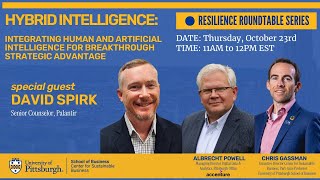
Hybrid Intelligence - Integrating human and artificial intelligence for Strategic Advantage