How to Rebuild After Losing Everything in Real Estate with Rod Khleif
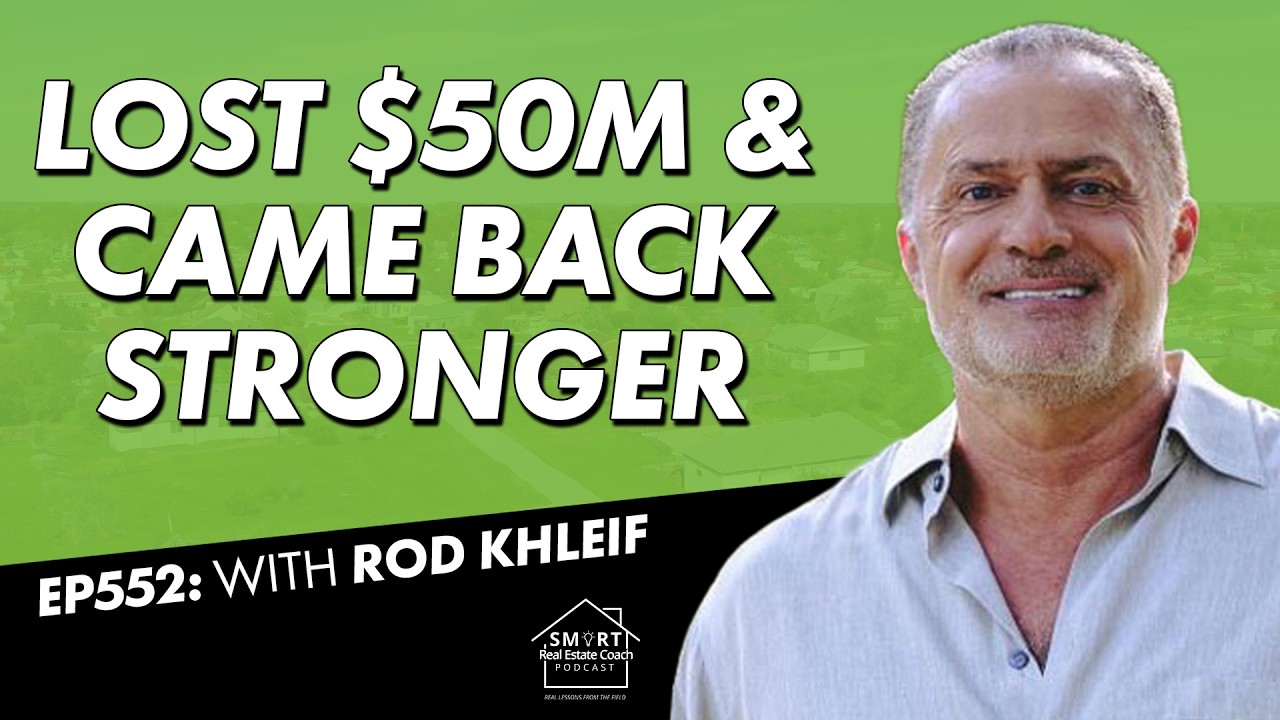
Rod Khleif lost $50 million in the 2008 real estate crash, then rebuilt using goal-setting, decisive action, and gratitude. He explains why job security is a myth and how to start a side-hustle to protect yourself.
Chapters
Welcome to the Smart Real Estate Coach Podcast, your source for actionable, real-life, practical investing advice. Each week we help you make a quantum leap somewhere in your business, your finances, and/or your life. Subscribe, leave a rating and review, and learn more at smartrealestatecoachpodcast.com. Okay, smart listeners, it's Chris Prefontaine, your host today. As usual, you're stuck with me. I can't wait to jump into this with my next guest because he and I hooked up, I want to say back in 2019. I was on his show and he was on this show, and you're going back to episode number 341. So that was a long time ago. He's the bestselling author of How to Create Lifetime Cash Flow Through Multifamily Properties. And you guys know I'm pretty picky with who we have on as far as multis as well, because Rod's an expert, and that's why I wanted him to come on. His podcast is 1% ranked real estate podcast, top 1% with over 20 million downloads. So that's a writer-downer if you haven't already followed his show. I know there's so many people in the community who said, yeah, I heard you on Rod's show. His show is called How to Create Lifetime Cash Flow Through Real Estate Investing. He's got over 45 years of active experience, guys. He's got me beat, and there's not too many guests I've had on the show that have more than my 34 or so years or 35, whatever the heck it is now. He's owned and managed over 2,000 properties. He's got quite the track record. And through his coaching program, his students have collectively owned more than 260,000 units. So not only, just like us, not only is he in the trenches every single day, he's helping students do the exact same thing. He's by far among the top tier. Like I'll say that in the in the infinite banking space. And I'll say that in the multifamily space. Well, he's it in the multifamily space. So with that as a backdrop, welcome to the show, Rod. All right, Rod, with that as a backdrop and a little bit of an intro, welcome back to the show after 7-ish years.
7 freaking years. Holy Toledo. Good Lord. It's great to be here, my friend. It's great to see you again. Of course, I've got more gray hair now, but, you know, so there it is.
I like how you matched. Yeah. We're there. Yeah. So, it's awesome to hang out again, Rod. Just as I said in the intro with your experience, I love kicking around things with you. I would love you to go into— we were just kind of chatting offline a little bit about your story and I'll say the struggles that you went through like me back in the day because there's so many lessons in there. You want to kind of peel that back a little bit for the listeners?
Yeah, sure. Yeah, sure. Well, let me go back even further because I think it'll lend some framework to what we're going to talk about. So, I'm a Dutch immigrant.
Okay?
Think wooden shoes and windmills. I immigrated to this country when I was 6 years old, my brother Albert, my mother Svantje, and we ended up in Denver, Colorado. Didn't have much growing up. In fact, I remember we shopped at an expired food store, believe it or not, they had it back then, and drank powdered milk with our cereal in the morning. Trust me, sounds better than it is. And, I wore hand-me-down clothes from the Goodwill and the Salvation Army all the way through junior high school till I lied about my age when I was 14 to get a job at Burger King because you could be 15 because I was tall. So, I could flip burgers and buy my own freaking clothes and then ultimately buy a car, which every kid that age wants. And I'm sure you have listeners that had it harder than I did and maybe even have it harder now. There's a lot of craziness with the jobs going away with AI right now.
Yeah.
We can talk about that later. But I knew I wanted more back then. And my mom had an incredible work ethic. So, she babysat kids so we'd have enough money to eat. And with her babysitting money, she invested and she invested in the stock market successfully with no formal education, but also real estate. Her first real estate buy was the house right across the street from us when I was 14. She bought it from a family named the Jewels and paid about 30 grand. And then when I was 17, she told me she'd made $20,000 in her sleep. I'm like, what? You made 20 grand? You didn't do anything? And this was back when 20 grand was a lot of money. We're talking 1977. Yeah, that's how old I am anyway. But, and I'm like, forget college, I'm getting into real estate. So I got into real estate, got my real estate broker's license actually right when I turned 18. Which you could do back then with just an education. Now they got smart to be a broker, then have your own office. You have to have some experience. But I was a broker right when I turned 18, and I was smart enough to go work for another broker. But anyway, you know, I— my first year in real estate, I made about $8,000. My second year, about $10,000. But my third year, I made well over $100,000, which back in 1980 was some pretty decent money. So what happened between year 2 and year 3 that caused me to 10x my income? Well, what happened was the broker I was working for, I was dating his daughter and he taught me about the importance of mindset and psychology, how really 80 to 90% of your success in anything is your mindset and psychology. Only 10 to 20% is the stuff we babble on about on our podcasts here, you know? And fast forward to today, you know, I've owned over 2,000 houses that I've rented long-term in 3 states. I own thousands of apartment units now. I'm actually buying senior housing as well right now. And You know, back in 2006, my net worth went up $17 million while I slept. And you might say, wow. And I said, wow. And I got a head so big I could barely fit it through a door. I thought I was a real estate god. And you and I both know what happened shortly after 2006.
Right.
I got my ass handed to me in 2008. Yeah, we both did. And I lost conservatively about $50 million. And so, you know, what I'm known for talking about on my podcast and And at my bootcamps and so on and so forth. There's really the mindset it took to have that $50 million to lose in the first place. And maybe more importantly, the mindset it took to recover from that. And what's good about that is those same strategies are what you would utilize to get started today. So I'm happy to drill down on some of those if you like, Chris.
Yeah, I think that's perfect, right? For, because that'll hit everybody. Literally, we've got people trying to leave the corporate world and we got people that are experienced.
So this is Perfect fit, I think. All right, well, here's the thing. So, it starts with goals. You've gotta know what you want because you've gotta have enough burning desire or hunger to push through fear or push through limiting beliefs. Or maybe you're comfortable right now. And Chris, you and I both know the comfort zone's a nice warm place. We also know nothing freaking grows there, right? So, you've gotta have that target and the juicy outcomes that you're shooting for to get you to actually take action, to get you to get up and kick ass for a few years And grind for a few years like most people won't, so you can live the rest of your life like most people can't. And it starts with goals. So, you know, like if you come to one of my bootcamps, the first thing we do is goal setting on steroids because again, how do you get anything if you don't know what it is? And so, and so, so that it starts with goals. And the next piece, oh, let me say something about goals. If you're, if you're, I teach people how to buy commercial real estate. Chris teaches, you know, subject-to and these incredible strategies for single-family that I did a lifetime ago. But if you're, if you're not interested in multifamily, you should still do your goals. Have your spouse do 'em, have your kids do 'em. I've got a goal-setting workshop that's at my Linktree. If you go to, and I won't try to sell you anything, it's just, it's, people spend more time planning a freaking Christmas party or birthday party than they do designing their lives. Doing your goals is designing your life. So, if you go to rodslinks.com, Rodslinks.com. At the bottom is my goal-setting workshop. Do it. Do it. You know, you'll leave so motivated after an hour with me, you'll be coming out of your skin. But start— it starts with goals. Then the next piece is you got to make a decision. So, like, when I lost everything in 2008, what I did was I reassociated with my goals because, you know, I was— it's very easy to focus on loss when you lose everything. And that's another piece. Let me just say that real quick. If you're going to start a new business, if you're in one of these jobs that AI is threatening, and I literally just laid off my daughter. Okay, I'm helping her start another business, but I had to lay her off because she does SEO for me. It's all AI is doing it all for me right now. So, if you're one of these jobs like IT, even legal, accounting, some medical positions, definitely anything in front of a computer, It could be on the chopping block. You need to be thinking about what you're going to do. Here's why I brought that up. Don't let it be your identity. Let it be your vehicle. Okay? When a business fails, I call it a seminar. And that was like, that was a $50 million seminar. Now, it was an expensive freaking seminar. Don't get me wrong. But it's only a failure if you don't get back up or you don't get the lesson. But what's critical is you don't make— if you do decide to start another business, whatever it is, Don't make it your identity. Have it be your vehicle. Because if it's your identity, you're a failure if it fails. But I've built 29 businesses so far in my career. I was blown away when I counted them. Several worth tens of millions of dollars. Most were spectacular flaming seminars.
Okay?
So, just be careful. You know, people kill themselves if they make their business their identity. So, I kind of got— went off on a tangent there for a minute. But the next thing you do after you do your goals is you got to make a decision.
Yeah.
And for me, it was like crawl out from underneath a rock. I was hiding under one. I lost everything. But if for you, if you're listening, you haven't done anything, you got to make a decision. And I don't mean dip your toe in the water. I don't mean one foot in, one foot out. I mean, you make a decision, it's freaking done. Okay? And then once it's done, you're like a train on a track. You know, if you don't commit, you don't make a decision to commit, you're going to get knocked off track. And so, So that's the next piece. Chris, please, please feel free to interrupt me because I'll just keep rambling on.
Rod, actually, since you said that, only because I mentioned, here we are, at least as of the time of filming, and I'll, I'll tell you when this is going to air for them to know. It's going to— this is going to air like soon, like in 2 weeks.
So, oh, hi.
There's so many people here. We are quarter 1 gone, but there's a bunch of people in corporate America who, I don't know, you probably feel the same way. It drives me nuts. I just want to shake them because Why? They could be on the chopping block for other reasons than AI. Why not kind of delve into this? So, when you talk about commitment, I go, all right, so talk to those people that are on the fence that are afraid. Anything else? Any nugget? Anything?
Well, again, if you're afraid, you've got to get— you've got to have enough motivation to push past the fear. And the only thing that will do that is compelling, measurable goals.
Okay?
That's what's going to do it. And so, you got to figure out what you want. So, do my goal setting for God's sakes, or do it yourself, whatever. But do that. And that's how you're going to push through that fear because there's a lot of fear out there. But I got to tell you, if you're in one of these jobs that's on the chopping block and they're talking like it could be 50% of people's jobs, I mean, it's insane. And I think it's credible. I mean, what is it? Meta, was it Meta just laid off another, what, 20,000 people? Or maybe it was Amazon. But I mean, when I do it in my own little company for my coaching business. My God, and it's my daughter. You know, that's a wake-up call. Okay? And so, you know, if that's you, for God's sake, start doing a side hustle. Figure out what you might enjoy. Go to Chris's event, come to my event, whatever it is. Figure out what you might like and, and get started now. Don't wait for the freaking shoe to drop because it takes some time to get up to speed. You got to get around people that are doing it. There's some pieces to this you got to learn. And it takes time. And if you're going to be that much further ahead, if there's any— regardless, even if you're not sure your job's going to go, get started in something unless you absolutely freaking love where you're at. If you have all the freedom you want, financial freedom, time freedom, freedom to go wherever you want, whenever you want, with whoever you want, then don't worry about it. But if not, get started in something. And so, yeah, anyway, you can tell I'm passionate about this.
On this note, to beat this up a little bit more, I've been saying for like 2 years at my events, screaming to these people, saying to my, to my audience, saying your job is your risk. Real estate's not a risk. People say, oh, it's risky, the market up that— no, your job is risk. Would you agree with that?
My dad worked for Continental Airlines for 36 years. Okay. He used to— the Continental Airlines had the golden tail, the plane with the golden tail. You could see them when they were flying by. He used to make us put our hands over our hearts when one of those planes flew by. True story. I love my dad. He came into my life way too, way too late and left way too early. But he worked for that company for 36 years, loved that company, and he got laid off. Okay? There is no job security. The only job security is between your ears. Your ability to learn something and take action on it is your job security, period. So, yes, in answer to your question. So, goals. Then you make a decision. Then you got to take the first step. Okay? You know, Dr. Martin Luther King said, you can't— you don't have to see the whole staircase. You take that first step in faith, the next step will be revealed. That's how it And, you know, in my business, you know, there's numbers. It's very empirical. Okay? And so, I get a lot of analytical people. And if that's who you are, and I love you, and you know who you are, how you have to check off every single box before you make a move, you can't do that. You've got to have some faith and take that first step. And sometimes, the most important decision in your life is to take that first step. And I would tell you, if you're analytical, you know, here's a great analogy. You can drive all the way across the United States at night. Your headlight only seeing 50 feet in front of you. You know you can make it. You know other people have made it before you. You may have some obstacles, but you know it can be done. It's the same way with what Chris teaches, with what I teach, but you gotta take that first step and you actually gotta do it. This life is not a dress rehearsal. You know, if you fear failure, a lot of analytical people fear failure, and I have at times as well. Fear regret instead. Okay? You know, we fail our way to success. Like I say, I've had 29 businesses. Most of them failed. Most of them were seminars. But fear regret. There was this nurse in Australia, maybe you heard about her, Chris. She was a hospice nurse named Bronnie Ware. And she asked her patients a question. The question was, do you have any regrets? And she wrote a book about it. It's called The 5 Regrets of Dying or something like that. It's a bestseller. The number one regret was not living the life I could have lived, living someone else's life, not doing what I know I'm capable of. Fear that. Okay? Don't fear failure. Fear of freaking that. Okay. And so, you were talking about what holds people back. We talked about fear. Let's talk about limiting beliefs as well. So, I'll give you— I've got a really funny prop for this. Okay. So, when I immigrated to this country, I got thrown into school and I found out what bullies were. I didn't speak English. I was 6 years old. Found out what bullies were. I got chased home, got my ass kicked occasionally. Then my mom, Sent me to school in these wooden shoes. These are the actual freaking wooden shoes. We found them when we put her in assisted living. And these leather shorts the Germans wear for Oktoberfest. Crack cocaine for the freaking bullies. So, I got my ass kicked again.
Yeah.
And then, the bullies would chase me home. They lived down at the end of our street. My mom would chase them off with a flyswatter. Next day, ass beaten. And I came up with this belief system that I wasn't good enough. I used to ask myself, how can I show them I'm good enough? And, And a lot of people have these limiting belief systems, Chris. And I'm not good enough. I'm not smart enough. I am not courageous enough. Another one of mine was, I'm not analytical enough. I'm not young enough. I'm not old enough. So many of us have these belief systems, these stories. And I'm going to tell you, if you have one of these that you're consciously aware of, sometimes you're not even aware of it. But if you're consciously aware of it, recognize that the acronym for belief systems is BS because there's no basis in fact most of the time. They're just, we believe they're real, but they're not. If you have one of these, drag it out into the daylight, look at it with your adult rational mind, recognize that it's BS, and it will dissipate. I used to be afraid to raise my hand in front of 10 kids in a classroom, and now I speak in front of literally thousands of people a year in flip-flops typically. So, there you go.
Yeah. Question for you then because 2008 to 2012 for me, Was definitely my belief system is all here. I, you know, that's why I waited 4 years to jump back in the trenches. So, right, you lost $50 million. Did your belief systems take a beating and get all disoriented?
Oh yeah. Oh, hell yes. Oh, hell yes. Yeah. No, I actually stayed out of real estate for a while. I started a litigation support company, you know, I built it out of the ashes of what I lost. It turned into about a $10 million company that I sold a few years back. But, but yeah, no. And then, and then, At the litigation support company, I hired a CFO who had done commercial real estate. I'm like, hmm. And so, he and I bought almost 3,000 units together. And that's when I started my podcast, I don't know, like 10, 11 years ago. Now, I'm blessed to say it's the largest real estate podcast really in the world for commercial real estate. I'm like over 30 million downloads, which doesn't sound like a lot in the social media world, but in podcasting, it's not terrible. But, you know, and so no, I took, I definitely took a hiatus. And again, it was hiring that guy at my litigation support company that caused me to get back in, start the podcast and get back into commercial real estate. Yeah.
But isn't it interesting when you trace back, you and I have been around so long, when you trace back things like that to say, oh, that's why I'm here. Oh, that's why this happened in a positive sense.
Oh, sure. Oh, of course. Of course. Yeah. I mean, I did some things wrong. And, you know, for example, with my houses, I had 800 houses at that time. I had 800 houses along the Gulf Coast of Florida. And what I did wrong was they were 2 hours south of me, 2 hours north of me, and everywhere in between. Florida has no state income tax. Okay? So, property taxes are higher. Although, DeSantis, God love him, he's about ready to remove property taxes here. But, Back then, they were higher than they would be comparatively around the country. I had properties in wind and flood zones, higher insurance. So, both of those things impacted cash flow. But what killed me was if I had a maintenance issue at one of my apartment complexes, we could stockpile parts, plumbing parts, appliance parts, door locks, window locks, things like that. And so, a maintenance guy could be in and out in an hour. Well, if I had to send him to one of my houses that's an hour and a half away, They have to go see what's wrong. Then they have to go find a Home Depot or Lowe's where we have an account. And logistically, it was just— it was, it was not logistically well thought out, candidly. And so, you know, they could take all day at one of my 800 C-class houses. See, there's A, B, C, and D class. A is the brand new stuff. D is the hood. C is just above the hood. It's older working class people. I'm not older, but it's working class demographic. It's a tougher demographic. And these houses are older. So, a lot of maintenance. Okay? And so, they never really cash flowed well. And so, but the big thing I didn't pay attention to back then, Chris, was tenant demographics. So, if they had good credit, they had income, and they paid at least a month's rent as deposit, I let them rent. Well, what I discovered in end of 2008, early 2009 is most of my tenants were contractors, plumbers, electricians, drywallers, painters, roofers. And that work fell off a cliff, man. They didn't have work, so they couldn't pay the rent.
Yeah.
Boom. But the next piece I want to talk about is focus.
Yeah.
It's so easy to focus, like it would have been easy for me to focus on that loss. And I just use it to teach now. I didn't let it become my identity. I did for a short while. I felt pretty shitty, but I pushed past that. But focus is power. Okay? Wherever focus goes, energy flows. both positive or negative. Okay? Whatever you focus on gets larger. But I will tell you, the most successful people on the planet have the highest degree of focus. Look at Elon. Look at Bezos.
Yeah.
I mean, these guys have the biggest companies in the world. They're the wealthiest in the world. But again, whatever you focus on gets larger. So, I'll have students call me or people call me and say, how do I get out of student loan debt? And I'm like, wrong freaking question. How do you make so much money that debt's irrelevant is the question you should be asking. You know, they asked Mother Teresa if she was anti-war. She said, no, I'm pro-peace. I mean, you get what I'm saying. You know, I listen to 2 podcasts. Um, I listen to Joe Rogan and I listen to Tim Ferriss. I try to get both sides of the aisle. I'm definitely on, on one side. On the other side is Tim Ferriss. He has a great podcast. And the reason I bring that up is both those guys get about 30 million downloads a week, I think. But, but anyway, on Tim Ferriss's show, um, he interviews the best of the best in the world, best athletes like Michael Phelps, the swimmer, uh, NFL, NBA players, billionaires like Ray Dalio, heads of the biggest companies in the world like Zuckerberg, actors like Ed Norton, Hugh Jackman, Arnold. And he deconstructs their success. It's a fascinating conversation. But he talks about how they became successful. And these are the best in the world. And I started to hear a pattern, Chris. I think we did an analysis of this a while back. 85% of them meditate. What does meditation enhance? Focus, right? Focus is super important, guys. So, keep that in mind. Yeah. So, another piece of this, and it's not as prevalent in what Chris teaches as it is in what I teach, and that is to play to your strengths. In the single-family space, you can do it on your own. A lot of people do single-family on their own. I pretty much bought 2,000 houses. You know, I had some employees and I had my brothers got involved for a while, but But multifamily, to buy a 100-unit apartment complex, it's a team sport. And, and I would tell you is to play to your— well, even in single-family, play to your strengths. Hire a line or partner for your weaknesses. Your strengths are your greatest assets because when you're playing in your strengths, number one is you love what you're doing because you're good at it. So you never work another day in your life. You get success much faster if you maximize your strengths. Okay. And, and the other thing with that, and so in my business, because it's, it's numbers, a lot of numbers, but it's also building relationships with people to raise money because you raise money for these deals. They take deals, but it doesn't have to be your own money. You raise money for them. So you got to build those connections. You build connections with brokers, things like that. So it takes an analytical person, but it also takes an outgoing person. Analytical is typically introverted. Outgoing is being, you know, obviously I'm the mouthpiece in my relationships. My past partners have been You know, CPAs, things like that. But that combination is fantastic in my business. But you want to play to your strengths, okay? And so just don't live someone else's life would be my point. And when you're doing that, if you're playing to your strengths, you're going to be passionate about it. And passion's required to influence people. And so that's another really important piece of this.
I love it. And you still on the real estate side, right? Just so they get the big picture. How active are you buying now? You mentioned a few things you're working on. How active are you right now?
Well, I have— I'll tell you, multifamily is in a meltdown right now, okay? Because a lot of operators got adjustable rate debt. Expenses have gone through the roof. I mean, this is the saying, the water's going out, you see who's naked. My SEC attorney that does syndications for these apartment complexes about a month ago told me he got 6 foreclosures in one day, apartment complexes in one day, 6 new clients. So, there's a lot of deals going south right now. There's a lot of opportunity. I mean, with crisis comes opportunity. You know, Warren Buffett's famous quote, be fearful when others are greedy. And there's been a lot of greed these last few years in my space. And then, but of course, the flip side of that is be greedy when others are fearful. And now, there's fear because, you know, there's some blood running in the streets. I'll give you an example of this. I've got an asset. We call them assets. I've got a 200-unit apartment complex in San Antonio. Right next door, there's a 300-unit that sold for $43 million in '22. Okay. $43 million. The bank now owns it. It's down to $28 million. Okay. I'm not even interested unless it gets to $24 million. $43 to $24. So, you get, you get the idea. And that's what's out there right now. It's incredible deals. But I haven't bought anything in the multifamily space in over a year, maybe even longer than about almost 2 years. I mean, senior housing, however, I've closed on assisted living facility. We've got another one I think about to go under contract. You know, there's 10,000 people a day turning 65 in this country. So, I don't just teach multifamily. That's what I'm known for. And I'll brag for a minute. My students, we believe, own about 300,000 multifamily units under my tutelage, something I'm very proud of.
Yeah.
And every other asset class, senior housing, student housing, self-storage, mobile home parks, you name it. But a lot of my students have a bunch of senior housing. I'm just getting rolling in it again because I started to do it back in '08. But, but anyway, so, so I haven't bought a multifamily in a while. I'm waiting. I mean, there's a huge wall of debt right now in commercial real estate that's hitting, you know, in the single-family space, you can get 30-year fixed financing in, in commercial real estate, multifamily, which is 5 units or more. You can get a 30-year amortization, but you're going to have a 5, 7, or 10-year balloon. It's called the term. 5, 7, or 10-year balloon. And so a lot of that debt's coming due, and those operators have 2 options. They either have to sell, and sales are down about 90%, or they have to refinance. And the problem with refinancing is they have to meet what's called debt service coverage requirements, the property's ability to service the debt. They're not looking at your debt-to-income when you buy an apartment complex. They're looking at the property's ability. And the problem is with the rates where they are, they're not able to do it. So a lot of these deals are in trouble. There's a lot of opportunity coming. So, I'm kind of on the fences waiting.
I love it. I love the projects you're working on now. Just so I don't forget, because you can teach all these, how can they reach you, Rod? Just so I don't forget to ask you that.
Yeah, yeah. No problem. I'll tell you what, 2 things. One, I have a book. It's the number one bestseller in 3 categories. I give it away for free, the PDF version. If you want the physical one, send me $7. I'll send you the physical one. But it's rodsbook.com, rodsbook.com. Now, if you're interested in learning what I teach, I do a virtual boot camp literally every, just about every 30 days. I only charge $47, so there's no freaking excuse. And it's not a sales pitch, it is full-on training for 2 days for $47. So no excuse. But it's, that's at rodslinks.com. So if you're driving, text the word links to 72345, but it's rodslinks.com. But again, if you want to check out what I do, my book is really good. I have never even had a critical word about it. You know, I get hate every day. No one should own 800 houses. I'm like, yeah, well, no one should be in their mom's basement bitching either. But anyway, but I've never had a critical word and I've, you know, I've probably given away, I don't know, thousands, tens of thousands of copies of it. So, but let me mention one other quick thing.
Yeah.
Who you hang out with is who you become. Be very careful. You know, you show me your 3 best friends, I'll show you who you are at every aspect of your life, your health, your happiness, your relationships, definitely your finances. And a lot of people will default to a peer group that they went to school with or that they work with. And those people may have their own limiting beliefs and fears, and they will hold you back out of fear of losing you or fear of feeling less than if you succeed. And sometimes it's family. So, I'm going to tell you, proactively choose who you allow to influence you. If it's your family, love your family, but choose your peers. You know, when I was losing everything back in 2008 and '09, I was in Tony Robbins' Platinum Partnership. And I was around people that were killing it in that crash. They were thriving. And they're like, get up, you puss, $50 million schmillion, go make something happen. Get around people that think what you think is hard is easy. Very, very important. And so, Yeah, your peer group is super important.
That was what pinged me between the eyes to wrap this bow on this, Rod. When I was like 12, I was 4 years into it and someone you and I know very well in the real estate space said, that's like a pimple curse. Like, that's nothing. Laughed at me. And so similar to your situation. Yeah, it is definitely, definitely association and proximity, right?
That's it. That's it. Who you hang out with is who you become and proximity is power. Can I mention one more thing? I know you want to wrap this, but I got one more thing I want to talk about and you guys listening You may think it's foofy, but I would tell you to ignore it at your peril. I want to talk about the most important foundational emotion we have available to us. It's gratitude.
Okay?
It makes us stronger when we face adversity, strengthens our immune system, makes our hearts stronger, lowers our blood pressure. It brings us closer to our spirituality, and it's how you manifest everything you want in life. You could call it prayer, but most mornings, I will sit and I will I will be grateful for the things in my life, the people I love, the things that I've done, and then I'll do gratitude for the things that I want as if I already have them. And I've gotten emotional being grateful for things I don't even have yet. And some of you are like, oh, good God, can we get on with the real estate? Well, this is how I had $50 million to lose and how I got it back. So ignore it at your peril. Highly recommend you put that practice into effect.
Right. There's like 10 things you said. You know, all the way back to the beginning of your story about lying about your age. That's what I did when I was like 10 or 11, had to get dropped off at the job. Then you bring up gratitude. I'm looking for my journal.
It's over on my desk.
So, if I miss one day, I start back at day 1. I think this morning was day 307. So, I couldn't agree more that that's super, super important. And I always say to the vets, okay, here's like the guaranteed formula. Here's the nugget. And guess what? Nothing to do with real estate. Because it's all the other stuff, right?
It's 80 to 90% of it. People think it's, you know, I'll get people, I'll be doing my goal setting session. I'll be, I'll see somebody twiddling their thumbs and I'll stop and I'll say, dude, this is more important than anything else we're going to do.
Yeah.
Okay. So, yeah.
I love it. Your energy, your candor, and this whole mindset space, guys, is the game. It's what, it's what challenges people and it's what keeps people in the J-O-B, frankly. Right.
So, right.
As always, awesome hangout. I'm going to try to get on a plane and come hang out with you more.
Oh, that'd be awesome.
Yeah.
And I'd love to have you here in my studio in Sarasota. I'd love to interview you for my show, bro. Seriously.
I heard. I got a lot of friends that, that, that went and said, oh, you got to go hang out with him. So we'll work on it. Love it. Love it. Love it.
Great to see you, buddy. Thank you. Yep.
Okay, guys, that wraps up our time together today. And I would love you guys to go ahead and share this because it works so well as a tack-on to the 3 Paydays system that we use. A lot of times people will take their profits and parlay them into some of the multi or perhaps the mobile home space or the storage space, right?
So it's a great asset class.
For those of you that have not registered yet for the September Rhode Island annual, this is the 11th annual now, 3 Paydays Live event, you can go to 3paydayslive.com and be the first to know on those updates. And we do have a cap at that event as usual, so I want to make sure everybody gets in. Also, those of you who maybe for whatever reason have not gotten my free books yet, you don't have to go to Amazon. You can get them for free here. Just go to 3 Paydays Books. That's the number 3, 3paydaysbooks.com/podcast. We'll see you next week on another awesome SMART Mastersclass.
Hey guys, are you simply sick of juggling a dozen different software tools for your real estate business? I know I was, and I know I'm not a tech person, so it was frustrating. A subscription for this, you get a subscription for that, and they don't even work together out of the box. That's very frustrating, especially in the real estate world where your best time spent is going to be out in the field or on the phone with sellers. And now you're stuck hiring a tech guru just to make all that sync up. So let's ditch the chaos and let REI BlackBook handle everything. Automate your lead follow-up, track every deal, analyze things quickly for you, make offers all in one platform. In fact, with the Wicked Smart platform, we now have access— if you're in the Wicked Smart community, to all the other associates' properties.
Can you imagine that?
So you're brand new in the business perhaps, and your seller looks on your website and sees 20, 30, 40 properties, instant credibility. So you're going to get everything on REI Black Book from our custom workflows for lead generation all the way to closing. It has it covered. Try it today for just a buck. $1, guys. Visit smartrealestatecoach.com/reibb. hyphen D-D. smartrealestatecoach.com/reiboy-dog. All right.
Thanks for tuning in to the Smart Real Estate Coach Podcast. If you got value from today's episode, guys, be sure to subscribe so you never miss a future episode. It literally takes one nugget to access some of the things we're doing. And when you're talking the amount of the size, rather, of the paydays, it's an opportunity cost that you can't let go. So don't miss an episode. And for goodness' sake, share it with someone who needs to hear it. If you're ready to find your best path for getting started on your real estate investing journey in general, head over to smartrealestatecoach.com/getstarted. We're going to help you take the guesswork out of your next steps. See you in the next episode.
More from Chris









Episode 575: Redefining Retirement as the Day All Your Choices Open Up with Doug Bennett

