The 3 Pillars of Note Investing & The Truth About Passive Returns and Risk with Jamie Bateman
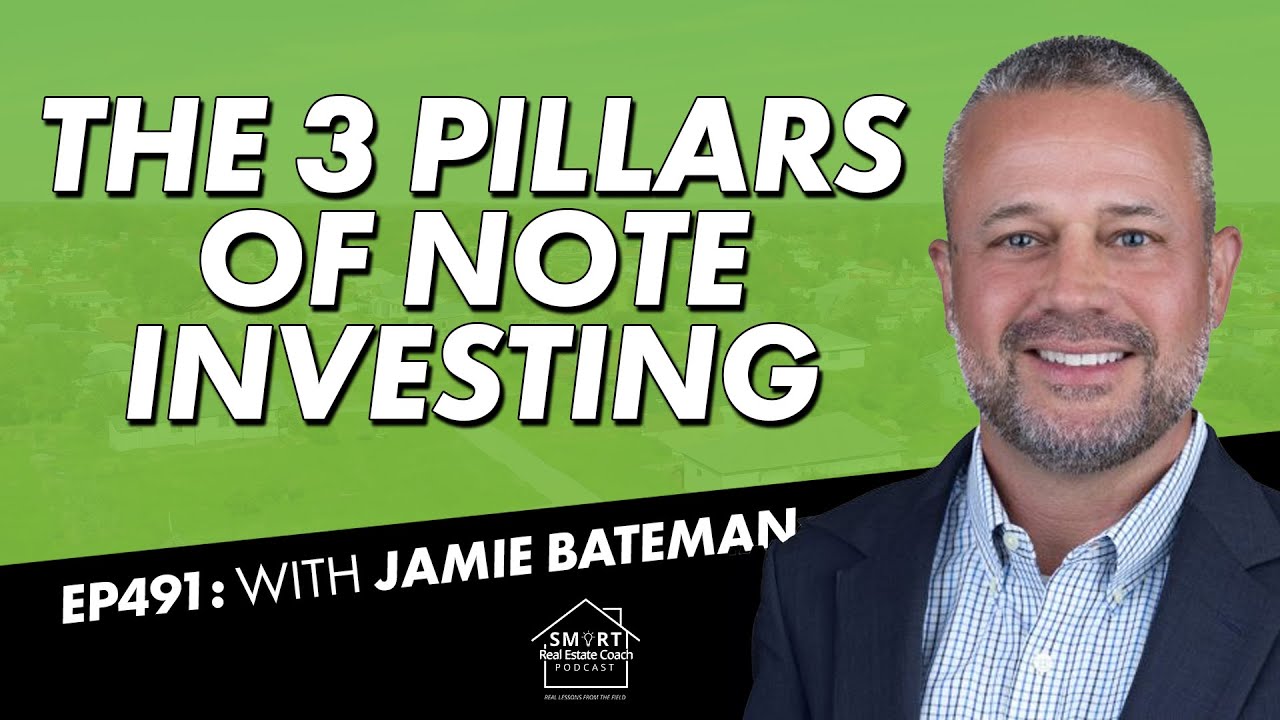
In this Smart Real Estate Coach podcast episode, host Chris Prefontaine interviews mortgage‑note investor Jamie Bateman. Bateman explains the three “legs” of a note‑investment business—capital acquisition, deal sourcing, and portfolio management—emphasizing his expertise in the management side. He differentiates active versus passive note investing, describing the hands‑on responsibilities of active investors (due‑diligence, foreclosure decisions, borrower bankruptcy handling) versus the hands‑off nature of passive investing through his Integrity Income Fund. The fund, a 506 offering, targets 8%‑10% annualized returns (with a $25k minimum for the 8% tier and $100k for the 10% tier) and typically purchases first‑lien residential notes in the Midwest and Southeast with loan‑to‑value ratios up to 75%. Bateman outlines typical deal sources—note brokers, online platforms like Paperstack, and tape lists—highlighting the relationship‑driven, inefficient nature of the market. He discusses minimum capital requirements for both active ($25k) and passive investors, and describes his mentorship program ($150 per hour, three‑session minimum) that includes building a “buy box,” due‑diligence checklists, and networking connections. Bateman notes a key downside: mortgage‑note investing lacks inherent tax benefits, generally being taxed as ordinary income, though self‑directed IRAs can mitigate this. The episode also includes promotional plugs for Bateman’s websites (labradorlending.com, adversity2abundance.com) and for Chris’s Smart Real Estate Coach resources (apprentice program, REI BlackBook, etc.).
Chapters
Welcome to another episode of the Smart Real Estate Coach Podcast, your source for actionable real-life examples and advice to help you move to the next level of investing. Each week we help you make a quantum leap in your business, your finances, and/or your life. We want to help you take back control, help you thrive during chaos, and lead you through the current crisis to a better tomorrow. For more resources, check out smartrealestatecoach.com. And be sure to give us a rating and review on your favorite platform.
Good morning, Wicked Smart listeners. It's Chris Pree, your host again, with another great guest. You know, I was on this gentleman's show. It's called From Adversity to Abundance. That's a writer-downer. I would go ahead and find that on your favorite podcast app and subscribe to that. We're going to chat here this morning with Jamie Bateman. Jamie's a dedicated entrepreneur in every sense of the word. He's a real estate investor. He's based in Maryland. He's known for empowering mortgage note investors, actually. So it's within our space and helping entrepreneurs achieve financial aspirations in general, which again aligns with our purpose as a company. Here's what I love, guys, on a lot of fronts here. He's a combat vet. I just have the utmost respect for veterans. If you're a veteran, thank you so much for your service. Former Army officer. His leadership qualities significantly influenced successful— his successful real estate career. If you think about it, I love The discipline that comes out of that is just right across the board, always amazing, right? He also, here's what else I love, after leaving his W-2, he immersed himself in this whole mortgage note investment arena. So, Army vet, a podcast about adversity to abundance, left his, escaped the W-2, which we've been helping people do in our community for 11 years now. So, buckle in here while we bring you the next wicked smart masterclass with my friend Jamie Bateman. You're going to love it. Okay, Jamie, with that as a little background, welcome to the show and good to see you again. Happy New Year.
I'm excited to be here, Chris. Thanks for having me.
Yeah.
And as I said, uh, I mentioned your show already, as I just said, but I also want to make sure they, they, um, subscribe. So I'll say that 15 more times before the show's out and they can get over there. Sure.
It was a plan as well.
Yeah.
Yeah.
Good to see you. Um, bring, bring us up to date. I mean, I gave this short intro, but bring us up to date on what's going on for '25 with you. What are you working on right now? Just Just give a 10,000-foot view and then we'll peel back. Yeah.
I mean, with, I know you mentioned my podcast, I'm trying to really narrow that down, the focus of the podcast so that we can better serve the listener and really help them kind of figure out which niche within real estate to head down and which path they may want to head down. And that may be, that may involve passive versus active. So we have solutions for both passive and active note investors. We can get into that later. One of the things that I'm focused on is kind of scaling what I'm already doing. We have a note fund that we manage that accredited investors can invest in. Really where my wheelhouse is, Chris, is managing mortgage notes and managing a portfolio. So not to get too far into the weeds here in the beginning, but there's 3 kind of legs to the stool for, with a mortgage note. business similar to your business. One is finding capital, 2 is finding deals, and then 3 is managing both the capital and those deals. And when I say deals, I mean mortgage notes in our case. Well, that 3rd leg is really where my expertise lies, and that's management of the portfolio. So I'm scaling on that side of things. To answer your question, I've networked and gotten access to additional capital, So I'm able to go out and find more deals and really focus on what I'm good at, which is management of a portfolio and then teaching other people how to do the same thing.
That's awesome. So, okay, I was going to go there next. So if I'm a Wicked Spot listener and I heard the intro, I heard that I can choose to be passive or active. Can you define if I'm going, hey, I'm looking for something like inside of another niche or tacking onto what I'm already doing, they might be doing creative with us, for example, because these marry well.
Oh, absolutely.
What would active look like?
Yeah, so active really, and it is sometimes a little difficult for people to wrap their heads around this. And to be honest with you, people want 2 buckets, active or passive, or black and white, but obviously there's a lot of gray in between nuances. Yeah. But to kind of simplify it, active would be, hey, I want to actually go buy a mortgage note or many, And I'm the person managing, so I'm doing due diligence on that asset to purchase it. I'm finding the seller of the mortgage note. I'm managing the day-to-day. If you end up dealing with non-performing mortgage notes, you're the person responsible for if it goes in, do you need to go for foreclosure or do a deed in lieu? Or if the borrower files for bankruptcy, like you're making all those day-to-day decisions and the operational decisions. That's a big deal. That's a lot of work, especially as you scale. So, you know, a lot of the gurus out there will claim, oh, mortgage note investing is passive all the way, mailbox money, 100%. Well, not necessarily. So active means, look, I've got time, I have energy, I have some capital, but maybe I'm not an accredited investor, but I'm typically a younger person who kind of really wants to dive into this and learn the business of how to manage a portfolio of mortgage notes. That's very different from the passive investor avatar whom we also serve.
Yeah, I appreciate your candor with the, you know, people say it's all hands-off because I scream about this all the time when people teach this stuff. It's not all roses. There's all kinds of nuances. You opened up saying that, like, there's just nuances going on.
100%.
Okay. So that's sort of active. Passive, on the other hand, because you specialize in management, talk about that a little bit for the listener that might be like, ah, yeah, I don't want to be hands-on. Yeah.
So there are many ways to get involved in mortgage note investing. That's really, as we said, our, my niche here as a passive investor. So in our case, we have, I've managed a couple of funds and we currently have one fund that's open. So I speak to that just as an example. We have accredited investors who place capital with us, and then we take that capital and go out and buy mortgage notes, both performing and non-performing mortgage notes. So as the passive investor in that case, in investing into a mortgage note fund, that's about as passive as you can get in this niche. We send a distribution to that investor every month. That's, you know, the track record speaks for itself. And as an investor, you get an ACH into your account, then you get a K-1 and, you know, you file your taxes and hopefully you make money, right? So you can certainly ask questions, you can certainly, you know, try to learn some, but you're, as a passive investor in a mortgage note fund, you're not really there to learn. You're placing a lot more faith in me or, you know, someone like you, Chris, as an operator. And it's a lot less, it's a lot more hands-off. And so you have more capital than energy or time, and you want to place that with us. There are many other ways to be a passive investor in mortgage note investing. You know, we can get into some of those nuances. You can be a joint venture partner on a deal. You could be a joint venture partner on many deals. You know, You can, there are other ways to buy partial notes. You can hypothecate notes. So these are terms I'm throwing out and we're obviously not going to go into all the details there, but there are many ways to be a passive investor in mortgage note investing.
So I had a couple things you saw me writing. One is, I know you can't make any claims, but just in general, if I'm listening, what could maybe someone perhaps expect Passively on a, from a return basis? Return-wise, what are we seeing?
Yeah. So for our fund, it is a 506, so I can talk about the targeted returns and talk about the track record. You're absolutely right. I'm not making any promises as far as going forward, and there's always risk. We have 2 different tiers in our fund and we pay monthly, so that's a key thing. But 8% and 10% are the 2 levels that we have targeted annualized returns that we pay. Now, if you want to, flipping back over briefly to, if you want to become an active note investor, you're doing a lot more work. You should be rewarded for that, right? So theoretically, and not theoretically, you can, it's pretty common to see 15 to 20% returns. To be honest with you, the returns have come down a little bit across the industry, which I think is not uncommon in the whole larger real estate space. Yeah. In the last few years, certainly we've hit returns of 30% or higher on certain deals, but that's not the norm. But as a passive investor, you can likely expect in that 8 to 10% range. The return is not the thing in that You know, that we're really, it's a solid return, but that's not really what we're competing with for the most part. This is much lower on the capital stack as far as risk goes. These are mortgage notes that are backed by first, these are first lien mortgage notes backed by residential real estate within, typically we buy in the Midwest or Southeast and markets that don't kind of go up and down quite a bit. So the point being, there is a decent amount of security. Like I said, there's always risk, but we're not shooting for the stars here with the return. This is a, you could even call it a slow, boring, stable investment play.
And what do you see? I got a few more questions. What do you see for loan-to-values on those in those areas you're talking about, or is it all over the board?
Yeah, it, a little bit all over the board, but what's nice is when we're buying, We don't have to buy. So, and we're often buying with a solid pay history there too. So that really helps. We're not, we do some origination, but we really don't do a lot of origination of loans. So we're buying preexisting debt. And so typically speaking, we don't go over 75%.
Okay.
Oftentimes it's way lower than that because the loan may have been around for quite some time and Real estate, as you know, tends to appreciate over time. And so that time is on our side in those cases. So 75% is kind of our max there. And typically we will use the term ITV only because we're not originating. So it's an investment to value, not, it's essentially the same thing.
Not loan. Yeah, I get you. No, good terminology. How about on both fronts, active and passive, Jamie, minimum amounts. So if someone's listening and they go, do I fit here or not?
That's a great question. I'll throw out the number $25,000. And I say that, so our fund, the Integrity Income Fund, the minimum investment amount is $25,000. And then if you want to hit that 10% targeted return, it's $100,000. I'm also answering your question with $25,000 for the active investor because you really do need some capital to get in this game. I mean, you, you, that's one of the mistakes I see people, because I do mentorship and I want to make sure people have some capital to work with initially because I really think you need to operate with your own capital first. And you can get in the first lien mortgage note space with $25,000. It may be, you may get one deal and then, then, you know, got to figure out how to get creative and After that. But $25,000 to $100,000 is a great starting point to get started as either an active or passive mortgage note investor.
And if I'm active, what are my sort of deal sources, right? Because that's where I think when I think of leads in my world, right?
Sure. Yeah. It's a very disorganized and inefficient space. It's all about relationships. It's all about building that network. And I'm not dodging your question, Chris.
Yeah.
Yeah. It's the million-dollar question that everybody wants to know. There are sites, online sites, Paperstack is one of them. You can, you can, you know, I have no affiliation with them, but they, you can go check out that site and that's a great site. And sites like that are great because you can see, you know, more in more concrete ways what this guy Jamie Bateman is talking about on this podcast. Oh, okay. I see what he means. I see what these terms are, what we're actually referring to here. You know, one of the downsides with a site like that is you may not know who you're dealing with, and it's hard to do due diligence on the buyer or the seller, the other party. And so it's really a matter of finding sources of notes. It's really a matter of working your network. It's a relationship space and it changes all the time. So I have a list of sources, and honestly, most of the note investors in the space have probably a very similar list, right?
Yeah.
And it ends up being the same 4 or 5. There are note brokers out there. Dave Polio is one with SN Servicing. He sends out, he's very active in the space. So you get on these lists from of note sellers and note brokers, and they'll send you what's called a tape. And that's simply an old school term of, it's just a spreadsheet of notes and with a lot of data on that. So it's a long-winded answer to your question, Chris. It's not like the New York Stock Exchange where you just, you know, oh, I'm buying at this price and it is what it is. It's a lot less regulated, but That creates opportunity, right? That's, those inefficiencies are where opportunity lies. So you can find deals just by networking and getting to know people and building trust and relationships over time.
Interesting. So something like Paperstack, what they, so the note broker's clear. Paperstack acts like a note broker too, as far as how the person behaves?
Yes.
Yes.
Okay.
I don't know that legally they're a note broker, but they act like it's an online exchange platform, like an eBay or something like that. So, um, yeah, I think, uh, you know, they're a little less, they, they, they're more software-based versus a note broker who's a little more hands-on from a manual perspective. Yeah. Um, but essentially they're saving the, serving the same function.
Yeah.
Okay.
Cool. Uh, you mentioned mentorship and I, you know, I'm big on this and I think I've had a coach in some capacity in my life, or if not 3 at a time since, gosh, I don't know, 1990, right?
Like I always been a coach.
So what does that look like? Who would fit that mold? And what kind of commitment? Just talk about that a little bit. And then I don't want to forget to ask you that. Any site you want to mention for yourself or?
Yeah, thanks. labradorlending.com is our primary website and you can, that's for both passive and active investors. And to be clear, I'm both a passive and active investor, so it's not like we're saying you have to be one or the other.
Yeah.
But for the most part, most people fit into one or the other when they really boil it down. What do I actually want from this mortgage note investing? Our mentorship program is, it's $150 per hour currently. It's an hourly thing. We, it's a 3-session minimum. It's pretty straightforward as far as the commitment goes. And it's honestly a pretty low commitment in my opinion.
Yeah.
What I need to see from people are that, you know, you are serious and you actually want to commit to this on some level. You know, we may have 3 sessions and then you realize this isn't for me, either mentorship with us or mortgage note investing broadly. Maybe you're going to be— it's not for you. But ultimately, Chris, you're the person who has energy, a willingness to learn, willingness to listen, willingness to take action. and has some capital, like we mentioned before, to get started. And after that, once we, you know, we'll have an initial call and then once they decide to sign up, it's pretty, there is structure and I've developed different templates and different, you know, kind of a pathway forward for most people. But the nice thing about our mentorship program is that it's not one size fits all. So your experience in real estate, Chris, is Very different from, you know, I don't know, a 22-year-old kid straight out of college or something. So if I were to mentor you versus that person, it would be a very different approach.
We'd be— they have the 3 hours, but they're different calls perhaps, right? Different content.
Exactly.
Yeah.
So we end up, a lot of what we end up focusing on for most people though, uh, building a buy box is really important. So what are you actually looking for? And again, that's different for everyone because Are you looking for cash flow? Are you looking for, you know, lumpy payments over time? Are you looking, what are you looking for? How much, you know, how much capital do you have to work with? Which states are you willing to buy in? And this is a very state-specific industry and that's largely related to foreclosure laws and things like that. So building that buy box is a critical piece for people because you need to be able to, as a new note buyer, as an active mortgage note investor, you really need to be able to You know, speak into the universe, this is what I'm looking for. And if you can't do that, we talked about the inefficiencies in the kind of the network of sellers. You really need to be active as far as declaring what you're actually looking for as a note buyer. And the only way to know that is to take the time to build that buy box. So building a buy box for the, you know, answering certain questions about which assets, which type of assets you're looking to buy is critical. Another piece that we work with newer note investors on is building out your due diligence checklist or process. And it could vary based on different factors. Largely that's focused on the asset itself. So the mortgage note itself that we're looking at and the property that we can go into lots of detail on that, but But also, I don't want to miss the fact that doing due diligence on the note seller is critical as well. And a lot of that is word of mouth and just talking to people about other people's reputation in the space. And so lastly, I'll just throw in that one of the main benefits of working with us and our mortgage note mentorship program is also who you get connected to. It may not even be the main benefit, may not even be from the actual session itself. Oftentimes it's I can introduce you to someone else in this space who could really help you in a specific area.
Association, right?
Association. Exactly. Yeah. But it could be a vendor you need or an attorney or just, you know, and we're really here to help fast-track you to get you to move forward. We don't really compete with courses, people who offer courses or even a membership group, which I think both of those have a lot of value that, that we don't frankly offer. At least not currently. So we're here to help kind of supplement that and really add fuel to the fire and really focus and kind of dive in deep on, is this a particular deal you're working on as opposed to a course that may not really touch on your key questions in your specific situation?
Yeah, I love it. So the labradorelending.com, that's where they'll go for mentorship too, anything they want, Relative to our chat today.
Exactly. There's an investors tab, and if you click on that, it goes to active or passive investors, and you can kind of get a better feel for what I'm talking about here, you know, which of those 2 paths you may want to go down. If you're a passive investor, there's an invest now button and you can invest in our fund, but that again is for accredited investors only. We do have some solutions for the non-accredited passive investor. We don't need to get into that today, but we do, we have tried to build out a solution for everyone who wants to get into this space in some capacity. But labradorlending.com is where they'll find all that information.
Love it. Super interesting. You could tell I'm asking selfish questions that I hope is valuable for everybody listening. That's why I do it with all my guests. Okay. What didn't I ask you, Jamie? If there's anything content-wise or nuggets you want to share, what, if you were me, what else could I be asking you? Because that was on my brain just so Organically as we kind of talk through things.
Yeah. Ask me what is a downside to mortgage note investing.
All right, fire away. Yeah, I should have asked that. Okay, go.
No, I asked the question. I'm just, I, and as I say, I say that somewhat selfishly because I want to point out that I think I like to keep it real. I think I keep it real. Put it that way. You and I both operate like that, so I appreciate it. Yeah, so it's not a, it's an asset class, it's a strategy. It's like you said earlier, Chris, it's not all rainbows and butterflies and unicorns, and maybe it's not for you, right? And so that's all. There are pros and cons to every niche in real estate investing. There really are no inherent, to answer the question, there are really no inherent tax benefits to mortgage note investing. Typically speaking, you're going to be taxed at your ordinary income rate. So real estate, actual, when we're investing, buying a residential property, that inherently comes with some tax benefits written into the tax code. Not so with mortgage note investing. There are solutions for that, such as working, you know, investing through a self-directed IRA, But that's one downside to it. There's really no tax benefits.
Yeah, no, well pointed out because like it's like saying in our world, someone does a lease purchase, they're getting whacked on taxes. But if they do, if they buy a sub-2, 1-owner financing, they have some advantages there. And there's pros and cons to that, right?
Right.
So I agree. Okay, great. So labradorlending.com, you guys, to go and get information about Jamie and get on the phone with him and see if you want to explore that further. Uh, Jamie, really appreciate it. Is there any other, any other, uh, social media, anything else you want to share with these guys that they can reach you?
Yeah, I guess the only other thing I'll mention, I think you mentioned this in the intros, my, the podcast that you were on, Chris, and your son was also on, which both of those were recent and fantastic episodes. Awesome. Uh, From Adversity to Abundance. Um, they're very inspiring stories. This year we're really focused on making the podcast more practical and providing more practical solutions for real estate investors. So adversity2abundance.com, and that is the number 2. Don't want to complicate things too much, but labradorlending.com and then adversity2abundance.com, the number 2. The second website is for our podcast. So this has been really good, Chris. I really appreciate the time and I'm excited for the new year and just The future is, future is bright.
That's awesome. I'm sure we'll be doing stuff together from a JV standpoint and we'll continue doing podcasts. So I appreciate you being on, buddy. Happy New Year.
Happy New Year to you as well. Thank you.
Okay. Wicked Smart listeners, that does wrap up our time together today with Mr. Jamie Bateman. As I always say, if you enjoyed this show on any level, could you please, please, please take a few minutes to rate and review it and share it with others? There's got to be someone within your center of influence. Think about it right now. who can benefit from some of the nuggets that Jamie just imparted with us. And we would really appreciate it. Take a few seconds now, share it with at least one person. When you do, email me, let me know your biggest takeaway. You can email me personally, go to email chris@smartrealestatecoach.com. I want to know your biggest takeaway. When I hear from you guys, which I really appreciate, because I usually do after each show, it tells me where to go next, what to pour gas on, what to alleviate in the next show. What to get rid of completely, et cetera, et cetera. So go ahead and give me an email and give me some feedback on that. Lastly, I am, as I've said from time to time over the last, gosh, 6 or 7 years now, fully aware that you take about 30 minutes or so of your limited 10,080 minutes every single week, and that does not go unnoticed. So I appreciate it very much. I want to give back to you guys. I've got a list of free gifts here. If you're not seeing this on the video, please write this down on the, on your, as you're driving or do a voice note. Because these are going to be some freebies. I am big on free, guys. If you've listened to me long enough, you know that I'm big on free because there's so much crap being marketed out there in the real estate space. And I said to a gentleman looking at our community yesterday, that's great. They're good marketers, but they never come behind it with support. We have a new apprentice program, for example, that allows new people just like you to become an apprentice, get like $13,000 or $14,000 worth of group coaching, get the ability to tap into our amazing Slack community with 140 40 plus or minus people in there for constant support and get to tap into 5 calls a week if you want to. There's nothing, nothing on the market like that right now in the real estate space. We're making a major statement doing it, and we invite you to become an apprentice. And let me get you a link. Go to smartrealestatecoach.com/apprentice-pod, P-O-D, just so I know it came from the podcast. We're going to give you some special items in there. Secondly, If you're a new listener, a Wicked Smart listener, and you haven't for some strange reason gone through my free master's class yet, check that out. It's smartrealestatecoach.com/PCM. It just stands for Podcast Master's Class. PCM. smartrealestatecoach.com/PCM. If you can deal with me talking for another 55 or so minutes, that's what it is. It's a free workshop. I'm big on free, as I said. As soon as you get through the freebie stuff, then you'll know, hey, this is a niche I want to attack or not. I'm biased. This is by far the most effective time, the most special time to be in creative real estate. And you have an opportunity to do that as an apprentice with our community. And on top of that, as an apprentice, you get a free bootcamp here in the office where, yeah, I'm going to hang out with you. My son Nick and partner is going to hang out with you. My son-in-law Zach and partner is going to hang out with you and one of our certified coaches. Guys, that's a ratio of 4 of us to about 10 or 15 of you sitting in our private conference room. You cannot beat that. I could go on and on. Check out that apprentice program. smartrealestatecoach.com/apprentice-pod. We'll see you soon. Hey guys, are you simply sick of juggling a dozen different software tools for your real estate business? I know I was, and I know I'm not a tech person, so it was frustrating. A subscription for this, you got a subscription for that, and they don't even work together out of the box. That's very frustrating, especially in the real estate world where your best time spent is going to be out in the field or on the phone with sellers. And now you're stuck hiring a tech guru just to make all that sync up. So let's ditch the chaos and let REI BlackBook handle everything. Automate your lead follow-up, track every deal, analyze things quickly for you, make offers all in one platform. In fact, with the Wicked Smart platform, we now have access— if you're in the Wicked Smart community, to all the other associates' properties. Can you imagine that? So you're brand new in the business perhaps, and your seller looks on your website and sees 20, 30, 40 properties, instant credibility. So you're going to get everything on REI Black Book from our custom workflows for lead generation all the way to closing. It has it covered. Try it today for just a buck. $1, guys. Visit smartrealestatecoach.com/reibb. hyphen D-D. smartrealestatecoach.com/REIB as in boy, B as in boy, hyphen D as in dog, D as in dog.
Thanks for listening to the Smart Real Estate Coach podcast. If you're ready to invest in yourself and take your investing to the next level, check out our 90-Day Jumpstart Program by going to smartrealestatecoach.com/jump. That's smartrealestatecoach.com/jump. Because now is the time to act boldly in this unprecedented market shift.
More from Chris









Episode 575: Redefining Retirement as the Day All Your Choices Open Up with Doug Bennett

