What it Takes to Go to the Next Level as A Real Estate Entrepreneur with Don Williams
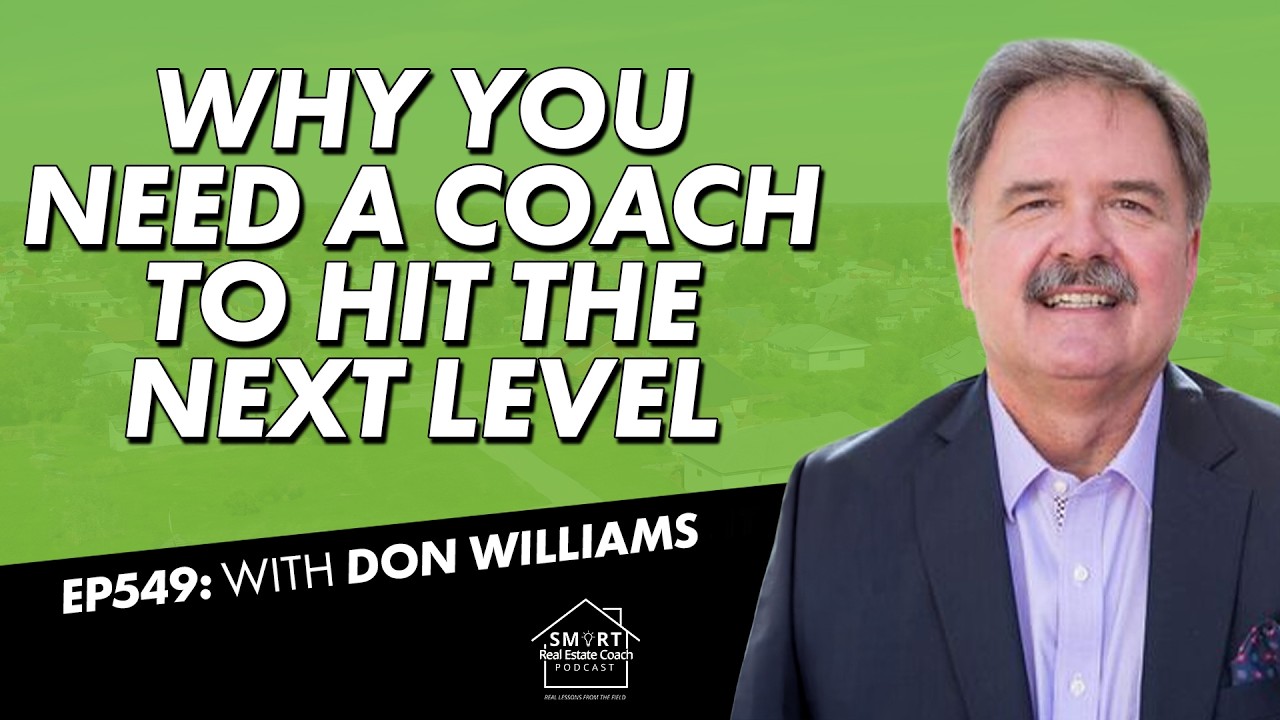
In this episode of the Smart Real Estate Coach Podcast, host Chris Prefontaine interviews veteran entrepreneur and sales expert Don Williams. Don shares his 30‑year journey from starting a business with $6,000 to founding multiple companies and becoming a bestselling author. The conversation covers the fundamental differences between W‑2 employment and entrepreneurship, emphasizing tax timing, cash‑flow management, and the two core business imperatives: bringing money in and keeping it from leaving. Don advises listeners to start a side‑hustle while still employed, and stresses the critical role of high‑quality coaching and mentorship. He recounts his first real‑estate acquisition—a 10,000‑sq‑ft office building financed with a rare 10‑year fixed‑rate loan that instantly turned a $7,000 monthly expense into a $3,500 cash‑flow, illustrating the power of buy‑and‑hold strategies. He also discusses personal setbacks such as a costly divorce and delayed property tax payments, highlighting the importance of reputation, disciplined buying rules (1%/1.2% rule), and a long‑term hold mindset. The dialogue delves into mindset versus skillset, the value of hiring world‑class talent, and an abundance‑focused philosophy. Don closes with a stoic quote, promotional offers for free books, a masterclass, and a pitch for REI BlackBook, while providing his contact information for listeners seeking coaching.
Chapters
Welcome to the Smart Real Estate Coach Podcast, your source for actionable, real-life, practical investing advice. Each week we help you make a quantum leap somewhere in your business, your finances, and/or your life. Subscribe, leave a rating and review, and learn more at smartrealestatecoachpodcast.com. Good morning and welcome, smart listeners, to another master's class. It's Chris Prefontaine, your host again with Smart Matt Real Estate Coach Podcast. Gonna hang out today with another gentleman that's been around for 3 decades. Uh, you've probably noticed a pattern with this. Uh, Mr. Don Williams. He's an entrepreneur. He's a sales and leadership expert. He's the host of a show I was on in January, which is how we met. It's called The Proven Entrepreneur Show. That's a writer down there, guys. The Proven Entrepreneur Show. This is typically how I'll meet people with just vast experience. So with over 30 years Advising, you know, everything from Fortune 500 companies to founders. He's got a serious track record. So, he comes in and he helps people grow revenue, enhance the customer experience, and build high-impact cultures. One of the many reasons I wanted him on, well, 2. One, 3 decades, right? 2, as a business owner and business advisor, are there perhaps maybe a nugget or 2 or things we can glean from his experience? Common pitfalls, things to avoid, things to look at as you're going forward in your entrepreneurial career, even if you're a solopreneur. That's why I wanted him on. A little background on Don. So, he started as a top salesperson. He reached number 1 in the United States in his teenage years. And then, he went on and found a dozen companies. This is why I wanted him to come on. So, again, could you think you could learn from someone who started a dozen companies starting way back in '86? Gosh, that's the year I got married. Man, oh, man.
Yeah.
With only $6,000 in his pocket. So again, I think I touched a chord there. If you don't have much money to start, how the heck did he do that, right? It was like me coming after the crash. How the heck? Well, these things are important to know and important lessons to glean from. So over the years, fast forward, he's been a CEO, he's been a consultant, he's been a keynote speaker across all different industries, and more importantly, just delivering super practical stuff. So, when I was on his show, I'm like, why haven't you been on our show yet? You got to come on. He's a multi-time bestselling author, and his books go from sales to customer loyalty to building legacy to leadership. And his mission is simple, help other people succeed by combining real-world experience with actionable insight. That's cool. Okay, Don, with that as a little backdrop, welcome to the show and great to see you again.
Hey man, thanks for having me on, Chris. I'm grateful.
Yeah, you bet. As we were just kidding around, I love, love, love, love experience, right? And I think what would be really cool after we just kind of give them some background on you besides the intro I did is we give them some kind of things you went through in all the entrepreneurial years. So real quick, let's talk about how you kind of look behind the green curtain. How did you land here? A little bit about your journey, and then we'll transition for some hacks for them and some pointers.
I'll give you the real short version, and then I'll give you a little longer. The real short version is I made about a zillion mistakes at everything I ever did, but I won often enough and big enough to get ahead of the game. And so, that was true in all of my entrepreneurial endeavors and in my real estate endeavors. And so, by the way, that should be—
you should write a new book, The Zillion Mistakes I Made to Become a Millionaire.
Yeah, yeah. I wish it was just a million mistakes to become a zillionaire.
Yeah, right.
There you go. But it is more like a zillion mistakes to become a millionaire. And unfortunately, some of them I had to learn the lesson 2 or 3 times because I'm a slow learner.
You and me both. So then let's talk about it. If you think back, and I know you could do a million different directions here, but as you think back, knowing that— picture the audience now. You're on stage and you got all these listeners and you got people that are trying to leave their job and they're a little afraid, they're timid. And then you got entrepreneurs that are maybe still struggling as a solopreneur, which I did for years. So let's address both crowds. Let's address the The W-2 people first, what words of wisdom would you give to them? Because in my brain, I know I'm a little bit more blunt. I just go, wow, you think, like, come on. I try and shake them, right? That's the risk. The job is the risk. So, what do you say about that?
So, here's what I would say on W-2 versus taking your first step into working for yourself. One, you will like Your boss better when you're working for you. But, and I don't care how much you like your boss now, but maybe the most important piece is how taxes work. Okay, so when you're a W-2, your employer withholds money from your check and actually pays it to the federal government before they pay you. Okay, it's generally funded a day before you're funded. When you have a company, okay, you still pay your taxes, but you pay your taxes at the end of the year or the end of the quarter. And so you— there's an opportunity to kind of kick that can down the road, okay? And we all know money, there's a time value, you know, of money. And so, um, I think people overcomplicate business. There's like only 2 2 things to do in business. One is bring money in, and a whole bunch of things ought to, ought to sit underneath that umbrella. And the other one over here is like, keep money from leaving.
Yeah.
Then a whole lot of things ought to sit under that. And if it doesn't sit under one of those, quit doing it. It's— it might be fun, it might be a distraction, but it's not business. And so that would be one, is if you're a W-2, I can't encourage you enough to get to where you sign the front of the check, not the back of the paycheck.
Love it.
Okay. And 2, it's a little scary. There's a little risk involved. And so if your heart palpitates a little bit when you think about doing that, do the side hustle. Get something going while you still are a W-2. And when that matches your W-2 income, at which time you'll have double income, but, but walk across the street and embrace entrepreneurship. And, and then the next thing I would say is this: most entrepreneurs are really smart, really driven, really optimistic. They think they know and can learn everything. And I'm not saying they can't, but you will do so much better if you get a coach who's been there and done that, who can just tell you, just put your feet in my footsteps and you will arrive where I am. And that will save you a lot of grief.
Yeah, I think every podcast I'm on, I don't know if we talked about on your show, but they, they'll say something like, what, you know, what would you do differently? Or what do you wish you did? And it's always Coaches earlier, mentors earlier to get there. I mean, it's a waste of time without it.
Yeah. And all the great coaches have coaches.
Of course they do. We always do.
Oh, there's always somebody who's gone further, gone faster that, I mean, I can learn it, but I'd rather you just give me the answers to the questions. Let's just cheat. Let's just ace the test, you know, and not learn the material. And then I guess the next thing I would say is this, is whether you're a W-2 or an entrepreneur. So I bought my first investment property, gosh, a long, long time ago. I was renting an office building in an office space in North Fort Worth. And so it was a Trammell Crow property. It was great property. I think I was paying $7,000 a month.
Wow.
On a triple net deal. So, you know, at the end of the year, I was getting a bill equal to like the 13th and 14th month. Okay. And, um, and I didn't know anything about that when I stepped into that. But after I had, I entered a 5-year deal, we did the 5-year deal. And then, um, I was like, you know, I'm spending so much money on this. I need to buy a building. And so I found a building, uh, and I went from— I mean, here was just the basic economics. I went from $7,000 a month plus that, that 13th and 14th month is going to hit me in December.
Blowing it away too, right? I mean, what do you know?
It's just, I mean, you're, you're deducting it as a business expense, but typically you want to, when things make economic sense, then we'll figure out the tax thing.
Yeah.
Okay. Don't do things for the tax thing and then figure out the economics. That's kind of backwards. And so I bought a building, a 10,000-square-foot multi-tenant office building, and my mortgage on the— and I was so dumb. I was so dumb. I went to the bank and I said, they said, what kind of loan do you want? And I'm like, I want a 10-year fixed-rate loan. They said, well, you can't have a 10-year fixed-rate loan. And I'm like, why not? And they're like, because that's not how we do it. We do 30-year amortization, 7-year calls. You'll just refinance it in 7 years. And I'm like, I come from a long line of wheat farmers. I'm a simple math guy. I just want a 10-year fixed-rate loan. And I kept going until I found a banker who gave me a 10-year fixed-rate loan. And, um, that was probably 10 or 12 banks. And I can remember as we were negotiating the terms of the deal, they were, they were like, how much you want to put down? I'm like, I don't know. How much do you need me to put down? They said 20%. And I'm like, okay, I can do that. And they said, what interest rate do you want? And I'm like, I don't know, what's a good interest rate for both of us? And they told me, and because it was a 10-year fixed-rate loan, it was 1 point higher than the 7.30 deal. And I was like, okay. And they said, so do you want us to escrow the taxes and insurance or do you want to pay them? And I literally said, I don't know, what do you want to do? And they said, You pay him. I was like, okay. And so that's what I did. And I immediately stepped into this building. My, um, $7,000 monthly expense went to like $2,500.
Okay.
And I had the building half occupied with tenants and literally It cash flowed at about $3,500 in rent. And so I really had about an $8,000 a month swing. I'm saving all the $7,000 plus I'm making $1,000. And I was like, real estate, this is magical. And I still own that property.
Next question.
Yeah, 30 years, I still own that property. And, um, I don't occupy any of it anymore, but tenants do. God love them. God bless them. I appreciate that. And, um, and that was my first step into real estate. And I didn't really understand depreciation. I kind of understood appreciation.
Yeah.
Um, but, you know, over the years with good professionals, really good accounting, outsourced accountants, Okay, I, I got to learn, hey, this real estate thing is a cool thing. You know, if you do it the right way.
Yeah.
And, and I did some things the wrong way along the way, but that one was— I never did anything wrong. Um, I never put another penny out of my pocket into the building after the down payment. One year I replaced 9 air conditioners, but it was all tenant-generated money.
Yeah.
Was it And, um, and I literally, my youngest son was born at 4 o'clock in the morning. And I had closing set for 10 that day, 10 AM. I turned to my wife at 9 and I said, are you good? She's like, I'm good. I'm like, I'm going to closing. And so I went and bought a building, you know, and, um, and that was like my first Very uninformed, maybe a little lucky.
But in hindsight, super smart.
But, but like the 10-year thing, that was pretty smart. And I ended up getting 2 banks who were going to give it to me. And, um, because I just kept talking to people and I just kept saying, well, I don't understand how that— I don't like that 7/30 thing, uh, scares me, you know. What if I couldn't get a loan? What if What if this? What if that? Now, I will say this. Here was one mistake. I went through a divorce about 7 years into that loan. And so in Texas, you know, you basically split everything down the middle. He said, she said, none of that really matters.
Yeah.
I mean, you'll waste a couple hundred thousand dollars in divorce court on that, but it doesn't really matter. It's just like, here's what you're worth. You know, here's half, here's half. That year, I literally— in Texas, your property taxes are due by 12/31. On 1/1, interest starts accumulating almost at mafia-like rates. Pretty high, pretty heavy. And, um, and I was just so strapped for money that I literally did not pay the property taxes until the 3rd week in June.
Oh, wow. 6 full—
Yeah. Now, June 30th, it would have moved into foreclosure and they would have sold it the 2nd Tuesday on the courthouse steps. And so, so A little lucky there, probably. But, um, you know, that would be like kind of the only thing on that particular property. There's other properties where I was like, gosh, I paid too much. I've, I ran into this wrong person. Oh my gosh, they destroyed my house. You know, things like that. But, um, but that, that has been a great one. And I'm a, I'm, there's a lot of different ways to make money in real estate. Oh my gosh. There's almost an infinite number of ways to make money. A lot of shiny objects. A lot of— yeah, my thing is this: buy stuff, pay it off, keep it forever. Okay. And that's— I've got friends that are like, that's not very sexy. And I'm like, well, I don't know. I sleep really good at night. Um, every, you know, if one of them burns down, I'm just going to call the insurance company and they're going to pay me. I don't, I don't care about the market. I don't care about any of it.
And it goes to zero.
Yeah. And so it's been pretty amazing. I feel like I'm talking your ear off.
You're awesome. No, you're awesome. And to that point, this is funny, this came up this morning, Don. We teach creative and everybody says, and we have the exit the way we do, but everybody says, well, how come you don't keep them? I said, who told you you can't keep them? So when people come in with us, they want to maybe earn money right away, but the ones that are all set financially, they buy it creatively and keep it forever. It doesn't matter. I had my building the same you, almost identical scenario. It wasn't as long ago as in '18, but it's because I was renting and go, this is crazy. And then what a way to go. And we bought it creatively. So just if you heard Don's story, learn how to buy all that stuff, learn how to buy it creatively and keep it.
Yeah. Love that. And let me draw like a hard line between A and B. Okay? So anybody moving from W-2 land to entrepreneur, As soon as you can, get a coach and get one that's worth having. And they're going to be— it's going to hurt. They're going to be expensive. If they're cheap, you don't want them. Just move on. I mean, just save you. I'll save you. You'll lose your money if you're going into real estate. Okay? You need Chris or somebody like Chris who's been there, done that, to show you how to get from A to B as quickly as possible and to kind of help push A and B closer together.
Yeah.
Had, had I done some, you know, coaching on the real estate side, I'd be further ahead. And I'm not griping. I'm, I'm blessed. But, um, and, and then just once you start being available to do real estate, I don't know, the universe will start— things will kind of pop up. So one day Um, because we have both commercial and residential properties. I don't have multi-tenant, but I'd like to. I think, I think that's the next thing is multi-tenant. But, um, but we have single-family houses and commercial properties. And, and I had a friend one day call me and he was fine financially, but he was just kind of cash short. And he had an opportunity that he wanted to do. And he was like, hey, I got this house. Um, I got a tenant in it. And, um, And this has been some time ago. I think, I think he said, hey, I want $100,000 for it. I'm like, well, what's the rent? And he told me, I think it was $1,300 or $1,400. And I'm like, do they pay? He's like, yeah. And I'm like, I'm in, I'm in. Okay. And, and like the old, you know, what they call the 1% rule, Don's really kind of like on a more of a 1.2% rule. I'm a little more demanding. than that. But anyhow, we bought that house literally sight unseen. I had never driven by it until after we closed. Now, did I know the seller? Yes. Did we have mutual trust and respect? Absolutely. Okay. But, um, If you're going to be an entrepreneur and if you're going to be a real estate investor, I'm going to tell you the most valuable thing you'll ever have will be your reputation with other people. And so that's worth— with my reputation, I can rebuild the money. Okay? With just money, you can't necessarily rebuild a reputation. Trust is a bridge built gradually. Okay? Chris and I met I don't know, not that long ago, 6 to 8 weeks ago, something like that. Instantly kind of connected. And I don't know, but somewhere, sometime, some way, Chris and I probably do something together. I mean, it's just kind of that type of thing. And you'll, you'll begin, you know, deals, opportunities will just kind of start showing up. And it doesn't mean you should say yes to every one of them. Okay. Remember, You know, the, the, like the old 1% rules, like if I can buy it for $100,000, I can rent it for $1,000, that qualifies. And man, a lot of people made a lot of money just doing that.
Right.
Okay. You know, I mean, they couldn't spell Excel and so, but they could figure 1%. And then with me, you know, I want like 1.2% with a 20% vacancy. So I'm a little harder on the buy. But Sam Walton, Walmart, they had all that success not based on how they sell things, how they buy things. Yeah. Made all his money on the buy side, not on the sell side. And I think you can do that in real estate. And Chris and I have talked about this. You can do that and not be a predator. I mean—
Oh yeah. Yeah. I think we did hit that because some are, some of the niches we talked, we kiddingly said shiny objects, but some niches are more predatory. I'm not going to call them all predatory. But they're more predatory than, for example, than what we do. You hit on 2 things, Don. You said one was the coaches and look, I'm not so naive. I always say this to think we're the only game in town. I'm biased to creative real estate, but find someone that's been out there for, you know, like Don and I for several decades because you're going to hit life things that are going to be important. It's not just, I want to get your opinion on this, Don. My opinion strongly is it's not just about Like say real estate, it's not just about the skillset of real estate. It's all the entrepreneurial things, which is why I loved having you on the show that come into the play that you have to learn. Because going from W-2 to entrepreneur or just going from solopreneur to scaling, all that mindset stuff and all that stuff is really more important than just the skillset. I can teach you the skillset overnight, but I can't teach you the mindset overnight.
Do you agree with that or? Oh, I totally agree with that.
And let me be real clear.
Don does not do real estate coaching. Okay, Chris does real estate coaching. Don coaches entrepreneurs on how to make more money. So if you got a $2 million a year business, I'll show you and help you—not only show you, but help you do five. If you if you're at five, I'll show and help you do ten. If you're at twenty, I'll show and help you to do thirty. Okay, now most of that is internal growth. Most of that external growth. Can't happen until you have internal growth. Okay. And a lot of that is mindset. Okay. But, um, but I, I can't tell you, I didn't hire my first coach till I was about 50, which was like way too late. And then, and this shocks people, you know, I have one training session with a genius that I was like, I want half a day. Just you, just me, your office. I'll come with a list of 50 questions. Just give me the answers.
Love it.
I just want to take the test and get an A. I don't want to learn the theory. I don't want to know how to do the math. Just give me the answers. And he's in San Diego, good friend today. And he said, 4 hours, $15,000. It's like, I'm in. You're gonna give me the answers? He's like, yep. I'm like, I'm in. Okay. Cost me $5,000 to get there. I'm staying in San Diego. Hotels are not like in Dallas-Fort Worth, you know, all that, um, for half a day. And, and I've told people that they're like, oh my gosh, you lost your mind. And you're like, you've lost your mind. Okay. I probably walked out with half a million dollars worth of knowledge.
Yeah.
In half a day. Okay. Would I have learned it? Probably. Maybe. Probably. Probably. Maybe. However you want to look at it. But how long it would have taken me, that I don't know. A year? 3 years? 5 years? I mean, I don't know. And so, um, getting a coach is just unbelievable. And especially if your coach operates a community where you can talk with other people going through similar experiences.
So diverse. Yeah.
Yeah, because you'll learn from the newest person. I mean, I do trainings with groups of entrepreneurs, 7, 8, 10 people at a time for an afternoon, and it always blows my mind how maybe the most impactful statement shared in an afternoon will be from the guy who's 27 and he's been in business 3 weeks.
Yeah, you never know, right? And it could be something off-the-cuff conversation. You made me think of something, Don, I didn't share this with you. So I did similar, I called this gentleman, I said, can I pick your brain? He said, yeah, I'll email you how much it costs to pick my brain. It was a 1-hour call, maybe it was an hour and a half, he was very generous, but it was 10 grand. So pay upfront and I can sit with my wife and track She'll say, well, how did you meet this person? Or how did this happen? And I always track it back to one of those experiences.
Absolutely. And I'm a big believer in if they don't pay, they don't pay attention. And so you can get like 15 minutes out of me, but you can't get 16, you know, because at that point it's like, hey, I got really good stuff to tell you, but I'm not telling you nothing, you know, unless you're a client. And, um, And so it just, man, it just makes all the difference. And you think about it, you know, Johnny and Sally grow up in Middle America. They get good grades. They go to good college. Their parents, their loans, whatever. They got a quarter million dollars and some kind of pedestrian degree. Okay. If they're, if they're not a doctor, lawyer, engineer, or Architect, you know, something hard science. It's pretty hard to trace the economics and make that work.
Yeah.
Okay. And it took them 4 years to do it. What if they could take— have taken that money and invested in a 3-week boot camp to where they'd walk out making a quarter million dollars a year? That would be By far better investment. Expensive. Okay. But I'll tell you this, when it comes to getting help for your business, figure out how to hire the most expensive person you can find. They're going to make it worth your while. There's a local billionaire here. I live outside of Fort Worth, Texas. And so he's in Fort Worth and he was one of the founders of XTO Energy. So it was 3 petroleum engineers who got laid off. They went to New York City, Goldman Sachs raised $33 million to capitalize their company. They left the meeting owning 7% of the company. They never owned— that was the day they owned the most. They never owned that much again. They sold the company 30 years later.
Wow.
to a little company by the name of Exxon. Okay. And, and he owned 97 hundredths of 1%. Wow. Cool story. Well, and here's the rest, Paul, you know, Paul Harvey, the rest of the story, because I've heard him say, I've heard him tell that story and, and the whole room goes, oh, he only owned He didn't even own 1%, you know, and he's like, hey, hey, hey, we sold for $35 billion cash. My almost 1% was almost $350 million. Yeah, nothing's gathered. Yeah, so I learned 2 things from him that day. One, you don't have to own it all, okay? And sometimes a way to pay to get those expensive people Give them part of the deal.
Yeah.
Sometimes they'll take part of the deal as opposed to cash upfront. The other thing is this. He said, you know, we purposely hired the very best people on planet Earth to put in our company. And somebody asked him, they said, well, how do you know if you're paying too much? And he said, you know, when you deal with the very best people on planet Earth, You can't pay too much. They'll demand that they deliver an ROI to you. And so that's the difference. You know, a lot of that's mindset. Am I thinking about abundance?
Yeah.
Or am I thinking about scarcity? Do I want to work with world-class talent? Do I want to Am I trying to find somebody overseas for $6 an hour? You know, it's like, you decide, you know, who do you want to be? How do you want to show up in the world? And I'll just tell you, hire the most expensive talent you can afford.
They will drag and spark and multiply revenue.
They will. Yeah, it'll be like, it'll be, I tell my clients, I'm like, here's all you have to believe. is that I have a magic box and you're going to put money in it and 10, 20, 50 times that's going to come out the box. And if you can believe that, we're golden.
We're in.
Yeah. And if you're all balled up on what's in the box, you're not my client.
I love it.
Yeah.
I love it. Don, before I forget, how can these guys reach you? Because I, you know, You and I could chat, and we have to have some encore interviews because we could chat for hours. So I want to make sure I hit that. How can they reach you? Anything you want to share? Website, phone number, it doesn't matter.
Whatever you want to share. Here's the easiest way to reach me. My name is Don Williams, a little bit like being John Brown. It's very common. Don Williams. My email, my personal email is don@donwilliamsglobal.com. And I'm pretty much all over social media. I think we post on 5 or 6 platforms 5 days a week. And so Facebook, LinkedIn, Twitter, Instagram, TikTok.
Not hard to find.
No, no, not hard to find. And literally, if you email me, I mean, I'll— I have other emails that my team responds to, but that's my personal email. I'll I'll ping you back. It's hard to get me on the phone just because I'm busy.
No, really, really appreciate it. And who would be— we should clarify this— who would be most appropriate to reach out for any kind of help? Like what if you could script the avatar? Well, it's this entrepreneur or it's this business.
So industry, I don't care. And the reason B2B, B2C, B2G, business, government, doesn't matter because people buy from people. Companies don't buy from companies, okay? Companies don't have relationships with companies. People and companies have relationships with people and companies, okay? So, um, probably you need to be, you know, at least a million, maybe two million to be able to afford me, okay? And it's not— and I got a lot of free stuff on social media if you're smaller than that that will help you, okay? Um, and I don't care about what industry and I really care more about where you want to go than where you've been. And so if you're looking for the best results of your life, you're my kind of person and I'll help you do that.
Love it. Love it. Love it. Don, thanks so much again. We got to do an encore together. Anything I didn't ask that you want to squeak in here before we wrap, just in case there's that one nugget that I that I said, I wish I had asked him that, or you say, I wish he asked me?
Oh, I think I'll leave everybody with— I'm a huge believer in the Stoics and the philosophers and all the wise words. Okay. So I'll leave you with my favorite quote of all. So whether you're a W-2, a new entrepreneur, an experienced entrepreneur, whether things are going great or not, I want to leave you with this thought. And it's my favorite quote of all time, and I stole it, so it's not exactly worded the way it was supposed to. But the quote is this: you are far better, you are far smarter, and you are far stronger than you think. And I believe that's true about every human. Um, you're, you're only— you're not achieving near what you're capable of. Okay. And so that quote is from Christopher Robin. He says that to Winnie the Pooh. And so my favorite quote of all time, far better, far smarter, far stronger than you think. And so remind yourself that in the mirror and go aim to do great big things and get people like Chris, or if you're in my niche, get people like me to go help you do it because it can be done.
I love it. And you made it easy to remember the Winnie the Pooh tie. So thank you for that. Don, thanks so much, buddy. Good to hang out as always, and I can't wait to hang out more. Thank you so much.
Thank you, Chris.
You bet. Okay, guys, that wraps up our time together today with Mr. Don Williams. Guys, please go ahead and rate the podcast, share it with a friend, help us get the word out. We are touching lives. We are creating wicked smart investors all over North America. If you are new to the show, thank you for listening. And if you haven't gotten our free books yet, Now would be a good time. And this is not one of those free offers that says, hey, get my free book, and then you go to sign up and you got to pay $8 for shipping or $10 or whatever it is. I get so annoyed with those. This is a true free offer. We will ask for your address. We'll ask for nothing else by way of payment. Just go to 3, the numeric number 3, 3paydaysbooks.com/podcast. Now, if you'd like to go ahead and check out my free workshop, Check it out at smartrealestatecoach.com/mastersclass. Make it a great week. We'll see you on next week's next super cool masterclass. Hey guys, are you simply sick of juggling a dozen different software tools for your real estate business? I know I was, and I know I'm not a tech person, so it was frustrating. A subscription for this, you got a subscription for that, and they don't even work together out of the box. That's very frustrating, especially in the real estate world where your best time spent is going to be out in the field or on the phone with sellers. And now you're stuck hiring a tech guru just to make all that sync up. So let's ditch the chaos and let REI BlackBook handle everything. Automate your lead follow-up, track every deal, analyze things quickly for you, make offers all in one platform. In fact, with the Wicked Smart platform, we now have access, if you're in the Wicked Smart community, to all the other associates' properties. Can you imagine that? So you're brand new in the business perhaps, and your seller looks on your website and sees 20, 30, 40 properties, instant credibility. So you're going to get everything on REI Black Book from our custom workflows for lead generation all the way to closing. It has it covered. Try it today for just a buck. $1, guys. Visit smartrealestatecoach.com/reibb-dd. smartrealestatecoach.com/reibb-dd. D as in dog. D as in dog. All right. Thanks for tuning in to the Smart Real Estate Coach Podcast. If you got value from today's episode, guys, be sure to subscribe so you never miss a future episode. It literally takes one nugget to access some of the things we're doing. And when you're talking the amount of the size, rather, of the paydays, it's an opportunity cost that you can't let go. So don't miss an episode. And for goodness' sake, share it with someone who needs to hear it. If you're ready to find your your best path for getting started on your real estate investing journey in general, head over to smartrealestatecoach.com/getstarted. We're going to help you take the guesswork out of your next steps. See you in the next episode.
More from Chris









Episode 575: Redefining Retirement as the Day All Your Choices Open Up with Doug Bennett

