Why Wealthy Investors Are Turning to Oil & Gas with Tait Duryea
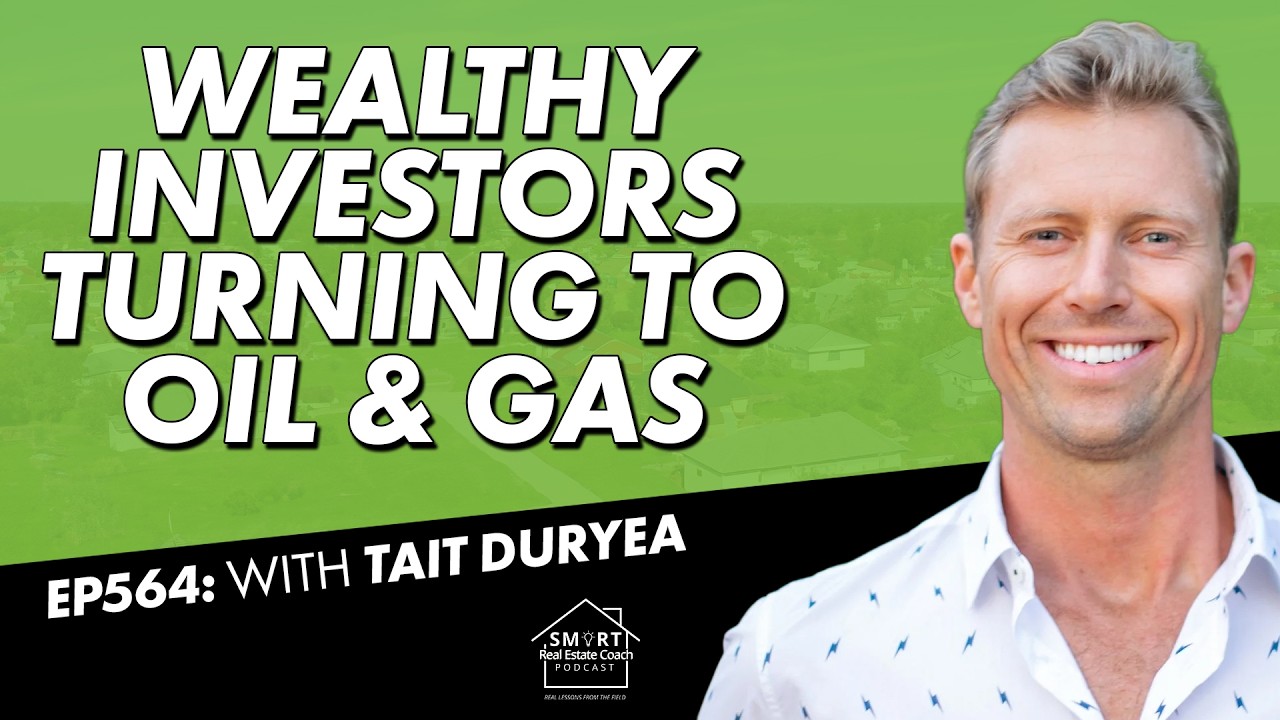
In this episode of the Smart Real Estate Coach Podcast, host Chris Prefontaine interviews Tate Duryea, founder of Turbine Capital, to explore why high‑net‑worth investors are adding oil and gas to their portfolios alongside commercial real‑estate. Duryea explains his background as a former airline pilot turned real‑estate investor, the evolution of Turbine Capital’s focus, and the strategic benefits of oil‑and‑gas investments: modern horizontal drilling with 98‑99% success rates, substantial tax write‑offs (IRC Section 263 non‑operative working interests) that can offset up to 80‑90% of a high‑income investor’s W‑2 earnings in year one, and faster cash‑flow returns compared with typical real‑estate syndications. He outlines entry pathways, emphasizing the Waypoint Energy fund’s $50,000 minimum and the advantage of fund‑level diversification across 40‑60 wells versus single‑well ownership. The conversation then shifts to Turbine Capital’s real‑estate outlook, highlighting bullish positions in senior housing (undersupplied Class A+ market, 7‑8% penetration, 80+ demographic growth), industrial properties under 250,000 sq ft (vacancy <2% when filtered for functional obsolescence), and selective multifamily and self‑storage opportunities. Duryea provides macro‑economic context—rising cap rates, inflation expectations, and the likelihood of continued money printing—and shares contact information for investors. The episode concludes with a brief plug for the podcast’s 3‑Payday System and related services.
Chapters
Welcome to the Smart Real Estate Coach Podcast, your source for actionable, real-life, practical investing advice. Each week we help you make a quantum leap somewhere in your business, your finances, and/or your life. Subscribe, leave a rating and review, and learn more at smartrealestatecoachpodcast.com. Hey guys, welcome to the Smart Real Estate Coach Podcast where we talk about real deals, real strategies, out-of-the-box ideas, and how to build predictable income and long-term I'm Chris Pre. I'm your host. I'm glad you're here. We're going to hang out today and chat with— it's actually a 2-part series. This is part 2. We had his partner Ryan on, I think it was last week or the week before. Ryan talked primarily about self-storage, owns a billion-plus dollars of that. Today we're going to speak with his partner, Tate Duryea. They're both past pilots, guys. He's the founder of Turbine Capital. Hey, Chris.
How It's are you doing?
a private equity firm. They specialize in commercial real estate investments and they were tailored for years for just the airline pilots, but now they've got obviously the gamut, doctors, investors like us, all different types of backgrounds. They've got, he's got, not Ryan, he's got 15,000 flight hours as a captain and a check-in man on the Airbus A321. And he just brings fresh knowledge to the airline industry's people looking for this kind of sidetrack. And then over the years has expanded his funds, as you're going to hear, into not just real estate but oil, gas, and all kinds of really cool things. So there's a home for all you guys here. I'm going to unpack a few different things with him and then on purpose just hit the high points. Then you can always go ahead and get back with Tate at a later date to get more information. And guys, if you have not yet Gone through our basic, basic stuff, our our our books. Just go to threepaydaysbooks.com/podcast and we'll get you a copy of those. All right, Tate. With that as a little backdrop, welcome to the show as part two from your your partner Ryan last week.
Thanks for having me on, Chris. Nice to be back.
You bet. This was cool that you it was your suggestion actually that we did a two part. I like it because coming from a background of not. a pilot and then coming from a real estate background. Today we're going to talk about something totally different because you were telling me off air that oil and gas is something super interesting and you began to list a bunch of reasons. So I'd love to dig into that if you're fine jumping right into that one.
Yeah, absolutely. So I've been a real estate guy my entire life. Started buying rental properties back in, just to sort of back up, how did we get here, right? Started buying rental properties when I was 25 years old. Through and through real estate. My company, Turbine Capital, we primarily focus on commercial real estate in a number of different verticals, but we got interested in the oil and gas space 3, 4 years ago and we started expanding into that vertical. And it is, I have found as an investor and as a, you know, our firm now has an oil and gas division, I've found that it balances real estate really nicely and it's a really incredible asset class. It's a rabbit hole that's like real estate that once you start learning about it and going down into all the different avenues of it, you realize how incredibly vast the industry is and what a great investment product it makes for a small piece of your portfolio.
Yeah. And Let's talk about size. My knee-jerk, as I said to you, I'm curious about it, right? So if the investors are listening, what can they expect? Like how easy can they enter? What size investment, et cetera? I'm curious myself.
So there are a number of ways to invest in oil and gas. You know, you can buy minerals. Minerals are like buying triple-net leases, right? So you own the minerals, people rent them from you, and they Basically take care of everything. You just get a check. The issue with minerals is that there's no guarantee that your minerals are going to get drilled this year, next year, a decade from now. And so cash flow can be unpredictable and there's no tax benefits. What we like to do is we like to invest in new drilling opportunities. And, you know, this, it kind of gets a bad rap. People will say, oh, I lost money in this. Well, as recently as 10, 15 years ago, it was actually fairly, a fairly risky proposition because we were drilling vertical wells and you can kind of think of it as putting a straw down into a layer cake and you want to get that chocolate fudge layer. And through some pretty incredible advances in technology, we're now going down with that straw, getting to the fudge layer and then going sideways. And so we're going down, you know, 18, 20, 25,000 feet and then turning the drill bit sideways over a vertical throw of about 1,500, 2,000 feet and then going sideways for 2, 3, sometimes even 4 miles now. So the commercial, the percentage of commercial viability, basically the success rate, is 98, 99% now. I mean, you're drilling a horizontal well right next to a very successful horizontal well, and the geology has gotten so good. And when you're doing infill and you're going horizontal, the success rate is so high. Anyway, the tax benefits were put into place, which we can get into, back at a time when this was a super risky thing. And so the government actually gave you basically subsidized your investment and said, you know, we'll be a partner with you on this because there's such a good chance that you're going to lose your money. It's not the case anymore.
And that stuff stuck all these years since then?
Say that again.
That stuff stuck, like the tax benefits stuck.
Yeah, the tax benefits came into play in the 1940s. They were codified into the Internal Revenue Code in the 1950s. And this is to take intangible drilling costs and As active tax benefit. That's the key. Real estate is fantastic. By no means am I, do I want all my net worth in energy. It's volatile and the returns frankly in real estate can be higher and more consistent than in oil and gas. However, there are certain vintages when commodity prices cooperate that do very, very well. And the tax mitigation strategy is just undeniable because In real estate, you get your K-1 on a passive deal, or you, unless you're a real estate professional, you can't take those losses against your earned income. So if you're a high-income W-2 professional, you're kind of stuck with this, you know, $50K negative K-1 and you're like, this is great, but I can't do anything with it until of course that deal sells. The suspended loss would convert to an ordinary loss and then you can actually use it. But in the oil and gas space, you might be able to take 80, 90% of your investment amount and write it off against your W-2 in year 1. There's nothing like it. And there's no material participation rules around this. This is IRC, I believe it's 263, that talks about non-operative working interest in oil and gas wells being non-passively treated. So you don't have this passive loss even though you are not materially participating in the well.
So interesting. And then how about the dollar side of that? The second part of that question, how little?
In terms of returns?
No, sorry. The listeners are going, okay, great. How much do I need to get started in something like that? 'Cause a lot of real estate people that I've talked to aren't familiar with it, right? So what's the entry level? It's like, not—
Right, right, right. So there is, and really it's as a passive investor, you know, unlike real estate where you can, You can go and you can buy a rental property, you can buy a duplex. It's very difficult to get the economies of scale to go out and buy your own AFE or authorization for expenditure. So how this works is there's a big industry out there where, let's say Exxon, or which is their drilling company is called XTO, or BP, or some of the more mid-market guys like Devon and Continental, still multi-billion-dollar companies. Once we started going horizontal, these drills cost $10 to $15 million each. So if EOG is going to go drill 10 wells, we talked about $150 million capital outlay. So even they, as a multi-billion-dollar company, like to spread their risk around a little bit. So they have started what is called selling down their AFEs. And so they might take 10, 20% of their drill project, put it out to the open market and sell it to funds that want to participate with them. And so they'll come in, we'll come in and buy 10% of their well package. They handle everything. It's a multi-billion dollar company that's drilling it, but we own 10% of that package. Now, mind you, if it's a $150 million package, that'd be $15 million to participate at 10%. So you're talking big numbers and there's also a lot of moving pieces in terms of the accounting, And so it would be difficult. I mean, you can, as an individual investor, you can go down to an auction and you can bid on stuff. And if you win it, you know, I mean, you might cost you $1 million for the privilege of getting in, and then they're going to bill you for your share of the drilling. You can do that if you're a high net worth investor and you have big enough pockets. You know, you could potentially participate on this on your own. However, because of the The compliance, the accounting, and that sort of thing. It just, it makes a whole lot more sense to invest in a fund. Plus you're getting all this diversification. You know, we'll have exposure and in our funds we usually have 40, 50, 60 wells in a portfolio that you're getting exposure to versus owning 100% of a particular asset, which exposes you to a lot of risk and just concentration risk on that one well. And that's where people lose money a lot of times. They invest in 1 well, 2 wells, 3, and they're being drilled by, you know, not a really established operator that they got in with.
So if I'm tracking along with what you're saying, you're, so your fund, or one of the things you could do with investors is they can invest obviously with you, with your fund.
Yeah.
What are we talking about for the money there?
We have a $50K minimum. Our fund is called Waypoint Energy and Obviously we've been around the block over the last few years and we've added this vertical very intentionally to our business because we think it's such a nice balance to ownership of real estate. I don't think that any more than 5, 10% of someone's net worth belongs in the oil and gas space, but it is an acute steam relief valve for high net worth investors who are looking to offset W-2 income, and it generates a lot of passive cash flow. And And I will also say that it generates a lot faster cash flow than a lot of real estate deals. Real estate, you might take, let's say $100,000 and put it into a passive deal. You're not really seeing much of a return for the next 5 years. It's the nature of real estate, right? You buy a rental property, you buy into a syndication, you're seeing 5, 6, 7% cash flow maybe over the hold period. And then eventually that project goes full cycle, it sells, And you get a nice chunk of cash back. You know, in the non-op space, when we're drilling, these wells come on very strong in the beginning. And so you're seeing most of the cash flow over the 10-ish year hold time where we're using 5 to 10 year target hold times on our funds each year. Most of that capital's coming back to you in the first 24 months.
You know, it doesn't matter if you're brand new to real estate or if you've been doing this for several years or a whole bunch of years. I learned the hard way back during the crash that doing creative deals is much better. It's a much better path in real estate in general than, let's call it, the old way— getting paid once, using banks, signing personally. 3 paydays, getting paid 3 times on a deal, it's better. 3 ways, not one. Money now, money over time, and money long term. And I don't care if you're in an up, down, sideways market, it doesn't matter. You can and should operate with the utmost confidence. There's literally nothing I love more than helping people create systems and simple systems and processes to become massively successful with our 3 Payday System, and doing so in literally any market and doing it geographically literally anywhere. So if you've been learning and learning and listening and studying and not taking action, I'm telling you, after going through it myself, it's costing you tens of thousands, if not hundreds of thousands of dollars by not taking action on the 3 paydays the way you should be getting paid. Many of the people that were brand new, just like you, that joined our community have fast-tracked their startup. Now, I mean, wouldn't that be ideal? If you said, okay, should I go fast or slow? Should I take action now or later? It's costing you too much money to wait. Each one of you are at a point in your life, I'm sure, where you want things to be easier, you want things to be better for you and your family. You probably realize that you not only want more, but you deserve more. in this life. So, to be able to give your family everything they want, build a legacy for you personally too, and to have time freedom to start enjoying life, frankly, whatever else you're seeking. And for some of you, now's the time, for example, to just focus on security. Maybe it's building a big solid bank account for retirement. We take these things super, super seriously, and it's my life's biggest reward to help you achieve them. I want to give you a free discovery session with our team. It's free. It's 15 or 20 minutes. You have zero to lose and everything to gain. And to understand how you might fit into the 3 Payday System that we've done now in over 80 markets as of this filming, go to smartrealestatecoachpodcast.com/discovery for a free call with our team. smartrealestatecoachpodcast.com/discovery. Because it's not whether or not you can do it or whether or not you fit. You can do it. It's whether or not you'll take action and do what it takes. And we can guide you through that process. That's smartrealestatecoachpodcast.com/discovery. We'll see you soon. So a little bit more aggressive on the coming back here, correct?
And then it drops off after that. So these wells come on very strong in the beginning, lots of cash flow in the beginning, and then it starts tapering off pretty dramatically. And so anyway, that's it. It balances. That's why I say it balances real estate very nicely. You make an investment in '26, You get some really strong cash flow coming into '27. It's going to crescendo as everything comes online, and then as they start to deplete those, that cash flow distribution starts to wane, and then you'll continue receiving those distributions at a lower and lower and lower rate over the years. But because you got that massive upfront tax write-off, the IRC's sending you a big refund, plus you're getting all this cash flow. And so it really increases the velocity of money, and that's why I love it. And then you can take those proceeds, And plow it into longer-term real estate deals. Awesome.
In case they didn't hear Ryan last week in this 2-part series, how do they reach you, Tate, for any information about this? And then I want to pivot a little bit to the real estate side and just see what's going on there.
Yeah, for sure. You can reach out to me directly, tate@turbinecap.com. We also have an investors@turbinecap.com email that goes to our entire IR team, including myself. Our website's turbinecap.com. You can check us out there as well.
Awesome. Let's do this. Let's talk to them about some of the real estate stuff you got going on. Yep. What are you liking right now? What's going on on the funds and on that side of things?
I think that in general, it is a just amazing time to be getting into commercial real estate. If you have dry powder, it's fantastic. Chris, as you know, You know, we hit the peak of the market in 2022. Interest rates shot up, valuations are down, cap rates have expanded from, you know, low 3s up into the 6s. So I think it's a back the truck up moment in time where we're at the beginning of a new cycle. I think real estate, probably residential as well as commercial, will trade sideways somewhat for the next 2 to 3 years and then really take off as wage growth kicks off again and we see more meaningful inflation. When we look at, and I know this is taking a little bit of a roundabout way to your question, but I think it's relevant. When we look at our national debt as a country, there's only 3 ways out, right? You can raise taxes, you can spend less, or you can print money. Which one do you think the government is going to do?
Easiest route.
You're going to print money, right? You're going to inflate out of the debt. And so I think that, you know, you probably agree with me when I say that long-term inflation prospects are grim. I think that we're going to see inflation rear its head again. And while that means that interest rates may rise, which is bad for real estate valuation, inevitably, Being in hard assets is where you want to be. So with that, you know, you asked me what do I like within the commercial real estate sector? I'm bullish on a couple asset classes right now, primarily senior housing, but senior housing is a very complex asset class. And so, I mean, we could talk for hours on that, but the demographics are just insane.
Crazy.
It's the fastest growing segment of the population is 80 plus. We have, we're at a 15-year low on construction of senior living facilities and market penetration for those facilities is only 7 to 8%. So it's not everybody that's moving in, but we are vastly undersupplied, especially in the Class A+ market. Baby boomers control 51% of the wealth in America. So if you think that baby boomers don't have money to spend on refined, dignified, high-end, you know, luxury senior accommodations where they can hang out with their friends and have activities and things like that, you're dreaming. Aging in place is fine, but loneliness is a real issue with seniors. So anyway, I'm very bullish on that asset class. I'm bullish on industrial in certain segments of the industrial space, particularly the smaller square footage stuff in prime corridor markets. And that's just because of the multi-decade trend that's happening where we're kind of decoupling with China and there's a deglobalization trend happening where we're bringing manufacturing supply chains back home.
And what do you consider smaller, just to give them a context of that?
Sub-250,000 square feet. So really sub-150,000 square feet. You know, when you look at the bomber facilities, half a million square feet and up, that's an oversupplied segment. San Bernardino, huge Amazon facilities, way oversupplied. But when you, if you filter national vacancy in industrial by sub, let's say 200,000 square feet and for functional obsolescence, the vacancy rate is less than 2%. And what functional obsolescence means is Yeah, I'm a manufacturer. I want to rent this building from you, but the clear height isn't big enough. It's not tall enough for me. So modern, when you look at just modern facilities that are up to standard of what the tenants are looking for, that vacancy drastically falls. So it's a little bit of, it's a little misleading when you see the national vacancy rate of industrial being 5-ish percent or even more. You have to filter down. You gotta drill down there. So, and then I think multifamily just got so beat up in the last cycle that there are certain submarkets that just make sense from a value perspective. You know, you just look at it and you're like, you know, how do you, you can cash flow on day 1 with a 6% interest rate. I mean, that's a good deal.
Yeah. And that's because that's just pure math and those are easy.
Yeah. And I have to give a shout out to my, Compatriot Ryan Gibson as well. I love the storage industry. You know, there's certain submarkets that were overbuilt, but the fact that nobody's moving, yeah, that's a, that is a downward, that provides downward pressure on NOI for self, for the self-storage industry because when people aren't moving, people aren't renting as much storage. So at some point the mortgage logjam will start to clear. People will start buying homes again and moving. And the self-storage will definitely have some tailwinds from that.
And do you have all 3 of those in your— keeping storage aside for a second, do you have all 3 of those in your aggressive right now? You're pursuing all 3 of those?
We currently are pursuing industrial and senior housing primarily. Ryan, obviously he was on previously and he focuses only on self-storage.
Yeah.
We're very agnostic. We sort of scour macroeconomic trends and look for where we want to participate in any given year. But, you know, I think you could probably add manufactured housing to that because affordability is such an issue. But for us, senior housing and industrial are the 2 big focuses right now.
Love it. You were lying. I was waiting till you were done to tell you this, but if you go back, I don't know, 5 or 6 episodes. Lon is his name. You align with a lot of things he was saying with statistics and whatnot. So, very interesting. I on purpose hit those top-level takes because I think you could go into— you could probably do an hour show on each.
We could.
Absolutely. Yeah, I know you could because you're super knowledgeable though. So, one more time how these guys can reach you, please, and I'll make sure we have everything in the show notes because those are going to all Require conversations, I would think.
Absolutely. Well, you know, our, our company was originally formed as a, as an airline pilot investor network. So that's where the, the name Turbine Capital came from, like a turbine engine. So turbinecap.com is where you can find us. We're certainly not just restricted to pilots. We have lots of surgeons, doctors, business owners, uh, all sorts of people in our network now. And, uh, and we're growing like crazy. So, uh, come check us out. And again, uh, investors@turbinecap.com is probably the best email address to, uh, to reach out to us at.
Love it, Tate. Thanks for being on, buddy, and making closing out part two of two. Thank you, buddy.
Thanks for having me, Chris. Always a pleasure. Good to see you.
All right, guys. That wraps up our time today with Tate. Appreciate you guys being here. If this episode helped you, share it with someone who needs it, please. When you're ready to take this beyond just listening, head over to smartrealestatecoach.com and let's get to work. Talk to you soon. See you next week. You know, guys, for years I've been at the business now thirty-four, but for years. We had some rent collection things in place. We had bookkeepers in place. We had marketing to go to all these different websites. Now we simply go to prosperity.io. It was built with us and you in mind. You can market your first property if you're brand new. You can scale if you're already in the business, but you can market your properties across 50+ platforms in one click for way less than hiring a pro. You can easily collect rent online, so it's like an escrow service for you. You can track payments, you can get monthly reports so you know how your investments are doing, or if it's your first investment, and no tech headaches, no guesswork, just smart tools to help you grow with confidence. Get started now at prosperity.io because every portfolio starts with a powerful first step. All right, thanks for tuning in to the Smart Real Estate Coach Podcast. If you got value from today's episode, guys, be sure to subscribe so you never Never miss a future episode. It literally takes one nugget to access some of the things we're doing. And when you're talking the amount of the size rather of the paydays, it's an opportunity cost that you can't let go. So don't miss an episode. And for goodness sake, share it with someone who needs to hear it. If you're ready to find your best path for getting started on your real estate investing journey in general, head over to smartrealestatecoach.com/getstarted. We're going to help you take the guesswork. Out of your next steps. See you in the next episode.
More from Chris









Episode 575: Redefining Retirement as the Day All Your Choices Open Up with Doug Bennett

