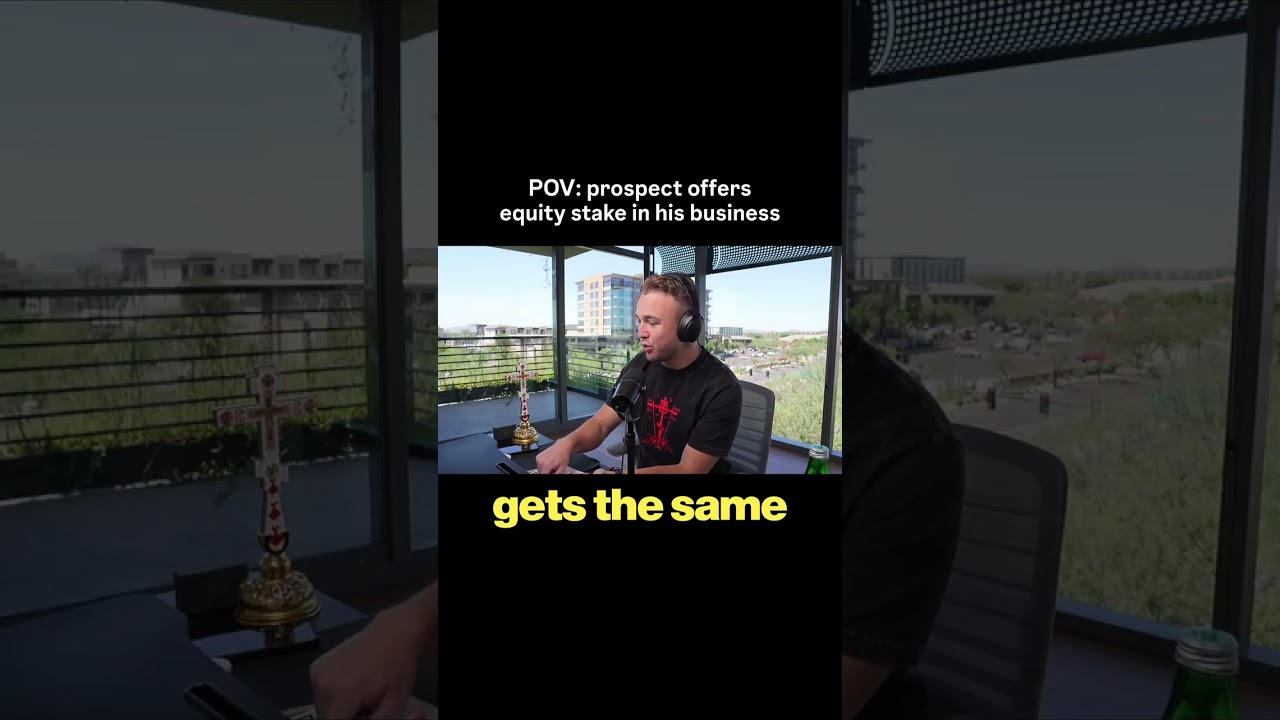
In this short YouTube role‑play, Christian Polk (the service provider) negotiates with a prospect who proposes an equity‑for‑services arrangement instead of paying the standard $25,000 upfront fee. Christian repeatedly asks why the prospect prefers equity, then outlines the drawbacks of a deferred‑payment model: lack of guaranteed cash flow, inability to staff a dedicated full‑time team, uneven attention across multiple clients, and misaligned incentives. He emphasizes that his firm’s value comes from providing consistent, same‑level support and on‑ground staff to ensure the client’s success. When the prospect pushes back, Christian offers to discuss breaking the $25K into smaller installments, keeping the core requirement of upfront payment while showing flexibility. The dialogue showcases a persuasive, firm sales approach that defends a traditional fee structure over equity‑based compensation.
Chapters
All right, so it's gonna be $25,000 to get started.
How about an equity stake in my business? That'll make you a lot more money in the long run.
I mean, maybe, but why do you feel like we should go with that model?
Well, instead of me investing the $25K, you'll make a lot more than that potentially, and I can, you know, that's just a better bang for your buck, and—
Yeah, I mean, maybe, man. Can I tell you why, like, that's not the way we do things?
Oh, I mean, are you flat out rejecting me already?
Yeah, well, it's just like ultimately, right? It comes down to what makes sense and what's going to get you the best results. So if we did it your way to where we work all for free and then we just get this big payout like at the end where we take a percentage or whatever, whatever it would be, would we be able to have full-time staff dedicated to you before we get our payday?
Well, I guess not. No, no, that's right.
We have no money coming in. And then at the end of the day too, right? If we, if we do this, like you want to be the only client we'd be taking on, we'd be taking on multiple clients doing it this way too. So what happens If we feel like, hey, your actual project, yeah, it's gonna give us some money, but this project over here is gonna give us so much more money, who are we gonna put our attention to?
Obviously the one that's—
yeah, right, man. The reason we do what we do is because number one, we make sure everyone gets the same level of support. Number two, we have full-time support staff and people who are actually on the ground that are gonna help you get this business up and going. Okay, so that way it makes more sense For us and for you, and we get people better results. So do you want us to be actually good at our job and get you good results?
I want that, of course.
So you're gonna have to pay upfront for it, bro.
Okay, well, I guess last chance, man. I mean, but I guess I go to upfront.
So if you want better results, man, we're gonna have to do it upfront, right? And if there's something that we need to do to like break it down to make it easier, we can do that. We can have that conversation, but we just need to make sure we're having the correct conversation. You know what I mean?
I know what you mean. Let's talk about splitting this up. That makes, uh, makes things easy for me.