4 Successful Manager Skills - New Manager Tips! Ft. Ramona Shaw
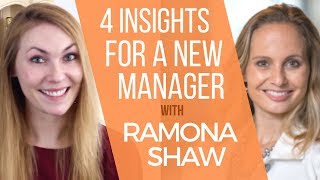
Ramona Shaw explains why skills that made you successful as an individual contributor won't work as a manager. She outlines four shifts: stop relying on old strengths, learn to adapt your style to different people, get honest feedback about your blind spots, and find mentors or coaches. Sixty percent of new managers fail in their first two years.
Questions this video answers
August 22, 2019.
60%.
ramonashaw.com.
Chapters
Hey, everyone.
This is Self Made Millennial.
I'm Madeline Mann.
Today you'll learn how to be a.
Manager for the first time by making four key shifts in your behavior. This channel is chock full of career advice, so make this your professional development moment of the week by subscribing to this channel and hitting the bell for a new video every Thursday. I have an expert on today's video. Her name is Ramona Shaw, and she is a highly talented. And her specialty is coaching new leaders to embrace leadership behaviors, skills, and habits to develop increased productivity, confidence, and success. So, yeah, she knows a thing or.
Two about today's topic.
And stay to the end, because Ramona reveals a simple and highly actionable solution to get quick feedback from your team and in a way that won't intimidate them or make them feel like they should hold back. Let's go. Hey, Ramona. Welcome to Self Made Millennial.
Hi. So good to be here.
Yes. And today we're talking about going from an individual contributor to becoming a manager, something that you have dedicated your career to. And I would love to hear why you find this such an impactful transition.
It's a great question, because oftentimes people think, well, it's just the next step in my career, when in fact, it's like something complet different, right? It is. It is what I believe the biggest transition in someone's career. And I recently was thinking about this metaphor a little bit as I was looking back at Holly vacation pictures, and I was in Costa Rica, and I was watching these little turtles. They pop, right? And then they have to run on the sand to not get eaten up by vultures. And then they dive into the water and they have to swim against the current for 24 hours to get out in the open water. And I thought this is kind of a really neat comparison to management because you're kind of running on the sand as an individual contributor. But then when you jump into leadership, it's a new environment. It's different temperature. It's no longer sand. It's the water. And the current is actually pressing against you. So you have to really swim, swim, swim, swim, swimming until this feels like the new comfort zone.
You're flexing completely different muscles, learning totally different skills. And I'm really interested to hear you have four shifts that you think that really make a successful leader. And I think this is the perfect lead in because I know the first one is what got you here won't get you there. And I'm very curious to know what you mean by that?
Yeah, it's a little bit that comparison with the sand and the water. Right. Often think, well, I've been successful and that's why I got promoted, obviously, so I'm great. But what people forget is that the skills that they've built throughout their education, university, college, first years in their job as an individual contributor are actually not at all the skills that will make them successful as a leader.
So how do people then begin to find out what those skills are and begin building those muscles?
Yeah, so that. And that is a nice leading into shift number two, because as an individual contributor, it's a lot about oneself. Right. How great am I doing in my projects and how great am I performing and how much can I get done? But then when you shift into a leadership role, what the key to understand is that even if you can do the job, if you can't get the team and the stakeholders aligned with you and on board with you, you're not going to be able to get the job done.
What are some of the ways that then a new manager can build that alignment and build that rapport among other people?
So the way to train those muscles is to understand that not everyone is the same way.
Right.
My one way of being is now needs to be challenged a little bit. And I don't say you need to change completely, but I'm saying in order to be successful with your stakeholders and with different personality types on your team, you need to flex your style a little bit. You need to adapt and understand, like, hey, what is that person meaning for me? What is important to them? What drives them? Do they love frameworks and data or do they love connection and collaboration or do they love facts? Like, what is it that they value and how can I convey my message to them and interact with them in a way that suits their style?
So if someone was to do one thing today to then start being better at building these relationships, finding out how people are different, what would you say is the first step?
Yeah. So a simple thing that everyone can start doing is to ask questions. And those can be short questions, but just with the curiosity mindset of, hey, let me try to figure you out a little bit more. You can ask questions of, hey, what gets you up in the morning that gets you excited about this work? Or you can ask, what do you love about people? What is something that they do? And you go like, I love it. This is so awesome. Or what was an email that you received this week that you felt like, wow, it was so well written and like, to the point. And I got it as far as.
Really uncovering both like our strengths and blind spots. I know that is one of the things that you really are focused on. What are some of your tips you have around that?
Yeah. So strengths and blind spots is all about understanding that there's things we don't know. We don't know. Right. I know. I don't speak Russian. I know. I don't know what the inside looks like of a tv. Well, I know what it looks like, but I don't know how it works.
Right.
I know those things. So one of the process that I usually use is to do a 360 degree feedback assessment that my clients to explore those. Because now we're asking people in their environment specific structured questions to explore and pull out some of those blind spots so that people then look at the 360 feedback report in a debriefing session, maybe for example, and they look at me and say, oh my God, I had no idea this was an issue. I had no idea the impact my action had. Because we judge ourselves based on our intentions. Right. But other people judge us based on the impact my action had on them.
But what if we don't have those kind of resources? What are some ways that we can uncover these strengths and blind spots on our own?
It's a great question. A great tool to use that doesn't require much help is to ask people for advice. So instead of asking, hey, can you give me some feedback about the last month or the last year? And then people think like, oh my God, feedback and feedback. I get anxious and nervous and oh, I don't want to do this. Instead ask them for advice. So maybe you can say something around, hey, I'm going to have this big presentation next week and I know you've done presentations like this in front of the company or the clients a lot. What is some advice that you would have for me or some suggestions for me? Or you can say, hey, I want to get better at building connection with my team, really being there and present with them. And I know you've led teams for a while. What pieces of suggestions or advice would you have for me to get better at connecting with my team members?
That is really neat because I think you're right that feedback does. Especially if you're asking someone who reports to you, that is a high pressure situation. But if they know that you are very long winded in your presentations and you ask for advice and they say, well, maybe fewer words on a slide, I would say maybe rehearse so you can get it down to a short pitch. I know the audience will really want you to be concise. You're kind of giving it in a way where, yeah, it's feed forward. You're not as harsh as it might make you feel more vulnerable. That is something I'm going to put in my tool belt. So thank you for that.
Yeah, that's really helpful.
And so let's bring us home with your fourth shift, which is don't go it alone. Tell me about that.
Given that there's so much to this, where you go from the sand environment into the water. So what got you here won't get you there. So it's these different skills. You need to really focus on relationships. You need to understand that you need to adapt your style to different personalities. There's not one size fits all. And because of importance of this transition, the shift number four is to understand that you should not, please don't try to do this on your own. And there's a lot of resources and tools and support out there that can help you navigate this transition better. Find support groups, find other people who go through a similar transition. Find a coach, find a mentor. Check with your boss. What leadership development courses, seminars, coaches can I do programs can I invest in? Because this is an investment in yourself. And there's a lot of research out there that say the research depends a bit, but it goes around. 60% of new managers fail within their first two years. So they either fail, they get demoted or they're underperforming and there's a real issue. 60%. Right. And so knowing this number, that ought to stack against you. And if you're not getting the help and the support around you to have those conversations to navigate the transition, your chances of failure or underperformance are just way too high to risk it.
Are there any courses or any resources that you want to give a shout out to that you think are especially helpful?
I have a masterclass that talks about these four shifts in more detail@ramonashaw.com masterclass and then I have a lot of different resources in terms of like, is it time management or communication? And I'd encourage anyone who listens and thinks like, hey, I want some help. Reach out to me. Contact me via ramonashaw.com contact and I am happy to connect you to my network or guide you in the right direction to whatever seems to be the most appropriate and best next step.
Amazing. Well, Ramona, thank you so much for coming on today.
Thank you for having me. Madeline. Thank you so much and wi fi hi 5.
More from Clegg





AI Won't Tell You the Full Truth | Arthur Brooks + Simon Sinek | A Bit of Optimism Podcast



How To Make the Best Decision | Arthur Brooks and Simon Sinek | A Bit of Optimism


