A Bit of Everything with Adam Grant | A Bit of Optimism (Podcast): Episode 17
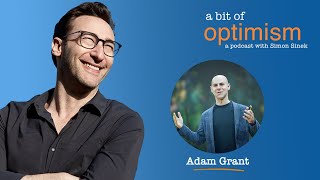
Transcript of a podcast episode (Season 2 kickoff) of "A Bit of Optimism" featuring Simon Sinek and Adam Grant. The conversation ranges across optimism vs defensive pessimism, leadership humility, hierarchy and cooperation, creativity and ‘genius’, worthy rivalry between Sinek and Grant, and reflections on speaking and writing. Tone is conversational, reflective, and evidence-informed.
Chapters
Welcome to season two of A Bit of Optimism. I'm thrilled to be back. And to kick off the new season, I decided to invite Adam Grant. Adam is an organizational psychologist, a New York Times best selling author, and one of the top rated professors at the Wharton School. He's also the yin to my yang. He has a breadth of knowledge that few others can even come close. It's kind of unbelievable. So instead of talking about something specific, we decided to talk a little bit about everything. And it was really interesting. This is a bit of optimism.
I invited you to be here because I love you, because I love your work and I love you and I love your perspective on the world. When I was thinking about what I wanted to talk to you about, you know, there's so many things that you've done that I find interesting.
That I actually in the end, decided not to pick a subject.
You know, you. You use the word love, and I have to say that's a strong word. I don't know if I love you, but I do like you a lot and I find you endlessly fascinating.
I love your work.
That's much better. By the way, if. If somebody has a choice between loving me and loving my work, I would rather they love my work and like me than vice versa.
Yes, that's true, but that's a whole different podcast.
Yes, it is. So how am I? I am. I'm good. And you?
Yeah, I'm fine. I find these times fascinating. I like disruption.
You're an alien.
No. You know Dr. Carson's work. Dr. Carson. James Kars, in his explanation of finite mindedness and infinite mindedness, tells how a finite minded perspective, all of the thinking is done in the past.
So that's why finite minded fears surprises and fears uncertainty, because they don't like those things, which is why there's so much preparing. So athletes are constantly practicing, practicing, practicing, practicing so that there are no surprises. And you know, in the military they're trained and train and train and train and train so there are no surprises. And you hear them say this all the time. They say, I didn't have to think, think. I just relied on my training. I didn't have to think. It was just the muscle memory. And so problems happen when there has to be new thinking in the moment. An infinite minded perspective is embracing uncertainty and surprises. The thinking begins now. You throw out all the old stuff because it's irrelevant, and new thinking begins. And so the reason I like disruption is because it forces new thinking.
I think that's the most compelling explanation I've ever heard for your alien mind and the way it works and, you know, but, but Simon, it, it actually, it. It highlights one of the things that I've learned from you. Even before we met, when I was watching your, your TED Talk and then some of your other videos, I remember watching you think out loud and thinking, I wish I had the courage and the comfort to do that. And then of course, my next thought was, well, maybe I could learn to do that. And I will never do that as, as well as you do, but it's been an aspiration for me and I think it's something we need more great thinkers to do because otherwise it almost seems like. It seems like a book or an idea or a talk kind of emerges fully formed from Zeus and we never get to see the stumbles and the contradictions and sort of the big gaps in our thinking. And so I love the way that you're actually willing to put your thinking out there because it sort of normalizes this idea that you may have a lot of good ideas, but not all of them are going to stand the test of rigor.
And thank you. That's very nice of you to say, and that's very true. And you can actually watch the progression of a thought too. It's like when I first started publicly talking about Finite and Infinite Games. It was a rough and tumble talk, but it's online. I did one for Google very early and I like, cringe at some of the things I've said, but there it is. It's on YouTube and it's not a fully formed idea. I don't know where it comes from. I mean, look, people ask me, how do you become a public speaker? And you know, I always tell them I cheat and I do two things, which is I only talk about things I care about. I only talk about things I understand. That doesn't mean I have to know all the details, but I have enough of a framework that I can actually have a conversation about whatever it is I'm talking about. And it's like two people sitting at dinner. It's like we're constantly having conversations about things we don't understand. We talk about politics, we talk about COVID yet none of us are scientists and none of us live in Washington.
And.
And yet we all talk as if we know all the details. And some of it's quite compelling, and some of us actually have some really interesting ideas to contribute to those things. So, you know, I know enough to be dangerous in whatever I'm talking about. And that's it really? And I think a little bit of courage. The first time I ever talked about Finite and Infinite Games publicly, I was inspired by Seth Godin. He and I were speaking at the same conference. I was hired to speak about Leaders Eat Last, which is the book that was out at the time. He went before me and he gave this wonderful speech about courage and taking risks and doing dangerous things in his wonderful way that he talks about these things. And literally, he came off the stage and I went up next and I said to the audience, I'm supposed to talk about this thing, but would you like me to talk about something that I've been thinking about but have never talked about publicly? And they all clapped. So I went, all right, this could suck. Here we go. And it was really that. And the audience is so supportive.
I think there's so many things I want to ask you about from that and a few reactions as well. But the first thing is I always thought that a talk had to be the final draft. And you said, you know what? I'm going to not only show you my first draft, I'm going to write my first draft on stage. And the only other person I know who at least is willing to admit to doing that is Trevor Noah. I remember going into the writer's room at the Daily show and asking him, you know, what his process was. And he said, well, you know, the hardest thing about doing the Daily show for me is when I do, when I do standup, I go in with a bunch of prepared material. But I usually end up thinking I have a more entertaining thought while I'm on stage than what I plan. And I, I end up throwing out all my material and inventing 90% of it on the spot. And I don't really have the freedom to do that in front of a camera. And I guess, you know, I, I, I'm curious about when, when you've regretted writing your draft on stage and when it's actually served you well. Because I, I imagine there are some times where it makes sense to do it, and there are situations where you might want to be a little more polished.
Yeah, that's true. So back when I was, when I was in marketing and advertising and worked for big companies, I remember watching these really powerful speakers on stage, and I would buy tickets and go to these conferences and see people like Seth Godin, you know, giving talks, and I was just blown away by how natural and spontaneous they were. And I actually had the false belief. I assumed that they were speaking extemporaneously because that's how good they were. And so I thought, whoa, that's a high standard. And so I literally thought, that's the standard I have to live up to. And so I practiced to do that, only years later to discover that they all rehearse and practice and memorize. And I didn't know that I. Because it looked so natural, I thought that was the standard I had to learn. So I learned the wrong thing. But it also happened when I was. I remember I would give formal business presentations with my PowerPoint, and I was having more ideas that were ahead of my PowerPoint, and I kept going ahead of my slides or saying things that were more interesting than my slides and having thoughts that add dynamism that wasn't on the slides. And the slides kept tripping me up. And so one day I thought, just let's bag the slides, because they keep getting in the way. And so it wasn't that I just decided to do it. You know, I had these prepared remarks, and I realized that I was comfortable enough. I got comfortable enough speaking beyond the slides, and then just trusted that I could do it without them. So I got rid of the safety blanket, and I think that's all it is. I think people cling to the safety blanket. It's like. I remember when I was learning to swim, you know, I had. I don't know what you call them in America.
I think they're called floaties.
Floaties. They call them armbands where I grew up. And so I had floaties on, and they were filled with air, and I'd learned to swim, and my mother would let a little air out as I was getting better at swimming, and I was at the point where they had no air in them. They were completely deflated. And my mother's like, you don't need them anymore. And I insisted on wearing them. And I think that's the PowerPoint for most people. You don't need them. You're not using. Makes you feel better when you jump in the pool.
I think that's a. It's a great metaphor, Simon. I want to actually circle back to something you alluded to.
Adam. It's so nice to be on your podcast.
You know, old habits die hard, right? No, no. But I feel like this is a rare opportunity where I don't have a script for what I want to learn.
Right.
I get to react to what I'm hearing in real time, which is always fun.
But you. You.
You alluded to something that I think is really fascinating, and it's it's actually something I've wondered about you on and off, but I don't think I've ever. I don't think I've ever thought to ask you about it. So you call yourself an optimist? Yes.
Yes.
I think you still. You still consider yourself. Is it still your identity?
It is.
Okay. And yet you were describing to me something that I associate much more with defensive pessimism. Have you. Have you come across that work in psychology at all?
No. Tell me about it.
Okay. So there's this psychologist, Julie Noram, who I think, in part, in reaction to the abundance of conversation about how we all need to be positive and cheery and optimistic, she studied this. This strategy that. That I recognized in myself. And I never know where I stand on this spectrum because I identify with both sides of it. But the gist is, think back to when you were in school and you're preparing for a big test. The strategic optimist would create this mental picture of just mastering the material, and that image would energize you. You'd study hard, and you ace the test. The defensive pessimist has a slightly different emotional experience, which is about a week before the exam, you wake up in the middle of the night in a cold sweat that you did so badly on the tests. You not only failed, but your instructor took away points on all your previous exams because there's no way you could earn those right. And that. That panic sends you into a frenzy of, you know, a motivation. You prepare hard, and you actually perform every bit as well as the optimist does. And when you're. When you actually track strategic optimists and defensive pessimists, they are equally effective, provided that a few things are true. Number one, the defensive pessimists have to be nervous far enough in advance that their anxiety can motivate them to prepare. And then number two, you have to be careful not to make them too happy early on, because then they get complacent and they don't do all this prep work, which is hilarious. Right. It's like, okay, if you're a defensive pessimist, you either get to be anxious upfront and successful, or you can be happy and bomb it.
Yeah.
So I. I was interested, one, in your reaction to that. But two, the level of preparation you're describing, it sounds to me like you have a little bit of defensive pessimism in you despite being an optimist.
Yeah. So I don't want to go down the semantic rabbit hole here, but based on her definitions, sure. I'm absolutely the defensive pessimist. I mean, you described my behavior. Yes. Though both of those seem like pejorative terms. So nobody wants to be described as, you know, a defensive. Like try, try calling your spouse a defensive pessimist in an argument. See how that goes. You know, the, the way I define optimism is not my, my work process, which sounds more like defensive pessimism. The way I define optimism is, is I generally believe the future is bright. What I choose to do is focus on that. There was a scientist in England. I'm trying to remember her name. See, this is where I adore you and where you're so good. And I have, you know, and we'll talk about worthy rivalry later, but this is where you are so good is your rigor and your ability to remember every study, every scientist, the details is fantastic. I have like these general recollections about what the, what the work is. But there's a scientist in England that I met, but I can't remember her name.
Well, tell me about her work, maybe I'll know it.
She was doing work in optimism and she'd actually come up with a test on are you an optimist? And where are you on the optimism spectrum? And so it was arranged for me to go and like take her test. And I was petrified. And because here I am with the self definition of being an optimist. What if she tells me that I'm like below average based on her assessment? So I had this horrible fear of taking her test. I didn't want to take it. You know, if you don't go to the doctor, you're not sick. You know, same idea. So anyway, I went and took this test. And the way that she tested for optimism was how bad news affected you. So there was a baseline where she gave you all of these scenarios and your reaction to them. And then she added some bad news to the section and then did these follow ups. And most people, they're like, let's say, I mean, pick a situation. You know, you go to work, your boss is in a really bad mood or something horrible has happened in the world, you know, and she gets some pretty dark stuff like cancer and stuff like that. How's your day gonna go? Some stuff like that. And, and once you're given the bad news, your baseline goes down. That's sort of, I think that's the gist about. She did it anyway. What it turned out was even in the space of bad news, I either stayed the same or went up in what I believe the future would be. That's how I choose to define optimism.
I like it. Well, that. That tracks with the. With the Marty Seligman definition of optimism, which is a style of explaining the events in your life. Right. And processing them in a certain way and saying, look, just. Just because something went horribly wrong doesn't mean it's my fault. Right. It's not necessarily personal. It doesn't mean it's gonna ruin every part of my life. It might not be pervasive, and it might not be this bad forever. So it's not totally permanent. And what I've always loved about that, that way of thinking about optimism as a style of processing events in your life is that means we can learn it and teach it. And so what it says to me is, even if your name is Simon Sinek, Right. You're Liter. You're literally a cynic.
I know.
And even if you. You imagine the worst case scenario and then try to prevent it. Right. You can teach yourself to process events in such a way that you don't always just see the worst in them.
Yeah.
Which is kind of. Kind of liberating.
And optimism is not Pollyanna ish either. People come to me like, you're grumpy. I'm like, yes, I'm grumpy. I'm very, very cynical. I'm often judgmental. You know, it's like none of those have any bearing on the fact that I still believe the future's bright.
Well, you're. You're a disagreeable optimist. I love it.
I am. How do you define yourself?
I've never known what to do on that, you know, on. On that axis because I feel like somebody called me an informed optimist once, and I liked that because it. It signaled not Pollyanna. But I think you're right. We shouldn't associate optimism with. With being a Pollyanna. In fact, there was a Teresa Mobile study years ago where she did this, what, early 80s. So basically what she did was she gave. Sorry, I'm doing it right now.
I know. I love it.
Must be so good.
I'm a little disappointed you didn't tell me the exact date, but we'll let it go.
You know, I'm pretty sure it was 82.
The paper is titled Brilliant but cruel, but I'm thinking it might be 83. Anyway, so what Teresa did was she gave people book reviews, and the content was identical across the different conditions in the experiment. So, you know, as the book was evaluated as, you know, as. As looking into these themes and all she did was she varied the tone. And sometimes the reviewer was overall enthusiastic about the book, and other times the reviewer was critical and the critical reviewer was judged as smarter, even though the sophistication of analysis was the same. And I thought that was such a problem. And I see this, by the way, when I mentor doctoral students is right around year two, the only thing they can ever do when they read a paper is tear it apart. And I'm thinking, okay, some of the smartest people in the world in this field wrote this paper. It got through the standards of our top journal. And you, a second year PhD student, think it's garbage. What's going on here? I think we have a culture where you learn that you signal your intelligence by tearing other people's work apart. And I think it often takes much greater intelligence to build an idea than it does to destroy it.
Oh, that's so good. That's so interesting. I wonder if it's. Did the paper comment on where that. What they believe the root is of that response?
I think the gist of Teresa's analysis, we should ask her. But as I remember it, she said, basically, if you're critical, you're seen as having higher standards, you're more discerning, and if you are positive, that signaled that you were easier to impress or too gullible.
Interesting. And I wonder if there's also insecurity in there as well, which is I have to prove that I know something and to simply agree. I don't get an opportunity. I don't get any mic time.
You know, that's right. Yeah. I'm offering nothing.
Great analysis, you know.
It'S. As opposed to the ability to sort of. Yeah, it, it makes logical sense. It is disheartening, though, isn't it, that the way that we perceive people as smart, as if they're critical. I mean, turn on the fricking television. All we have is a culture of blind criticism to the point where we've. We've even lost the interest of asking the person or following up. We lodge our criticisms and our analysis before we even just say, hey, what did you mean by that? Can you clarify your point? I don't understand. Do you know of any research of people in leadership positions who express doubt or uncertainty about their own intelligence? In other words, I don't understand.
Yeah, there's a whole body of research on this by Brad Owens and his colleagues. So they study it in terms of leadership humility. And one of their most interesting findings is you normally think, you know, a leader on the extreme end of humility is basically going to be too self deprecating. And if they go to the opposite extreme, then they're going to be a narcissist. Well, it turns out those two axes are independent. And so there's a group of leaders that Brad calls humble narcissists, which sounds like an oxymoron, but they actually are rated as the most effective leaders by their teams. They also end up having the most productive and creative teams. And this has been shown in both the US And China. And I think it's a little bit of a misnomer to call a leader a humble narcissist. I think what we're really talking about is confident humility. And as you know, it takes tremendous confidence to say, I don't know, right, to recognize that you are capable enough, that you've established enough credibility, you know, that you can admit when you're uninformed or when your knowledge is incomplete. And so I think in his data, what he would tell you is that when leaders are able to do that, right? When they're able to say, you know what, we're in the middle of a pandemic. I have no idea how we should be evolving our strategy and I'm not sure if we should be reimagining our products or our services. But I am confident that I have an amazing team around me and that together we can figure this out, that that's what really builds trust and credibility and leadership. Is that the kind of thing you were driving at?
Yeah, that's 100% what I was driving at. Because some of the best leaders I've met, and I love it when senior, senior leaders take somebody that they respect and put them in charge of something that, that they have no experience in. And the good leaders who in those positions, and I've had the opportunity to meet some of them, you know, I show up on the third or, you know, their third week of work. I'm like, hey, how's it going? They're like, dude, I don't know anything.
And they're very open about it. They show up on their first day and they say to their teams, hey, guys, I don't know anything. You've been doing this for years. I don't, I haven't. I'm going to ask you a ton of questions. I'm going to lean on you. I'm going to try and learn as much as I can. But I'm here to give you the space you need and the top cover you need to go up and do your thing. I'm here to look after you. And it forces what is considered good basic leadership behavior. The problem is, I think people, when you know too much, you know, when you actually do know how to do somebody else's job better than they do, because that's what got you promoted. You know, you don't actually become that leader that you need to be. You end up becoming the manager. Not because you're a bad person or anything. You just. You just know too much. And there's something to be said for ignorance. And it goes back to what we're saying before, which is embracing uncertainty and surprise. You know, like, I know nothing. This is exciting.
Yeah, that's. That's such a cool reaction. I wish that was the default response right when. When leaders realize they're in over their head to say, this is a learning opportunity. And that, of course, reminds me of another study, which is an Elena Botello study, looking at career catapults. And the. The question here is, why do some people fast track to the CEO position? Or why do they end up on an accelerated trajectory to the C suite? And it turns out if you break down people's career experiences, there's usually something that seems like a counterproductive situation that helped them got there. So for some people, it's actually moving laterally or backward instead of up because it allowed them to learn. In other cases, though, it's having to clean up a big mess and getting responsibility that's way above your level of experience, which, of course, is where you really get challenged and stretched. And I think it would be incredibly exciting if more leaders were willing to take on those kinds of risks and say, you know what? Let me try to run a function that I have no expertise in whatsoever, because that's what I'm gonna grow.
Yeah. I gave a talk to some top surgeons at a top hospital in the country, and they kept going on and on about how we're the top surgeons. We're the top surgeons, you know, and all of this stuff. I said, yeah, but I don't. I actually wouldn't trust you with my surgery. And they all sort of, like, looked at me, I guess I said, because my fear would be that on some arbitrary ranking. And it's usually deaths, right? For a surgeon's. It's how many people have you killed on the operating table? That people, once they're labeled top, that they have the fewer deaths than other surgeons, they will take easier cases for fear of upsetting their. Their rankings, whereas another surgeon may take the most Difficult cases, which means more people are going to die. So is the top surgeon the best surgeon, or is the top surgeon the one who's taking all the easier cases that he can ensure he's going to have success so that he doesn't have another death that'll ruin his record because he becomes more obsessed with his ranking than actually helping people survive? Whereas the one who says, this is impossible, I'll give it a try, and it failed. I want that person.
That's fascinating.
So I think some of these rankings are very, very dangerous because we don't know the motivation. And the question is, is what's the motivation? Is the motivation the ranking or is the motivation the work?
Yeah. Oh, this is so interesting. So a couple data points that might speak to that, and I'm curious to hear your interpretation of them. The first one is there's a Boris Groisberg study of star security analysts on Wall Street. And a general pattern is when you become a superstar in the investing world, you immediately assume that the grass has got to be greener somewhere else, and now you're worth more. And so you get poached by another firm. And Boris finds that it takes, on average, five years to recover your star status once you leave for a new firm, unless you take your team with you, in which case there is no drop in your performance. And so part of what I see there is, if we take your surgeon analogy, you've got these surgeons who think they're individual geniuses. They underestimate how dependent they are on the people around them to be successful, and then they basically failed to reconstruct the collaborative environment, the routines, the complementary strengths to offset their weaknesses that made them great in the first place. And so I wonder if there's something we can do to help people who think that they're individual geniuses recognize that they're much more interdependent than they are independent. In fact, I wonder if we could have a declaration of interdependence, not just a declaration of independence.
Yeah, yeah. This is something I've talked about for a while, which is our country has overindexed on rugged individualism. You know, that it's not all about the me and the self and the self help and the like. How do I get ahead? And, you know, like, we have an entire section of the bookshop called Self Help. We have no section in the bookshop called Help Others. And you're right, you know, no single human being has ever achieved anything by themselves, even if it was just their mom saying, you can do this. You know, there's always someone, a relationship that believes in us. And I completely agree. And I think this goes to humility. Bob Gaylor, who's the fifth chief master sergeant of the Air Force, has my favorite definition of humility. He said, don't confuse humility with meekness. He said, humility is being open to the ideas of others, which I absolutely love.
I like that a lot. And so if I, if I overlay that on the Brad Owens work we were talking about, he would break humility down into, into three buckets. The first one is learning from others, which is exactly what that quote is highlighting. The second is appreciating others strengths, which you could probably argue is a precursor to learning from others. And then the third is recognizing your own fallibility at some level and realizing, I don't have all the answers. And I think the meekness part of it is the part that so many people get wrong. One day I was curious, I looked up the Latin root of the word humility and it turns out it comes from, basically from the earth is the Latin root. So it's about being grounded. Right. It's not saying I can't do this and lacking self esteem. It's saying, you know what, I may have strengths, but I have weaknesses too. I'm imperfect and because I might make mistakes and I'm human, I need to learn from other people.
Yeah, they're not mutually, they're not mutually exclusive ideas. I mean, we know people with huge egos that are very humble to your point, like they know they're good, they think they're good, they're ambitious. And yet to all those definitions from Brad Owens, that they're open to the ideas of others, they respect others, and they're very open about what they know and what they don't know and where they need help.
There's a case to be made, I think that Steve Jobs even evolved in that direction. Right. If, if you look at what he was like when he basically got forced out of his own company, and then you compare that with the Steve Jobs who came back to Apple, right. And was willing to say, you know what, I'm wrong, I screwed up and we're going to try to fix things and make them better. I don't know that I would say he was, he was ever humble, but he was, he was more humble than he had been. And I don't think any of the narcissism went away either. Right. He, he still thought he had extraordinary ideas and believed that he could run a company that was going to change the world. But his openness to learning from other people, his willingness to say, you know what? The most important product that I ever created was not, you know, the Mac or the iPhone. It was the team that made the the Mac and the team that built the iPhone. Right. There is a tremendous amount of humility in that, that recognition that he could not have done it without that group of people.
And what most people don't know about him is that he invented none of the products that Apple ever made. Zero. A total of zero. But he pushed people to make those products better.
Well, and I also heard once in a talk that he had a hell of a why.
So, Elizabeth Gilbert, when she gave her TED Talk, I found that very insightful. And it was also personally very helpful to me when I wrote my sophomore book, when I wrote Leaders Eat Last, because everybody kept saying, how are you going to write a book as popular as start with why? Or how are you going to give a second TED Talk that's going to be as better than the start with why TED Talk? And the answer was, I'm not. Like, that was an accident. I can't reproduce it right. I won the lottery once. I can't strategically win the lottery again. But she gave this wonderful TED Talk about the concept of genius, where back in the pre Renaissance, genius was this daemon, the spirit that lived in the walls. And when you did, well, people said you had your genius. Ah, great book, Adam. You had your genius. And if you screwed up or something went badly, oh, I guess your genius wasn't with you. But somewhere in the Renaissance, we started to confuse having your genius with being the genius. And now if you do something great, you are the genius. And now there's this unbelievable fear that you're going to fall off the mantle. And I found that so peaceful, you know, that I'm not fully responsible for the work that I do. That there's this, whatever you call it, Damon in the walls or Matt Damon lives in my walls or, or. Or inspiration or whatever you want to call it. It's just this calm that I'll do my best work, and if it's with me, then it'll be well received, and if it's not with me, it won't. And I'll just try again next time. And I really like that. I really love what she talked about.
I like the way you just reframed that. Because I, I also, I found Liz's talk riveting. I especially love the part where she talked about how passion waxes and wanes, but curiosity always stays with us. And I've. I've tried to apply that to my creative projects ever since I was on the fence about this genius idea, because I felt like, yes, in some ways, it's freeing, but there are other ways where I think, well, I don't have any control. This is horrible. I'm gonna do my best work. And it still might be a total dud. And I think your point to say, I'm still gonna do my best work, but that's not enough for it to have the impact I want it to have is probably a. I guess you're more Buddhist than I am, is one way to put this. And more accepting of the, you know, the mix of internal and external forces that affect our lives.
I think you're giving me too much credit. I was at a luncheon, and I'm very bad at these things because I'm an introvert, and I don't like talking to strangers. And so I usually bring somebody with me to these things so that I can talk to somebody. But I happen to have gone to this one alone, so I, of course, was talking to nobody. You know, the hosts came and introduced themselves and then disappeared. And so there was a buffet. So, of course, I made my way to the buffet by myself. And I happened to be standing next to a guy as we made our way down the buffet together, you know, shoulder to shoulder. And one of us said, how are you? Or have you been here before? Or whatever it was. And we get to talking, and we got along, so we decided to sit next to each other. Turns out it was Baz Luhrmann, the director. And the way he describes his work sums it up beautifully for me, which is exactly how I like to approach mine as well, which is. He said when he's working on a project, he treats it like it's his child. Like he puts everything, all of his energy into this thing so it can be the best thing that it can be. And then when it's done, he puts it out into the world and it goes off and it lives a life of its own. And he moves on to the next project. And he says people will come up to him, be like, oh, my God, I love Moulin Rouge. And he'll say, oh, how is he? I haven't talked to him in ages. Say, say hi for me the next time you see him, you know, And I love that. That our responsibility, folks like you and me are to do our best, put the work out, and then move on. Like, I have no interest in giving the start with why talk anymore? Because it's old work. Like, I love it, I'm proud of it, I still believe in it. I live my life by it. But I'm interested in new things. And I love the fact that I don't try and push it in any direction where I thought it would go. It went other places. And I love just watching it, like a proud parent go off and do its thing. And I've tried to do that with all my work. You put it out there and you just sort of watch it go do its thing. And if it ends up in drug rehab, well, then, you know, I'll be supportive and visit every Saturday.
You know, Simon, that, that metaphor number one is beautiful. Number two, it captures perfectly how I felt every time I see somebody write.
A non drug rehab, well, then, you know, I'll be supportive and visit every Saturday.
You know, Simon, that, that metaphor number one is beautiful. Number two, it captures perfectly how I felt every time I see somebody write a nonfiction sequel. Which is to say.
You'Re still too attached to this idea. You were supposed to let people run with it. The whole point of a book is that people, hopefully it either starts new conversations or it revives old conversations. And it really gets people thinking. And, you know, the idea of saying, well, now I have to do the follow up as opposed to going and giving birth to something new to me was always a waste of somebody's creativity and time.
It's like, my first child is so magical. I'm going to try and have another one just like the first one.
Yeah. Why would you clone them? It completely misses the point.
Exactly. I don't, I don't want to clone. I want to bring something new into the world every time.
But, you know, it's the devil, you know, Right. Like that was so successful. If I do a follow up, it'll have great success, which sometimes is true. But I think that goes back to whether it's good work or whether it's popular work. There's a lot of bad work that's popular and there's a good. A lot of good work that's not. And sometimes you hope the stars align and they go together, but not always. There's a book that I just bought but haven't read yet called Survival of the Fittest by Brian Hare and Vanessa Woods. It basically takes on that we've misinterpreted Darwin, that when he said fittest, he doesn't necessarily mean strongest amongst social animals. It's sociability, it's cooperation that it's the ability to take care of the tribe and take care of the group that is more likely to ensure your survival. So we misinterpret it again in that rugged individualism, sort of like we read the word. It's not that Darwin got it wrong, it's that we got the Darwin wrong. But anyway, so it makes this case you made as well. They do it from a biological standpoint. They do it from a biological, evolutionary standpoint.
Well, what I think is so interesting about that is, you know, there was this. This idea that got popular in the 60s that you're familiar with called group selection, where, you know, the traits that made a group successful, the thought was, you know, might be important and that, you know, even if you had a, you know, a skill or a trait that was sort of maladaptive individually, if it helped the group, and if the group was full of those people, you know, they would be better off at some level. And it got just eviscerated and it's now making a renaissance. And they're evolutionary thinkers like David Sloan Wilson, who have actually really put some teeth in the idea and said, look, you know, it's actually possible for a group to be fitter than other groups and, you know, therefore to outlast and, you know, propagate its. Its genes. And the funniest thing is Darwin actually knew this. He wrote about it. He wrote that a tribe of altruistic people would actually out survive a tribe of selfish people, because the altruistic people would put the group first and the group would therefore be able to live. And it's so interesting that we've largely ignored that in our explanations of what it takes to be the fittest.
Yeah.
Why do we not recognize that the most generous people are often the ones who are most valued by the group and therefore most likely to survive?
And there's great data on this, which is that hierarchy is not a bad thing. And we're naturally hierarchical animals because we have to be. Our survival depends on it. And it's sort of like the quote unquote history of leadership. You know, we lived in tribes no bigger than about 150. There was an inherent problem. These are austere times. Food is harder to come by. We're all hungry. Some hunters bring back some food, we all rush in to eat. And if you're lucky enough to be built like a linebacker, you can shove your way to the front of the line. But if you're the quote unquote creative one of the family, you're going to get an elbow in the face. And this is a bad system because the odds are if you punched me in the face this afternoon, I'm probably not going to wake you and alert you to danger. So we evolved into these hierarchical animals. We're constantly assessing and judging each other all the time, who's alpha and we give preferential treatment to our alphas. So in this case, we know who our alphas are in the, in the tribe, we voluntarily step back. Our alphas are given the opportunity to eat first, we're guaranteed food and we don't get an elbow in the face. And this persists to this modern day. There's not a single person on the planet that is morally offended by the perks that our alphas get. For example, no one is morally offended that somebody more senior in the company gets a higher salary. Zero. People are. We might think they're completely useless at their job, but nobody's morally offended by the fact that they're given more because they're further up in the hierarchy. And there's all kinds of other perks. You know, for example, if you're a senior and you left your coat in the other room, someone will go get your coat for you. If you're junior and you left your coat in the other room, you get your own coat. Right? It's just these are the perks that come with moving up the hierarchy. However, the group wasn't stupid, which is we don't give these perks away for free. There's an expectation, a deep seated social contract, that if danger threatens the tribe, the person who's actually smarter, actually stronger, actually better fed is going to be the one to rush towards the danger, to protect us. That's why we gave you first choice of meat and first choice of mate. And where we get morally offended is when our leaders don't live up to that deep social contract. So when we know that there's a CEO who would sooner lay off people to protect their bonus than sacrifice their bonus to protect their people, that's what morally offends us. It's not their pay, it's whether they're willing to live up to the deep seated social contract. Now the one part I rarely talk about, which is in that same research, when they go back and they've discovered anthropological digs of tribes and you know, it's 150 people, it's, it's pretty spread out, all the different Hudson families, what they've been able to find is that they can tell the quality of meat, that everybody's Eating because they can tell from the bones and what they find is that the good quality meat is actually distributed. So even though the alpha has the opportunity to eat first, that alpha chose to share the best cuts of meat with the rest of the tribe.
So interesting.
And that's what made Homo sapien thrive, which is we were cooperative, we looked after each other and our alphas, like a parent, took particular care to take care of the tribe.
Well, that forces us to really rethink what it means to be an Alpha. Right. And what it takes to become an Alpha. I'm thinking one of the, one of my favorite frameworks in psychology is, is to say, look, you know, if you, if you think about what it takes to get alpha status, what most of us do is we think, well, you know, the alpha male or alpha female is the most dominant. But dominance is only one path to status, right? There's another path that's called prestige, which is basically saying, look, I'm going to earn the respect of the people around me not by intimidating them, not by being tougher or stronger than them, but by helping them, by trying to make them better, by, you know, really living the values of the group. And I think we would get ourselves into trouble when we, we take, you know, some degree of confidence as a proxy for competence when we assume that the people who are most dominant are then going to use their dominance to elevate the group as opposed to just to elevate themselves. And you know, it's interesting that you mentioned the, the, the firing and downsizing theme because the research on this is so clear. There's a, there's actually a paper in one of our top management journals called Dumb and Dumber which compares companies that downsize and let go of people to companies in similarly difficult financial positions, but that either delay the firings as long as possible, they may go to furloughs or pay cuts or even, you know, a four day work week for everyone. They actually perform better, right? And some of that is, is because they're able to hang on to talent that they didn't realize they needed. Some of that is because they have less survivor's guilt in the people that stay and also less survivors anxiety. And it has been so short sighted as I've watched CEOs who immediately said, well, we're going to have to lay off half our workforce in the past six months. I look at that and say, do you not realize the moment you do that the people who are your, your biggest superstars are going to, are going to think to themselves, well, you know what? Writing's on the wall, I might be next and they're going to jump ship. And now you've just shot yourself in the foot.
But this is part of the problem. It goes to everything you said before, which is, you know, to come into the room and shit on everybody else's work makes you look smarter. To come in and fire everybody, makes you look like you're the turnaround person. You know, like I came and I made it, I had the turnaround. It's like, well, how'd you do that and how did it do the years after you left? You know? And there's not a permanence to these decisions, but rather a temporariness to these decisions because the entire incentive structure only rewards the temporary success. And I unfortunately am. You know, I think it's hard to teach an old dog new tricks, especially when what got these people to these extreme statuses is not a tenable strategy. For a company to survive in the long term. I think we just have to wait for that generation to die off and replace them with new thinking.
Well, that is the Max Planck theory of change in science, right? The paraphrase is that science progresses one funeral at a time, which is so sad.
But I understand it. I understand it like if I've been doing one thing my whole career and it's done me really well and everybody says you have to change. Like I have no evidence in my entire career to show me that I should change. If this one note has served me very well. And despite the fact that now the Internet's a thing where when I started it didn't exist and I have to completely reinvent how I imagine business, for example, I still refuse to do it well.
Okay, so two, two additional data points that, that I, I just, I can't resist. One is Damon Sentola. He's one of the the most interesting sociologists of social networks. Has a book coming out called Change, where he shows that influencers are actually overestimated in their ability to shift other people's behaviors and beliefs. When it comes to spreading, you know, a product or an idea, fine. But if you want to create lasting or deep seated change, he finds that the influencers are the slowest to change because they're the ones who are pretty content with the status quo. And so they're the least likely to adopt whatever your innovation is and you can't rely on them as much as you think you can. The other thing that you just sparked is a couple months ago the economist asked me to Write a piece on how bosses and companies are going to evolve post pandemic. And my first reaction is, this is just a fool's errand, right? What's it. What's the old saying that historians can't even predict the past with perfect accuracy? The future is not going to work so well. But I thought maybe what I can do is I can go to research on other crises and recessions and try to figure out what's the, you know, the imprint that that creates. And there's this amazing work by Emily Bianchi where she shows that the state of the economy when you graduate from college casts a shadow on the next couple decades of your career. And so, for example, if you graduate from college during a recession, you're significantly happier with your job a decade or so later because you're grateful to have a job. And the most, I think, uplifting part of her research is that if you graduate from college and start your career during a recession, if you become a CEO a couple decades later, you. You actually pay your employees more generously because you. You know what it's like to be at the bottom and struggle. And so I wonder, to your point, if the next generation of leaders is going to experience a real sense of noblesse oblige.
Ah, wonderful. And remember, the current generation of leaders we have right now come out of the 80s and 90s, which are these boom years. You know, greed is good, Gordon Gekko, stock market ridiculousness. You know, that makes a lot of sense. That makes a lot of sense.
You might have just connected those dots to make a case for optimism.
Very interesting. You and I cannot have a discussion without us at least talking about the concept of worthy rivalry. Because I wrote about you in Infinite Game, when I used you as the primary example in this discussion of what a worthy rival is. And the way I defined a worthy rival was where you have a competitor in a finite game, which is a competitor is to be beaten. If there's a winner, there has to be a loser. But in the infinite game, we don't have competitors. We have rivals. And some of those rivals are worthy of comparison. And the way I define a worthy rival is they do some or a lot of things better than you, and their strengths reveal to you your weaknesses. And when that happens, very often the human response is insecurity or a heightened competitiveness. I'm going to beat them, right? Because it's born out of insecurity. And that was my relationship with you for many, many years. You know, I would log on to Amazon to check my book rankings. And I would immediately check yours. I would check no one else's. Even though there's lots of books in our category, I would only check yours. And if you were ahead, I'd be like, that, Adam Grant. And if I was ahead, I'd be like, huh, huh. There you go. And you and I knew each other, and we would see each other professionally. We were always cordial to each other. You're always very nice to me. And it was when you and I were interviewed together at the Aspen Institute that we were asked to introduce each other. And I remember I turned to you and I said, you make me really insecure. I said, all of your strengths are all of my weaknesses. And when your name comes up, I get uncomfortable. And you said something to the effect of, funny, I feel the same about you.
And it was this incredibly cathartic moment that I realized the competitiveness that I had with you and had nothing to do with you. It had everything to do with me.
Okay, so we. We have a lot to talk about here, so let me. Let me. Let me. Let me rewind to the beginning of your story. So I think I must have watched your TED Talk in the first year that it came out, because my students would always tell me about the. You know, about what they were watching. And I'd barely heard a TED at that point. I was like, ah, I wish I could speak like that. Like, it's just. There's charisma oozing through the screen. I didn't even know that was possible.
And.
And I remember thinking, you know, maybe. Maybe one day, if I ever get invited to the TED stage, I will be a fraction that engaging and dynamic, but only a fraction. And that was kind of annoying. And then I sort of forgot about it in large part because, like, you know, I was hiding in the ivory tower as an academic, and it didn't even occur to me to compare myself to people who are writing books and giving TED talks. Right. Because I didn't belong in that category. And so I didn't know that we had a rivalry other than having been insecure. When I saw.
By the way, a rivalry doesn't. In a competition, both parties know. In a rivalry, sometimes the other party has no clue.
There is. Yeah, okay, so maybe we had an asymmetric rivalry, but you were mine worthy rival.
I wasn't necessarily yours.
Well, there were. I mean, there were just so many candidates, right? Like, I could make a list of. Of all the authors and speakers I admired, and it's like, well, why would I Just compare myself to one. And then something really funny happened, which is a few months before that Aspen event, two of our mutual friends independently told me, yeah, your name came up in a conversation with Simon Sinek. I was like, oh, I'm flattered that anyone was talking about me. Why? And both of them had had different versions of, you know, like, Simon really enjoys competing with you. I was like, I had no idea. This is news to me. And so I thought, you know what? This is so interesting. Like, we are so lucky to be in a profession where neither of us has to worry that this is zero sum.
By the way, for the record, I didn't enjoy it.
Okay, well, that. That's good to know.
I just thought, like, what. What if we got together and talked about this? So we had this Aspen thing coming up, and I was like, okay, I'm. I'm supposed to talk to Katie Couric. What. What if Simon joined us? I bet we could have an even more interesting conversation. And I don't think you gave yourself enough credit, because I remember we were sitting, we just walked up, and Katie said, what do you guys want to do? I'm here. Like, let me know. And you said, I think we should introduce each other. And had you not done that, I'm not sure that either of us would have spoken about this feeling of mutual insecurity. So I thought that was a. It was a courageous and vulnerable move that you made. And it completely. The moment you said, like, well, you. You know, your strengths are my weaknesses, I was like, hello, pot. I am kettle.
And this is what exactly what happened, which is we are not competitors. You know, I don't consider us competitors. And it turns out, because it's not zero sum, because putting good ideas out into the world and your. Your ideas and my ideas are so complementary in so many ways.
Yeah.
You know, it's one of the reasons I enjoy your work so much.
Ditto.
You add a depth and robustness to my work. And this is what I admire about you so much, which is your ability to not only read all these studies, but to remember them and track them and add the credibility. Because I may have a crazy observation or a theory, and you'll say, ah, let me give you some data on that. And it's this yin and yang that I love. And where before I viewed you as a worthy rival, now I view you as a friend and compatriot.
Wait, are we friends? When did that happen?
Yeah, well, just 20 minutes ago. And for the record, for the record, no longer compare our Book rankings and never have since that Aspen discussion.
Wow.
Ended that day because it was this recognition that it was entirely my insecurity and had nothing to do with you. So me looking at these arbitrary rank. Because book sales is. It's a metric. It's an arbitrary metric. And all it was doing is feeding the insecurity. It was feeding a competitiveness because at the end of the day, it was irrelevant because the only thing I had to compete against was myself. I had to make my work better than my work, not my work better than anybody else's work.
Yeah.
And to be out loud about it was cathartic. And I've had a much healthier attitude towards all those kinds of relationships where ever since that day, I have no competitors other than myself. And yet I admire some people's work and some people's work I don't admire. And the people whose work I admire, I can either partner with them, work with them, or I can use them as a pacer to push me to work harder.
Wow. Well, I was going to say I was honored to be your worthy rival, but I guess I no longer deserve that honor. So we'll take that off the table.
Your strength still revealed to me my weaknesses. Don't you worry.
Same. No, no. And, Simon, So I have to say that it's amazing. It's almost like we're a whole person if you combine both of our work. Because I feel like every time I read something you write or I see you give a speech or we end up chatting informally, you push me to ask bolder questions and you think about things that I would just never even. It wouldn't even occur to me. Right. I think you're. You're. You're a much more original thinker than I am. And you also, like, you have that ability to turn your ideas into stories that people never forget. And I desperately need more of both of those things. And so I think that's. That's awesome. I do wonder if there's something lost by not having a worthy rival and if there's, you know, if there's something you're missing by only competing with yourself. And the reason I ask in part.
Oh, no, no, no, no. Worthy rivals are absolutely essential. I have plenty of worthy rivals, and you are absolutely still one of them.
Okay, good.
The point is to make that mindset conversion that these are not competitors to be beaten, but their mere existence reveals to your weaknesses, which means that's how you can become a better player. No, Worthy rivals are absolutely essential to the growth of Ourselves and the growth of our work.
Great. Okay. That was exactly where I was going, because I was. I was thinking about this episode of my TED podcast Work Life that I had done where you had a cameo where, you know, we. We had that back and forth about, you know, sort of being. Being insecure around each other. And I was so impressed by the evidence showing that people actually perform better when they're competing against a worthy rival. And I like your frame shift to say, look, you know, just. Just because I've got somebody in mind who's better than me at certain things does not mean I have to beat them. What I want to do is learn from them.
Correct.
And these are people who raised the bar for me.
And the instruction I always give is, you don't have to like them and you don't have to agree with them, but you do have to respect them because their work is good work or they do something better than you, and that's respectable.
That's a great example of a Simon Sinek mic drop right there. Right. Like, I. I would love to be able to produce that sentence in real time. I. I'm gonna have to sit down and write various drafts of it for two hours and then market test it on Twitter to see if people think it's dumb or insightful, and then the mic will drop. But no, I mean, this wisdom on demand skill is something that I would actually like to study and figure out. Is that teachable?
Well, you can hook me up to electrodes if you need to.
Sadly, I'm not that kind of social scientist, but I have friends who are. As do you.
I do so enjoy talking to you. We really should do it more often.
This has been a long time coming.
Adam, such a joy. Please be well. Take care of yourself.
Likewise, Simon. This was fun. Thanks for the invite.
My pleasure. Good to talk to you.
If you enjoyed this podcast and you'd like to hear more, please subscribe wherever you like to listen to podcasts. Until then, take care of yourself, take care of each other.
More from Clegg





AI Won't Tell You the Full Truth | Arthur Brooks + Simon Sinek | A Bit of Optimism Podcast



How To Make the Best Decision | Arthur Brooks and Simon Sinek | A Bit of Optimism


