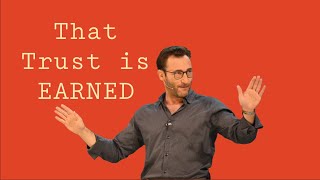
Simon Sinek tells law enforcement that trust comes from small, consistent actions. He gives an example: let someone call a family member before you tow their car. Dignity in how you treat people, guilty or not, is what builds public confidence in policing.
Can you, off the top of your head, can you think of you talked of you compared, you know, the finite mindset to some things with law enforcement?
Sure.
As far as infinite, can you think of anything off the top of your head where you could relate that specifically to what we do, what that might look like?
Anybody who's wearing a uniform here knows this because you've had this experience in your career, right. Which is treating someone with dignity. Treating someone with dignity has nothing to do whether they are guilty or innocent. Right.
That everybody here knows that when you treat somebody with dignity, the way they respond to you, even if they've committed a crime and they're sitting there in handcuffs, is very, very different than when we don't treat them with dignity. So for example, treating someone with dignity may look like somebody gets pulled over for expired tags or something and they've got a warrant, I don't know. And you have to tow their car, right. So you call a tow truck and now somebody who's maybe financially struggling, you've just put at least $300 more that they have to deal with, or treating them with dignity is like, hey, I got to tow your car. Before I call a tow truck, do you want to call somebody? You want to call a family member or something who can come here and get your car, that'll save you 300 bucks, you know, and help you out, you know, and if you can't call somebody, I'm going to have to tow it. Right. That's treating someone with dignity. And everybody here knows that when you treat somebody with dignity, sometimes you're taking them to jail and they thank you. And the way in which people respond to the uniform, if treated with dignity has nothing to do with breaking the law or being put in handcuffs. It's human being to human being. And so I think in a law enforcement, when law enforcement is conducted in a policing organization, you're thinking about the longevity of the value of the uniform. You're thinking about the relationship of those who wear the uniform in public, how much the public is willing to help us if a crime is committed and we go out to the public and say, can you help us? And their willingness. Those, those things are determined right now on a day to day basis. Right. And you asked before about building of trust, right? Trust does. There's no big thing you can do that builds trust. Trust is built up with lots and lots and lots of tiny little innocuous little things. Think of it like your own relationship. Like, you know, have you ever been in love? The person who fell in love with you. There wasn't. Like I bought you flowers on Valentine's Day. Now you love me. That's not how it works. It's like I went to the fridge to get myself a drink and I got you one, too, without you asking. I woke up in the morning and I said good morning to you Before I checked my phone there was a game on and you said, honey, can I talk to you? And I paused the game and said, what's on your mind? I'm being idealistic.
My point is, no one of those things made someone fall in love or trust you. But it's the combination and accumulation of.