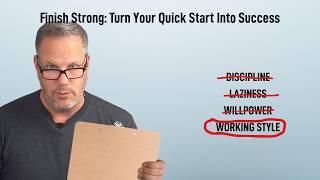
Michael Clegg explains the "high thrust" working style: starting projects fast but losing steam before finishing. It's not a discipline problem but a behavioral pattern that becomes a strength with three guardrails: explicit deadlines, clear standards, and a concrete definition of done.
Chapters
If you start a lot and finish almost nothing, it's not a discipline problem. You're not lazy, you're not broken. You're what we call high thrust. And there's a simple fix that will stop the half done trail. Hi, I'm Michael Clegg. Everybody calls me Clegg, even my wife. And today we're going to talk about those of you that start fast but tend to stall out. Because once you understand what high thrust really is, you can stop leaving a trail of those half done project. And you don't have to change your personality. High thrust is just a working style that loves starting things. A new idea, a new project, a new book, a new plan. You're all locked in. But finishing it. That's where things tend to get messy. Not because you're lazy. Maybe you get bored. Maybe it's just the maintenance phase or doing something over and over and over again. Your brain is already chasing the next thing that's got you all excited. Let me confess something to you. Years ago, I decided I was going to stay in the fence of our newly built home that my wife and I bought when we were first married. New house, new fence, new feeling, excitement. I go to the store, I buy the roller, I buy the brush. I even buy one of those spray thingies to stain it faster. I work all day, clean up, put stuff away. In my mind it was stamped done. But I got to let you in on a little secret. Two and a half years later, my wife comes up to me and says, hey dude, do you know you didn't finish the fence on the backside of the house? And of course I'm like, what? Oh. And lo and behold, I go out, check on it. I didn't finish the whole back corner. Now, in my defense, it was over where the H vac equipment is. There's no gate on that side. Nobody's ever on that side of the house. But in my mind, I thought it was already complete. Honestly, I'd forgotten that I didn't finish it. But here's why this matters. A lot of high thrust people label themselves undisciplined or lazy. But if you have a boss or a leader that you're working for, they might label you unreliable. That's why it's important to understand what is your working style. Because essentially all it does is create guilt. Shame causes friction. But high thrust isn't a character flawless. It's just a predictable pattern. It's how you were built. But it's also a superpower. If you put the right Structure around it. Here's the pattern that trips up high thrust people. The speed and excitement of starting something new outruns your communication process. So you move fast, you speak fast, you pivot fast. All of that just creates a lot of ambiguity to the people around you. And unfortunately, ambiguity creates worse whiplash for other people. You'll hear phrases like, I thought you had that. I assumed you knew what I wanted. We agreed on this, didn't we? Look, it's not bad. It's just a signal that you need to put some guardrails and structure around you. With that thrust becomes a true superpower. Trust me, high thrust doesn't need constraints, it just needs those guardrails. Here are three guardrails that make high thrust people unstoppable. One, what I call the magic words of business. By when, by when will you get this completed? By just a simple deadline, due date, finish line. Those things are created for you so that you understand when things are due. If you're high thrust, what you don't need is somebody saying, just get that soon, or asap. If it cannot be found on a calendar, you don't need it. You need hard details and dates. Number two, Standards, boundaries plus expectations. It's not micromanagement, it's just clarity. So ask for it. Because if you're working for a high thrust leader, oftentimes unless they understand that they're high thrust, they're not going to provide those things. And that creates a lot of friction in the workforce. So as a high thrust leader, I have to understand that I have to give clarity. And by the way, my teams around me know that I'm high thrust. So if I do lack clarity or lack a buy win or some guardrails for them, they know to call me on that. And in fact, my expectation is that they do those things. But if you're working for a high thrust and they don't know they're a high thrust, that can create some problems. And number three, the definition of done. This one changes everything. As an example, last year before the holidays, it was my last working day before I went home for Christmas. I text my wife like a good husband should and just asked, hey, do you need me to pick up anything on the way home? And her response was a phone call. Well, my wife hates talking on the phone, so I picked it up pretty quickly and she says, hey, Clegg, our toilet in the master bath is continuously running. I think you need to get one of those kits. So I immediately say, hey, no problem, I'll swing by Lowe's. I'll pick up one of those kits and I'll fix it when I get home. Her immediate response to me was, do I need to prepare to be without a master bath over the holidays, or are you actually going to fix it tonight? So what she provided to me was the by, when and the definition of done. I'm going to fix the toilet today and I'm going to clean up, pick up the tools, clean up the trash, make sure that it's all complete so that she doesn't step on something going to the restroom in the middle of the night. That is the definition of done. Now, quick context. There are two other working styles, allegiance and tenacity that I'll cover in a later video. Today is just about you high thrust people. You don't need any more shame because once again, this can be your superpower. So take a look at one of your priorities right now. Whatever it may be something you're working on at work or could be something in your personal life at home. Write down the definition of done. What does good look like? Create the Buy when. Make sure you have standards and boundaries. So essentially what you're getting to is what is an observable outcome. Buy when. If you want help identifying your working style, whether you're high thrust, high allegiance, or high tenacity, just comment or message me lens and I'll send you some information on our Leader lens process that will help you or your employees identify which working style they are. Until then, please like comment and share. We'll talk to you soon.