Gratitude with Omar Brownson | A Bit of Optimism with Simon Sinek: Episode 44
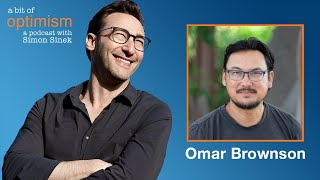
Omar Brownson talks with Simon Sinek about gratitude as a skill you can train. He credits a silent retreat and work transforming the LA River with teaching him to use gratitude to manage impatience and strengthen relationships, even difficult ones.
Chapters
When you hear that someone is living in gratitude, immediately we start to think of them as a monk sitting on the top of a high mountain. To say we need to live in gratitude sounds like hippie dippy, ooey gooey stuff. But that's exactly how Omar Brownson lives his life. And he is not a monk. He's a businessman and an urban planner, and he's into all kinds of cool projects with architects like Frank Gehry. But he learned the hard way that his high stress life was hurting him and hurting his family, and gratitude was the solution he found. This is a bit of optimism.
Omar Branson. Before we start an episode about gratitude, I think it's probably important that I start by asking you, what are you grateful for right now?
What I always come to is just this moment being able to take a breath, pause, and just notice that there's so much to be grateful for. Whether this moment with you, getting to meet you, the spontaneity, and, yeah, I'm overwhelmed.
When somebody says, do you have a gratitude practice? You know, it sounds a little hippie dippy to a lot of people. And I think if we just change the words, instead of saying, do you have a gratitude practice, simply ask the question, what are you grateful for? The thing that I've taken away since I've met you is to ask myself that question when I'm feeling good. That's obvious. I think we all sort of feel gratitude when we're in a good space, you know, oh my God, I love you, you're the best. But I think what I've taken away from you since I've met you is the ability to say, what am I grateful for? In times when I'm struggling, in times when I'm not feeling my best? Is that part of a gratitude practice? Is that. What does gratitude practice mean?
Well, I think that's absolutely the time when gratitude counts. And I think, as you said, anybody can be grateful for when times are good and things are going your way, the wind is behind your back, it's when you're facing the headwinds that I think the gratitude really kicks in and the power of it.
Because it's, you know, the brain has a biological bias to see the negative. And so learning to not be reactive to the brain and just being like, okay, wait a second, is this actually reality or am I falling into some bad habits here?
How did you discover gratitude?
So about seven years ago, I was leading the large sort of scale transformation of the LA river. And yes, LA has a river. Not Everybody knew. I didn't know when I first started that we had a river.
When I first saw it, I thought it was like a sewage thing. Yeah.
Concrete channel. That was in Terminator, you know, Great, great chase scenes with schwarzenegger. Actually, it's 300 million gallons of water that goes down the river a day. All to say it's 51 miles. A million people live within a mile of the river. And it's to me, an opportunity to reimagine la, the second largest city in America with green infrastructure. Right. Like, how do we bring nature and culture together? We were working with the architect Frank Gehry. And so it was high profile, lots of attention. If there's a million people, there's 3 million opinions. And I was stressed out as the founding executive director. And I received a fellowship to go travel. And I told the foundation that I wanted to do a silent retreat to begin that fellowship. So I spent six days up in Big Sur. And in all that silence, I just realized how impatient of a human being I am. And at the end of six days, I got to talk to this monk about it. And he said, omar, the root word in Latin for impatience is patus, which means to suffer. And he said, that's your burden to carry. And I was like, I don't really want that burden. And so how do I sort of do something differently? So I tried meditation, I tried mindfulness, but it was ultimately the practice of gratitude that helped me learn to pause and just not feel that energy of like, why isn't things moving fast enough?
The obvious solution to impatience is to be patient, to learn patience. Right, yeah. And that didn't work for you. The sort of meditative, mindful, take a deep breath didn't work. And what helped you overcome the suffering of impatience was to discover gratitude.
Yeah, I mean, and I think that part of it is meditation and mindfulness can be very head oriented. Gratitude is something you actually feel in your heart. It's an emotion. And so I think part of the challenge is that I was already kind of very logical, very rational. And that sort of logic, rational brain was trying to control everything. My fear came up around, how do I control everything that I don't know. That uncertainty, that unknown. In a large scale project that's thinking about the next 20, 30 years of Los Angeles, there's a lot of moving pieces and at some point realizing, like, how do I let things go and be more present? That's actually an emotion, not sort of a way that the brain can think.
Why is it that gratitude Is the thing that helps you let go of that. It seems incongruous.
I think part of it is learning to actually feel your emotions without becoming your emotions. So when you're very kind of logic, you're like, you can rationalize your feelings. You can rationalize your emotions as opposed to feel them. And when you feel them, then you can actually let them go. And so you're like, oh, look, there's fear. Oh, look, there's anger. As soon as you're able to. I like to think of it as noticing and name something. So often what we do is we maybe notice what we're feeling, but oftentimes we don't name it. But by noticing and then naming, then all of a sudden, it doesn't have sort of the same power over us. It's sort of like the fear of fear is greater than the fear itself.
I learned this recently from Sarah Kubrick, the millennial therapist, how we don't do a good job of labeling our emotions. You know, when you ask me, how do you feel? It's usually good, bad, angry, happy, sad. That's about it. You know, and emotions are more complex.
I always thought, like, emotions were like wild beasts. I imagine horses trampling through the prairie. And I know that, like, you know, I've gone to good schools because I've studied hard. I've ran and played sports because I could train my body. I never knew that I could actually train my emotions. I just thought you were either born with an amazing disposition and cool, calm, and collective, or you weren't. It's not something that we teach. And this is. I think what's beautiful is that my daughters actually have social emotional learning in their school. So they actually are learning mindfulness and meditation and gratitude. Those were not skills at all that we even talked about. I think you say it incredibly well, that it's not about soft skills, it's about human skills.
Yeah, I hate the term soft skills. You know, we in work, they always talk about hard skills and soft skills. Well, hard and soft are opposites. And I would hate to think that the skills of being a good human being are the opposite of being being a good worker. It proposes that we should suppress any humanity at work. And so I like to call them human skills. And I want to be good at my hard skills, and I want to be good at my human skills, and that makes me better at whatever I'm doing. When you asked me what human skills were, I would have said listening, Effective confrontation, Conflict resolution, how to give and receive feedback. These are the standard list of things I offer when somebody says, what are human skills? And I've just recently added gratitude. The skill of gratitude, I think, is a human skill that we don't practice.
In some ways, instead of, I'd say hard skills and humans skills. One way I would think about it is technical skills versus adaptive skills. And technical skills sort of allow us to solve specific problems, but often those problems tend to be very linear and narrow. I would say adaptive skills are the ones like, how do we actually deal with the messiness of humanity? Right. And this is a concept that I've been playing with, is like, if gratitude makes visible what we value, fearless gratitude is what enables us to see what we take for granted and maybe make invisible. And so when we can learn to kind of see what we make visible and to actually see what we make invisible or take for granted, then we're actually really, I think, in a place to be more present to all the challenges that life presents.
Let me say it back to be clear that I understand. Gratitude is acknowledging the seen, the understood, the present. Fearlessness is acknowledging the unseen, the hard or impossible to understand, and the unknown future. And that's that combination of being immensely grateful for what I have that makes me stronger as I go into the unknown and more accepting that I cannot control it, but rather I will find gratitude on each step of the path.
Yeah.
So if I think about the unfolding of my own movement, of my own career, my own ambitions, things go wrong all the time.
Yes.
And to either discover and be grateful for new opportunities that were unknown. In other words, it didn't go according to plan, but I kind of like where it's going. Or it didn't go according to plan. I don't like this, but what can I learn from this? I'm grateful for the lesson. I'm grateful for the relationship. I'm grateful for something that happened. And I can always find at least one thing. I'll share a story. So I have an uncomfortable relationship with this one person in my life who's been in my life professionally. We're not friends. We have a professional relationship. And I don't trust him at all. And I've struggled many times because I felt used. I've suffered unbelievable anger towards this person, and I've attempted to reform them. And one of the ways I attempted to do it was by taking responsibility for my part of the broken relationship. And so I called him up and said, let's meet for lunch. And we sat down and I said, I'm sorry I didn't ask for anything in return. I just said I'm sorry. And I went through the things that I'm sorry for, like being reactive, being inappropriate, you know, whatever. Whatever it was. And he just sat there. He didn't even acknowledge. He didn't say thank you. Just sort of nodded as if this is about time. And I realized, I'm not reforming anything here. This relationship is so broken. The only way I got over that, because it was like a. Everybody knew not to bring up his name because I would go off the handle.
Right.
It was like such a trigger.
And where I learned to put that anger aside, where his name was no longer a trigger, was when I started to ask myself, what am I grateful for from that relationship?
And I am grateful that I went on the journey to learn how to take accountability for my part, even if I didn't think that the other person was going to. I learned a skill set that I did not have because of that situation. I'm grateful also that I can accept someone's nature and not try to change it.
Well, I think that acceptance is like one of the most powerful sort of pieces of it. One of my favorite quotes is Leo Tostoy, Everyone thinks about changing the world. No one thinks about changing themselves.
Yeah.
And that. Then how do we reorient when it's like, okay, all I can do is actually control myself. This is where gratitude. Like, how do we trigger our positive emotions so that we don't become triggered by our negative ones? And it's not that we don't feel the negative ones, it's just how do we not become triggered by them? Like anger, just anger is a. Is a good feeling to acknowledge. Petty anger, not so good. It's not that you. Those challenging moments don't go away. It's just how. What is your relationship to them?
Now we have to talk about how triggered we all are by each other. Whether it's vax versus Novax, mask versus no mask, left versus right. You know, this president versus that president. Somebody merely uttering their point of view can literally send somebody else into a tailspin. And by the way, I see it on both sides of the political equation, an intolerance that you simply acknowledge somebody's point of view on the other side, and it literally can. It sends somebody into a rage, like me and that. That guy in my career. Like, it's such a trigger. And to say to oneself, what am I grateful for? To look inwards. I hear this with psychology students. You know, I love asking people who major in psychology why did you choose to major in psychology? And almost universally the answer is, well, I want to understand other people so that I can understand myself. And what I've learned in my.
In my.
In my entire career is it's the exact opposite, which is the more you can understand yourself, the more you can understand other people. And that practice of gratitude to go inwards to what you said, which is everybody wants to change the world, but nobody wants to change themselves. We're in a young generation that's very activist, very. Wants to change the world, which I admire and adore. To change the world, we must have to say to ourselves, well, what work am I willing to do on me so that I can change the world, change my family, change my community, find peace and love?
And the neuroscience supports that. Part of changing your sort of emotions and feelings is your physiology. And your physiology is often being driven by your environment. And so how you relate to your environment and whether you're like meditation and breathing, helps settle the body. And so, like, some of the more interesting work right now, I find is actually in embodiment work, which is how is your body physically reacting? Your body's in some ways, like this giant algorithm that's constantly processing information. And if your body's on high alert, then how you process your environment is going to be very reactive. And so thinking about our relationship of like, how are we giving thanks, how are we connecting to people, how are we being present to them? That's actually about us, not them.
There's an irony in this, isn't there? And for those who listen to my work and know my work, I say this a lot, which is there's an entire section in the bookshop called self Help. And there's no section on the bookshop called Help Others. And what we need is a Help Others industry. And the great irony in being a better servant to others and for others is that we have to be willing to take on ourselves. We are part of a relationship. We are a puzzle piece, but we are only one puzzle piece. To know our shape and know what piece of the puzzle we are, and to be the best puzzle piece we can be makes us connect with others a lot better.
Gratitude helps us actually change the pace at which we adapt to change. And if we can adapt to change faster, then we can be more present. If we're slow to adapting to change, then we're actually like, holding on to something past or reacting to what's coming at us, and we're not being present to what just is.
For anyone who has not Practiced gratitude as a practice, you know, it's not like saying thank you for the birthday present. The thing that I find magical about it is it can be very, very small. You know, somebody asked me recently, how is it that I'm always so happy?
And the answer is, because I find joy in little things. I don't need big things to make me smile. Seeing a hummingbird outside my window, like, I really like that. I think they're so cool. Or the rumble of a beautiful sounding engine, you know, because I'm a bit of a gearhead, you know, like, those little things, I just. I acknowledge them. I say, oh, God, that's such a nice sound to look at. That bird isn't. Isn't that pretty? Or a color or a sound or a sentence? And I think that's part of what gratitude is, which is when you say you have a daily gratitude practice, you're like, well, I don't have that much stuff in my life to be grateful for on a daily basis. We're thinking too big.
What I would say it's not. You're not actually appreciating small things. What you're appreciating is specific things.
Oh, I like that distinction.
And when you appreciate specific things, then you're actually really being able to sort of see it unto itself. And so this actually came up in the last gratitude class was the story of walking home with my youngest daughter. And she was telling me. She's like, dad, I'm really grateful for this sidewalk. And I was like, you're grateful for. Why are you grateful for the sidewalk? And she says, well, if we didn't have the sidewalk, it means we would be walking in the street, and that would be very unsafe. And. And so by having the sidewalk, we can walk home safely. And, you know, and it brought up this poem that I remembered, this specific line that sidewalks are where errands and epiphanies can happen. And so when we can appreciate the mundane and the miraculous and just sort of be open to all of it, that's when we're actually noticing the world as it is, not as we want it to be or as it should be, or, you know, what it could be. Just, this is the world as it is. And gratitude is just sort of like, how do we actually just sort of see the world as it is? How do we just notice what is there and appreciate it?
When we talk about reconnecting with people who trigger us or we disagree with and the Thanksgiving table. Politics has entered the Thanksgiving table, you know, for so many they struggle to sit down with that uncle or that aunt that has different views to them for fear of somebody getting triggered. And sort of there are these deals that are made, we just won't bring it up. So avoidance is one strategy for sure. But I think what you're talking about is we can find, and I'm going to use the word specific instead of small because I really like the distinction. Find something specific to be grateful for in anything and everything that happens for your daughter. She found safety in the sidewalk with her dad, which is, my goodness, so beautiful and poetic, that level of specificity to be specific about the thing we're grateful for, that thing can be shared, that thing can be talked about and help someone else see the world in a different way. So now we're getting into the help others industry, right? So one of my favorite things to do is tell my friends the things that I'm grateful for in our friendships. I can't help it. It comes out all the time and it reinforces these friendships over and over again. I have a friend who she and I have very, very, very different political points of view where we represent the polar opposites of America. And yet she's one of my dearest and best friends in the world. And one of the things that we have found that helps us listen to each other is that we regularly tell each other what we're grateful for from each other. And that creates safe space for us to have difficult conversations because we have already acknowledged and built a very strong foundation for all the things we really, really are grateful for, for in each other. So it's not that we've avoided having difficult conversations, it's that we show up for those difficult conversations with deep love, respect and gratitude for the other.
And what I hear you saying also is that you're willing to listen, right? To hear and be heard, to see and be seen. And this is, I think one of the fundamental challenges is that when we have disagreement, we make the other person feel invisible, right? And then because the other person then feels invisible, then they're like going to shout out or they're going to go away. What you're doing is sort of showing that like, hey, I see you. Hey, I hear you. And that's what gratitude is, is an acknowledgment as opposed to just sort of taking those things for granted.
And it goes in a very uncomfortable direction for some. And I learned this from Dia Khan, the BAFTA and Emmy award winning documentarian, where she said, we all have this desire to feel seen and feel Understood and feel heard. And unfortunately you're going to struggle to find those feelings unless you're willing to show them to another first.
What I appreciate you saying is you're acknowledging other people's feelings and emotions. And it's hard to do that if you can't even do that for yourself. Right? Like if you can't even sort of acknowledge not just the joy, but the pain, the anger, you know, the full suite of emotions that we have. If you can't even acknowledge that for yourself, it's gonna be really hard to acknowledge in other people.
And we become self righteous about it, right? Well, they should go first. They should listen to me. I'm the one who's not heard. I'm the one who's not understood. And we don't just see this play out in big political discussions, but we see this play out at work between employees and employers. We can create victims out of ourselves. What have they done to me? And it goes both ways. It just plays to that theme that we are not in any of this alone. Like we don't go through career alone, we don't go through life alone. You can't go through relationships alone. You can't even walk down the street alone. At some point, whether you like it or not, you're gonna have to interact with people, sometimes substantively and sometimes innocuously, but you're gonna have to do it. So expecting the world to fawn or fall over to make us feel seen, heard, understood, happy, safe, grateful. It's an impossible standard. And that goes back to that psychology misunderstanding. The better I can understand myself, the better I can learn to make others feel seen, heard, understood. The better they will be equipped to make me feel the same. And this is what the help others industry is all about. The help others industry isn't about martyrdom. It's not about this excessive amount of giving to the point of self pain. That's not what this is. The whole point of the help others industry is initiative. That's it that I will choose to go first. That's all it is. I will acknowledge another because I want to be acknowledged. I will hear another because I want to be heard. I will forgive another because I want to be forgiven.
This is why giving is receiving.
And this is why giving is receiving. I mean, it's so corny, right? And this is what I think is important about your work, is you're spiritual ish in the way you talk about this stuff.
That's perfect. Yes.
You know, you're spiritual ish in the way you talk about it. So it's not alienating to those who find the stuff deeply spiritual, but at the same time it's not alienating to those who find the stuff non spiritual. And I think that's really important, which is you are a spokesperson to the people who need to hear this, not to the people who've already heard it.
Well, I think this is what's so powerful about the people who resonate with you is how do you speak to early adopters, right? Like who wants to sort of see the change, is ready for the change and you're not going to necessarily reach everyone at first.
You're referring to the law of diffusion of innovation, a theory put forward, I think, in the 60s by Emmert Rogers. Basically the all population sift across the standard deviation, the old bell curve. If you have high performers in the population, you have low performers regardless of the size of the population. The first two and a half percent are your innovators, the big idea people, your Steve Jobs's, your Elon Musk's. The next 13 and a half percent are your early adopters. Then you have your early majority, your late majority in the laggards. And the whole point is, if you want to have an impact on the world, you actually don't go after the world, you don't go after the majority. You go and find those early adopters, the ones who are a little more open minded, a little more open to taking a risk, a little more open to giving it a shot, whereas the majority wants a guarantee. What do I get if it goes wrong? Will I get in trouble? Will you take the blame? Will you pay me back if it doesn't work out? An early adopter mentality is just higher risk tolerance. And by the way, we're all early adopters in various places. It's not a fixed thing. I'm a laggard when it comes to fashion.
I am not an early adopter. And for change to happen, it's to find those who are willing to make the change and eventually it catches on. And this is what the law of diffusion is all about. It's about creating tipping points. You know, there was a time where we used to talk about world peace pretty openly and now it sounds like, weird. I think we miss that. I think we miss idealism in our nation. Idealism seems to have gone by the wayside. And like practicality, everything's practical, everything's algorithmic, everything's metrics, metrics, metrics. Measure, measure, measure. What gets measured gets done. It's like well, you know, how do you measure the hug from a mother to their child? How do you measure that? That should be done. We're not measuring it. Kind of important, you know, not everything has a metric, but we know that these things are important. I think that's reconnecting with these things. And this goes back to your point of the unknown and the fearlessness, which is, I'm going to do this thing because it's the right thing to do, even though I don't know exactly right now, but I'll find out later, and then I'll be grateful for it.
Well, that's. Yeah, that's. That's dealing with those fears. And what is scary, I get a.
Kick out of technology. You know how reliant we are on such imperfect technology in this modern world. You know, our cell phones are constantly dropping signals and Zoom is constantly freezing. And, you know, this stuff mostly works, right. But it's unbelievable how broken it is, and yet we're perfectly fine with all the broken and imperfections. But when it comes to people, we expect perfection.
Well, yeah, I mean, that's the right. We expect everybody else to be more patient, to be more kind. And what does it look like for us to actually do it?
I have a last line of questioning. How old are you?
47.
So we're about the same age. I'd like to know something you're grateful for for every decade of your life. 0 to 10, what are you grateful for?
So 0 to 10. I was born in San Francisco and moved to Saudi Arabia when I was six months old. And I went around the world twice by the time I was three. Even though I don't remember any of that, what I appreciate was that I sort of had an immediate sense early on in my life of, like, we live in a global society.
10 to 20, 10 to 20.
I moved to Los Angeles. It was the 1984 Summer Olympics. It was Sam the Eagle. And there was just a sense of moving from a rural community in the Pacific Northwest to the big city of la.
It was a sense of awe. At the same time, I'll just say that I was in LA in 92 with the civil unrest and seeing my city sort of burned down.
Not being able to see the end of my block because there was so much smoke in the street. And I learned early on that democracy is fragile and cities are fragile, and so to not take them for granted.
20 to 30, I think, 20s to.
30S, was learning that I could actually build things and getting sort of a sense that that idea of Wanting to build the world that I wanted to live in, that I could actually do it. And so beginning to be in real estate and like, actually physically building things that I could contribute and make a mark was pretty exciting. 30 to 40, that is definitely Kids, kids, kids. There would be no gratitude practice, but for having kids and learning that they move at their own speed and I can either learn to adapt or be unhappy. And so I was like, okay, my heart is going to have to become bigger if I want to be the parent that I want to be. And so, yeah, I would say my wife, who having an incredible partner and then having two kids that really are teaching me how to be a better human.
Forty to now, I think moving from.
Just building things to now building companies and really being able to. How do you not just do the work, but create the conditions for the things that you want to see happen and be in collaboration with other people. I think the other sort of piece that I'm starting to really begin to appreciate is just my own creativity and art. So it's not just sort of like a business mindset or social good, but what does it mean to tap into more creative energy? I'm becoming more and more firmly believing in the power of metaphor. And so that sort of long horizon that's in front of us, what are we picturing that's there and how do we actually sort of move towards that or it move towards us? And what is that metaphor in our life that we're going to be connected to?
So your gratitude journey in decades is gratitude for the world and appreciation for the fact that there's more than one point of view, a sense of awe that came. And in that awe, a sense of all of that is great and big is also incredibly fragile.
There is the ability to build the world you want to build in this fragile world coming right down to your family that you have a choice to build in how you build that, it is just as fragile as everything else. And there's a responsibility that then moves into a sense of rebuilding and creativity. And this gratitude journey that you've been on since the day you were born is this relationship of big and fragile and responsibility in those things that we can do big things, and the world is big. But my goodness, we each have a responsibility to hold it up, otherwise things will break. Whether it's society at large, the world at large, or just how our family, our family dynamics that we have a role to play and we have to be creative in all of that. I have to bring you back in a few years so that we can talk about the next decade.
What a gift you just gave me in reflecting back what I said and I feel heard. Thank you. And I think part of what this next decade is about is us not just creating, but how do we co create. I think that's in many ways the platform that you are helping to create and unleash is like it's not just about one person, but it's about many people. And how do we actually all sort of pull together?
Omar, you are as magical now as the moment I first talked to you. And I never do this. I never use this as a platform to plug. But if you're interested in Omar's work, please go check it out because you'll be grateful.
Whether you want to go check out his stuff on his website, which is in the link below, or if you want to check out the course he teaches on our platform, you can check that out. I think we need a little more gratitude in this world.
You know, my temptation is to say a lot, but it really is a little.
Specific. Specific. We did it. You know, we need a specific amount of gratitude in this world.
Omar, thank you so much. Truly.
Thank you.
Thank you so, so much.
If you enjoyed this podcast, would like to hear more. Please subscribe wherever you like to listen to podcasts. Until then, take care of yourself, take care of each other.
More from Clegg





AI Won't Tell You the Full Truth | Arthur Brooks + Simon Sinek | A Bit of Optimism Podcast



How To Make the Best Decision | Arthur Brooks and Simon Sinek | A Bit of Optimism


