Having a Laugh with Michael McIntyre | A Bit of Optimism with Simon Sinek: Episode 32
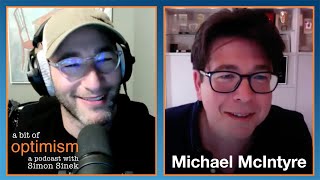
Simon Sinek talks with comedian Michael McIntyre about how COVID-19 changed live performance and what comedy does for people. McIntyre hadn't performed in front of an audience for over a year when they recorded this in May 2021.
Chapters
The last performance I saw before COVID was Michael McIntyre live at Radio City Music hall in New York. Radio City is actually a small venue for Michael. He's one of the world's most successful stand up comedians and he usually does venues the size of stadiums. These past few months have been a bit stressful, so I decided I needed a bit of a laugh and so I called Michael and that's exactly what we did. We laughed about many things, including his shitty wi fi. This is a bit of optimism.
Should I force quit?
I'm not very savvy. I'm gonna just start force quitting. Hold on. Okay, I'll tell you what. I'm now force quitting. Adobe Flash Player install manager. Don't even know what that is.
Oh, yeah, you don't really need that anymore.
I'm going to force quit the calculator.
Okay, that's not doing anything either.
Now we're going to force quit. My scanner, Basically, I just scan signed invoices so that I can't do during this podcast.
No messages, no more pinging. Excel. Never used it. I don't know why it's open. I don't know what to do.
I don't know what to do either.
This is live, right? This is going out live. All right, here I am at your service. So tell me when you want to start this podcast and I'll have to try and be optimistic.
That's the only requirement, is you have to be optimistic. So we're going to start now. You ready?
All right. It's a bit of a stretch.
Michael McIntyre, the indefatigable.
Hang on, what does that mean? There's a fat in there?
It means you don't get fatigue.
Oh, fabulous. But I have also put on weight.
The endless energy of Michael McIntyre.
That's what endless eating will give you. That's one of the pluses of this lockdown weight. So, yes. Sorry, you were introducing me. Give me a big intro. Cause to be honest, I need it as much as.
Ladies and gentlemen, you haven't done a show. When was the last time you did a show?
Wait, isn't that my big introduction? Ladies and gentlemen, this is an American thing. You have to give me a big up. You've got to tell everybody how sensational I am. No.
Michael McIntyre is perhaps one of the greatest comedians that has ever lived. He's unbelievably famous, he's unbelievably funny, and I cannot believe that he agreed to come on my little podcast. This is the most humbled I felt with any guest ever. Ladies and gentlemen, boys and girls, Michael McIntyre.
Thank you very much, Simon. It's actually a pleasure to be with you today on your wonderful podcast. A Bit of Optimism. We're going to have to have a lot of optimism with regards to the quality of WI fi currently in my house, because I hate to tell you, I actually missed a lot of that intro, so I'll need to.
Now, I'll take your word for it that it was. It was really.
I mean, I big upped you big time. I said you're one of the greatest comedians that ever lived, ever.
Yes. I love the way you're using the past tense, because.
The greatest comedian living.
I was. No, I used to be a comedian, Simon, as you well know. And you came to one of my last ever performances I did in New York. Now it's amazing to think back at what used to happen and performing, because it's been. Well, it's been over a year since I've been on stage. I dream about it sometimes and I have tried a zoom gig that's been an absolute catastrophe.
Why was it a catastrophe? Because you didn't have the audience energy.
You need feedback that time. And it's really. That laughter is really key to the.
Whole process because that's why you do it right. You do it for the laughter.
And I can't tell you how encouraging laughter is. I took it for granted, but sitting at my desk trying to be funny and there was like thousands of people watching and I had no idea whether they're enjoying it. And also the CEO of the company, he made a speech before me and he was the only person I could see. And I didn't realize, but he had gone. He had actually signed off. He wasn't watching the gigantic. So what remained was the final shot of his face before he signed off, but I thought he was still there. And I'm here to tell you that final shot was not a smiley one. He looked incredibly upset because he was obviously looking. You know that face you make when you're looking for the leave button. So he's sort of frowning, looking down. Then I started laying into him for not laughing. He wasn't even there. It was just an image of him. So, yeah, these are very taxing times. How's it been for you?
I adjusted with my work. Also, feedback matters. And so I stopped giving speeches. I prefer interviews because then I can actually engage with someone even though I don't have an audience.
You're very good with an audience, Simon, and you're very funny. As well. You have a good sprinkling of laughter in your joke.
You're very kind, and you need that.
It breaks a room. You need to sprinkle. The best speakers will sprinkle comedy in there just to bind the audience together at key moments. It's vital, isn't it?
I think, that comedians play a more vital role than people realize. Stephen Colbert said once that you can't be angry when you're laughing.
I think you're overlooking tickling here. I think when you're being held down and tickled, you have an enormous amount of rage.
That's actually true still.
You're laughing your head off.
But other than tickling, you can't be angry and you can't be sad when you're laughing. And I remember when Covid first happened, when we first went into lockdown, all these funny videos and all these memes just sort of pouring out that we were all forwarding to each other and laughing out loud. And it sort of really did help when we had so much uncertainty as what was going to happen. And can we touch the milk we just bought for fear of death?
That was a weird period in surfaces. I think we've sort of come to terms with the fact that you can't get it from surfaces.
Correct.
But yes, Shopping and cleaning while you were shopping and then cleaning and then buying cleaning equipment and then using other cleaning equipment to clean the cleaning equipment you bought and then squirting the cleaning equipment all over the table, then rolling the cleaning equipment. It was sort of mad. It would sort of go on ad infinitum. You've got to clean the next one, and then you've got to buy that one to clean that one. Or who wanted to clean this one? No, there was endless cleaning and rubber gloves, and it was a very. Well, it still is very scary. But, yes, you're right. A lot of comedy. It took me a while to engage comedically. I didn't find it particularly funny for a long time. Still don't. Have you avoided it, Sim?
I have fortunately avoided Covid. Yes. I have not had it.
Have you had a vaccine?
I have. I just had my second shot last week.
Fully vaxxed.
I'm fully vaxxed. I mean, it's a thing. My favorite thing is, like, when somebody says, did you get vaxxed? I'm like, yeah. And then they always ask Moderna or Pfizer, like it matters. And I do the same thing. I go, which one do you get? And they go, johnson and Johnson. Okay, cool. Moderna.
Okay.
Cool. Like I have no opinion.
You say, okay, cool, but then you walk away and delete them from your phone. That is an unfortunate follow up question. It's almost like we're slightly worried that the future of society is going to be divided into these subsets of like, Pfizers can only marry Pfizers.
That's exactly right.
It'd be like a Moderna singles night.
They're having a mixed wedding. It's a Moderna and Pfizer.
Yeah. When you. Instead of bridal groom. Okay, Pfizer's on the left.
Did you. Were you able to avoid it?
I didn't avoid it. I got it in November. I mean, it wasn't awful. I was very fortunate because. But it's scary as many people, obviously more than many people know because you go through it and then there's that sort of wait to see if you either get a lot worse or get better. So, yeah, I got it. It lingered a really long time. Thankfully, I was the only one who got it in my house. Weirdly, I got it, my housekeeper got it and my wife didn't. So you can read into that however you like. Let's just say a lot of questions, which I coughed away.
Yeah, I just. I'll tell you in a minute. I coughed my way through that and luckily I think I got away with it. But yes, and I'm getting the vaccine, I think on Sunday. So this is happening.
Which one are you getting?
Well, I'm going to get the Pfizer. I think the Pfizer. Pfizer. You don't get to choose, but I think it's the Pfizer. My wife's had the AstraZeneca last week. So obviously I'm just hoping the housekeeper gets the Pfizer.
One of the things that's been impressed me, you've been really actually productive during COVID You wrote a book.
Yeah, I actually. It's been all right. I wrote a book. I wrote a second autobiography.
I mean, it begs the question, how does one write a second autobiography?
Well, it's exactly the same as the first.
Or you're just picking up where the last one left off.
No, it's the same. It's actually the same words. It's just a different cover.
That's why it was so easy. Yes, it picks up where the last one left off.
My Life, Volume two.
Well, yes, because the first one was called Life and Laughing and I wanted to call it More Life and More Laughing with a view to a follow up, Still Alive and Still Laughing and Then the final incomplete installment on my deathbed.
Nearly done laughing.
Yeah. Barely alive and dribbling. But the publisher thought it wasn't good to do that. So at the moment it's called A Funny Life and they like it. So that's good.
That's good.
At the moment, it's all the grammar and stuff, which is like. I didn't realize I was so hopeless. Like, words I literally had no idea I've spelt wrong. The whole book led. I didn't know led was led.
Yeah, I think we were taught it was led, wasn't it?
Maybe.
I mean, I write books on leadership and I'm actually not 100% sure.
Well, I wrote a book on leddyship, which is.
I put this thing I like doing where I just put things on their own line. I hate too much text.
Yeah, you and me both.
It just take a breath and take this in. So I'll just put it on its own line. Also, it means I end up with more pages.
Yeah, it's good. It's like a poem. I like writing in a manner that helps people read it the way I want it said. You know, ellipses and spaces and gaps so that you're forced to take the breath. So you're forced to take in whatever line is the next line. I love doing that.
Well, it reflects the way you speak and it's your voice, and people need to hear your voice. And everyone can write. Simon, let's be honest. I mean, writing is just. It's just saying stuff but written down, isn't it? I mean, it's not. It's. It's no great shape.
No, I think it's different because otherwise everybody would just talk into a tape recorder and then have it transcribed, and that would be a book. And those make bad books.
Right. Well, I'm sorry. I wish I hadn't have done it that way.
But that's wonderful. I think that's so fantastic that you spent the time to write a book and you developed a TV show. Like, how can you say you've been unproductive?
I don't know how I know. On paper, it looks like I've been very productive. I had an idea for a TV show in the bath. I don't know why I always mentioned that I was in the bathroom just because I was in the bath. I literally thought, I'm going to come up with a TV show idea. I want to come up with a game show. So I came up. Well, I came up with two. One of them was awful.
Is it Something you can talk about publicly?
Well, yes, it's on the back burner. I mean, we can bring it off the back. It was just a quiz show where the other person has to quickly ask the question and know the answer. So it would be me versus you. I would just give you a subject. You have to come up with a question.
Okay, let's try it. Let's try it. Okay, so you're going to give me a subject and I have to come up with a question and an answer for myself?
Yes, but I've got to answer it. But you have to know the answer, and you've only got five seconds to do it. Oh, gee. The theory here is that under pressure you're going to say something silly.
Okay.
To be honest, this is an idea I've not voiced out to this bath.
Okay, so I'll give you the subject of. Okay, you see, it's even hard to think of this subject. I'm going to give you the subject of. Oh, my goodness. Of podcasts. You've got five seconds.
How many podcasts have you done since before this one?
You have to know the answer.
I know the answer.
You know how many podcasts I've done before this one? You know that?
Yeah.
Oh, God. Now I'm gonna have to guess. I don't know. 3.
1.
Okay. As you can see, this idea doesn't necessarily have legs. I would like to try it on one side then.
Okay, so now let me do it to you. Okay, I've got one for you now. Okay.
Let'S do zoos.
Name a zoo.
In.
In London.
The London Zoo.
That's the correct answer. You see, there could potentially be fun in this game.
So you're winning.
This is the idea I didn't go for. Other one is called the wheel. And so we made 10 of those. We're making 16 more, and it's going to be on NBC, I think, early next year.
Oh, that's fantastic. Oh, I have to see if I can watch it on BBC iPlayer or something like that.
It's a really, really fun show. As I said, we're making more in a couple of weeks.
That's really good. So I want to understand how you wrote a book, devised and produced and executed a TV show. Are you sitting writing jokes like you used to?
I don't write jokes. I tend to write notes of things that make me laugh, and then I just perform them over and over again in little gigs and build them up. So home life has always been very relaxed and, you know, not high pressure and Overly creative. And I'm just sort of dad and a husband here. So, no, that sort of disappeared, which is awkward. And I really wanted to come back. And with regards to working, I need to keep busy. And now that I finished the book and finished the TV show, I can feel myself getting a bit sort of confused about stuff and inarticulate and going slightly mad. But, yeah, everybody was forced to pivot. That's an Americanism, isn't it?
Yeah, we're all pivoting.
Yeah. I didn't know about pivoting until an American mentioned it was a possibility. So I pivoted away from Stand up and started doing the TV show. And, yeah, I went back to writing a book. And writing's a lovely thing. Cause you're cocooned in your own bubble. You can write rubbish, but then fix it the next day. And it's a different type of creativity.
Do you want to go back to life as you had it before COVID or do you think that this will permanently change the way you live your showbiz life?
Well, we have to appreciate things more. I mean, it would be criminal not to appreciate everything should the world come back. Because I think everyone was quite excited about appreciating the small things at the beginning, but now it's going on and on and on. It's getting really, really serious. It's like, how far into this are we? Is this year one of five? Is it year one of ten? Is it one? Are we nearly out?
Yeah.
You know, every time you get a bit of good news, suddenly there's a triple mutated something coming in from India, it's coming in from Brazil, and it's just terrifying.
It's humanity versus Mother Nature.
It absolutely is. And there's so much to learn from it. But whether we will, I'd love to find out, which means it would be over.
But you want to go back to sort of doing your gigs and doing your shows like you're craving going back to the way life was. Or do you think that something happened? Because for I realized that I was on this hamster wheel and I was enjoying the speed that I was running. But one of the things that Covid did for me is I looked. I was like, oh, my God. I wasn't running fast. I was just trying to keep up. And Covid stopped the wheel.
The terrible thing is when you're trying to keep up with other people and you can't be doing that. What a waste of life that is. And that's the lesson I've tried to Learn, because competition is a natural instinct. It's a drive, which is good, but ultimately it's kind of meaningless because like you said, if you're always chasing something, if you're always. I think that people struggle with is how much people need something to look forward to. And not knowing the future is really damaging to that because living in the here and now, in the present, is not an easy thing to do. We're not used to that. What we're used to doing is knowing something good is coming or thinking it's going to be good, or even if it's a goal, it could be a holiday, or it could be. I need to achieve that.
That's such a great insight. That's like telling your kids, we're going to Disneyland on this date. And like, the kids count the days down, the excitement, you know, they have to get their chores done and get certain things so that they can go to Disneyland because there's conditions put on the trip and. But if you just said, we're going on holiday one day, it's kind of a little unnerving, actually. And that's what we have. We keep being told we're coming out of this, and then the target keeps moving.
With regards to holidays, it's fascinating how that is what people are desperate for. But what is a holiday? It's something to look forward to. It's a change. It's a break. Every single person who came on my game show, when I said to them, what would you do if you won that? Every single person, not just the holiday they wanted to go to, where you just said Disney, they wanted to go through those gates into fantasy land of everyone smiling at you, saying, welcome home, dressed up as smiley characters and just stay there for a bit and not have to worry.
That was Walt Disney's vision, which is a place to escape depression and sadness and the drudgery and grayness of real life and come to this place that was always bright and sunny and fun. I mean, that was his vision.
Whether it's a reality or just a fantasy, it keeps people going. That's one of the many things that's been taken away.
But you still haven't answered the question. Do you want to go back to the life you had before COVID or do you think that there will be changes to the cadence or the way you live your life because of COVID.
It's weird because I. I'm always complaining. So when I'm working, I want to be at home, and when I'm at home, I want to be working, you know, it's that. But that's also how I function. It's also what, you know, how I find things funny. It's that kind of mania and neurosis that creates comedy. I know because I've had a lot of time to think about it. But I'm happiest when I'm being creative and I've come up with something good. And I was able to do that a bit under these circumstances. But really nothing beats live performance and the instantaneous reaction because it's very cathartic, because it washes everything away. You know, everybody worries about how they're being perceived. Are they on good form? Are they thinking, right, do people like me? Nothing is more magical than just saying something to an audience of people. And everybody, you know, confirms it and laughs with you. And it's just, it's instant feedback. It's not like you have to write a book and you have to put it out. One person likes it, another person does it. Why is, you know, you're on Amazon. Why is that person giving me a two star review? It's just like I said something funny. I thought it was funny. It was, they're all laughing. Then I followed it up with more stuff that just came out of my head and I didn't even think about it. And it's just joyous and it fuels me, it keeps me, keeps me going. And without it I always go a bit weird. And now I've been forced to be without it. So I've had to sort of find a sort of inner self confidence. I'm here to tell you. Still looking.
I wonder if comedy will work socially distance. Because one of the things that happens when somebody laughs, everybody laughs. It's like things are funnier when you're with a friend. My test is something is really funny is if I can watch by myself and laugh out loud. That's like the greatest test of something's really funny. Because things are funnier with your friends. And so if you're socially distanced, the question is, will the laughter spread across the audience like it does in a packed house?
But it's obviously going to be more difficult. And of course, the funnier you are, the more dangerous it is because people, I mean, if you physically laugh.
You know, if you're not funny, you're not super spreading. You're sitting there slowly and calmly breathing in and out and then you're leaving early. No, that's the earning of Asia. It costs us. Seriously.
Obviously there's that, but I mean, look at the nightmare, Simon. I mean, and then think about masks. I mean, you're performing to people.
That's right.
You can't.
You can't even see them smiling. You just hope they have smiling eyes.
Listen, I'm a huge one for resting faces. I mean, I'm always scanning the audience. And if anybody looks miserable, I start to really. I focus in on them. Why. Why are they not smiling? Why are they not on the edge of their seat? Why are they. What do they do? Why are they even here? Did. They ate me? I start to lose my mind over it. But now you know that you can't even see their. You know, their faces are behind a mask, they're socially distant. I mean, it's like all my worst nightmares in regards to performance.
You and I have different strategies when I'm on a stage. And of course, I'm scanning and I can see somebody looking very angry and disapproving. And then I see somebody else who's nodding and smiling and agreeing with everything I'm saying. I fixate on the person who's nodding and agreeing with me because it makes me. I'm like, ooh, this is going great. And my. My energy goes up and my confidence goes up. When I focus on the person who's scowling at me, I'm like, this is over. I can't do this. Like. And then I spend my whole time trying to convince one person.
Well, I can't cope it when people go to the loo because I'm waiting for them to come back because I'm always thinking they might have walked out. Sometimes I accidentally. I'll be mid joke and they'll come back in and go.
Because I was so thrilled that it was that they were so desperate to go to the loo. And it's not that they've literally just walked out. And not only that, I see sometimes they're in a couple. I'm like, I'm so awful. They've left the show. They've left their partner to just walk. Oh, no, they're back. I'm fine. No, I'm definitely viewing it in a more negative way, which is why, honestly, I've had the best gigs of my life. When I can't see the audience, I always ask for the spotlight. Just hit me in the face. I don't wanna see anything. Especially when I do the bigger rooms. I can't see a single person. And you just. You relax and you just. You just. You're dealing now with one noise. It's like one animal is laughter as opposed to lots of individuals.
I find this so fascinating. Cause we are the total opposite. I always request the house lights as bright as possible so I can see the people, so that I can make eye contact with somebody, so I can talk to a person. If I'm talking to a blank void, I don't know what to do. My worst gigs are when the spotlight's on and the house lights are off.
Well, you're obviously a much more positive person, hence the name of your podcast.
But I would like to plug mine A Bit of Pessimism, which is also available on Apple, itunes or whatever it is.
Also, the pandemic has cut short our burgeoning friendship. We've only met a few times. You saw me in New York after my show, and of course, that's when this was all put.
That's right. I came to see your show. Right. What was it in March of last year? Right.
It was February.
February. So it was right when this thing was just beginning and we was just hearing the first reports of it in the West. And I came to see your show at Radio City, which, by the way, was fantastic.
That was the last show I did. And I started that show by saying, as a joke, this could be the last show I do. And it was for a long, long time and ongoing. I mean. I mean, it's absolutely wild. But it's an experiment, you know, if you look of it like an experiment and try and get the positives out of it, like when I finally get back on stage and, you know, and like I said earlier, we've got to learn from it, Simon. And you're going to help people do that. That's why you're so brilliant, is that you can get people thinking about the right things, which is so important. And also, let's not forget that the world didn't seem to be going that great anyway before as well. It's not like everyone was flying. Everyone was quite stressed, not really understanding. Social media is going crazy.
I do think that when there's this kind of massive disruption, I'm a great believer in balance. In all clouds, there are silver linings. And for all of the stresses and strains that we've gone through because of COVID and the murder of George Floyd and what that started, that good comes out of things. And even though I think we're in a period of extreme stress and we don't know how things are going to pan out, there's a momentum and an appetite for things like police reform in the United States and really focusing on race Relations in the United States and other places around the world. And what does happiness mean? I think, you know, I think that this is a big opportunity for us to reevaluate. Happiness is not just how much money we make and the promotion we get, but it's the time we spend with our families and the time we have to ourselves and doing creative things. The balance tipped too far for Covid, but I think it forced us to reevaluate and I think that's a. Ultimately, I think a lot of good will come out of this period of darkness and uncertainty. But that's the optimist in me that's very optimistic.
But having said all that, when we are allowed to leave our homes for good, this is all over. I'm going to feel like such a loser if I'm ever staying in. Can you imagine having to. I mean, I feel like I have to go out every night even though I don't want. Can you imagine having to say the words, yeah, I'm just going to stay in and have a quiet one? I mean, I think we've got our fix.
Well, I'm an introvert, so I've been planning my whole life for this pandemic.
I always like talking about phones with you. How are you feeling about that? The whole obsession with mobiles? Because the problem of course, with the pandemic is we've been forced to onto our phones and to give up any sense of rules with kids and stuff. It's just like, what else are you going to do? How much is your usage got? I mean, your screen time, my personal screen time.
I like the phone I saw. One of the things that was great about COVID is people actually picked up the phone. Like people who would never dream of phoning and would just text were actually making calls to hear the voice of another human being. And I love that. So that I think is great. You know, I don't think technology is bad. I mean, I don't have a. I'm not anti phone. I think it's the balance of technology in our lives. And I think a lot of people were spending time with their family and watching tv, you know, which is great. And people didn't have the phone at the dinner table. They put it away.
Well, I've certainly been on my phone a lot more than. Well, it's got.
Are you texting friends? Are you playing games?
What are you doing? I know, I'm just sort of scrolling around the Internet.
I mean, at night. The terrible thing is I'm sort of embarrassed about My wife and I are both on our phone, so sometimes I wake up in the night and just start looking at my phone and I'll catch her during it. There's a sort of glow. You get a sort of giveaway bedtime glow in the middle of the night. And I sort of build a sort of pillow wall between us so that I can hide the fact that I'm on my phone for ages. Sometimes I'm holding it lying down over my head, reading my phone, and I fall asleep. This has happened at least four occasions. I fall asleep and the phone drops out of my hand. You know, sometimes the remote will fall out of your hand, lands on my face, wakes me up, and then I just carry on scrolling.
I think that is addiction, by the way.
And my son, his bedroom is above us, and we know that he's gone to sleep because this is terrible. The phone falls out of his hand and lands on the floor. We can hear it hitting the ceiling. And I'll be like, oh, Luke's just gone to sleep. And we hear it go crash. And it's like, oh, he's gone. Oh, bless him.
It's terrible.
It is terrible. But, you know, isn't it all? But, you know, we'll address that.
Michael, it's such a joy to talk to you. I just. I adore it. This has made my week. I just love the way you see the world. I just love talking to you. It's a constant, constant giggle. I just adore it.
It's been very fun. I'm sorry about the WI fi, but I think it just about held out.
Look, I think we've all become a lot more patient with people's children running through meetings and frozen wifi and turning on CAT filters and not knowing how to turn them off, because, you know, I think it's actually made us just a little more empathetic. And so I have empathy for your shitty WI fi.
Thank you so much for having me on. And you're brilliant and you help people think in the right way and you're an excellent person.
And on that note, thanks, Ty. You're the best. You're the absolute best.
If you enjoyed this podcast and if you'd like to hear more, please subscribe wherever you like to listen to podcasts. Until then, take care of yourself, take care of each other.
More from Clegg





AI Won't Tell You the Full Truth | Arthur Brooks + Simon Sinek | A Bit of Optimism Podcast



How To Make the Best Decision | Arthur Brooks and Simon Sinek | A Bit of Optimism


