How to Breathe Out Fear with freediver Li Karlsen | A Bit of Optimism Podcast
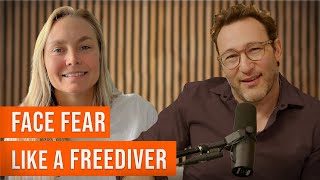
Freediver Li Karlsen explains how breath control in the ocean taught her to manage fear and stress. She's dived to extreme depths, held her breath for minutes, and swam 75 meters under pack ice to face a childhood terror. Longer exhales and diaphragmatic breathing shift your nervous system toward calm.
Questions this video answers
Around 80 meters (≈240 ft) depth; training/personal best cited as 80 m.
Around seven minutes when lying completely still.
Around 75 meters, taking about one and a half minutes.
About 80 seconds down and 80 seconds up (≈2 minutes+ total surface-to-surface; Li says a bit more than three minutes including transitions).
She says she started freediving in 2018.
Chapters
Courage is not about bravado. It's about staying calm. Which raises the question, how do you stay calm when everything in your body wants to panic or freak out? Well, Lee Carlson knows a lot about staying calm. A former soldier, she is now one of the world's most accomplished free divers. She holds numerous records, can hold her breath for seven minutes, and can dive down over 260ft on one breath net net. Lee is a certifiable badass. But that's not the main reason I wanted to talk to her. It's what free diving has taught her about managing fear and stress. And it turns out the lessons she's learned also work above the water. Something as simple as changing how we breathe can help all of us manage our stress and fear. This is a bit of optimism. Lee, thank you so much for doing this. I'm such a fan of yours.
The thing that I find astonishing about your story.
Is how you got into this. When I think about freediving, you know, the thought of holding my breath and going straight down in the ocean.
Is a horrible idea. And just to be clear, your record is you have gone down 80 meters, which is insane. That's 240ft.
Yeah, something like that.
That's not like the bottom of a pool.
That's a very, very deep pool.
It's a very, very deep pool, and you just hold your breath and go straight down and then come back up. What made you want to do this in the first place? Because it's a very scary sport, and it also has a lot of casualties. It's a dangerous sport. What. What made you want to get into this? How did you get into this?
That's a good question. My mother asked me that the whole time, too. But thank you for the very nice introduction.
I think it was. I felt limited in life because the ocean was. I was so in love with it and at the same time, afraid of it. So I wanted to explore those fears of, you know, going into that deep darkness where you can't see the bottom and just curiously explore what's down there. And in the beginning, it freaked me out completely. I was so afraid, and it was like I had so many excuses in my head. But then when you get past that, you get past your mind's limitation, there's complete freedom. And being down there, it doesn't feel like you're lonely. It feels like you're in complete solitude.
Oh, lot to unpack there. So I've had the feeling where I've gone to the bottom of a pool and run out of breath and the panic to get to the top of the pool, to get to the air, is real. And this is in your words, in your life, shallow. No matter how deep a pool I was in.
When you come up from a deep dive, does that panic of running out of air happen and you learn to control it or do you never get to that point?
It's almost the opposite. It's like the closer you get to the surface, after you've been down there in the darkness by yourself, it's like you don't really want to return to the surface because it's is messy and there's noise and there's, you know, your brain turns on again. So when you get up there, it's almost like you're being rebirthed and then you have to, you know, be in the normal life again. So it's almost like you're stepping out from your real life and you get some peace. And then like, physically, what's happening to you when you dive is that your lung, they, they compress. So it's actually very comfortable from the.
Pressure of the water. Pressure.
Exactly. So just by being at 10 meters depth, around 30ft, right, your lungs are half the size, which means that if you take one breath and you go down to 10 meters and you have half the volume, your brain perceives that as you have that you have a lot of oxygen molecules. So down there, I don't have the urge to breathe at all unless I do something very stupid and waste a lot of energy and oxygen. So when I go up again after 10 meters, my lungs expand and that's where I get the urge to breathe again. So the last 10 meters is the most dangerous part of the dive.
And do you have that feeling of, as I said before, do you. Do you get that feeling of, I'd like to take a breath now, please. Like in those last 10 meters.
No, I don't get that in depth in the ocean. I can get it sometimes when I'm in the pool because you're so close to the surface. So it's like your brain understands that you're actually closer to. To the air.
And just so that people understand the incredibleness of your record, you hold the record for holding your breath, right? The Nordic record, Is that correct?
There's different disciplines. So the world record that I have, it's an unofficial world record where I dove under the pack ice in Greenland. So it's ocean ice. So it's below the freezing point of fresh water because it's salt water. So it's minus 2 degrees. So I dove under Celsius. Yeah, Celsius. I dove under the pack ice and the icebergs. And then I have Nordic and Swedish records in.
Well, in the pool, where you go back and forth. And also for depth, where I go straight down vertically.
And that's the 80 meter record.
Yes, that's a training record, a personal best. I have the World championships now in October, so let's see how that goes.
And how long can you hold your breath when you go down? When you do this 80 meter dive? Like, how long are you under the water?
You usually calculate 1 meter per second. So you go down 80 seconds ish, and then up 80 seconds ish.
So how much? Do the math for me.
That's two minutes. A bit more than three minutes.
A bit more than three Minutes. But you can hold your breath for seven, right?
Yeah, if I lay completely still, if I don't move at all.
Right, because you're obviously, you're kicking your feet.
Exactly.
You're moving, you're using energy.
Exactly.
So just like I can sit really still and maybe go for like a.
Can you?
Yeah, fair point. Fair point. I'm trying to think how long I've held my breath underwater. Over a minute. But. But what I find astonishing is you can go three minutes while kicking your legs.
Yeah.
Okay, change the subject slightly.
Okay.
About this magical life that you live. So you live in between Stockholm, Sweden and in Mauritius.
Yes.
Do you bounce between the two?
Yes.
Stockholm, because I think work and life is here.
And Mauritius, because oceans, oceans, oceans, dolphins, whales.
And so you. I've seen. And for anybody who's curious about this stuff, the magic of what you do, go look at Lee's Instagram and you will see images that will blow your mind of you swimming with sperm whales every single day.
Almost. Yeah.
And what's interesting is you can't go scuba diving with sperm whales because the bubbles from the scuba will scare them away.
Yeah, it disturbs them.
So. But if you hold your breath.
Yes.
As your Instagram demonstrates, you can go right up to them and socialize with them.
Yeah. Usually they come to you, they check you out, they use their echolocation. It's like a clicking sound. And then they kind of invite you to the pod. And they're very playful and empathetic and curious, especially the calves. So they usually come straight up to you. And I mean, they're like five ton, you know, calves. So it's like quite big creatures.
How big are the big sperm whales?
Between 15 and 25 meters. The females are a bit.
Smaller, they're like up to 15 meters. And the males are huge.
25. So 75ft? Yeah, for a big one.
Yeah. And up to 30 meters for the males.
30 meters?
Yes.
So 90ft?
Yeah. Huge. It's like a big, big bus.
So how many times a week will you go hang out with the whales?
Two to three times a week, normally in the mornings.
Before my coffee.
Do you think they recognize you?
They do, yeah. I have one of my friends, her name is Jade, it's a sperm whale calf. She recognized me instantly and she always comes and tried to nibble my fins.
How do you know it's the same whale? I mean, I hate to say it, but like.
Well, you reckon they difference? Well, they have patterns on their belly.
Okay.
And they also have scars on their fins and the big ones that can dive deep, their main food is giant squids and the squids have long tentacles. So when the whales eat them, they fight back. So if you look around the eyes of a sperm whale, you will see huge scars and sometimes they're all fresh, like bloody from fighting with these giant squids.
Wow.
You know the horror movie 10 to 15 meter long squids that lives down in the deep, they eat them.
So you do recognize them and they recognize you and they come straight to you. You said your friend, your buddy Jade.
Yeah.
Which is a 15 meter whale.
Yes.
Comes to hang out with you and you always comes to you. So you recognize this whale always comes to you. How, how long can you hold your breath when you go diving with the, with the whales?
I usually dive down to around 10 meters with them and I stay for one and a half to two minutes. So as long as a dolphin, that's.
What dolphins, they'd hold their breath one.
And a half, 90 seconds. Yeah. Dolphin hold their breath for one and a half minutes. Sperm Whale hold their breath for one and a Half hours.
Wow.
Yeah, yeah. The funny thing with sperm whales is that they have. Their lungs is 1200 liters by the surface. And when they dive down to 2000 meters where they hunt for these squids, their lung size is 6 liters, ish, which is the same size as yours when you're sitting here.
Wow. From the, from the compression, from the, from the water pressure.
That's the pressure.
Wow. So are there dolphins out there as well?
Yeah, yeah, Spinner dolphins and bottlenose dolphins.
So you can dive with the dolphins for the same length of time that the dolphins dive?
Yes.
Can you take a breath that quickly though? Because they can take a quick breath and go down for another minute and a half. You can't do that.
Yeah, that's why I sleep with the tape on my mouth to buffer the CO2. That's the main reason.
How much time do you need at the surface to hold your breath? To go down for a minute and.
A half to two minutes, five to seven seconds.
Oh, that's it.
Yeah, it's exhaling. You get the CO2 out and then you dive again. And I do that a few rounds.
And so you can go diving with dolphins?
Yeah, I play with dolphins.
The images of you on Instagram with the whales I find incredible. And then you go sometimes see them when they're sleeping and they're all vertical. There's like this whole pot of whales just hanging out in the middle of the ocean. Vertical.
Yeah, it's like a forest of whales.
Which is the craziest image. And the images of you diving under the ice, we have to talk about that now. Diving under the ice.
As if free diving isn't stupid enough.
Or cool.
Or cool stupid. Or cool.
Yeah. It's a fine line between what's stupid and what's cool.
Why on earth would you dive under the ice when if there's anything that goes wrong, you actually cannot get to the surface?
It's not going straight down like free diving, it's going in a hole. Swimming horizontally to another hole.
Yeah.
And so if you get the calculation wrong, if you go in the wrong direction, if you run out of air before you get to the hole, you cannot get out.
Yeah.
That is truly horror movie stuff. Getting stuck under the ice.
Yeah.
What possessed you to choose to do that?
And it's freezing frickin cold.
Yeah, it's very cold. It's beyond cold.
I mean, you were in Greenland when you did this, which is notoriously cold.
The coldest, most non friendly place on this planet.
So what possesses you want to do this?
I was terrified of getting stuck under the ice from when I was a.
Kid, by the way. Everyone is terrified of getting stuck under the ice. This is not unique to you. Some people are afraid of heights, but not everybody. Everybody's afraid of getting stuck under the ice. Okay, so you were afraid of getting stuck under the ice as a kid. You live in Sweden, so that's a real thing.
Yeah. The thing was, it was preventing me from living to my full potential. Because when I became an athlete and started competing in freediving, the stress, the carbon dioxide that accumulated, it brings you not only excuses why you should go up to the surface, like why are you doing this, this is super stupid. But it was creating so much stress in me that I was coming up to the surface. That was part of my emotional blockade because I was imagining all of these different ways that I could die on where even if I was in super warm waters in the Philippines diving, or if I was in the pool in Eric Dalsbodet, which is the national arena here in Sweden, I was imagining having a layer of ice that was preventing me from coming up to breathe when I was down there. And that was stressing me out so much that I was. Was preventing me to. To reach my full potential. Right? So I figured that I. I have to face this fear. So I had the possibility to. We have been shooting a documentary for about one and a half years, and I told these guys about my fear and my challenge, and they were like, hey, we want to tag along and film that. And if you fail, that's actually good for the production.
So if you die, not die under.
The ice, like not. It's okay if you don't. We don't want you to push to your maximum limit. We want to follow you when you meet your challenge. And obviously I told them, like, I cannot imagine myself failing. I have to visualize myself actually making it. Otherwise, you know, it's the athlete, it's.
Like, yeah, every athlete has to imagine getting the gold, right?
Yeah.
Yeah.
So in March this year, we went to Greenland and I had trained myself to have like an over capacity with depth. I could dive to 70 meter plus. I could do more than 200 meters horizontally in the pool. I could hold my breath for around seven minutes and I could sit in zero degree waters without a wetsuit for more than 10 minutes in several rounds. But when you come to that hole in the ice, that void, I was back as a kid again, you know, looking down in the eyes and I was like, I have no clue what's down there. And that fear became a curiosity in my search for freedom. And I did the dive and it was so hard. It was the hardest thing I ever done in my life. And everything that could go wrong went wrong, the documentary will show. But afterwards, I was at complete peace.
What went wrong? So you go down into the ice.
One of the things that went wrong was that we couldn't get to Greenland because it was iced hurricanes. So Instead of getting 12 days, we got two days. So I just got one day of doing like a quick recce and then the second day when I was doing the actual recce.
Meaning reconnaissance.
Sorry. Yeah, reconnaissance.
Take the girl out of the army. You can't take the army out of the girl.
So the second day, my. My exit hole had frozen. It was like half a meter with pack ice. So we had to do another exit hole, but I couldn't see that one because we had so short of time. So I didn't really know where my exit was and the wind was much stronger and we had to abort a dive. And the hole that I was sitting in, it got frozen the whole time because of the cold. So I had to sit with my fins, you know, and just stare up the ice because it was getting frozen, just waiting.
It would just freeze over while sitting there.
Yeah, it was that cold. And the thing with Greenland is that it's pack ice and it's super thick. And then you have icebergs that's moving around. And since it's salt water, it's minus 2 degrees. So it's actually below the normal freezing point for fresh water. And all records so far have been done in fresh water because it's the, you know, this safer and maybe saner way to do it because the ice is the same. It's like a really.
It's the same thing, same thickness.
Exactly.
Or from. From one end to the other. In fresh water, if it's 4 inches thick, it's going to stay 4 inches thick everywhere.
Whereas seawater, it's like a mountain underneath and you don't know what's down there and it's moving.
So we couldn't have any safety lines. So I didn't know where I was going and I couldn't be attached.
So you can't attach a line from one part of the hole to the other where you hold with your hand so you can go in the right direction.
No, because everything was just moving and.
It would get stuck in the mountains.
Exact. And if I was too buoyant, I would get stuck in a crevice. Or if I was going too far below the icebergs, I would start descending and it was 500 meter deep. 500 meters.
And that's because of your wetsuit, right?
Yeah, the wetsuit was a 7 millimeter wetsuit. So when I go down, it decreases and I lose my buoyancy super fast compared to a 3 millimeter wetsuit.
So if you're too buoyant, you get stuck in the ice and you die. If you go too deep, you lose your buoyancy and you will sink and you'll die.
Yeah.
If you go in the slightly wrong vector, you'll die. If you go in the right vector. But the ice moves, you'll die. If you run out of air at any point, you'll die. There's no safety line.
So tell me again why you did this.
I wanted to.
And let's be clear. There's a reason the Guinness people. The reason this is an unofficial record. Spoiler. You do it. The reason this is an unofficial record is because the Guinness people will not endorse something this dangerous because they don't want people to keep trying it because someone will get hurt.
Yeah. I don't recommend anyone.
Right. So this can never be an official record because the Guinness people won't do it. But the fact is, you did it. How long was the dive?
Around 75 meters.
75 meters. Horizontal?
Yeah. Yeah. Under two icebergs. And a tunnel.
And a tunnel, yeah.
How long did it take to get from one end to the other?
Around one and a half minutes.
Did you panic?
No. I don't really remember the dive.
I don't remember anything. It was like the strongest flow state I've ever had in my life. But as soon as I surfaced and I took my first breath, everything just came over me like, holy shit. What did I used to. Because I was convinced that I wasn't able to do it because of the conditions. I knew that I was super strong. And I got, you know.
You could physically do it. Exactly, but you didn't know the conditions.
But the conditions were just, like, crazy. So what I did was that I aimed for my safety diver that I knew was, like 10 or 15 meters away from the hole. And she pointed vigorously up towards the hole where we attached the line with a strobe that was blinking. And in the last second before I. Like, I was going to her to. To get the regulator, and I was like, I'm gonna pass out. I'm like, I'm too drained. Then I saw the strobe, and I was like, fuck it. I'll just go for it.
So you were actually. Actually in an out of air. You were actually looking at her singing, I haven't. I'm gonna fail. I'm just gonna go take a breath of air from the diver.
In my head, I didn't. You can't see it in the film, like, when they're filming. But in my head, I was like, okay, I'm going to her. But then I saw the hole and her hand, and I was like, ta da. There it is.
So it's like, you think you haven't gotten to the finish line, and then you realize it's just around the corner.
Exactly.
Can't wait to see this film. So you went into this because you were afraid of the dark ocean, you were afraid of the depths of the ocean, and you did this to face your fears?
Exactly, yeah.
There are other ways to face fears. Was it specifically a fear of the ocean?
I perceived the. The darkness and the depth as a scary void. So I was also afraid of heights. Like, I didn't want to be in, you know, very deep waters where I couldn't see my. My feet or, sorry, my feet. My. But the bottom. My feet on the bottom, maybe.
And so. And so now, how has your life changed? How you know, you had this fear? You talk the way you.
The.
One of the reasons I wanted to have you on the podcast is you don't talk about it like a sport. You talk about it like a yoga practice. You talk about it like a meditation practice. When you talk about basically, which is an athletic event, you don't talk about records and depth. You talk about mind and release. You talk about calm. I'm curious how you have changed personally. Like, what kind of person was Lee before you started freediving? And what kind of person is Lee now?
I see freediving as self medication. Like, training for me has always been self medication. And then I found this amazing medicine that works for my life in general, both on a physical, emotional, and a mental level. So the. The lead that started freediving 2018, six years ago. I was still in the army then. I was working at the headquarters. I was very much into my career. I was, like, full on. Everything was, you know, work, and I didn't have any real place to ventilate. And then I found this fear of mine that I explored. And I wouldn't say I became obsessed with it, but it was. It became a passion really, really fast.
And I think something that becomes a passion really, really fast is what we like to call an obsession.
You could say that.
Well, it's still where all of my money is going for fins and wetsuits and travel. So, yeah, maybe it's an obsess.
What kind of person were you before you started freediving? Were you anxious? Were you like, I know you were ambitious. Like, were you. Were you sort of, you know, high strung? Like, what kind of person were you before? I'm so curious about the transition.
I was definitely anxious. And I know now from my therapist I had layers of PTSD from. I mean, both from the military and life in general. And that's something that I had to work with in order to dive deeper. So in the beginning, I was high, performing in depth, really, really fast. But then I reached a certain level or depth where it was like, you know, an invisible wall. Like, I couldn't get deeper.
What depth?
I got to around 60 meters.
And you couldn't go past 60 meters? No, it was like you ran out of air every time.
Mentally, it was like I couldn't even. I stopped wearing my dive computer that tells me the depth. And it was consistently at 60 meters. I mean, that's also physical because it takes a lot of time to get adapted to the depth. Basically every cell of your body has to be adapted within the mammal dive response that we have to be able to handle this pressure. But it was definitely not mental, but emotional. So I got to a point where I felt like I couldn't breathe when I was at surface because I had so much pressure in my chest from things that I didn't deal with in life. So that's when I had to take, you know, not one step back, but a hundred steps back, and you start to work with it from within. And as I did that, the emotional and the mental perspective of getting different tools, it didn't just improve my diving, but it also made me, what I would say, a better human being.
What. What did you do to treat yourself, to go beyond the 60 meters?
The first thing I did was to start to be aware of my inner being, the awareness of my breath. To be able to hold your breath, you have to be able to breathe properly. And the breathing, I mean, it doesn't control everything we do, but you can basically tell your brain and your whole system to be afraid by breathing in a stressful way, although there's no stress. And that's where we tend to get stuck today in society, because we're not taught how to breathe for life. You're taught how to breathe for diving and breath holding, and you're taught how to breathe as a soldier, like when you're shooting, to get the right shooting position. But a lot of people, including myself, I was creating unnecessary stress by breathing the wrong way, where I already had a lot of stress in my life.
So what is breathing the wrong way? So obviously breathing is autonomic. I don't think about it. My body breathes because it needs to breathe to survive. So if it's automatic and autonomic, like, how am I breathing the wrong way? Why is my breath causing me stress? And yours no longer does. Start with, why is my breath causing me stress?
Yeah, I mean, you can breathe to be alive and you can breathe to Be living. Right. And what happens with the stressful breathing that's completely natural if you're being chased by a lion, which we usually are not in today. Right. But it's a very shallow mouth breathing, and it goes to our chest and it activates the sympathetic nerve endings in the upper part of our lungs. Parasympathetic breathing, or the state, is basically the opposite. So you take breath with your, preferably your nose by using your diaphragm, the breathing muscle, and some call it belly breathing, but it's basically not aware of breathing. But you exhale longer than you inhale. And that's usually the opposite of what we do today. We're very good at inhaling, but stress is basically accumulated carbon dioxide. So the breathing that we use in freediving is a very aware state of how much carbon dioxide we have in our body.
So give me an example of this. Shallow inhale with a long exhale.
Yeah, sure. I mean, start by relaxing your shoulders and then create awareness.
That would take about an hour.
And then inhale slightly with your nose, just like a small puff. And then you can exhale with your nose or your mouth. And then you take a half an inhale too. And then.
So super relaxed.
So I'm doing this short inhale through my nose and then a long exhale.
And I'm pushing the breath in not into my chest, but into my belly. So I want my belly to expand.
Preferably your ribcage. Like if you put two fingers on the lowest part of your ribcage.
Which I'm doing.
Yeah. You should feel that when you inhale, they go down and outwards a little bit.
Oh, wow.
Because we can do belly breathing by just using our abdominal muscles.
Right. Which is what I learned.
Yeah. So that's. That's one way. But if you have the rib cage moving, then you know that you're using the diaphragm.
Diaphragm. Interesting, interesting. Okay, so the short inhale, long exhale.
Yeah.
Do I push the air out or let the air fall out?
Passive exhale.
So let it fall out as long.
As it's a little bit longer than the inhale. And that's basically the key. Like, no matter what state you're in, you don't have to be diving or shooting for that matter. As long as you take a longer exhale than an inhale, that's an aware breathing that will take you into a parasympathetic and relaxing state.
So do you use this just in your day to day when you have stress?
Yeah. All the time. Like, I don't sit in, you know, in silky pants in a yogi position. I do it.
At the bus station or when I'm walking or when I'm talking. It's like, where's my shoulders? Okay, they're up, Relaxed, how am I breathing? And then inhale with the nose. Because the thing with nostril breathing, now, it's getting a little bit nitty gritty here. You have nitric oxide in your sinuses. So when we inhale nitric oxide, like through the sinuses, they expand the blood vessels, so the. The gas exchange between oxygen and carbon dioxide becomes more efficient, and it also dilates your vessels.
So put in layman's terms.
So if you breathe with your nose.
Better to breathe through your nose than your mouth.
In general, yes. Especially if you're talking a lot. Let's say that you're a speaker, let's say that you do talk.
It's really good. Then to compensate with nostril breathing, you don't have to, you know, not talk or not breathe with your mouth.
But also, though, some people might suggest that is a good strategy.
So nostril breathing with your diaphragm take longer exhales than inhales. That's like breathing for life in general, I would say.
Okay, so let's pick up where we left off before. I asked you what Lee was before you started free diving and who Lee is now. So you were somebody who carried a lot of stress, you had anxiety, and as you learned, layers of ptsd, both from combat, the army, and other things in life.
Now that you're a champion free diver. But more important, you've learned how to breathe and manage panic and stress, because that's what going to depths is, right? It's managing panic and stress. Who are you now? What kind of person are you now that's different than you were before?
I would say I'm much more in touch with little Lee, the playful part, because the adultly that had completely taken over before because she thought she had to, was very stressed and anxious and was taking on a huge responsibility and being worried about things that she couldn't control. And I think a part of letting your inner child not take lead, but flow in life enables you to deal with things in a more playful and fun and harmonic and peaceful way.
If I met you before, yeah, I'd say, what kind of person are you? What would you have said before?
I was very much captainly. I was very rigid. It was my way or the highway. I was extremely focused, ambitious, I'm still ambitious, but I'm much more relaxed in letting things be as they are and not worrying so much. There's very few things that you can control in life, whereas breathing, once again, is one of the few things.
This reminds me of Victor Frankl, you know, Viktor Frankl, who wrote Man's Search for Meaning. And when he went to the concentration camp in the Second World War, he was struck by how all of these people, the prisoners, were all suffering the same experience. But he remarked that some had the will to live and some didn't. And that's what he realized was we cannot control the world around us, but we can control our reaction to the world. And you're taking that a step further, which is we cannot control the world around us. But the one thing that we can control is our breath. Because I think it's very hard. Even when I talk about Viktor Frankl to people, you know, I say, oh, you can. You know, we can control our reaction, we can control our mindset. And I think that, though. That we can control our reaction, we can control our mindset. And I think that though that's true, I think it's much easier in concept than it is in practice. You know, change. When you're in a bad mood and somebody says, come on, cheer up. Like, that's changing your mindset.
That's healthy.
All you want to do is punch them in the face when somebody says, buck up. You know, when you're in a bad mood, I think it's very hard to just change your mindset. You know, what you're saying is control your breath, which is something I can actually do rather than just think about. And so it's basically the same idea, it's the same concept, it's the same philosophy, except it's much easier to practice controlling my breath. Like, even just now, what you've taught me, which is take a short breath in through my nose and then some sort of long exhale. Like, I can do that.
Yeah.
Or when I'm. And as you said, I don't have to, like, go take a yoga class to relax after a stressful day. I can do it in the meeting, I can do it in the conversation. I can just start.
Yeah. And I mean, even if it's a small sense of control, it's a mentally huge control because you are controlling yourself and your inner environment and the external environment. It could be a war zone. And that's okay because you can't take responsibility for it, and usually you can't do anything about it. It is what it is. It sounds very stoic and almost like apathetic, but in a way, it's the most kind thing you can also do to yourself because your own responsibility is taking care of yourself and therefore being kind to yourself. You can illuminate kindness.
The big lesson that I'm learning here that is pretty profound, which is I always thought free diving was about holding your breath. I always thought free diving was how do you learn? How do you practice breathing so that you can maximize oxygen in your lungs? And I'm sure that's a part of it as well. But what I'm learning from you is it's actually less about the breathing to survive the breathing, not to pass out. But it's really a stress management that you're breathing for. Stress management, because if you suffer stress and freak out when you're at depth, you're probably going to die.
Yeah, It's a direct feedback. You will die.
I mean, you'll actually die, like if you panic at 80 meters, at 70 meters.
No, not theoretically, you will die. Yeah.
So this is the amazing thing. It's not about how you hold your breath so you don't die. It's how you manage the panic, how you manage the stress, so you don't die. And obviously, if you can do that in an environment where you physically couldn't breathe underwater and at pressure, then the same lessons used above the water have the same impact, which is stress management. And so.
One of the reasons I wanted to talk to you was not so that we can teach people how to go free diving, but how we can learn some of your stress management techniques from breathing. This is what I'm learning now that we can manage our stress. I wanted to bring you on just because I think what you do is madness. But what I'm learning is it's the furthest thing from madness. It's probably the most important thing we can all learn to do, which is to breathe. And you said it. There's breathing for living and there's breathing for life.
Yeah, exactly. And even the philosophical part of you can't really.
Inhale more oxygen. You can't increase the oxygen saturation in your blood, because unless you've been holding your breath for three minutes or more, which you haven't, what I can see, your oxygen saturation is between 95 and 98%. So when we say that, as you said before, taking a big breath, it's all about exhaling the carbon dioxide. And if you apply that in life, like you don't usually have to take on more things, you have to deload. You have to let go of things to feel the stress relief. And that's when you can move on, and that's when you can thrive. Because if you don't do that, you're probably fighting unnecessary battles inside, creating stress, choosing stress instead of choosing freedom and controlling what you can control to be able to thrive where you actually need it.
Now, one of the things that I know that you do to practice nostril breathing, which is a more efficient form of breathing, as I'm learning from you, is that you tape your mouth shut at night when you sleep. Is that correct?
Yes.
And that way you guarantee that while you're sleeping, you're only breathing through your nose to help build lung capacity and also just to practice breathing through your nose normally. Right. You're training your body.
Yeah. And I didn't make this up just to be like, you know, it's not something that I girl guessed. I read this beautiful book called Breathe by James Nestor, and he recommended it. And for me, it works really, really well. I would say that I'm not. I don't snore. What I know. But one part of humans is that our breathing evolution is actually going the wrong way, because we are mouth breathing the whole time, and we're not taught how to breathe for anything, unless you're a free diver. So it's not only the nitric oxide in your sinuses and stuff, but also for us Swedes in the winters, if you breathe through your nose, the air has a longer time to warm up, so it's easier for your body to deal with the bacteria that actually goes through your nose here. And then it gets heated up before it hits your lungs.
Because it's true. We have cilia in our nose to clean air. That's what it does in our mouth. We don't clean the air.
No.
And I'd also, we also, I know that when we're sleeping, when we breathe through our mouth, we let out a lot of moisture from breathing, and so we dehydrate ourselves. You can wake up dehydrated.
Exactly.
And breathing through your nose, I think, mitigates that. And let's just be clear, it's not a piece of duct tape here. It's a tiny piece of medical tape. Because I know you showed me this. The tiny piece of medical tape that you stick on your hand first to get rid of some of the sticky so in case you do panic at night, you don't die.
Exactly.
And then after you rip it off your hand, you just stick a little piece over your top lip and bottom lip vertically.
Have you tried it yet?
I have. I have. When you. I tried it for a while, actually. I was doing it every night for a while. The thing that I found astonishing about it was, especially as mouth breathers, you know your nose gets clogged up.
Yeah.
And if I tried to breathe through my nose, I couldn't, you know, or maybe only one nostril. And I remember, I remember that's how I was going to bed and I was putting the tape, and I'm like, I'm gonna die because I can't even breathe through my nose. And within seconds, my nose cleared up and I was breathing.
You want to know why?
Yeah.
Because the. The carbon dioxide that you then accumulate by taking a little bit longer exhale that we usually get when we breathe through the nose. Because it takes a longer time to exhale through the nose, it's actually not vaporizing the mucus, but it loosens it, so it's easier for the body to get rid of.
Wow.
So in theory, I'm not saying anyone should try this, but if you actually have a little bit of clogged sinuses, you could try to hold your breath or just breathe through your nose and the mucus will loosen up. Loosen up. Exactly.
This is amazing. Okay, let's keep going with this. So even when you exercise, and I know you do vigorous exercise, you'll do cardio or something, and you don't breathe through your mouth, you have learned to only breathe through your nose. When you exercise, how do you get enough oxygen in your lungs? I mean, like, if you're doing vigorous cardio, how do you get enough oxygen in your lungs just through your nose? I don't think I could. Or at least I couldn't get the air out. I might be able to get it in, but out, I need to, like, exhale hard. But you're teaching me to exhale longer, and when I exercise, I exhale quicker.
Yeah, I mean, it's a transition period. So what I had started doing when I was walking and doing, like, running, I started using nostril breathing as much as possible, specifically when I was exhaling. And it took me a good year before I was comfortable with doing that. And don't get me wrong, like, if I do vigorous, like, high intensity workouts, I do have to exhale through my mouth now and then. But for me, lowering the pace a little bit and then breathing the right way by exhaling longer and let. Letting my body to learn how to work with the carbon dioxide.
It takes a while, but it's possible. And it is harder because the carbon dioxide in itself is creating a stress. It's the fight and flight reflex that we have in our brain. But also for me, specifically in freediving, the thing that I train the most is my body's capacity to handle the huge amount of carbon dioxide. Because when we hold our breath, it's not the decrease of oxygen that freaks us, freaks us out. That's not what's getting us the urge to breathe. It's the increase of carbon dioxide. So the better my muscle cells and my whole system gets at being able to buffer carbon dioxide and acid, the better I am in the pool and at depth.
This is a really interesting insight here, especially when dealing with panic and stress and anxiety, which is we think we need to get air in, we think we need to get oxygen in. I just need to take a deep breath. We often say that, oh, I just need to take a deep breath. And what you're saying is the total opposite, which is the panic and the anxiety and the stress doesn't come from our desire to get oxygen in, it comes from the need to get carbon dioxide out.
Exactly.
And so really what I need to do when I have stress is not the inhale, it's the exhale, the long.
Exhale, and thereby the switch from the sympathetic to the parasympathetic, from the stressed to the relaxed, is the long exhales.
First of all, what's the difference between sympathetic and parasympathetic? You've mentioned it a few times.
Yeah. Sympathetic is the. In the autonomic nervous system, you have the sympathetic drive. Not in. Sympathetic as in being kind.
Right, right. So this is everything that happens automatically.
Yeah, exactly. We can't.
Breathing, heartbeat, all that stuff. Digestion, digestion, blood flow.
And the parasympathetic is the recovering state. And you can't affect the autonomic nervous system because it's autonomic, but we can control our breathing, which stimulates the parasympathetic and sympathetic nervous system. So our brain can tell us to be afraid and we start breathing in a stressful way. But we can also tell our brain that we are afraid by breathing in a stressful way.
Oh, okay. So.
So it's a circuit.
Ah, okay, so this is. Let me repeat this because this is very. This is important. Right. If there is a genuine reason to panic, like there's a lion chasing you, there's a burglar, you hear a bump in the night, you're afraid you're going to get fired from your job, your body will react in fight or flight, you'll start breathing shallow and getting ready to run. But what you're saying is we can also create stress where there may not be any or we may be overreacting to the inputs that we see. Like we had a fight with somebody, maybe we did something wrong at work. I mean, let's take, let's stick with that analogy. And we start fearing that we're gonna get fired. But that's not necessarily because we are, because it's real panic. It's because we start breathing shallow and our body interprets the shallow breathing as you better start panicking in your mind. It's connecting the physiological with the mental. And so if we learn to breathe, what we are actually doing is allowing the mind to say, oh, there's nothing to panic about.
Exactly.
Wow, wow, wow. Okay. Do you know why I like having this conversation with you is because you have to learn to breathe and understand all of these physiological and nervous system things based on the actual science. Because otherwise you'll die.
Yeah.
I mean that, that's, that's the stakes here. Right. Whereas I think a lot of the.
Well intentioned but sort of the space of meditation and yogic and like though there is science and science ish around it.
Some of it's flat out wrong because there's no stakes.
Yoga and meditation is, they're fantastic tools. But just as you said, you won't die from meditating or doing yoga. Wrong. But from freediving you will. But it's not, you know, something that we strive for. And even if it's an extreme sport, it doesn't mean that we are taking extreme risks.
And what you have learned to do, to do this is basically you've learned to.
Scientifically meditate.
You could put it that way.
That's what you do. I mean, what you do. I would. I think another way to describe your extreme sport is extreme meditation. You go into a deep, deep meditative state where you learn to get the carbon dioxide out of your body. How to manage panic so you don't panic when you're 80 meters below the surface of the ocean, 240ft below the ocean surface. Solitude and no panic. The important thing is it's less the solitude and the lack of panic. The peace that you feel comes from the lack of panic. And I know when I have meditated there is a calm and a lack of panic. And like all the problems of my day seem like they can go away. What you're teaching me is a better way to meditate because as you said, you've learned to meditate because there are stakes. And I love what you said. If you get meditation or yoga wrong, you won't die. But if you get your meditation wrong, you will die.
Thanks so much for coming on.
Thank you, Simon.
I've learned so much. I'm going to do this breathing thing. I'm particularly fascinated by how to manage the stress in real time and not having to go to a yoga class to manage the stress from the week before or do a meditation in the morning to manage the stress the day of, but rather to be able to manage stress and conflict in the moment, whether it's in my mind or in real life. Huge.
Do it when you can and don't punish yourself not for being perfect. Just include as many good things as you can when you can.
Lee, always an inspiration. Thank you so much.
Thank you Simon. You too.
If you enjoyed this podcast and would like to hear more, please subscribe wherever you like to listen to podcasts. And if you'd like even more optimism, check out my website SimonSinek.com for classes, videos and more. Until then, take care of yourself, take care of each other.
More from Clegg





AI Won't Tell You the Full Truth | Arthur Brooks + Simon Sinek | A Bit of Optimism Podcast



How To Make the Best Decision | Arthur Brooks and Simon Sinek | A Bit of Optimism


