How To Get More Interviews While Applying Less
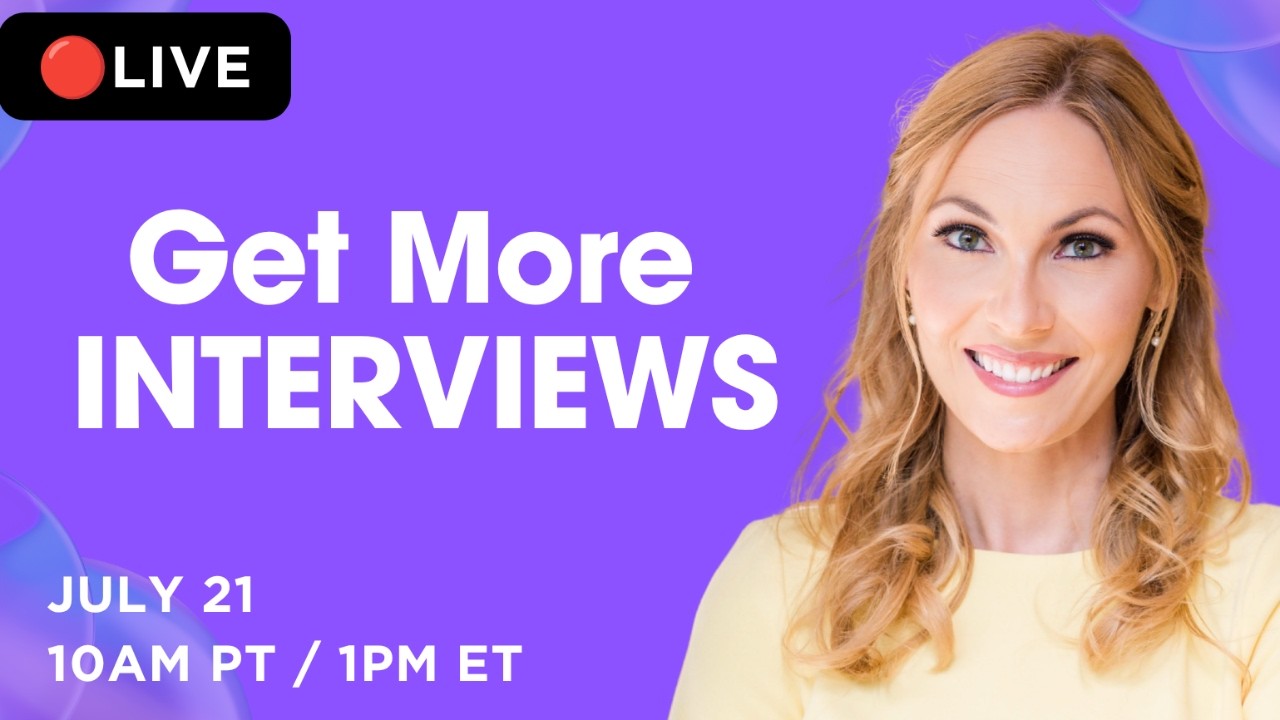
Madeline Mann shows how to land more interviews by applying strategically instead of constantly. A well-optimized LinkedIn profile can generate over 50% of interviews through inbound recruiter outreach. Focus on targeted job search, role-specific resumes, and direct outreach to hiring managers rather than mass applications.
Chapters
Hello and welcome. We are live. It is time to talk about how to land more interviews, even if you bombed some of them, right? Because here's the thing, and even land still the offer, even if you bombed the interview. How to keep going, how to save yourself when that— those moments in the interview didn't go quite as well as you had hoped.. And this is so incredibly common. And go ahead and say hi in the chat. Say where you're joining us from. Welcome, David, good to see you back. And what's great about this session is I am here live with you, ready to answer your questions. So whatever questions you have, go ahead, you can pop them in the chat and we can discuss them. And, you know, I go live every Tuesday. Okay, every Tuesday, same time, same place. And it's been so great to see a lot of the same faces coming back day after day, week after week. So it's so great to be here. Now, a lot of people view the, the entire job search process, the entire hiring process, as it has a strict timeline, as it has a strict framework, and we must follow that framework, and we must wait for the company to essentially give us the signals that we can proceed and all that kind of stuff. And that creates this false idea that if things don't go quite our way, maybe if we're applying to a role and the role closes online, does that mean we can't still get that job? Not necessarily. If we get rejected by a company, they say, no, we're not going to hire you for the role. Does that mean you can't have that job? According to my clients, a lot of them have landed jobs that they were previously rejected for, or at companies where they were previously rejected. If you bomb an interview, does that mean that you're not moving on? Typically yes. Typically, I mean, uh, typically yes. If you don't do well in the interview, that's usually the large portion of what they're judging you on. But are there things you can do to, you know, better put yourself in a position? Oh my gosh, you guys, I am realizing that I'm doing the wrong topic. Oh my gosh, I think this is a topic for next week. So actually, today's topic— sorry, guys— is how to get more interviews while applying less. Sorry. Well, that was a little preview of what we're going to talk about next week. So sorry, I was preparing for next week as well and also writing a bunch of stuff for it. So I'm realizing, oh my gosh, wrong thing. So there you go. We're actually going to talk about how to get more interviews while applying less. Oopsies. Thanks, guys. But you guys are so, are so kind to me. Okay, so I'm seeing a lot of people here. I'm seeing Kristen from New Jersey, Nicole from California. Sheldon from South Africa. Mer from New Jersey. Wait, Kyle also from New Jersey? Are we just like having so many people from New Jersey right now? And we met 10 years ago when you were working in Venice. Of course, of course I remember you. Good to see you. Thanks for popping in. Donna, bella canto. Barry is from Oregon. Safi from Pakistan. Obviously, I'll need to be here next week, says David. I love to hear it. Kelly's here. Okay, so let me, let me redo my intro then, because— and then you have a little bit of taste, a little bit of preview of next week. So how to get more interviews while applying less? It sounds like a paradox, but it really isn't. Now, applying a line absolutely is very helpful when it comes to landing more interviews, especially depending on what is— ooh, Kristen says next week's topic is going to be really good. Okay, perfect. I'm so glad to hear that. So, you know, applying a line absolutely works, and especially when we're thinking about, we're thinking about how qualified you are for a lot of these roles. If you are more of a cookie-cutter candidate that fits into these jobs you're applying for, applying online can be an effective method, especially if you are quick with it. If you are not kind of waiting for these postings to be up for too long, then that can be an effective method. And, you know, I work with my clients, we put them through the Glory Formula, which even if you're not a cookie-cutter candidate, The Glory Formula does kind of give you— give the impression that you are more of a cookie-cutter candidate. So, uh, it can be a good kind of workaround. Uh, so, but there are other things you can do, and we're going to walk through what those are. That's because a lot of people, they just only think about applying online as the one and only way to land more interviews when there's a lot of other things you can do. All right, more people are saying hello. Ah, Mark is here. Abby's here. Shima's back. Hello. Great, great to see you guys. Okay, so first of all, the— like, when I'm working with clients and I'm trying to get them way more interviews, the very first thing I do is I look at their targeting. Okay, write that down. Targeting. What are they targeting? This is literally the most important thing. Targeting lots of different jobs in lots of different industries is the fastest way to not land a job offer. This is the slowest possible thing you can do is target lots of different opportunities. You want to get really focused because when you get focused, you then are speaking to the exact right things that those hiring teams are looking for and the opportunities come faster to you and you can attract a lot more. I also have a strategy which we can talk about, which is about how to use LinkedIn to basically have a lot of opportunities come inbound. And if you're If you— if your targeting is all over the place, just, just forget about LinkedIn. Like, it's not even going to help you at all because your targeting is, is bad. Um, so that's the first thing you need to do. Um, so, uh, put yes, kind of, or no in the chat. Do you know very specifically the role title and the industry you are targeting? Yes, kind of, or no? I want to hear how targeted you feel that you are. Now, of course, you know, there's multiple role titles for the same role. So that's okay if you have multiple titles that essentially mean the same thing. But I'm talking like, don't be cross— crossing departments and just spreading yourself super wide. That's going to lead to attracting fewer opportunities. And literally this one strategy, and like I said, I use the Glory Formula to to do this. This one strategy can lead to more interviews without even changing anything else. So even if you're still applying to the same number of things, even if you're networking the same amount, even if you're kind of just editing your LinkedIn profile, then, then this, this one change. Okay, so I'm seeing a lot of people that could probably use some better targeting. We started off strong with Ryan. So said yes and yes. Oh, Omar said Matthew said no. He's just like, hey, I, I know I'm not targeted, I'm just gonna say no. Perfect. Um, Karuri, um, says yes. Barry says kind of. Ringside Rush says yes and no. Kind of says Virginia. Cole says yes. Uh, Shulvis says yes, kind of. Okay, so, so there's— I'm seeing a lot of yeses, I'm seeing a couple nos, and a lot of Um, kindas. So, um, yes, I'm targeted in the role and industry, but there are different TAs, which makes it complicated. It's very annoying. There are different TAs. I've always known that word to be talent acquisition or teacher's assistant. So, um, maybe that's what you're referring to. Um, yes, okay, got it. So, so that is your homework for today. If, if you are a kind of or a no, make sure you're getting super targeted and you know, when we think about things like, oh, you have to tune your resume and all of that, but we're also getting so much slush from AI. Like people just put their resumes through and be like, oh, it's tuned now when, when the AI is not trained to do that action. So we often then kind of we learn too late that we keep applying and applying and then we're not getting results. And that's really frustrating. So, um, got it, got it. Okay, great. So another thing about targeting is if you're struggling in the job search right now, you need to look at the market demand of what you're targeting. So how many open roles are there right now in your profession? Uh, is your, is your Are you targeting a role title that's kind of going out of vogue, that doesn't really exist anymore? That's happening to a lot of professions. I'm having a lot of— that's a huge thing I'm focused on right now with my clients is evaluating market demand. I have some clients right now that are in content designers, and we're looking at some other directions. I have someone who is, who's looking for VP of Human Resources Operations roles, and we're kind of thinking, okay, maybe we're going to go for more of a VP of just HR. Because there's more rules there, right? Like, there's, there's these different modes that we are— I'm constantly discussing with my clients. And you— a lot of people, for some reason, for some reason, they forget that jobs are to get paid. And when you're choosing a job, not only initially in your career, but then every single time you make a change, the core— one of the top 3 decisions that you make about that job is: 1, how much is it going to pay me? And how easy is it going to get this job? And how is it going to be to keep this job? That's called market demand. That should be the number 1 thing, um, because jobs are to get you paid. So if that job is not going to pay you properly, you're not going to employ you properly, that is not a good job for you. Um, of course there's 2 other criteria as well as part of the wealth formula, but, but we, we often are like not focusing on that part. Um, so there might be some reskilling you have to do. Often that often that means getting creative. That's something— another thing I work with my clients a lot about. What's creative ways that we can show that you have these skills that literally might just take you a handful of hours? That is going to be hugely impressive to companies. Yes, yes, yes. This person says, my challenge is that most of the roles in my field are in areas that I don't want to live in. So true. Yeah, that, that can be really tough. And, and, uh, that, that is kind of like a market demand thing. Like, if, if, if you have a specific local market and the jobs are not there and that is the only place you are able to live, um, then yes, there might be a market demand, uh, issue there. So yeah, I totally, I, I can totally hear you. So really thinking about that. Okay, make sure you're doing— you're figuring out market demand, and you're uncovering that so that you are not putting yourself through a harder job search than you have to be. Now, when it comes to a resume, the best way— like, like I said, like, one of the easiest ways to get more interviews without sending applications is to improve that— the application game, right? So if we're just going to improve that, there's 3 reasons why your resume currently is not getting calls. Okay, do you guys remember what those three are? So, okay, and this is— and Ring Size Rush says, roles exist in my field, but I struggle with standing out as an applicant. Okay, perfect. So that is one of the things we're going to talk about right now. So if you're— if your application has not been accepted, what are the three reasons it could be? And it could be more than one of these three. Could be all 3. So the first one is timing. The application just didn't make it in in the right timing. You know, it just— maybe they're already far enough through the interview process. Maybe they started the interview, you know, maybe even applied within a couple of days, but you really had to network into that position because they had already started interviewing before the job went live, or at least the job went live on that job board. This is hugely common. A lot of my clients do land job offers from finding out about jobs before they are posted on job boards, or they just are never posted. Um, and a lot of my clients where, uh, the company will create a role for them. Okay, that all comes from networking. So that's the first one, timing, right? Um, and second of all, the second thing that can happen is What do you think? The company didn't see your resume. Okay, so if they got 500 resumes, and they, you know, got through 300 of them, and you're number 302, and they found enough people to interview, you're out of luck. For industries like education, government, they typically will review all applications as a rule, as a standard. If you are going for corporate roles, which is typically what I coach people on, that is not the case. That is very rarely, almost never the case, because it makes more sense for the company to, you know, go until they have enough candidates to interview and then be aggressive with giving offers to the ones they like so that those candidates don't then go and take other offers with other companies. So it's just a more— it's a more efficient way to use their time. So, so, okay, so people are guessing. So it's, it's not just standing out as an applicant, staying out the right way, not tailored to the advertised role. Is it true that the ATS is filtering 97% of applications? No. It is not true. Uh, is it true that if they have over 100 applications, they won't even see your application? No, that is not true. Um, okay, so the third thing then— so we've already gone over what are the two so far, the three, the three reasons your application didn't get accepted. One, timing. Timing was off. Okay, let's talk. Two, they didn't see it. Okay, they just, they just didn't get to it for whatever reason. Maybe they started with the most recent resumes and you applied early and they started with the most recent ones, so only ones that have sent in the recent. Maybe they start with the first ones and you applied later. Maybe they had, they were sorting it by certain things and that just didn't put you in the right order. No one saw it. Okay, the third reason What's the third reason that, that you didn't get the interview? And I think that this is the thing that you guys actually went to first, is your resume is not good. And a lot of us are a bit blind to that, especially now with the use of AI tools, where we're just kind of using like generic AI tools, where we're just like kind of popping things in and saying, oh, this sounds really good. And it tuned my resume and all that kind of stuff. 'Isn't this good now?' And you send it out, and what it did was just made, made you sound like every other person who applied. Um, so it's not actually necessarily helping you as much as just kind of making you kind of fall into the fog. And, and, you know, I don't know, it's, it's, it's, it really depends on, on how much you already have the skill of writing a resume. Maybe you're just using AI to kind of like to further tweak some of the things, which I think is totally fine. And I've built my own bespoke AI tools that I let my clients use, but they are very specific. They are— they're not just like, okay, talk to ChatGPT and, and just have it spit out things. No, it's like very, like, very structured, very, um, very precise. So, so that's the thing is that it's also, um, and that's another thing that's, that's happening is, is with our clients you know, there should be a certain hit rate with your applications. And that hit rate has to account for timing and it has to account for maybe it not being seen. So that's not on necessarily on you, but at a certain rate of not, of not getting calls back, you have to start looking in the mirror and saying, my, my application is not good enough, right? My application sounds too generic. My application sounds too non-specific. My application's too broad. My application isn't, isn't actually fitting what they're looking for. Um, yes. Um, are, are cold emails, cold DMs annoying for the ones receiving them? So it— I think if you're a recruiter, you are getting a lot of emails, and basically your entire job is just fielding so many relationships at once that I would not recommend hitting up recruiters unless you're already in a conversation with them, unless they're reaching out to you via LinkedIn, all that kind of stuff. Um, I would focus on the hiring managers though, because their job is to hire someone as quickly as possible, and you reaching out to them is, is actually a kind of a relief to them in some ways because so many people are spamming lots of jobs out there. They're not really even qualified. And it's nice to hear from a hiring manager, oh no, I specifically want to work at your organization. I took the time to further reach out to you. And so I do think that that can be a really good thing. And in my program, I give folks like the exact things to say because you don't want to just simply reach out. You want to say the right things. So yes, should we reach out to someone in the hiring team? Yep. Perfect. Yes, we just talked about that. Perfect. What's the workaround for not sounding the same as every other applicant in the resume? So here's the thing. Uh, one thing I'm noticing is that a lot of these AI resumes get very flowery. Okay, they add so much fluff. So many adjectives, so many action words. Every bullet starts with developed and executed, or, you know, it's like always like a two-pronged thing at the beginning. It's like, all right, already, like, just use one word. Stop using two at the beginning of your bullets. They'll, you know, create, you know, summaries for you on your resume and on your LinkedIn profile of like seasoned professional with, you know, creative perspectives and innovative industries, right? Just all this yucky, yucky stuff versus really what these hiring teams are looking for is more direct to the point. Hey, I can do exactly what you were asking for and the problems you're trying to solve. You know, one of the reasons why my clients get so many interviews is because we don't start from the person's experience. We start from what they're targeting. And I think a lot of the reason why people kind of sound all mushy mushy is because they're just kind of like starting from like, oh, this is what makes me sound amazing. Um, so I have a little— I have an interview a little later, and with researching, I've run across a lot of negative reviews, so I'm hesitant about the company. How should you believe the truth about them? So it's tough to say. I don't— I'd have to see it to understand. The bottom line is people who write reviews online are, especially about companies, stuff like that, are the angriest, are the people who are trying to get back at the company. So, you know, if the company has thousands of employees over time and there's even, you know, 35 bad, terrible reviews. Okay, that's like, you know, 3% of people got upset or so, right? Now, now, I'm not saying— now, maybe the company really is terrible, okay? Maybe that's true. But I just— you always have to kind of come in with a balanced perspective. So here's what I've done before I've accepted any job offer. I go find people who no longer work at the company, who did work there but no longer do. And we talk and I ask them questions and they're very honest. So that, that can help you to be actually sure. Okay, so Michael has a 6-page CV resume that has info for CTO, Chief Architect, VP of Engineering. I tailor it down to 3 pages when applying. I want to upload my resume to an external executive recruiter's website. Should I upload the 6-page one or what? Um, so, you know, I mean, frankly, no one's going to read 6 pages, right? I don't think it's necessarily going to— it's not going to make it so, oh, we're not going to hire Michael because he has a 6-page resume. It's just no one's going to read it. Um, the issue that you— that happens when your resume becomes 3 pages, 6 pages, all that, you, you're kind of— you're lacking the, the focus of telling them exactly what they need to know at the exact moments. So when I'm designing a resume, I'm always focused on controlling every moment of where the person is looking and the information they're collecting. Because the way people read resumes is pretty much like scanning them quickly, especially like if you have like multiple bullets under each job. Very rarely is someone reading past the second bullet on that job, right? So you better have your first bullet or two for under each job. High-powered is supposed to— especially once we get past like the past 10 years almost, kind of looking at job titles and companies, but they're not really reading it. So I think just think about a little bit more. And, um, you know, I— this is something I do with my clients is I actually go through, okay, here's what you actually need and here's what's actually helpful. And there's different strategies you can do that if your best experience is maybe like 15, 20 years ago, there's ways to make it so that that's actually highlighted without you having to go for a resume that's 3 to 6 pages. Again, I'm not a stickler when it comes to number of pages of resumes. I just— there's a lack of— there is a lack. It's like, it's like, have you heard the quote that I, um, I would have written you a shorter letter, but I didn't have enough time? Like, it's almost like a— and I'm sorry to say this, but it's almost like a laziness that you just kind of like spill all this information, expect them to make sense of it, versus doing the work upfront of saying like, actually, here's the most important information. So, you know, to write a shorter letter takes more time. To write a shorter resume takes more time. I just filled out a survey for the company and did a Loom video. I just received the name of the person who watched the video. Should I reach out directly to that person? Um, you could, sure. Yes. I mean, the good news is that— so one of the reasons why you would reach out to someone is to— I was, I was naming the 3 reasons you don't get a call. Um, 1 is timing, 2 is someone didn't see it, and 3 is your resume's crap. Someone's seen it, right? So that's like really nice that there's a confirmation. So I would maybe give it a beat because they, they're seeing it, right? But as always, I always say that to, to log interactions in your job search, not just applications. So if it's a thoughtful email that's not just some sort of like, you know, generic like thing that you're saying, I think that could be a good connection. Though that's wonderful that that is being viewed. And that's great that you were able to confirm that. I interviewed and we know some of the same people and worked for same companies. They liked my skill set, then received not interested. What are they looking for? Maybe someone was better. Maybe someone was better. Maybe someone's better at interviewing. You know, there's people who are better than us out there. Um, so what I would say is, if everything was positive, you know, the, the job— this is another thing that I think people get a little bit caught up in. The interview process is not this love you, hate you situation. It can be a love you, really like you, really like you, kind of like you, don't like you that much, hate you kind of situation. So you could be— they could have chosen the person they love, and then you could have been the person they really like. And if they had another role, they would have just hired you too. Um, and so I would say keep in touch with the company, right? It's, it's— I think too many of us take a rejection as the end of the road, and there's so much more. Like, like I said at the beginning on accident when I thought that we were talking about a different topic, um, a lot of my clients still land jobs at companies that have previously rejected them. So it's, you know, that's very possible that you could still land a job there. Is it okay to reach out to the hiring team even if the, the main person I interviewed with said the internal recruiter would get back to me? If the main person I interviewed with said that their internal recruiter Um, that's interesting. Okay, so you haven't interviewed with the, the hiring manager yet. Um, I don't hate this approach again because, you know, it's kind of the same reason we send thank you emails is a lot of people underestimate the power of a thank you email. And it's really to show, like, you might think that this is a well duh, but a lot of people don't. A lot of people interview for jobs they don't want. And, you know, let's be honest, that's probably happened to you before. So the hiring team is actually looking for signs that you really, really want this job. Why? Because they don't want to have to hire and rehire this role in 3 to 6 months because you didn't actually like it, you didn't actually want it, and then you took something that was better soon after. So they are trying to cover their butts. And so if you did reach out, you might say, hey, I just want you to know I did have an interview with X person and went really well. Here's the reasons why I really like your company. Here's a couple of things about me. I hope I get a chance to interview with you. I think that could be nice, right? Just really shows that eagerness. Speaking of timing, are we currently in peak hiring season or is there typically hiring season during the year? So I, I've had a lot of clients land job offers in the past few weeks. Um, is it peak hiring season? Absolutely not. Um, but I, I think that like kind of obsessing over like when is the hiring season is, is quite counterproductive because people quit, people retire, people There's, there's org changes, there's new projects come up all the time. It's not really based on time of year per se. The reason why I said it's absolutely not peak hiring time is because it's, it's dead of summer right now. So no, like if there is a time that's maybe less high volume, it's this though. Like I said, like I'm looking at the stats of the number of offers my clients are landing and it's not lower. It's not lower this month. You know, we're two-thirds of the way into this month and we're at a really healthy offer rate. So, um, that's why I think it's not a super helpful, uh, thing to think about. Uh, hit it hard as well as like a lot of my clients. If you saw, um, one of my clients come on, uh, in January when I did a live session and, and she spoke about her experience, um, she landed a job through my program and then it wasn't quite exactly what she wanted, but she was so confident with the skills and everything in the coaching from the program that she quit it pretty quickly. Now, I don't necessarily recommend that, but she was super confident and she knew what she was doing. And this was— she quit it around Thanksgiving, and by January 1st she had a new job that was like really high paying. And so we— like, that would historically be an amount of like a period of time where I'd say no, hiring is low during that time, but it actually isn't. My clients have a really good success rate around the holidays as well as we do. One of our most common start dates for our clients is like that first week of January, sometimes second week of January if it's like kind of like a weird, weird day that New Year's falls on. So yeah, I wouldn't, I wouldn't focus too much on that. Oh, by the way, if there is, I know that there's, there's been some pings and stuff like that. Um, for, uh, to, to get coaching, to speak, um, speak to us about coaching, let me put that in the chat. Um, I'll put it in chat. www.madelynn— oops, let me make sure that this is spelled right— madelynnmann.com/coaching. I believe it's also, if you're on YouTube, it is in the description as well. It's like at the top of the description as well. Um, so I'll put that in the chat. Hopefully it pops up across platforms. We're currently, we're currently streaming across 4 platforms right now. It is LinkedIn, YouTube, Instagram, and TikTok. So hello to all my friends all across different platforms. It's always really fun to be here with all of you. Okay, so let's see. I had a ton of success with recruiter outreach and oftentimes having them push me to the hiring manager, but definitely be careful not to spam them multiple times a week. Oh, why? I love to hear that. Yes. And like so many people just like sleep on some of these more classic strategies. So it's so great to hear. And I think especially, you know, when we're thinking about outreach, I would, I coach, it really depends on, so here's what would happen. Like if this was a real coaching call, I would like, you know, you would get off mute and we would talk. I'd be like, okay, Wyatt, what size companies are you targeting? What industry? And then the advice I would give you based on specific things and like looking at your LinkedIn profile, looking at your resume, all these things, the outreach would, you know, would be tuned, right? Because things like, Like, the outreach I would recommend for a top employer, a big company, a Disney, an Amazon, a Google, is different than a smaller startup that's less known. So there's, there's always different strategies you want to do, and as well as across different industries as well. Um, so on this note, who's the best person to reach out to in case we've applied to a job at a startup and their team isn't that big? I would try to apply to— I would try to reach out to the person who seems like this is who this role would report to. But in the end, who's the best person to reach out to? The person who's most likely to respond. So if there's someone at this company that you have something in common with or anything like that, that's a really great person to reach out to. Your information has been so insightful. I'm so glad to hear that. Um, I was laid off from my job after 34 years with the same company, so I'm looking for a job and hitting ageism, says Virginia. Any advice? I am so sorry this happened. This is brutal. And actually, um, the thing I would say I would say probably you should probably book a call, uh, if you're interested in getting coaching. I would say my— some of my favorite clients are people who have been working in the same company for at least over a decade, because the bottom line is you have the most to gain from coaching because you are going to— because interviewing and job search is a skill. It is a skill. It is completely separate skill from being good at your job. So it's something you need to build from the ground up. And, uh, so it's just— I don't know, it's just like the transformations are so wild and so stark. And usually also, if you've worked the same place for over 30 years, there's just so much great stuff to unearth. But also, a lot of times you're thinking a lot of the experience all kind of blends together. So you're sitting in the bottle, you can't read the label. There's the, the job market and the way things work is completely different than when you landed this job. Possibly even in your life, things just kind of always went from one thing to the next, where you landed that job and then there you kind of were promoted or you were laterally moved and like everything just seemed to flow. And now there was this definite cut and you feel like the floor fell out from underneath you, and then the traction of things that worked before aren't currently working. And so it's really scary and it's really confusing. And so, um, definitely stick with it. Um, you know, definitely our, our our calls are free if you want to hop on with one of our coaches to talk about coaching and see if it's the right fit for you. But also the fact that you are here right now and you're getting educated on the hiring process is such an important thing. Very few people do this. I know it looks— I have over 30 million views on my videos just on YouTube alone. And it might seem like, ah, the secret's getting out. But y'all, the The Secret Is Not Getting Out, job shopping. And even though my book is a bestseller, still fewer, way fewer than 5% of candidates are even employing so many of these, like, insanely powerful strategies I'm talking about. So you are still on the inside. You have the insider track as well as— I think actually now is the best time. I found that you know, especially the publishers were really hungry for my book on job shopping. It's called Reverse the Search: How to Turn Job Seeking into Job Shopping. Because job shopping is the antidote to like this mass, like everyone's kind of mass applying and, you know, just feeling, just kind of like becoming like all this like generic mush. Job shopping is really kind of the antidote that has a really high percentage of working. For example, like a lot of my clients report over 50% of their interviews come from LinkedIn, like come from inbound, like not them not applying at all, like the company's coming and finding them. Um, I have a ton of screenshots. I have to— the issue is I can't pull up all the screenshots right now because, um, and all the chats because I do keep my client list confidential, uh, for, for their privacy. But sometimes when I do classes, like, I'll show the screenshots. Um, and just within the past, like, a couple weeks, I did a session to help people with their optimizing LinkedIn profile. Like, yeah, I'm now getting like 6 to 12 recruiters reaching out to me each week and all that kind of stuff. And it's just, it's the new normal. And you know what they'll do is they'll come on my coaching calls and they'll complain and say, it's taking me a lot of time to respond to all these recruiters who are interested in interviewing with me. I'm like, oh really? Oh really? Is that, is that really what we're, what we're getting up, up in arms about? That is a beautiful, beautiful thing. But no, I kid, I kid. They're, they're amazing. And, and it is true, you know, it is a lot to sift through because it's not always the perfect role they reach out to you about because they're like trying to get to know you and all that. Let's see. Is it beneficial to reach out to recruiters listed on the job posting? Yeah. So I said that I would say that I would focus on more of the hiring manager because the recruiter is the person who's getting the most outreaches or just whoever's most likely to respond. Just the recruiter is not always the most likely to respond, but it's not like a bad thing. And yes, she misses— Virginia, check out Madeline's live on this. Yeah, so I've done several lives, even some that are specifically on ageism and all that, and people really really thought they were super helpful. Let's see. Is there any type, font type and size that also matters in your resume per PAR method? So PAR method is, is for interviewing. So I wouldn't, I wouldn't mention that. But for font and size, I would say typically just try to make it as readable as possible. Sans-serif, make it a sans-serif font. And I would say probably around 11 or 12 size font. Sorry, 10 or 11 size font. That being said, I think— I don't think changing your font from 12 to 11 is going to suddenly get you interviews. Okay, so I sent an email to a recruiter for a role I had interviewed 2 times with to update them on my timeline as I'm in the final round with no— with another company, um, but no response. Bummed. Told them they were my first choice. I'm really glad that you told the company that you are in final rounds because that is something I really like. I My strategy with my clients is to get them as many offers as possible, even if the offers they get aren't like— every single one is not necessarily their perfect, you know, opportunity. Because like, an offer begets more offers. So you can use your offers to further generate other offers and to help other companies to speed up. Now, it doesn't always work. And I'm also like very diligent about like reading those emails and making sure, okay, let's frame it the right way so that they get super FOMO and they give you an offer too. But also it could be that you did nothing wrong and it just, it wasn't, it didn't work out, or they're still in the process of considering, or they're closing the role, or, you know, there could be a million different reasons. Ah, Pogo says, Peak hiring season depends on industry and even company itself. Yes, for academic schools, summer and December, January will always be peak, but for other businesses, it could be year-round. Perfect. I love, I love that response. Oh, Douda says, does applying on the company's internal career portal give a higher callback rate than Using LinkedIn Easy Apply? Yes, I would say overall, yes. And I, you know, I'm just saying yes as like a clean way. Of course, you could, you know, there, there are obviously counterexamples where maybe you applied to both and blah blah anyways. But overall, yes, I think if you're going to apply to a company, apply on their company website. Don't apply through LinkedIn Easy Apply. That's a really great tip. Thank you. I have a final interview tomorrow with a regional VP for a sales role. All previous interviews should have been really easy so far, but should I expect this one to be more difficult? So I'm not sure what this person is to you. Is this like a skip level interview? So you've already interviewed with the hiring manager and this is skip level? Um, so here's the thing, it depends on what you consider to be more difficult. So they're likely— they're going to expect you to, um, possibly have a lot more questions. So this isn't the case always, but typically as you go higher up in the chain, they prepare less for interviews and expect you to drive more of the conversation, which can sometimes feel exhausting and kind of— you're actually put on the spot where it's actually sometimes easier just to receive questions. So they're actually looking for you to be asking super smart questions because they're like, hey, you have access to me, shouldn't you be asking me really good questions? It could also be more of a get-to-know-you interview, but it could also be that they're grilling you because if they have real— if they have the shared expertise of what you are doing, then they might like dig into certain skill sets. So that'll be interesting to see, depending also kind of on their personality. Whitney says, do you know why the interview process has become so demanding with at least 4 rounds of interviews? Yes, Whitney, I do know why. So of course I cannot answer for every single company, but in aggregate, companies are scared. They're scared to hire the wrong person. And there's another reason too that I'll get to, but the primary reason is that hiring you is a massive risk, Whitney. Kind of a sucky thing to hear, right? They're terrified, right? It's— they— if they hire the wrong person and that person doesn't perform, they invest all this time into the hiring process, into the training process. Then they have to, you know, terminating someone takes so much time and weeks until you figure out that they were kind of a crap hire. And then you try to like, you know, performance improve them and they get rid of you. They're really scared. So they don't want to rush, especially because hiring companies are not, you know, the, the honeypot isn't spilling over with resources right now. So if they could only hire 1 person in a team where they used to hire 3, they're going to be like, oh, we have to pick the right person. So they might do more interviews. The other reason why it's, it's longer is, um, buy-in. It's like, it's, it's like interview tourism where they just kind of have you kind of go around and dance monkey for the different stakeholders just so everyone can like give their stamp of approval, but it's not actually improving the decision quality. All right, um, so what's the difference between a candidate who simply has a good resume and one who consistently earns interviews? Um, well, they could be the same person. Who simply has a good resume? I guess I'm not totally understanding the question, because if you have a— I don't know if— I mean, maybe, maybe you consider having good resume simple. I mean, I think having a good resume is phenomenal. Um, I mean, there's, there's— remember, there's 3 reasons why you get an interview or not. I talked about it earlier. So it's— the first is timing. So, you know, making sure you have the right timing. Second is making sure the, the actual application gets seen. And the third one is like, is the app— is your application actually good? So it sounds like the third one's fine. So I would say if you're— if your application's phenomenal, I would work— focus on the other two. Okay, um, and as well as market demand, also as well as, you know, networking, as well as your LinkedIn profile. Like, there's a lot of different things. It's not just You know, there's a lot of different dimensions there. Um, okay, so, so, uh, Greg asks, are there any adjustments to my interviewing approaches, strategies that will help me when interviewing where I immediately suspect the interviewer is unskilled and untrained? Okay, so here's the great news. When someone is unskilled and untrained in interviewing, my clients thrive in this situation because they know all the job shopping strategies. For example, they go into the interview with a prepared— with prepared things that they want the interviewer to hear and know. For example, kind of an indication that your interviewer is maybe less skilled, is if the first question they ask you is, so tell me about yourself. Already, they are kind of showing that they want you to lead them, because they have all the information about you already. They have your resume, probably your LinkedIn profile. Maybe they even have a cover letter, application questions. They already have so much information. So for them to say, tell me about you, is kind of crazy, but it shows that they didn't properly prepare and that they want to be led. Essentially, they want to be like, okay, just tell me which direction we should go in. And that's one of the reasons why my clients do so well, is they're like, all right, game on. Let me take you in this direction. And you can— if you've ever seen when press— what are they called? Press in sports? What do they call where it's when you kind of like, we have all the microphones there or press junket or something like that. Um, that's not a press junket, you guys know what I mean, right? And they, and they're asked questions and you see people like kind of turn the question towards like, they don't necessarily say yes or no, but they turn, they answer the question, but they turn it towards something like that they really want to get across. And that's a really important skill to build. Okay. Um, let's see. What do you think about adding personal details to your resume, i.e., dog lover? So I think adding personal details is, is a great thing. I wouldn't add something as generic as dog lover. I wouldn't, I wouldn't add love to travel. I wouldn't add love to spend time with my family. You're just describing humans. You're just describing humans. That's— there's nothing unique about that. That's pretty much like most people. Uh, so what you want to do instead is like, the, the point of putting that there is to start a conversation that feels a little bit more organic and where you can connect with someone. So, um, maybe you'd say like, uh, have raised 8+ Australian Shepherds, right? Um, you know, lover of, of, of, uh, Huskies and Pugs, right? Something like that where it's like, oh, I have a Pug, right? The connection you're gonna have is gonna be so much deeper than, than someone who just sees that you like dogs. Like, because I like dogs, but if someone said they're a dog lover on their, their resume, I wouldn't remark on it because it's like, okay, So is probably like 90 out of the 100 people in the room next door to me, right? Now I know you probably just put dog lover just like as an example, like really quick. So I don't mean to be harping so hardcore on it, but just be more specific and it'll be a lot better. All right. Is it still a negative to take a part-time role while job hunting, says Kyle? No, I would say absolutely get your, get your bag. Get your money. I think that reducing your level of emotional and financial desperation does wonders for job seekers. That's one of the things that I get feedback from my clients is that they'll come into my program like, I gotta go, I gotta land a job. And I help to strip away that desperation and help to bring this confidence out in them. And so then when they're in the interviews, they— the interviewer wants to feel like it's a mutual thing, which kind of falls along with what I was telling you earlier about why they're really afraid that you're going to take the job and not actually want it. So they want it to feel really mutual. And so the best way to feel that way is if you, uh, if you kind of are out of that desperation mindset and that you're actually focused on it. Now, of course, Like I said, what I teach my clients to do is like, even if you don't want this job, still get the offer. Like, let's make everyone love you. So it's not that we're not going to still pursue it to our hardest, but sometimes taking a part-time role can really help you to take away that, that pressure. David says, why is sans-serif font? My training in teaching reading is that serif font is more readable. I find a serif font— so you guys, like Times New Roman, if you guys aren't familiar with these terms, a serif font is like Times New Roman, right? It just looks kind of dated. Maybe, maybe psychologically it is more readable. It is quite— it doesn't look very modern. I definitely have never had issues reading a sans-serif font like a Helvetica. Or an Arial where it's just like so clean. So, you know, do you. But I do think like if we're kind of looking for— especially if you're kind of going for, uh, uh, if you're going for, for more modern industries like technology and so on, uh, entertainment, I would, I would use sans-serif. Appearances sometimes matter, you guys. I know. Let's see. Oh, Shima asks, what if you don't have offers but you're in different stages for interview process? Can you still say you have offers or final stages? I would never say you have an offer if you don't have an offer, but you— yes, you can leverage of, hey, I'm in final stages. I think that's totally fine. Henry asks, why— what is the best way to answer the question, why did you leave your last job? Why'd you quit your last job? So I have a whole extensive video on YouTube on this with 9 different answer examples. Um, so I would say point to that because it depends on why did you leave, right? Like, what I do on coaching calls is when a client asks me this, I say, okay, tell me, why did believe. Just tell me the unfiltered version. And then what I'll do is I'll say, okay, and I'll put it through my Madeline, like, brain filter system, through, like, those 9 different categories I give that video. And there's a few other categories that, like, I had already given 9 examples of that video. So there was— there's just so many endless ways you can rephrase this. And then I put it through, and I'm like, okay, well, then here's exactly what you're saying. They go, oh my God, that answer is so much shorter and so much clearer and doesn't lead to follow-up questions. Because that's the most important part, Henry, is You, you want— this is the answer to this question, why'd you quit your last job, is not going to impress them, make them happier with you. All it can do is continue to make them feel neutral. The things about you that's going to impress them is your skills, your personality, your ability to communicate, all those things. So, so this question can only hurt you. So you want it to be as quick and concise to where we can move on to questions that actually help you. All right. Um, Ajish, I say, says, Ajish, Ajay says, if there's a year gap after a previous job, how can I counter it? I try to learn relevant courses related to my field, semiconductor fabrication. How do the hiring managers see this from your point of view? Um, so I would say gaps are not, are not the end of the world. Um, you, you do want to exactly like when they ask what have you been doing in this time, you should be able to say, say, speak of something, um, productive. But also you could talk about, you know, how you've taken some time to figure out exactly what's your next step. I've gotten to spend some time with your family. You're looking for the right next step, all that kind of stuff. Okay, so Gerster says, I'm 62. Honestly, is it going to be difficult to find a job in today's environment? I have not been able to find a job for over a year. I have 25 years of experience in my industry. I, I have quite a few clients in their 60s. And there is— our data does not show any correlation with time to hire from when they start the program to when they land an offer based on that age. So we're not seeing that it's harder to land a job in your 60s when employing job shopping strategies. Now, are you— one of the toughest things is like, you're probably going to have to do strategies that are different than what has worked in the past. You might have to adjust the way you're positioning yourself and, and all that kind of stuff. But I would say that's kind of become one of my specialties. I just recently was in an article in AARP because I've become a bit of a thought leader in it when it comes to ageism, as it really— I have some, some very strong strategies that completely blow through it into where, you know, any ageism that was existing it won't be holding you back. So as mentioned earlier in this call, I have done some lives on this topic as well. But also just like the job shopping strategy, I think work really well. All right. Yeah. So let's see. Press conference. Thank you. That was the word I was trying to think of earlier. Thank Thank you, I appreciate— use Calibri, says Matthew. Um, yes, Nick says the default font in Claude is Anthropic Serif. I would say serif fonts are still very modern today. Lots of large news publication websites use sans-serif fonts. Use sans-serif fonts. Yes, okay, cool. Um, all right. Um, so we are kind of nearing our, our time here. So for those of you who were asking, uh, about coaching, so, um, to hop on a call to discuss coaching, um, I'll put that in the chat. Link there. And I also put it at the top of, um, the YouTube, uh, the YouTube description. So if that— you can also go there as well. Um, so yeah, if you're interested in getting coaching, you can go ahead and head over to that link, um, and you can book a call and just see if it's the right fit for you. Uh, now if you guys could throw a Wi-Fi high five in the chat. I would love to see it. It's so good to be here live with you every week. Truly, this is something I'm always looking forward to. You all always have some really interesting questions that come about, and, you know, also really interesting conversations even between people who join us. And it's always fun to see so many people showing up week after week, right? I gave us a little preview of, of what to expect next week as well. You know, I'm always preparing, I'm always focused on these sessions, making sure that I'm showing up for you guys. David says, thanks for another great session. Information about pairing modern versus dated was particularly informative and thought-provoking. So glad to hear it. Oh, I got a Wi-Fi high five from, um, uh, Shafiq. Yay, Mark! Thanks, Tina. Thanks, Ryan. Thanks, Virginia, Sonia, Whitney. So good to have you guys here. Same. So many familiar faces back week after week. I love to see it. I will talk to you all later, and I'm going to send you away with a Wi-Fi high five. Oh, thanks, Madeline. Your tips are on point. Aww. Okay, and Barry's looking forward to next
More from Clegg





AI Won't Tell You the Full Truth | Arthur Brooks + Simon Sinek | A Bit of Optimism Podcast



How To Make the Best Decision | Arthur Brooks and Simon Sinek | A Bit of Optimism


