How To Make Millions With 1 Client
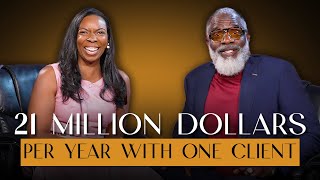
Alison explains how minority-, women-, and veteran-owned business certifications unlock government contracts. She scaled from a $68,000 salary to $250,000 first-year revenue, then landed a $10M contract that grew to $21M from one client in a year. Government set-asides can reach 30% participation rates on multi-year, nine-figure programs.
Questions this video answers
Anywhere between 5% up to 30% of the contract (Alison states 'up to 30%').
$68,000.
Over $250,000 (first year in business).
$40,000 contract; three-month duration.
She signed a contract for roughly $10 million which grew, and last year produced $21 million in revenue from that single client.
Chapters
The answer to that bid and the work is executed. Now what people don't realize is within those bids, anywhere between five, up to 30% of the contract is assigned to minority, women and Veteran owned businesses.
30%. Up to 30% of the contracts of the contract, yes.
So if you are assigned.
If you're a corporation and you're assigned $100,000 contract, $30,000 of those dollars are assigned to either minority, veteran or woman owned businesses. No, you're right on par. I mean, I help contractors, engineers, consultants, high level professionals take the existing skills that they have and to use corporate and government contracts to help grow and scale their businesses.
So when you say you help them use current skills they have, what does that mean?
So I'll share a little bit of my story with you. I became a junior consultant for an engineering firm.
Okay.
And we worked in the space of utility services.
What's that mean? Utility services?
What doesn't it mean? So we worked closely with municipalities. I specifically worked in the area of stormwater utility management.
Stormwater utility management.
I know. And it was, it's.
The government can come up with some long titles, can't they?
Well, what's been happening is, is that we've been having more intense rain events, okay. And stormwater needs to be managed. So there's a whole rate process of how that is managed. What's the cost associated with that? I know, let me tell you something.
Stormwater has to be managed. What does that even mean? I never, Let me say this, I'm 62. I've never heard anybody say, well, you know, stormwater needs to be managed ever.
Let me tell you. But in urban municipalities all across the country.
Cities, urban cities with highly impervious areas are in need of managing their water resources. And as water comes down, it needs to go somewhere and it needs to be dealt with. So there's a whole rate making system behind it. Municipalities are now in essence creating rate structures and are charging whether it's residential, corporate or governmental agencies, however it be. They're now charging a stormwater utility charge.
But I'm not acting brand new, y'.
All.
Like I've never heard this conversation before.
Yes. So nonetheless.
I found myself in this field after a period of fasting and prayer. I had worked with one of the largest investment firms on the planet and 2008 happened. I lost my job and through a period of a 40 day fasting and prayer, this is where I ended up working in stormwater utility management. At that point, I was desperate. I asked God to give me a Job and unsolicited.
I received a call for a job that I never applied to. Come to find out, during that 40 day fasting and prayer period, my professor, I aced his class and he recommended me for this consulting job. And before you know it, I found myself in this space. Well, nonetheless, that acted as a catalyst that put me in this, you know, in this industry whereby I actually was rubbing shoulders with municipal executives on a day to day basis. And with that, I've grown to learn a lot about government contracts, how corporations work with the government, and how women, minority and veteran owned businesses.
Play into that.
Long story short, the government pays or the government demands that as they issue bids and bids, all bids are, is an ask, right? Bids, that's what the word means, is an ask. So the corporations and governments need corporations to come in, or governments need corporations to come in to fulfill a need.
That the need already exists.
Right, the need already exists within.
Within the government. Exactly. And they put out a bid. Corporation comes in to be pending on the area that you're in.
So for example, so are you saying though that if a business that's not a minority, veteran or woman owned business, if they get $100,000 contract, they have to subcontract $30,000 worth of that work out to women?
One of those categories potentially depending on the area. So the government's job ultimately is they want, when they issue bids, to equal the playing field. So in equaling the playing field, there's an understanding that minority, veteran and women owned businesses are at a disadvantage. There are tons of other certifications out there, including small business certifications. There are what's called HV zone certifications, there's a plethora. And then you have local municipalities that also have their own certifications that are very specific to specific industries. So nonetheless, in the area of construction, where women aren't concerned, women are not overwhelmingly involved in construction or involved in utility services. So the government, in attempts to close that gap, has these certifications, which gives women a leg up to be able to bid for construction jobs or utility services work. And that's just one.
So basically you're saying if women will just get in the game of bidding on government contracts, they already have points on the board.
Exactly. So when you go in to apply or to respond to rfp, which is called a request for proposal.
Okay.
And when you're responding to the bid you receive, it usually operates on a point system.
Okay.
When they're assigning the contract to someone or when they're assessing all of the Bids that came in when they're assessing all of the proposals that come in. And it usually operates on a point system. And one of those points that are being one of the point segments are, is this a woman owned business? Or how much minority or women or veteran participation do they have on the contract? So oftentimes what you'll find is corporations, in attempts to acquire and win the bids, they go over and above what is required because they know that that's attractive to the municipality to be able to win bids. One of the things about corporate and government contracting is that you can actually earn three to four times more than what you would earn through a corporation. So for example, I worked with this engineering firm for 30 months, two and a half years. My salary at the time was $68,000. My first year in government contracting, I was able to earn over $250,000. That was my first year in business. I had very little knowledge about exactly what it was that I was doing. I mean, I had knowledge about the services that I offered, but in terms of running a business and the day in and day out, I had to learn on the fly. But that was the least I've ever earned.
Wow.
We were able to grow and scale. Throughout the last 10 years, 12 years, we were able to grow and scale my business. Last year alone we made over $21 million. That's crazy. Yes, but it's crazy.
Good but crazy.
Listen to me. When I first started doing this, I actually thought it was illegal. I didn't tell my mom, I didn't tell my dad, I didn't tell my best friend. I didn't tell anybody what it was that I was doing. But I've come to learn that people make millions of dollars every day. Some of the largest corporations in the world work with the United States government. The United States government is the largest spender on the planet. They are your best opportunity to grow and scale your business. And a lot of people, as soon as they hear government contracting or corporate contracting, they feel as if that they cannot do it. The smallest contract that I've ever acquired at one time was a $40,000 contract.
How long did it take you to fulfill that contract?
It was nothing. It was a three month contract. I did, I was doing, put it this way, because it came so natural to me. Right? And this is what we teach people. We teach people to take everyday skills that they have and we teach them to take those skills to corporations and to government. Now we do that strategically to help speed up the process so that you could Collect your check. One of the things about women and minority business owners is that when you have your certifications and you hold your hand with the government, you actually get paid within two weeks. Most people that work for the government directly, they don't get paid for 90 or 120 days.
Wow.
But these certifications help you get a leg up. And that's why we developed the Win Big Bids Challenge, the certification edition of the Win Big Bids Challenge. Because what that enables you to do is to get your certifications. There's been times that I've been able to acquire contracts. I haven't even been on the site, the work site. I act as a middleman, bringing the buyer and the seller together. The buyer being the government, the seller being these corporations.
And I may include you in the bid and you get a piece of.
No, they don't include me. I'm the one that's making the connection. I act as a broker between the two. I draft up the proposal and I submit the bid. I am 100% owner of my business as a woman business owner and as a minority business owner.
And so you subcontract the corporation?
Yes, I subcontract the corporation to help them get those bids.
Wow.
So I come in and I act as a broker. I might see that there's a bid going on. I reach out to several corporations. In essence, I do my own mini bid process whereby I select which corporation I deem to be the one that I desire to work with and then I marry the two. In essence, the government will give me the resources, they give me the call to order so that I can execute the work and then I send the corporation out to do the work. Doing this process has allowed me to be home with my baby from the time that she was born until she was six years old, before I sent her to school. I think so many middle aged women are wedged between taking care of their children, sometimes even taking care of their husbands, and especially taking care of their parents. Middle aged women are worn out and last year I got the first taste of that when my mother in law passed away in my home. And it's six weeks later my mom took sick. I had the opportunity, the blessing, to be able to sit at my mom's bedside for six weeks when she was in the ICU with less than 1% chance of survival. And so many people when their parents are going through difficult times, they're not able to be there with them and they're wedged in between this idea of taking care of their own families and taking care of their parents. And then there is this conundrum, right, about the financial responsibility. I gotta go to work even though my mom's in the icu and even though I know that she needs me. You know, it was an eye opener for me, me walking through that process. It was an eye opener for me. And it just, it acted as a paradigm shift. And it really changed the way that I view the world. It changed the way that I see middle aged women and the challenges that they deal with. I call it the curse of Eve, in that there's so much on the backs of women. And I'm surprised that we're bending over backwards in so many different ways. And government contracts and corporate contracts I think is an accelerator. It acts as an opportunity for women to be able to better balance the day to day responsibilities that they have. Now. Going back to something that you said before, we were talking about the corporate contract, whereby, like I said, the smallest government contract that I was able, ever able to acquire was the $40,000 contract.
My responsibility in that role was to act as PR on behalf of a local municipality. And all that required me to do was to have a phone, a phone line. I sent out notifications to local homeowners, and I was a sounding board for them. So if they had any questions as it relates to the local municipal project, I was the person that answered those phone calls.
And before you knew it, $40,000 over a three month time period?
Yeah, absolutely. Absolutely.
Now you got me wanting to take out my phone because I'm. Y' all might. Y' all might not do it, but I'm getting out my calculator right now because she just said $40,000. 90 days.
That's $444. That's 444.44.
But that was not the only contract. That's not the only contract that I held at the time.
Okay, but before we get into the other contracts, you held how many hours per day over this three month time period were you working?
Maybe a couple hours a day, if that.
A couple of hours a day. Okay, okay, okay, okay. So I got to do that again because now I want to see how much you were making per month divided by three months. That's $13,333 a month part time.
And this happens every single day.
Okay. All right. So you told me what the smallest contract you ever got was.
Yes.
What's the biggest contract you've ever gotten?
So let me tell you what happened. So the biggest contract that I ever Received. See, oftentimes corporations acquire government contracts. So for example.
A corporation came to me and they said, okay, we want you to be able to provide us a certain level of service.
In essence, we've transitioned to a staffing firm and we provided them a certain amount of labor services.
And the contract was supposed to be for $10 million roughly.
But the thing is, when you do a good job, they keep giving you more and more work.
And this was last year. So my largest contract that I signed was actually for $10 million. But because of the value that we provided, it actually grew. And that's how we ended up having last year a $21 million year because. And that was only through one client. That was only. That $21 million was only through one client.
All $21 million of it.
All $21 million of it. Yes. And this is the thing that I share with you folks is that I have seven other companies, several of which have other certifications and other ongoing contracts. But one client could in essence, change your entire life, I guess so.
$21 million. Yeah. One client, $21 million.
You wouldn't believe how easy it is to be able to, you know, I'll give you an example. So. So we did our first win big bids challenge a couple of weeks ago. Now at this point we had a young lady come in to the challenge and during the challenge she was able to acquire her certification and she did all of the things that we told them to do.
Her women owned business certification.
Absolutely. And she did all the things that we told her to do during the certification. The very next week she went out to a pre bid meeting and during that meeting she was able to meet with a lot of the officials that were there locally and she began to in essence, share the services that she offers. Right now they're working things through to be able to put her in position to in essence share her services with other local, with other local women owned businesses to be able to help cultivate their businesses so that they're ready. The biggest challenge ever is that women, minority and veteran owned businesses in large part.
Are not built out in a way whereby the government can use their services.
Because.
I don't know if it's an educational issue, I don't know if it's not having the resources or really that they just don't know that these, these opportunities exist through the government. I mean, so nonetheless, they love her services and her ability. I believe her website, myco.com I'm your COO. And so she comes in and she Helps organizations build their operations out.
So with that, now they're looking to see if she can partner with them to be able to help other minority businesses. The city of Philadelphia specifically. I do a lot of work with them and one of their representatives pulled me to the side and stated that.
They actually have a search party, in essence, looking for women and minority and veteran owned businesses to be able to partner with other organizations and other institutions. One of the young ladies from our.
This whole conversation is so odd in a good way.
One of the participants in our latest win big bids challenge, she mentioned that she called or sent information into a construction entity. They called her back the very next day and put her name on their proposal and submitted it into the municipality. You gotta understand, if these corporations are not meeting the threshold for the minority, women and veteran owned, you know, thresholds.
They are at risk of losing the opportunity.
Wow.
Right. Because like I said before, everything is weighted. It's weighted based on a numerical formula. And if they're not necessarily checking all of the boxes, then they're at risk of not winning the bid.
So your $21 million.
Contract for last year.
Yes.
Was that a municipality or was that federal?
So what we did was we strategically partnered with a corporation that had a government contract.
And in essence, that's how we were able to exponentially grow in that way.
So they had a government contract. So the contract itself was bigger than 21 million?
Oh, absolutely. These contracts on the construction side and on the utility services side are easily in the nine figures. We're talking $200 million contracts and beyond. I mean, it goes up from there.
And how long does it take to fulfill on those?
It could take over a period of a couple of years, three to five years on average. Most of the contracts that were. That were engaged in. Yeah. And this is, and this is what I'm saying. It's almost like when Jesus was talking about, you know, when the woman was there and Jesus was talking about, well, you know, the crumbs from the master's table. Right. Like these are just the crumbs that the government is giving out. And that's all you need really, to change your whole world or to change government crumbs. Government crumbs, yes. Come get these government crumbs. We teach you how to strategically create partnerships with corporations. To me, that's the fastest way for you to be able to be on an assignment and to build your resume.
Because the corporations already have the assignments, right?
Because the corporations already have. Now, if you want to go through the process, depending on your industry or depending on your sector, it could take a few months before you even know that you're assigned the contract. And like in the case of a couple of, you know, the item, the jobs that we've been on, it might even take a couple of years. It depends, right? We all know that the government is a very political space. So what we teach, in essence, is how to strategically align yourself with corporations who are already going after large contracts. And we teach you how to partner with them and then you can.
So good.
We're looking forward right now to a few of our students getting money within 30 days. We think that they're going to certainly be able to land their contract within 30 days of our certification challenge.
So crazy. I've got all kinds of ideas going off.
But let me tell you though, what's so amazing about this is the check clears. Most small businesses have the challenge of, in essence, pandering to the everyday person and attempts to, you know, they're selling their services, but sometimes they're not always getting their money on the back end. When you partner with the government, oh.
You get your money.
They will print money if they don't have it. Wow.
And they don't go to jail for it.
And they don't go to jail for it. Exactly.
Wow.
Exactly.
One of the items that.
We like to.
I just encourage anyone to just join a challenge. I think we charge pennies for the challenge. But this is my life's work, right. This is something that I've been doing for the last 12 years. It has revolutionized my life. It has revolutionized the lives of those who are like, finally understanding, like, wow, your corporation that you work for probably already has a government contract. Lockheed Martin, for instance, one of the largest entities on the planet. 79% of their revenue comes from government and corporate contracting. And a lot of people tend to believe or think that.
79% of them. 79%, that's a multi, multi, multi, multi billion dollar.
Correct? Absolutely, Absolutely. I believe, I'm trying to remember here, but I believe one of the largest contracts that they've acquired was like a $13.9 billion contract. Just crazy. Like, I mean, but you're talking about in the Department of Defense, you're talking about, you know, they're in an entirely different realm. But what if you worked for Lockheed Martin? You can easily become a partner for Lockheed Martin because you already understand the ins and outs of their business. If you are a minority working for them, you can become a minority partner. The same firm that I used to work for as a junior consultant has turned around and, you know, we've gone after municipal bids together.
Wow.
It happens every day. If you work even for the government itself, you know, a lot of the vendors that they work for, it's easy for you to step out of that. On average, the average American makes what, $55,000 a year? You can easily come out of, let's say, if you work for the government, partner up with one of the local corporations that work for the municipality, and you could quadruple your income. It's that simple. Doing the same level of work.
Okay, so I get it.
You have an engineering background.
No, no.
You have a consulting background.
I worked as a consultant. I did acquire my master's in business. But to be honest with you, you know, we all know school is just that, right? School is. School is a. Is a. What do I say? It's a marketing. It's a marketing tool. It doesn't necessarily say how smart you are or how far you're going to go in life, Right?
So. But none of that has anything to do. I have met people that can barely read and write, and they are acquiring government contracts by strategically hiring the right people and putting them in place.
So I got a question for you. We talked about your smallest contract. 40,000.
Yes.
We talked about your biggest contract. 10 million that turned into 21 million, right? What's the strangest? Like, give me three of the strangest government contracts you've ever heard of. Somebody bid, like somebody winning amusement parks. Okay, yeah, that's true.
Golf, bowling, bowling alleys.
Let me tell you something.
The government amusement. What is the government going to do with an amusement park? I don't even understand.
The government engages, they sell everything. They sell cat food, dog food. People make millions of dollars selling everyday things operating through the government. There's no limitation to it. The government buys everything. There's a NAT code. As long as you can find a NAT code for it, there's a bid out there that matches your NAT code.
I don't understand.
Okay.
I don't understand what the government's going to do with an amusement park.
Also understand this. No, I'm saying the government Eng In a lot of social projects, right? So if I had a social. If I had a social contract and I hired a smaller entity to go in and maybe take 100 of the poorest children within a particular urban environment, part of that would be possibly to send those children to an amusement park.
Okay, now I understand. Okay.
Or the dog and cat food example, you know, going back to A lot of the hurricanes or any sort of natural devastation that might occur, a lot of animals are abandoned in situations like that. So you have FEMA who is out there and they're buying regular everyday paper goods, pencils, pens, paper. They're buying everything, including dog and cat food.
Okay. It started to make more sense.
How it works. But like figuring out how to make my brain think of those kinds of things, that's probably the challenge.
And that's the thing, you know, we live in, you know, probably one of the most complex governments in the world and some of that is by design whereby they're not necessarily forthright in all of the information. It's for those who know to know. So with that a challenge like what we have here in the Win Big Bids challenge, we help you to navigate through all of the, what I call bureaucratic befuddlements.
And like I said before, some of the. Which is designed to keep you out. Exactly.
To like thwart your desire to even move forward.
Exactly. So the goal is really we're building.
We'Re talking about billions of dollars now.
We talking about, we're talking about trillions of dollars. That's what we're talking about. The reality is.
I did all of what I was able to do part time. Myron. We've established what I call for our more high level offerings the campaign convert and commission system. Whereby if you systematically do this. See, I wasn't systematically every day going after the work. Had I been systematically going after work, we certainly would have been at least $100 million company by now. If I was very systematic and if I really was about the money, if I was really gung ho about going after government contrasts systematically. If someone really wants to do this in a way whereby they're able to, it's identifying your niche and it's going after it in your. For the federal government. See, everybody wants to run to the Tampa, possibly Tampa, like I said, Miami, New York State.
Chicago, Chicago, L.A. absolutely, absolutely.
They're looking for minority and veteran owned and women owned businesses to come in and pretty much in essence, you know, flood especially. They even have a list specifically of women owned areas where they're desperately searching for women owned businesses. And some of those are in the area of like farming as I mentioned before, engineering, construction. There are so many different elements, there's so many different areas there. It is a big area where they're looking for women to participate and be involved in.
So one of the things you mentioned when I asked you about like strange government contracts, you said golf now, you know, I'm a golfaholic. So what's the government buying golf for?
It's probably a social.
A social contract that exists out there. And they're funneling, you know, children through probably a senior program whereby. Or even for veterans. Right. Getting them to become more active. I mean, you don't necessarily know until you look. There's so many different opportunities out there. And then every year they're adding new stuff, they're adding new sectors, they're adding new industries and businesses. The United States government is the best in the world.
And they offer these.
They're the best in the world at buying things.
Buying things? Yes. They are the largest spender on the planet. People from all around the world are coming into the United States government in attempts to do business. Absolutely. Sheesh.
Sheesh. How about y'? All. Y' all thinking sheesh, or is it just me?
Like, every time I hear somebody talk about government contracts, I want to just go grab a couple of them.
Oh, yeah. But it's. It's very easy to do. And the reality is, is like I said before, you know, we have that campaign convert and commission system, right. So campaign, pretty much you're reaching out to all of the people within your realm and you're telling them.
That in essence you would like to. This is. These are the services that you offer. So you're telling, you know, the municipality itself, you're telling all of the corporations all around you, all that work with the municipalities.
Everybody.
Absolutely. In the conversion piece, there's two halves of that. As a matter of fact, this model has been created after Christ's mission and how he did his business. Okay, Right. He said, repent for the kingdom of heaven is at hand. That is a campaign. And that was his entire campaign while he was here on the planet. In the conversion process, there were two different types of conversion that went on. There were people who were converted whereby they wanted to dedicate their entire lives to the mission. Those are the people. Those are your employees. Those are people that. Those are your team members. People that want to become a part of the process. Right. There's a campaigning that happens when you're speaking with someone. Right. A lot of people tend to think when you work for an employer that you're meeting their needs. No, they're also meeting your needs. Right. It's a two way street. And then the second half of that on the conversion side is those that are converted, but in essence, they live their lives where they are, but they become a mouthpiece for what it is that you do, Right. So those are the people that you would consider that are buying your product or your service. Right. As, as in the government. So you're converting and then you have the commission. The commission part to me is the most important because now you're taking the systems that you've created for selling your service and you are handing it off now to the people that work for you. And that's how you see most small business owners get caught up in the day to day operations of their business, working in the business instead of being able to work on the business. So we teach them systematically. These are the different checkpoints, this is what you're looking for. Once you reach this level of service, once you reach this amount of income, it's now time for you to either hire an assistant, hire an operations manager and move on to scale your business.
So you start out with campaigning and then you convert and then what's the last thing that you do?
Commission.
What does that mean?
So commissioning, in essence is where you are handing off. So most small business owners are the ones doing their it.
Okay, got it.
They're every part of the business.
Commissioning is like the delegation.
Commissioning is the delegation.
It is automation.
It. Here you go. It is marketing. Here you go. It is finance. There you go. And so what that allows now is for you to be more free. It allows for you to, you even get a procurement. So now you're not searching for all of the bids, you have a procurement team now that's searching for all of the bids. And before you know it, you're able to run a seven or eight figure business out of the comfort of your own home, part time.
There it is.
Wow. Wow.
Mind blown.
Yes. So, so in essence we go through the process of teaching you step by step how to do it. Wow.
That'S so good. No, it's, it's. The reason I say it's so good is like number one. It's not like you said, hey, I think I'm gonna go teach people how to get government contracts. It's like you got a job as a junior consultant with an engineering firm and then when you left there, you did the same thing, but you did it for yourself and you made like four times as much money and then you just scaled it from there and now you're just showing people what you've learned. Did I leave anything out?
No, you didn't. Listen, I thought it was a fluke. So the first year when we made $250,000, it was just, it was me. And the only expense I had at the time was a laptop and a 2009 Toyota Corolla.
The subsequent year I made $500,000. And this is when I.
So you doubled your income in one year. Okay.
And it was just me. So towards the end of the second year is when I was feeling the pressure. I mean, I was a single person, so I was able to work around the clock. But I said, this is a little bit too much. The most challenging piece was introducing people into the business and getting them somewhat caught up because my entire team works from home.
But in essence, we brought them on the next year after that. So we kept growing in incrementals of $250,000. And then we kind of hit a lull at about a million. Once we hit there, we didn't really know how to grow. But what we did from there is we in essence went from, you know, I had a team, they were going out day to day changing out water meters. So that's kind of what the team was doing. They were in pits, they were in confined spaces doing that work. And then we decided, and we were only doing that for commercial, and then we decided to move over to residential. Well, that opened up the floodgates and my team was out there doing that on a day to day changing water meters. Absolutely. And then we stepped back from that and see.
So that's a fortune to be made in James.
So let me tell you, let me tell you. So I went from consulting and then, you know, the municipality's talking to me and they're like, well, the contractor doesn't want to do this anymore because of the liability. And I was like, well, would you be averse to me doing it? And they were like, sure. So they, you know, they. We went through the process still and we were in first position to win the bid. And then before you know it, our.
Guys who that bid, if you don't mind me asking, do you mind?
I can't even remember. It's been so long ago. Usually they were really good about most of the contracts that I got at that point. It was like $100,000 contracts. And then we would re up. So once we kind of like ran out of funds, then it's like, do you want to continue? Yes, they want to continue. So that's more or less how it happened. But the contract permitted for that. It permitted for a renewal period of a certain amount of time. And then at the end of the fiscal year, we would have to apply all over again. Right. So you might have a contract for maybe two to three years with the municipality, and then you might have to go back in again. But reality is, just like anything when you're participating in government and corporate contracts, you've now developed a relationship with the government, right? So in you developing that relationship, of course you're gonna win the bid again. I mean, it's. Don't get me wrong, just like anything. Not guaranteed, but it's not guaranteed, most likely. But just like anything else, we understand your distribution system. We understand the ins and outs. We know all the players to the game. If you go with someone else, you're probably gonna pay two to three times more because now they have to learn all of the these things all over again.
And you don't know if they can deliver because they've never delivered for you before. But you know, this person who has can.
Absolutely. And then we took our show on the road. So we went from doing local residential units to me talking to a much larger global corporation. And they said, well, you know, we're having a hard time dissecting, you know, the line of demarcation of work. So now I said, okay, how about we just provide you with the staff?
It allowed us to become more hands off in the work that we were doing day to day. And it was just amazing for me to see that I was actually working less, but we were making exponentially more money. We were making exponentially more.
Isn't that amazing how that works?
So we went from, you know, servicing, you know, a local municipality of about maybe, you know, 200,000 to working in the Philadelphia metro. You know, I think it's like, I don't know, 1.4.
Million units that they had to change out. And then we were just, in essence, providing the staffing and handling all of the workers compensation and the union, the union payments, the union dues and that sort of thing. But to me, it was such an eye opener. And then now you go to all of the other corporations within your segment and you tell them, hey, this is what we're doing. And then they call you. And it's so funny because after what we did last year, we had to take a step back to say what just happened. Unbelievable. And every time that we've repositioned our company, we've been able to make more and more money by doing less.
So as I mentioned before, we were able to acquire that 21 million with just one client. If I was really out for the juggler, I can find probably 10 more clients just like that, working on projects just as big within our sector.
And then do $100 million?
Absolutely.
$200 million.
Absolutely. Wow.
It's a crazy town.
Now, I will say, you know, when I went through everything that I went through last year with my mom being sick and my mother in law passing away, it just really allowed me to step back and think about what really matters in life. And you can only have but so much money before you know, there's not much more that you can have. There's not much more that this world can offer you.
Right. You're like, okay, well, I got everything I want. There's nothing else to buy. So now what am I going to do?
And it just led me down this path of I'm going to teach people to do what I've been doing.
Wow. So good. So good, Allison. So.
If this is going to be my last question, you go get a government contract like any business, you got the cost of doing business.
Absolutely.
And then you have your margin, which is the difference between the cost of doing business and how much you get to keep.
Right, Right.
So what kind of profit margins are you looking at on a government contract?
It depends on your industry. So one of the things that I will share.
With everyone and I talk about it in my book.
Your wealth, God's way, start a business, make money, and live life to the fullest, is that I think consulting is the best way to get into business. In that consulting has some of the largest margins you'll ever see. So, for example, as I mentioned before.
Consulting with the government.
Absolutely, absolutely. They don't have the.
I'm sure it's obvious to you, they.
Don'T have the resources in house. So. So the government operates just like people do. Okay, Right. So you're, you're in your house, you have, you own a home, and your plumbing goes awry. What do you do?
Call the plumber?
You call the plumber. Well, that's exactly what the government does. Government puts out a contract and they call the plumber. Now, a plumber is not a consultant in the more conventional sense. Right. But let's say there is a very specific. So let me get into a little bit of some of the things I know. But like, let's talk about a water distribution system. Right. There's piping underground all throughout the United States and specifically, even within your municipality, there's a problem that happens.
Well, no one on your team knows why that problem happens. You have to call a consultant. The consultant has seen, you know, several different problems all across the country in varying ways and varying circumstances. And they come in and within Two seconds, they can identify what the problem is. Well, that's a lot better than having your guys fiddle around trying to figure it out.
There's so many other things the government in large part a large, a large part of their employment staff is, are so in the weeds of what they do day to day that they have a hard time visualizing their challenges from a top down perspective. And as a consultant, one of the jobs that I had was going from municipality to municipality looking at the same problems from municipality to municipality. So it became a lot easier for, for even me as a junior consultant at that time to be able help identify what those challenges were or even begin to map out the problem beginning to end. And a lot of those skill sets I brought into our offering whereby we can show people from beginning to end, and a lot of those skill sets, in essence, we teach. This is what the government likes to see, this is how they like to see their data and managers are managing, they're managing their team members, they're managing their people. So they don't have the time to do that. It's easier and sometimes cheaper to bring in a consultant to figure it out. It's like the government is a behemoth.
Right?
Right. So when you move one thing, you might be breaking something else or you might be moving something else. But having a consultant come in that's looking at all the parts specifically from a high level, and they're talking to all of these different departments, they're able to isolate and identify whatever the challenges are and be able to come up with a viable solution.
So good. So for somebody who desires to learn this stuff from you, where do they go?
Well, every month we host a challenge. Myron, you've taught me how to do challenges. And with that We've taken my 12 years of experience in this realm and we have a five day challenge, Sunday through Thursday and for two hours for vip, one hour for general admission, we teach you the ins and outs of how to acquire your certification. For the first couple of days and then the last couple of days, we really talk about the money makers, we talk about the strategy, how to, you know, come together with corporations, how to be able to create viable partnerships with them. And sometimes you can do it with little or no money at all. The biggest challenge that people have when talking about government and corporate contract, they think they need to have all this money to get started. And I'm here to tell you that's not how it was because that's not how it was for me. Wow.
Wow. So good. So they go to, they can go.
To winbigbidschallenge.com winbigbidschallenge.Com yes, they can.
Well, that's a tongue twister.
Winbigbidschallenge.com they could also go to lisonetnoff.com there's just so many different ways that you can get through to the challenge, get through to, you know, me and my team.
We'Re ready and we're here.
Wow, this is such a good interview. Like now I'm gonna, now I'm gonna go look on the government website and see what kind of contracts I can find that I can already fulfill. I don't even have to do anything for it.
No, you can act as the middleman. And I'm telling you, like, there's a lot of money to be made. The most I ever made. Just because being a middleman was we had a relatively large construction entity come to us and they were at a bind because they were towards, you know, they were at the beginning of their contract and they needed to source materials. And in essence, it was a pass through. I did a 5% markup and I made over $75,000 doing it.
Wow.
And that was the work. Just that getting the deal done was the work.
That was the work. And guess what? They found a supplier, they found all of the pieces, and all I had to do was get a contract here, get a contract there, collect your piece in the middle, and that was it.
And us to la vista, baby.
But, you know, that's a wonderful way to get started.
Sure it is. Every extra 75,000 helps.
Absolutely, absolutely.
Wow. So good. Such a great conversation. You know, I think I'm going to have to take your challenge.
Let's do it.
Yeah. I think I've been fully persuaded.
So join Alison on her challenge. Who knows, I might be there on the one you take. Go to win bigbidschallenge.com and get registered right now. You'll be glad you did. Alison, thank you for joining us.
Good stuff.
It has been a pleasure.
Absolutely.
Wow.
More from Clegg





AI Won't Tell You the Full Truth | Arthur Brooks + Simon Sinek | A Bit of Optimism Podcast



How To Make the Best Decision | Arthur Brooks and Simon Sinek | A Bit of Optimism


