https://www.youtube.com/watch?v=5H2HMRDFjbY
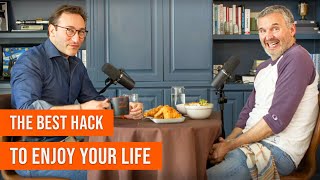
Phil Rosenthal, creator of Everybody Loves Raymond and Somebody Feed Phil, talks with Simon Sinek about building a TV career, the creative process behind his shows, and why everyone eventually faces cancellation in this industry. They eat and swap stories about the television business.
You created Everybody Loves Raymond and Somebody Feed Phil. It's always got some name in it.
Yeah.
So what would you name my show?
Somebody talked to Simon.
So lonely. Before we turn on the cameras and the mics, I tell every guest who comes on the show that this is not like an interview show that they're used to. It's more like a conversation. I tell them to imagine that we're out for a meal. and the people sitting next to us are eavesdropping on us because our conversation is better than theirs. Well, for this episode, we decided to do just that. Literally.
Holy crap, this is a best cheesecake.
As soon as I heard that Phil Rosenthal, the brilliant creator and executive producer behind Everybody Loves Raymond and the joyful heart and face of Somebody Feed Phil, was coming on the show, I wanted to give him food. So we turned our little podcast into an even littler restaurant. Please pull up a chair at our table for the latest episode of Somebody Talk to Simon. I mean, a bit of optimism. This episode is brought to you by True Classic. The way they became our sponsor is because I loved their t-shirts. And so we just called them up and asked them if they wanted to work together. And they said yes. So check out their clothes@truclassic.com I warned you before we turned the cameras on, which is we have so much damn food that we brought. Yeah. Don't finish anything because we have to get through it all. And I haven't had breakfast, so I'm spacey. Great.
I had a little protein drink, so that's good. You're hungry too. Oh yeah, yeah, but that's my secret, by the way. the number one question I get is how come I'm not fat? And it is one reason is I don't finish anything. If you see me eating like crazy on the show. Yeah, I am, but I'm not really, unless it's the most delicious thing I've ever had and I know I'll never get to this part of Chiang Mai again to have this bowl of khao soi, I'm finishing it. And it may be ordering another one. If you're in a town that's famous for certain dishes, you want those dishes.
You got those dishes.
You have to.
Let's get our first dish out here. Let's get our breakfast dish out, because we've got not just courses. We have breakfast, lunch, and dinner.
You really thought this out.
We have a lot of food. So what we decided to do is there's a bunch of great restaurants in Los Angeles, which is where you and I live.
Listen. If you can't travel, live in LA.
Live in LA. The world is here. And we have a bunch of great restaurants. And so we ordered some of the dishes from some great places. Look at that, bring it on in. Thank you, David. So I haven't, I love a breakfast burrito.
Hi.
I love a breakfast burrito too. It's one of my favorite things.
So I love a breakfast burrito. My favorite breakfast burrito in Los Angeles is from a place called Oaks Gourmet. Don't know, in Los Feliz will go. It's my favorite. But somebody recently recommended these, which is from a coffee joint called, I think it's called Civil Coffee or Civet Coffee, Civil Coffee. Civil coffee. Civil coffee. I've never tried this breed.
Never heard. No idea.
We're highly recommend. Is that here in Sherman Oaks? Yeah, it's not far. It's in Studio City.
Anyway, there's cheese and egg.
Yeah.
And then bacon and cheese or bacon and egg. Wow. I'm trying cheese and egg first.
We're going for bacon.
Okay.
Cheers, my friend.
This is very good to see you.
This is good.
Yep.
Yeah, this is good.
I will say.
This ranks up there is extremely good. It was an oaks gourmeT. It's still my favorite breakfast burrito.
All right, I'm happy to try that.
Yeah.
So no offense, I'm not finishing anything.
No, no, no.
Taking bites.
What made you want to start an eating show in the first place other than the obvious, which is to get paid to travel around the world to eat. It sounds like a good gig.
It's a scam. You talk to people who leaders in business, they're not as honest as I am.
It's a scam, right?
It's a scam.
And what are you, seven season in?
Coming up now is season eight.
Season eight. Did you imagine when you came up with the idea that it would get picked up for eight seasons?
No, you're hoping to fool one guy at a network. And maybe they'll let you film one. By the way, the first time we filmed one, I think it was Barcelona. We started on PBS. The first one we filmed was Barcelona. And I have my first scene, which is a meal. And the meal was so fantastic, I said, if we're canceled right now, Dainu, it's worth it. It was worth it. Everything I went through. And it took 10 years to get the show.
How? What?
Yes.
But hold on.
This is today's lesson.
There was precedent. There was precedent. Like you had Bourdain, who did his cooking show and traveled around the world. He's like.
But he was Anthony Bourdain. I mean, that was a sexy superstar. Look at me. It wasn't in Fair Haven.
So I want to know. So, okay, so you had phone numbers because of everyone loves Raymond. So you know who to call and they'll take your call.
They don't want that call. Hey, you know what I've got for you now? After having a somewhat successful sitcom, me is the host of a travel show. My own agents looked at me as if I pooped on the carpet. They didn't want to hear it.
Right.
The reason I shifted gears that way is because after Everybody Loves Raymond was over, I had been there for nine years. The business changed greatly. in those nine years. They didn't want that kind of show anymore. They wanted hip and edgy shows.
They were moving from Everyone Loves Raymond to something like Friends. Okay.
They just wanted friends.
Got it. That was the formula.
They wanted young, hip, family sitcoms. Good looking. Yes. And it's, you know, we had a hard time selling Raymond when we sold Raymond because it was already de classé. It wasn't, It was, it's not sexy to people, the family sitcom. Although, if you look back at television comedy history, it's the building block of networks.
All in the family.
All in the family, go back to I Love Lucy, a domestic, a father knows best, happy days, the Honeymooners, domestic, not workplace, domestic family sitcoms, with kids or without kids.
Yeah.
Well, that's not what a young executive or even an old executive wants on their resume because that's not cool. And when they get fired from this job, they want a resume that says, I'm still relevant. I'm not doing old fashioned.
Raymond, even though the data shows, that's really funny.
That's always a number one. Shut.
Yeah, yeah, yeah.
If it's done right.
If it's done right, of course.
I distinctly remember wanting, in the age of Seinfeld and Friends, to do the opposite. Not even, because that's all I could do, is that because that's my wheelhouse. I would know how to do the hip and edgy young hip sitcom. But business wise, why would you do something that's already exists already there? Maybe you last a season or two and maybe you get A little luckier, but you're copying what's out there now.
Is that your personality? Are you a contrarian? Or is it...? Okay, so it's... that's funny.
No, and I disagree with you completely.
So you're not a contrarian, but it's for your own creative... Because doing nine years of a thing...
Yes.
How do you keep I mean, you're in the writers room. How does that fresh up? That's a whole show.
I mean, we could do a whole show about this, but I'll give you the short answer. If you sell something that's high concept, do you know what high concept?
Say more.
Okay, high concept would be a show where we're from Mars, our family's from Mars, and we're going to live on a street and pretend to be normal Americans. Okay. That's a high concept show. Now, with a high concept show, they have to serve that premise every week.
Right.
That would get boring and repetitive and can't last very long.
Right.
To last maybe a few seasons tops.
Right.
Because every week, oh no, they're gonna find out we're from Mars. Right. So it's the same story practically.
Right.
Yes, you can have Little stories that weave in and out. But that main premise is going to have to be served. You know what low concept is? Low concept is a guy who lives across the street from his parents with his family. That's very low concept. That's a low concept.
It's not going to go forever.
And it's not hip and edgy and it doesn't sell because it doesn't sound like something novel. But in television, like in movies, like in books, like in anything we do in life, it's all about the execution.
Right.
So if you execute that premise, the guy with his family who lives across the street from his parents, the possibilities of episodes are almost as endless as real life.
Right.
And so if you worked for me, your job on Everybody Loves Raymond was to go home, get in a fight with your wife, and come back in and tell me about it.
And that's it's everyday life.
Everyday life is infinite. The possibilities are infinite. Do you know what I find? Or at least nine years. Do you know what?
At least nine years. Yes. Do you know what I find so funny about this, which is, and it goes to what you said about the executive who's making decisions whether they know it or not or admit it or not. Yes. They're making the decisions for their career, their resume. Of course they are.
Not necessarily for what people want.
I need a long time to learn that. And if you think about it, like even the pitches you're talking about, which is, you know, we have a show about people People living normal lives where they have fights with their spouses and they have kids and their kids are annoying. We're selling shows for the pitch, the day of the meeting, not for actual the longevity or the ability to create great entertainment. And then you say, we have a great writer's room, we've got some grit, and that's where the magic happens, I'm assuming.
I hear ideas all the time. The concept is a package, right? The concept, any idea is valid.
It's the execution.
Look, we just ate two breakfast burritos.
Yeah.
We love a breakfast burrito. You and I both admit, it's a great thing. It's breakfast that you hold in your hand. We love the tortilla, we love everything about it, but what's in it that makes a difference? Why do you love the one from Oaks more than the one we just ate?
It has-- why do you love that? Because it has a fried egg in it where it actually has gooey yolk, which is unheard of in a breakfast burrito. There you go, that's one of the reasons.
I've had it that way and I don't know why more people don't do it. It actually tastes better because there's extra sauce.
It comes with free sauce.
It comes with yes.
Yeah.
So that's we're the same.
But.
That'S everything.
Yeah.
What's in the burrito is everything.
Yeah. Right.
Not that it's a burrito. That's... Tell me what's in it. Tell me how you make it.
Okay. So as you and I are talking, we have more food coming in.
Here comes... Oh.
Now you may know this is dangerous.
This is... Don't tell me this is, this is from Anna Jack Thai. This is one of the best. Oh, my buddy! Justin! Hi! Are you... Everybody, this is Justin. He's a genius. You've never met Simon?
No, we've never met.
Well, this is nice.
Justin's, we should tell everybody, this is from Anna Jack Thai.
This is some of the best fried.
Chicken in the world. And Anna Jack Thai is a very hard to get into restaurant in Los Angeles. That's closed on the day we're shooting, but you brought us food anyway. Thank you very, very much. Thanks for bringing it by. I didn't even know you were gonna be here.
So nice to meet you. I just wanted to say hello. So kind.
Just a friend here.
Listen. Enjoy. Thanks, David. Not only is this some of the.
Best fried chicken in the world, it will be featured at my daughter's wedding. You're having anajack tie at a wedding?
Yes.
God bless you.
Love you.
Love you!
All right, I'm coming in.
It's perfect.
It's perfect.
That's good. Yeah. This is really good fried chicken. I've only been to Anajak Thai once, mainly because I couldn't get in.
Well, this is your not only did it come to you, the guy came to the guy.
The guy who is Anajak Thai.
Why did Justin come?
I don't know. That was a surprise. I've never met him. I never met him. I didn't know he was coming. So that was a real treat.
We were talking about what I think.
Is so interesting about this, this idea of the execution, which is you're 100% right, but nobody sells the execution. They always sell... You can't. They always sell... But it's everything. It's our resumes.
It's not just creative product.
But making TV shows is not just creative product. But making TV shows is not just creative product.
But making TV shows is not just creative product. But making TV shows is not just creative product.
But making TV shows is not just creative product.
But making TV shows is not just creative product.
But making TV shows is not just creative product.
But making TV shows is not just creative product.
But making TV shows is not just creative product.
But making TV shows is not just creative product.
But making TV shows is not just creative product.
But making TV shows is not just creative product.
But making TV shows is not just creative product. But making TV shows is not just creative product.
But making TV shows is not just creative product.
But making TV shows is not just creative product. But making TV shows is not just creative product. But making TV shows is not just creative product. But making TV shows is not just creative product. But making TV I went on a tour of Apple. The Apple historian is the guy who took me around. And he was saying, one of the cultural things that Steve Jobs built into this place was, nobody cares what you've done. They care what you're gonna do. It's all about future. And he said that they'd hire these fancy people from Facebook or Google, these fancy engineers who may have worked on some famous fancy product, And they'd walk around like they walk on water and like, Do you know who I am? Do you know what I've done in my career? And invariably somebody will say to them in a meeting, We don't care what you've done, we care what you're gonna do. And I think the idea, well that's of people living on their past accomplishments. Yes, and this is sort of, because let's be honest, you could have, given what you did with Raymond, you could have absolutely showed up and said, We're gonna do another Raymond type show, the family, and you would have been, You would sell that stuff, you could have sold that the next day, 'cause you've got the proven track record.
You wanna know the truth?
Yeah.
Had a spinoff of Raymond ready, ready to go. Because I love the writers so much in that writers' room, and I knew that this was an exceptional team. These are some of the best comedy writers in the world. How do we stay together? We loved each other. We know the show has run its course, but now how do we drive the car over here? Right. We had a spinoff already featuring the brother, the brother's wife, and the brother's wife's family. Now we're gonna shift gears and do another family in a different situation. The brother's wife's family, by the way, was Chris Elliott, Georgia Engel and Fred Willard couldn't be better.
Great.
They were on the show 30 times. So proven. Right. They said no because the studio said no. The network.
The network.
Because now these people, this is not the kind of show we want to do anymore. Everyone in your cast is 40 or older. We're looking for young. they said no.
So it didn't matter.
Didn't matter. So I tried to write another pilot. No. My sensibility was not. It wasn't even the thing they wanted, right? Didn't matter. Didn't matter. And my agent said, just. They like you. Just be more hip and edgy, that's all. I said, well, you got the right guy. I'm Mr. Hip and edgy.
Right.
And it is funny.
Is it rude to laugh when somebody says I'm hip and edgy?
I do these live shows and I tell the story and I get laughs. I say, you know, I think they said sexy and my wife fell off the couch. But I'm... Yeah. So after years of struggling, Against this tidal wave of hip and edgy.
Right.
I said, wait a minute. What about this dream that I have to do this? You're gonna beat your head against the wall anyway of show business. Pick a spot in the wall that you might love. Yeah. And so I did. And then convincing people was another story.
How many years after Raymond did you start pitching the, the, this is too good. We probably should take this away before we finish.
I would say about four. So, so years. So I'd say about three or four years of struggle.
And.
Then a whole new struggle. Now, I did other things in between, but always I was driving towards this. And then I sold it, finally, to PBS. But my agents didn't even want me to sell it.
So what was the reason they said yes?
I sold it with one line. I said, I'm exactly like Anthony Bourdain if he was afraid of everything. Got it. And they said, we've been looking for a food and travel show with humor for years.
Right.
But I wasn't allowed to go to PBS by my agents because they said, there's no money at PBS. That turns out to be true. But they had money for six episodes. And we did them. And then here came Netflix.
Oh, so Netflix saw it.
Yeah.
And came after you.
They were just kind of starting.
What I'm trying to get out of your stories is where the lessons are for how people live regular lives. Not everybody's gonna be selling TV shows or necessarily in show business, but the idea, I mean, you've said it. I mean, if you're gonna have to beat your head against a wall, pick something you like doing and beat your head against that wall.
The best advice I ever got from anybody was from Ed Weinberger, a great show creator and show runner. Mary Tyler Moore Show and Taxi and great classic sitcoms that I idolized. As I'm writing the pilot for Everybody Loves Raymond, I ask him for advice. He says this, Do the show you want to do because in the end they're gonna cancel you anyway. That's a life lesson. We all get canceled one day.
We all get canceled.
So live the life you want to live.
It's the, thank you, thank you. Okay, so this more food, more food. We got lots of food. So this one's great. So there is a place, thank you, David. There's a place on Ventura called the Joint. Do you know the Joint? Nope. Okay, the Joint is, ah, there's our Nori, our seaweed. So the Joint is the best fishmonger in Los Angeles. Like if you ever are cooking at home and you want to make fish, Go get their dry-aged ora salmon. Here's how good it is. As I'm preparing to cook it, I'm eating it off the fish raw. Yeah, yeah, yeah. Because it's that good. Sushi-grade. And they just recently started offering hand rolls at their joint, which is a— Which restaurant? I'm Ventura. It's a fishmonger. It's on Ventura and Studio City. It's a fishmonger and coffee shop. I know, what a combination. Yes. Anyway, so you can now get hand rolls there. So they put together a bento box. You can get it to go. This is how it comes. We're supposed to make our own hand rolls. Great. And I'm keeping on brand. I have Star Wars chopsticks.
Oh my god. Because... Hold on.
Oh my god, they light up.
Are we gonna duel?
I mean...
I love it.
You know...
This is fantastic.
So you can be a good guy or a bad guy. I'd be a little boat. A little boat, there you go. Good and bad. And I think this is... Samuel L. Jackson was the only one with a purple one. And I think the reason he asked for a purple one is so he would stand out in the scene.
Also, purple's cool. He's cool.
So these chopsticks are incredibly hard to use. They're pretty but impractical.
Well, you're free to use fingers, too.
Free to use fingers. I'm gonna just use my fingers, 'cause I'm the one eating it.
Well, I have to try these.
I've never made a hand roll for the record, but we're making them now. Well done. Food going everywhere. This is giving new definition to playing with your food. I'm gonna do, this looks like tuna. See now, how are we gonna resist not eating that one? That one looks like some sort of salmony something.
Salmony something.
What I might do, is just eat some of this.
Yes. Good idea.
I'm gonna handle it, 'cause it looks so good. I love sushi.
Me too.
Mmm. That is gorgeous.
Have you been to Japan?
Four times. I love it. It's my favorite place in the world. Did you have the egg salad sandwich at 7-Eleven?
Yes.
Best egg salad sandwich of my life.
So last season we did Kyoto and it blew me away.
Did you go-- okay. Kyoto. Yes. Did you go to-- there's a restaurant in the woods?
Nope.
Oh, I wish I talked to you before you went to Kyoto.
I wish you did, but I'll be back because it got in deep with me. It really had a profound impact on me, Kyoto. I thought it was spectacular.
And there's a great pizza place. Some of the best pizza I've had in my life was in Kyoto. Yes, yes. I went there, it was incredible. Great. There's a restaurant, it's in the middle of the woods. It's a tofu restaurant, but you sit on the floor, very Japanese.
Yeah.
And literally you tell the taxi, take me here. They drop you off in a parking lot, and you're like, well, where the hell's the restaurant? Yeah. And you put it in your phone.
In your GPS, and you realize you're nowhere near it. Mm-.
And you start walking through the woods. How is that? Amazing.
So fresh and clean and they make.
Them for you when you go.
Wow.
But my god, I love this place. Oh my god. Oh, just need a minute.
Crispy. Nora.
Everything's, everything's very nice. So you walk through the woods. You're literally walk, you're like, where the hell is this? You're in the middle of trees everywhere. And then in the distance you see a little house. And you're like, I think that's it. And you go to the house, the door opens, you take your shoes off. It's the restaurant. You sit in the woods. It's the most magical meal. But Japan is magical.
Japan is magical.
They know how to live. And they don't invent everything.
They perfect everything.
That's true. I didn't invent pizza, but my God.
It was the best pizza I've ever.
Had in my life.
Whatever they focus on, they make perfect and beautiful. When I first got to Tokyo, I thought, I'm in a pinball machine. I don't get it. I'm walking outside. I'm in like some kind of Times Square and then I get on the subway and go 40 minutes. I'm in another Times Square. I don't understand. It's like New York Times Los Angeles.
Yeah.
You can't believe the density and the scope and the-- it was overwhelming and I understood Lost in Translation where you want to hide in your hotel.
That movie is so good at capturing that feeling.
However, first restaurant I went into, calm, serene, beautiful, magical stuff starts coming to the table and. And you're. You're transported and you start to get it really quick that they can't control the outside, but what they can control, they make perfect and beautiful. Yeah. My joke is, if you go to the pharmacy and buy a pack of gum, they wrap it for you as if it's for your 100th birthday, and it's just a great way to be the other thing. the other like mind-blowing lesson I got was there's little kids on the street. You've even seen videos of this, three-year-olds going to the store for their parents, going out into the street. Like imagine Ventura Boulevard, a three-year-olds walking alone, going into the store, buying something, coming back on the street alone. How is this possible? Oh, somebody said, the community cares for the children. I'm like, what?
What?
But we've forgotten that as a society. We've forgotten that as a society, which is, you know, you know, if you go to, like, lower income neighborhoods, everybody sits on the front porch and they raise each other's kids. And then as soon as you start accumulating any kind of wealth, you move to the middle class and the suburbs and above, everybody moves to the back of the house and just, you keep your own kids separated from everybody. And there's something to be said for Like, and I've been to like slums like Dharavi in the middle of Mumbai. Yes. This large slum with a million people. Yes. And one square mile, whatever it is. Yes. And kids are running around and they're safe because everybody's looking out for everybody's.
Kids and that's why it works.
But what like, like it's we forgot.
How to care for each other.
We forgot how to care for each other and we put walls up in front of each, you know, walls up and in, I mean, but this is city living, right? I mean, that's what urban living is, which is you live in your apartment in New York City, or any city.
And you have five deadbolts on the door.
And you have five deadbolts. And you don't know your neighbors, even though literally you share a hallway with them.
Forget about a street. I live in a very nice neighborhood.
And people don't come out of their house there. I make a point when somebody moves into our neighborhood to go knock on my door. Of course! Say hello. And it's for a very simple reason. It's like all of us are around are my where I live. Yes. Like somebody will call me. Yes. And be like, hey, there's a package that's been outside your front door for two days. Do you want me to go get it? I'm guessing you're not home. You know, that idea as opposed to having it just sit there and like somebody who's scope in the house, you know, like just people looking out for each other.
It's just a nice thing. It's what it should be. We want to live in the world and we create the world we want.
To live in because the world exists.
But the way you want to use it the way you want to execute it. It's up to you.
Okay, so Netflix picks up your show from PBS.
Yes.
Which is a dream.
Dream.
They say you're in the big leagues now.
They actually asked me, I had the nicest meeting I've ever had. I've been doing show business for 30, 35 years. Nicest meeting ever. Imagine this. You go to a meeting and they say, Is there anything you didn't have over there at the last place that you'd like to have? who says that to you?
Wow.
I said, I'd like a theme song.
Is that what you asked for? Yeah.
They said, you can have a theme song. So I called this band, Lake Street dive, who I'd met years before. Kind of like them. I said, would you want to do a theme song for a TV show? They said, your TV show? Yeah, they said, sure. So I wrote some lyrics and sent to them, and they wrote some additional, better lyrics and this catchy tune that nobody skips. on the show. And it's become my favorite song.
And what you said before, which is this idea that this advice you've got, make the show you want because it's gonna get cancelled anyway.
That's right.
So whether you get one years or nine years, you're gonna have a fun time doing it because it's the show you wanna do, which really is just a microcosm of what life is, which is we're all gonna die. There's one thing that we can, I can guarantee is we're all gonna die. But the problem is, is life we hope is long. And so we don't live our life with that sense of make the thing you want because we think oh, I'll get to it or I need to do this responsible thing first.
Why else are we here?
Why else are we here?
If we don't, if we can't know the meaning of life, I mean we could spend our lives studying that, right? But I think without any studying, I think we're supposed to enjoy ourselves.
Yeah.
Was Raymond your big break?
Yes.
So what were you doing before?
Well, I would say big break would be your first job in television writing at all.
Which was?
The Robert Mitchum sitcom in 1989.
Oh my god.
Yes, that's the right response.
Yes.
I didn't terrible.
No, Robert Mitchum had a sitcom.
He shouldn't have. That lasted seven episodes.
Okay.
But what you can learn from your first job in the field, you can learn from any job in the field, right? So I learned what not to do. I learned how bad it can be.
What were you, what didn't work there? What was the big lesson?
The premise number one. You don't put Robert Mitchum in a sitcom, he doesn't belong. But the story behind that was he had been in a TV movie. When they remember TV movies?
Yeah, yeah, yeah.
And this genre of TV movie is called a warmady. A war... warmady.
Warmady.
Warm feeling. Not a comedy, not a drama, a warmady.
Oh, that's terrible.
So a lukewarm bath of shit.
Yeah.
Just nothing.
This, I don't know what this is. This is a surprise. Hello.
Oh my god.
Okay, this is totally, I don't know what this is, this is my surprise.
This is chicken liver mousse.
Wink wink. I don't know where this is from.
I don't know anything about this. Wait, that looks familiar. I know this. Why do I know this? You gotta tell us where it's from. Petit Tresor. Yeah, literal Le Fevre is the great French chef who opened Petit Tresor. You've been to Petit Tresor?
No.
No. So he's a brilliant French chef, okay? He's a friend of mine. We filmed with him when we did an LA episode. We didn't have this. Wow.
I mean, so, wow.
You and I grew up with chicken liver. Red wine mixed in with this.
It's very different than my mother's.
Beautiful sauteed onions underneath.
Yeah.
Fresh as bread.
And when you get to about here, about three quarters in, that's where you have the heart attack.
But if you're gonna go, it's a good way to go.
So you have your big break with your seven episode dramedy, warmady.
Yes, right. And I start to, first of all, I'm thrilled because I'm splitting a salary. I had a partner at the time and that's a very good way to break in is you have a partner and the reason you're attractive to them is because you're two for one. They pay one salary that you guys split. So, I'm splitting $1,000 a week. I'm getting $500 a week. And within a few weeks, I'm a thousand air. And I think this is the greatest thing because I went from eating tuna fish for dinner to eating whatever I wanted. And I can afford the rent and I can now, you know, I get that gets me another job. Jobs beget jobs. Right. Now, I've had the experience. Now, you know, if they like you at all, you're welcome. And after a few years, now my partner and I don't need to be partners anymore. Nothing personal.
It's just like your careers are now solid enough that you can go do your own thing.
Let's make one salary for one person. That'd be good. And I get a tape of a comedian named Ray Romano.
Where was Ray in his career?
He had been a stand-up comedian. He had been working 12 years to try to get on David Letterman Show. And he finally gets on. And from that one six-minute appearance, Letterman says there should be a show for this Ray Romano. There should be a sitcom. And Letterman had a producing deal with CBS. Now, the way it works in Hollywood is comedians and their people start looking for writers to create shows for their clients, for the comedian. And writers are just looking for comedic talent to write for. So you take a meeting over lunch. Usually we met at Art's Deli on Ventura Boulevard, where every sandwich is a work of art.
And.
He had, you know, a lot of stories about his family because I just asked him, Tell me about yourself, where you come from. And he just said, I got twin boys and an older daughter. My family lives close by and they're always bothering me. My brother is older and he's a police sergeant and he lives with them. He's divorced. He's jealous of me. He saw an award that I won for stand-up and he said, Never ends for Raymond. Everybody loves Raymond. I said, well, it doesn't seem like there's anything there we can use. No, but I thought, that's a good place to start. I didn't know if he could act even.
Yeah, right.
He wasn't an actor.
Yeah.
So make him close to himself. And I saw this as a vehicle for all the stuff I wanted to do.
Right.
Family. What I didn't know about those characters, I'm putting in my characters. There's a lot of my parents in those parents. Yeah. There's a lot of my wife in that wife. There's a lot of me in Raymond.
Yeah.
And the situations. And I write this pilot and I use a real thing in my life that I gave my parents Fruit of the Month Club and they acted as if I sent them a box of heads from a murderer. Why did you do this to us? There's so much fruit. I can't talk anymore. There's too much fruit in the house. So I put that in the show. That's the scene they tell me that got us on the air. Why? Because it was very specific and I learned a great lesson. I thought you would laugh at that because you'd go, oh, look how crazy Ray's parents are in that scene. Right. No, your parents are crazy too. You related to it.
So it wasn't.
And it, the lesson is the more specific you get. Yeah. Not just in writing, but in everything in life. The more specific you get in your cooking.
Yeah.
The more universal it becomes, the more people you hit. Because we all deal in specificities. So even if there's a Crazy thing about you that is not something I do. I'm gonna relate to it because I do a crazy thing too.
Oh, this is so good because we try and make things general to have mass appeal, but it always fails. Always fails because it ends up appealing or, people can find no relevance to themselves. It's weak.
It's weak.
But if you, and it's, you know what it is, there's an irony in this, which is the specific, the more specific you are.
Yes.
The more specific you are, it's kind of like, People who are bad listeners, okay?
Right?
Or fortune tellers if you're into that, right? Yeah. People who are bad listeners, which is you're on a date and somebody says, oh, my parents sent me this fruit of the month club and it's driving me crazy. Yes. And you're like, oh, your parents, my parents sent me that and you're competing in specific stories.
Exactly. But you're relating.
But you're relating because the feeling that comes from the story is the same. Is the same. And so the specificity is a Trojan horse that allows somebody to find their specificity, but what is general and relatable are the feelings that go along with the stories.
Exactly.
But to your point, the more specific is the story. Specific is the story.
So that fried chicken.
That is genius.
That is delicious in a specific way. Not in a general bland way, in a very specific way.
And one of the things we haven't done is talked about the specificity of why we like the chicken liver. We just, which is there's nostalgia.
Number one.
Chicken liver is a nostalgic thing.
And then it's specifically this guy's treatment of it with the red wine, the chives on top, the beautiful bread, the beautiful sauteed onions underneath make it delicious.
In a way that it makes it a more, as if you can't make chicken liver mousse richer, he made it richer.
Absolutely. Well, that's a French influence. And we appreciate it. It's hard to argue that's the best chicken liver I've ever had.
My mother's is good. My mother's an amazing cook. We were spoiled as kids. I was not. We were spoiled. My mother was such an amazing cook and she would experiment sometimes, oh, I know what's coming now.
Okay, you're killing me.
I invited Ryan Bartlett, the founder of our sponsor, True Classic, to sit down for a conversation. We call this an ad with authenticity. One of the things I like about you and your company, which I think most people don't know, is how generous you guys are. You don't advertise your giving. It's not a thing you do for stunts or public relations. You just send them six pallets of t-shirts. There's no virtue signaling about look how nice we are and you should be nice too and buy one from us and we'll give one away. You just quietly get it done and it's one of the most attractive things about you as an entrepreneur and as a human being.
Thank you, I appreciate that. For a long time, I never wanted to talk about any of it because to me it felt gross to put it out there to the world and it always felt very fake when I would see businesses just kind of checking the box of this is our mission and we help the ocean and the end. I don't want to be that. I want to be the people that show up on demand for people. If there's a crisis, I want to be the one that they call and say, hey, we lost everything, can you help us out? Like, of course, that's exactly what we're here to do, not just some arbitrary organization that we're going to donate to. I want to make true impact for people right when they need it. That's why the LA Fire Department, you know, there was a tornado last year in Nebraska, we sent a bunch of stuff, like just always things that are popping up, I'm jumping on them and I'm making sure the team reacts to them too. If they hear something or overhear A customer lost everything. We're going way overboard for them. We're sending them stuff that isn't even t-shirts sometimes. We're just sending them things that they need. It's so magical for them that a company is thinking that far for them.
Literally, I might kill you with this one. So, this I'm very excited about. This is the only one we've given plates. Wow.
So.
My mother's an amazing cook and I remember like, we were so spoiled. The food was so good. We didn't know that as kids. We just ate. It's just dinner. And then we'd go to friends houses and we'd be like, this is your dinner? Like, just like, this is.
Oh.
And then we start to realize, like, Mom's a great cook.
Oh, we're lucky.
Yeah.
It's like my parents had a marriage that was far from perfect. Holy crap. This is a basque cheesecake.
It is.
One of our, one of the places we go in season eight is San Sebastian and the Basque Country. You've done it already?
You went there already?
Yeah.
Have you been there?
I have never.
Oh, well, if you like this little.
Treat, I think you're gonna love going there. This is a great story.
Yes. This is the Basque Cheesecake from Pajol in Santa Monica. Oh, boy.
Yes, I've been there, but I haven't.
Had their Basque Cheesecake. Okay, so now I'm gonna tell you the story behind the Basque Cheesecake. God, that's beautiful. Okay, so my friend Will Gaddara, Yes. I think you know, he was the former owner of Eleven Madison Park. Oh, absolutely. So Will's a foodie, right? Yes. To say the least.
Yes.
Will and I are having dinner, and he says, we're doing bang-bang tonight. Two dinners. So bang-bang is we had appetizers in one restaurant, main course in another restaurant, dessert in another restaurant. That's bang-bang-bang. That's bang-bang-bang. So we moved, and by the way, the main course was woe-vo just that night. Nice. Okay. So we're sitting at WOVO, and he says, I know where we're going for dessert. We're going to Pajoeli.
Great.
They have this Basque cheesecake, and way it happens, two chefs went on vacation to the Basque region, and they tried this Basque cheesecake, and they competed, just as a friendly bet, as chefs do, just for fun, who could figure out, yes, good, that recipe.
Great.
So the guy who owns the French restaurant figured it out. He won the little friendly contest.
Yes.
So he's figured out the recipe for this amazing cheesecake. The problem is he has a French restaurant. There is literally nothing in that restaurant that is not French. He cannot serve a Spanish dessert in a French restaurant. So what he does is every night they made one cheesecake. And if the staff liked you, they gave you a slice. You couldn't order it. You could have a slice. They didn't charge you for it. And if you saw somebody get in, be like, Could I have a slice? They go, no. Oh. So because Will's in the restaurant business, he says to me, this is one of the top five desserts I've had in my life, he says to me. And because he's in the restaurant business, he calls up his friend who owns the restaurant and says, Do you have any cheesecake left? He says, We have one slice left. They gave you a slice. You couldn't order it? You couldn't. They didn't charge you for it. And if you saw somebody get in, be like, Could I have a slice? They go, No.
Oh.
So because Will's in the restaurant business, he says to me, this is one of the top five desserts I've had in my life, he says to me. And because he's in the restaurant business, he calls up his friend who owns the restaurant and says, Do you have any cheesecake left? He says, We have one slice left. Will says, Hold it for us. We show up, we drink way too much, whatever it's called, chartreuse. Yes. And they, it was a lot. And then we eat the cheesecake. Yes. It's one of the top five desserts I've ever had in my life.
And it's here.
And here it is. Oh man, so there's only one more funny story to share. So you remember, you can't buy it, you can't order it, you can't get it.
So.
I'm on a date and I say to the girl, I got a surprise for you. And I take her to Pajolli and we sit at the counter and I sort of lean in to the waiter and sort of put my hand up as if I'm sort of like, I was like, hey, Is the chef here? He goes, no, he's not here today. And I'm sort of like trying to make, like, maybe he knows who I am, like, maybe we can do this. And I say, Any chance you can get a slice of cheesecake? He goes, I think we can do that. And I'm thinking, Eh? I'm in. I'm in. And he brings us a slice of cheesecake, and it's the most amazing thing. And I've got brownie points, 'cause this girl's like, this guy can get cheesecake. And then he says, Would you like anything else? And I hold up the menu and it says, Cheesecake. Best cheesecake on the menu. So all I did was surreptitiously order something that's on the menu. They put it on the menu.
They put it on the menu. And I didn't know that they put.
It on the menu. It turns out, Wow, this guy can really order from the menu. Exactly. So the point is, anybody can go.
To Padolli and have this cheesecake. Excellent.
Okay. It turns out, Wow, this guy can really order from the menu. Exactly.
So the point is, anybody can go.
To Padolli and have this cheesecake. Excellent. Excellent.
Okay.
Yes. It's one of the top five desserts I've ever had in my life.
And it's here.
And here it is.
Oh man, time.
How big a slice do I get? You gotta, it's gotta be small. You gotta eat the whole slice.
So this is the last thing we have. Please make it small. That's good.
Good?
Yeah.
Okay. This is the, it's one of the top five desserts I've ever had in my life.
And it's here.
And here it is.
Oh man, time.
How big is that? You gotta.
It's gotta be small.
You gotta eat those slice. So this is the last thing we have. Please make it small.
Oh, this is the. Hold on.
Hold on. Gotta get the middle bit.
Oh, man.
This is this cheesecake. Okay, so for those who aren't looking, it is a gooey, drippy, creamy cheesecake with a top, like all bass cheesecake is burnt. Yep. Seared the top of the cheesecake. All right. So excited.
Didn't overeat the rest of the meal, so I have. Thank you for this.
Oh, this is, I'm so glad I found something you didn't know, because everything else you own the restaurants.
No, this is okay, you ready?
Here we go. Here we go.
Come on. That doesn't get better than that.
Top five desserts of all time, right?
That's good. Good?
Yeah.
Okay. This is the freaking... Oh, this is.
The shit as said.
Hold on, hold on. Gotta get the middle bit.
Oh, man. Unbelievable.
Yeah.
This is this cheesecake. Okay, so for those who aren't looking, it is a gooey, drippy, I mean... Holy cow. I don't think there's any conversation we can have right now.
I'm so glad I came. This could solve wars.
Yeah.
This is something very specific that everybody can relate to.
It's the great, unless you're lactose intolerant or you can't eat sugar.
If you're lactose intolerant, take a pill. Take a pill.
Take a lactate.
Take a lactate for this one, it's worth it. Or just suffer. Suffer indigestion.
Yeah, it's worth it. Food, I always say, is the great connector. We all got to eat, first of all, everybody on the planet eats. But if you and I never met, we sit down and we have something amazing like this. First of all, we're happy because it's so delicious. Next, we're talking and we're in a better mood because the food was delicious and we might share a smile or a laugh. So I always say food is the great connector and then laughs are the cement. And so now we had a nice lunch and it was so nice. what's gonna happen? We want to eat again.
We definitely want to eat again.
Right?
So that's how friends are made. That's how. That's how romance begins. They call it date for a reason. Right? You go on a date. Where are you going? You probably go on the movies, but you're gonna eat because that's where you get to know the person.
Yeah.
Over a pleasurable experience.
Did you have a happy family? Happy childhood?
I have to say in retrospect, just like you were saying, you don't know what you have. You go to someone's house, I can't believe the food is so terrible. I must have great food at my house. No, we didn't have lousy food. And a lot of the time my family was yelling at each other. But when we weren't yelling, we were laughing. My dad was very funny and my mother also was funny.
Did your dad know he was funny?
Yes, he actually told jokes. The way my parents met was, My mom was on a date with a fella and she went to a nightclub in New Jersey on amateur night and they listened to musicians and then this young skinny tailor from the garment district gets up and tells old Jewish jokes that she thought was hysterical. And she said, that guy, I think I like that guy better than this guy I'm on the date with. And I always say, if my dad was not funny that night, right? I'm not here. So I owe everything in my life to Max's sense of humor and my mom's sense of humor for appreciating his sense of humor. It's our most underrated value as human beings. Sense of humor.
Is everybody funny?
No.
Some people, sadly, are born without a great sense of humor. But I think it's who we're attracted to as friends. You don't have to have my exact sense of humor. You just have to appreciate mine and.
I have to appreciate yours. You don't have to be the joke.
Teller, but you can be the laugher.
Yes, that's your part in the equation. Because a good team, I find, has like on my team, for example, a lot of people who are like brilliant idea generators. Yes. And they're terrible at execution.
But I've got people who are fantastic.
Fantastic executors, but they're not the big idea generators. Not everybody has to have the same skill.
So they did, you wouldn't need them. You need the friend who loves your jokes. Absolutely.
And that's what makes it work. Because you encourage each other. You encourage each other.
Yes, but I tend to be attracted to people who are, I think, way funnier than me in different ways.
Right?
Like that's the writer's room. Have you ever been in a writer's room?
I haven't. I've always wanted to.
It's probably heaven on earth if you like to laugh. You're literally getting paid to laugh. And then the only sunshine coming in this room is the menu for lunch. And then you get to order whatever you want from wherever you want. This is at the peak of television. This may be gone now.
Right.
This life. Right.
In our virtual world now.
Exactly. And the end of entertainment as we know it.
Yeah.
Right.
Where kids can make their own movies on the phone by speaking into it and saying, Make me the, I want to be an out of space and do my own version of Star Wars and I want to be the hero. And I like the girl down the street and make her the girl that I get and make my friend over here the villain and he pushes a button and then this is soon this will happen and then AI creates a movie that not only he can show on a giant screen, but he can hit a button and distribute it worldwide why does he need a studio? Why does he need an agent? Why does he need a movie theater? Why does he need? Doesn't.
Does that bother you?
Of course! Because the art is gone then.
But here's the thing, I don't think so. I think where I'm coming out on AI, especially when it comes to creativity. I think what technology does is it reorganizes the focus. So for example, we were an album culture. We listened to eight tracks and records and CDs and tapes. We were an album culture until the MP3 player showed up, and now we're a song and playlist culture.
Right?
So the technology changed our preferences and our tastes. Changed our area of focus.
And who did that screw? The artist.
Screwed some artists, gave life to new artists, but not the life that.
You know, Beyonce has to tour because the album isn't gonna make her the money that she can make on tour.
Okay, we're gonna go down this rabbit hole. Yeah. Okay. All it did, so it changed the business model. Yes. And so we can't whine that technology has changed the business model. That's like publishing whining that there's an internet. Yes. You know, remember, it's Netflix that pioneered streaming, not the television and movie industry. Sure. And it's Amazon that invented the e-reader and not the publishing industry. You're right. And it's Apple, a computer company that invented iTunes and not the music industry. It's because they're all clinging to the past and missing that technology changes our lives. And you can change with it. You can go kicking and screaming, or you can go out of business.
I have three options. I have nothing against the technology.
It's the fairness. Fairness. I mean, the business models change. And so Beyonce may have been able to make tons of her money from selling her albums. And then the MP3 and the Spotifys, I get it, I get it. Unfair, took it away, changed the business model. But I guarantee you that Beyonce makes more money on her tours than anybody with a couple of songs who had a one hit wonder through an MP3, the business model changed. And now the better the tours, correct.
Me if I'm wrong though, AI is an amalgam of everything that AI takes from.
Correct. It's derivative.
Human.
It is actually derivative.
So it's a lot like stealing.
It's derivative.
How is it not like stealing? If a movie studio, I don't know how this writes a script using AI.
This is destroyed IP law. I mean, let's start there. Like the whole IP law probably needs to be rewritten.
But if a movie studio.
Yeah.
Writes a movie script using AI, which has stolen plot lines, lines of dialogue from human beings. Yeah. That studio owns that movie, don't they?
I don't know the answer to that. Like I said, I think this is uncharted territory. However, what I think is more likely to happen is that a studio will take what it owns.
Yeah.
And feed it into the system. All the movies that IP owns.
Oh, they don't do that.
Or let's say, they just take, take.
Take, take from everybody.
But I'm saying, if we're gonna talk legal, like where there's no legal problems, let's say Amazon that now owns James Bond.
Yeah.
Puts all the James Bond movies in and says, Make another James Bond movie for us based on all the previous James Bond movies. They own all the IP anyway. They own the new IP that's sped out for the old IP.
Pretty sure they're not gonna stick to that rule.
Yeah, that's the problem. I mean, that's a different but you can ask AI to write something in the style of me and it'll go on about why and purpose and all of this stuff, which is a 15 year old book.
Yeah, it's mostly terrible now.
It doesn't know what it's I'm gonna write.
Yes, but it's mostly terrible now. But you could see in a few years it not being terrible.
It's not terrible. Some of it's amazing. But as an artist myself, I think what people miss is that we're all so result oriented. We want the product. Give me the movie. Give me the screenplay. Give me this.
Yeah.
That they forget that what makes you you. is writing nine freaking seasons of Raymond.
Yep.
And you are a better writer now than you were from season one. You're more nuanced, you understand dialogue better, you understand conflict better. There's no learning if AI does all the work for you. You might produce a good product, but you go through life learning nothing, growing nowhere, and you'll have a class of artists that will be the same entry-level human being after 15-year career as they were after a one-year career. And I think it's the wisdom that we're forgetting. It's this very human thing that computers can't give us, which is what makes me a better thinker, problem solver, better viewer of life, pattern connector, is not because of my... -Because you Googled the answer. -It's not because I Googled the answer. It's because I struggled to write my own book.
Exactly.
And that's what made me better at what I do. And my last book is a much more mature and better piece of literature than my first book. First book's a nice idea, but it's, I wouldn't say it's well written, but.
The computer is gonna get better at that and it's gonna learn the way you learned over time.
Yeah.
And then replace you. You're not afraid of this future? I think it's, we believe, maybe naively, that we will always have some value as people.
I remember when the internet popped up and there were the same things like the death of bricks and mortar stores. There would be no such thing as a store anymore because we're going to do all our shopping on the internet. And what we forgot is people like shopping.
They do, but some of that came true. Some of the business failed.
But some of it came true. Because of Amazon's pricing model and Amazon's ability to make it impossible to build, but again, it's a convenience. But it's business model, right? Yes. At the end of the day, we still enjoy going to stores. And I hear you, but I don't think it's because the internet, it's because.
Of the pricing that Amazon can offer. I think it's a little of both, because when I can sit in my bed and order something and it comes by the end of the day.
That's the problem. I mean, remember when the early internet shopping, it came like two weeks. And so like convenient was going to the store.
Of course. But now that you can get your.
Groceries in the same day, in the same hour.
And even other stuff.
Yeah.
It is crazy.
Well, I think we can agree on one thing.
Yes?
We don't know what's gonna happen. We're probably all doomed. So...
So enjoy the moment.
So enjoy the moment. Surround yourself with a little bow. I don't even have to summarize and be specific. Do the show you want to do because they're going to cancel you anyway. And everything you talk about be specific.
I think so. Like you just like you said, you all the knowledge that you accumulated through struggle and hard work made you specifically you. There is no other you. And that applies to everyone.
And I think so that's a great question, which is Do we become more specifically us over time? Yes.
Of course.
So are you less specifically you when you're young?
Yes.
As a 21 year old, more generic than a 50 year old?
Because you didn't live long enough yet.
There's not enough specifics.
Yeah, you need the wrinkles.
Got it.
The little wrinkles.
The more wrinkles you have is the amount of specific experiences you have that made you you.
That's right. The wrinkles are earned.
Wrinkles are earned. The specifics are earned. I really like this. It's a great philosophy for life. I thought we were just going to talk about food.
That's a big part of it and it's a great metaphor for a lot of things in life.
Yeah. I have a cookbook.
Food is art.
It can be, yeah. I don't understand people who...
I think chefs are great writers. You write a recipe. You put ideas together that maybe haven't been together before. Roy Choi, for example. You know who he is?
I don't.
Roy Choi created the Kogi truck. You know what that is?
I don't.
It changed the world. Why? Because here's a Korean American who, growing up in LA, loves Mexican food and culture. He takes Korean barbecue and he puts it in a tortilla. It makes a Korean barbecue taco.
Wow.
Then he takes a truck and paints it with the word Kogi on it. And as the internet is coming and people are writing now on the internet, the Kogi truck is at Ventura and this... Come there and crowds start coming. Now people go, wait a minute, food trucks used to be just be for construction sites. Now they're cultural phenomenons. The reason you seek food trucks everywhere on earth is because this guy Brilliant. Put Korean barbecue in a taco.
He's the OG.
Roy Choi.
Wow.
That's, that's have him up because that's a great story and real entrepreneurship and yeah, and a work of art that took over the world. We love a food truck. We love it because it's handy. It, everyone is different. You can travel by going to a collection of food trucks. which, you know, a place like Austin will take an old parking lot and put a ring of food trucks around it that's been curated. We have a Mexican one, we have a barbecue one, we have an Indian one, we have this, and you have a food festival.
So why shouldn't chefs be afraid of AI?
Why shouldn't they?
You said that writers are under threat, musicians are under threat, painters are under threat because this AI can do what they do. So why not the chef? You said they're writers. They write these recipes, so why not, the AI, give me a recipe for this kind of dish with these kinds of ingredients?
Because the computerized restaurant could take their job away. If the truck can drive itself, and the food can cook itself and serve itself to you, they're out of business.
I don't think it'll ever happen.
I hope not.
But I'll tell you, for a very simple reason.
Yeah?
I want somebody to smile with me.
Of course!
There's a cookie place in New York City that I went to, Everything's stark white and very futuristic and it looks like some Woody Allen movie. And you go in and there's a screen, you go bleep, bleep, bleep and you say what kind of cookie you want and the person in the back gets the order on a screen and they prepare the cookie and they put it in a bag and then just somebody hands, I think they haven't, they just put it on the counter with your name on it. And the people, I was looking in the back and the people in the back look so unhappy in a job and it's not the job. It's not the mean, the, There's no social connection. It's not the mundaneness of making a cookie and put it in a bag. Yeah, yeah. It's, what makes my job fun is I want to talk to you and say hi and smile and say thank you and say please. Yes. Like stupid little shit.
Also, you know, pretty girl might come in.
And, pretty girl might come in. But I think what will happen is people will demand it. And I think the companies will always offer what the market demands. And so companies might be looking for all this way to eliminate people and eliminate this and little of that. Until the one person who starts the food truck, who says, you know what? We're making our own food so that you can see who makes it and will smile at you and hand it to you because you'll know that I made it with love. And that's the one that's gonna have the line around the block and all the other AI trucks are gonna put people in it because that's what the market demands. Unless one thing.
Go.
That's the best cookie you ever had in your life. No, I don't think if a machine made that best cheesecake right now, right.
That we just had.
All right, all right, you win. you'd still love that cheesecake, right?
I love the story that goes with it. Of course we do. I've got the story.
I always say the story makes it taste better. I really believe that. And if Grandma smiles at me while she's giving me her, you know, beautiful pasta in Italy, I'm in love with the whole thing. I'll go this far. I asked Thomas Keller because I have a podcast, too. You'll come on mine. It's called Naked Lunch.
And we eat every time.
I only eat with those. I have nothing against the technology. It's the Fairness.
Fairness. I mean, the business models change. And so Beyonce may have been able to make tons of her money from selling her albums. And then the MP3 and the Spotifys, I get it, I get it.
Yes.
Unfair, took it away, changed the business model. But I guarantee you that Beyonce makes more money on her tours than you.
Thomas Keller came and did that. And I said, you, have advice for me for the diner? And you know what he said? The number one thing, what do you think it was?
What?
Well, you want to guess?
Great staff.
That's it. Service.
Service.
That's everything. Yeah. Especially for a diner, you want a warm, cozy hug of a place.
Anybody with a couple of songs who had a one hit wonder through an MP3, the food has to be good, but service can ruin good food.
Of course it can.
And great service enhances mediocre food. The business model changed, and now the.
Better the tours, Correct me if I'm wrong though. AI is an amalgam of everything that AI takes from.
Correct. It's derivative.
Human.
It is actually derivative.
So it's a lot like stealing.
And you've got both, you're a winner.
And if you fall in love with the people in the place, you're a customer.
It's derivative.
How is it not like stealing? If a movie studio, I don't know. You're coming back.
You're coming back. Right?
We all want to be accepted.
And that's why I think we're safe.
From- you- know how this is? Right to script using AI.
This is destroyed IP law. I mean, AI taking over the world is because fundamentally people want human beings. They want to feel loved. They want to feel held. I mean, let's start there. Like the whole IP law probably needs to be rewritten.
But if a movie studio.
Yeah.
Writes a movie script using AI, which has stolen Plot lines, lines of dialogue.
They want to look somebody in the eye. You know what everybody wants?
A hug. Absolutely.
A metaphorical hug of good service or a literal hug. You know as well as I do.
That goes out in the show. From human beings.
Yeah.
That studio owns that movie, don't they?
I don't know the answer to that. Like I said, I think this is uncharted territory. However, what I think is more likely to happen is that a studio will take what it owns.
Yeah.
And feed it into the system. All the movies that IP owns.
They don't do that.
Or let's say, you know as well as I do that if your staff is amazing and a customer comes in, they will hug the staff. The regulars will get hugs because that's how people are.
Yes, yes, yes. It's vital. AI will never take that away, but they could take away a lot.
So we kind of, I think, just.
Take, take, take, take from everybody.
But I'm saying if we're gonna talk legal, like where there's no legal problems, is let's say Amazon that now owns James Bond. Puts all the James Bond movies in and says, Make another James. Yes, but I think again it goes back to the Beyonce challenge, which is the enterprising one. James Bond movie for us based on all the previous James Bond movies. They own all the IP anyway. They own the new IP that's sped out for the old IP.
Pretty sure they're not gonna stick to this.
We'll figure it out. We'll figure it out. The enterprising ones will be able to put their finger on the zeitgeist and say, you know what? I can't make money on an album anymore. But the album is my... To that rule. Yeah, that's the problem. I mean, that's a different... But like, you can ask AI to write something in the style of me. Yes. And it'll go on about why and purpose and all of this stuff. Yes. which is a 15-year-old book.
Yeah, it's mostly terrible now.
It doesn't know what it's, I'm gonna write.
Yes, but it's mostly terrible now. But you could see in a few years it not being terrible.
It's not terrible, some of it's amazing. But as an artist, myself, I think what people miss is that we're all so result-oriented. We want the product. Give me the movie. Give me the screenplay. Give me this. Yeah. That they forget that what makes you you is writing nine frickin' seasons of Raymond, and you are a better writer now than you were a marketing tool for my tour. I'm gonna do the best tours of anybody, the best concerts of anybody. And instead of slaving away trying to market my album, I'm gonna slave away making the best tour I can make. And I think it just changes the energy and it changes the model. And so because we're in a period of flux right now, the people with the old business models that can't imagine new business models are the ones screaming the death of everything. For good reason, it's going to be young people or really enterprising, experienced people, but young people who are not encumbered by the old business models will be the ones figuring out the new model. Listen, it's always been, or the truck from season one, you're more nuanced, you understand dialogue better, you understand conflict better, there's no learning if AI does all the work for you. you might produce a good product, but you go through life learning nothing, growing nowhere, and you'll have a class.
Of.
Artists that will be the same.
A small set of people who make the most out of the business. There's only one Tom Hanks, right?
There's only entry-level human being after 15-year career as they were after a one-year career. And I think it's the wisdom that we're forgetting. It's this very human thing that computers can't give us, which is it's the it's what makes me a better thinker, problem solver, better viewer.
There's very few giant movie stars of.
Life pattern connector is not because of.
My and the kid that I described who talks into his phone and pushes a button and a movie comes out.
Yeah.
The kid who's best at that will be the new Tom Hanks.
Yeah.
Because you Googled the answer.
It's not because I Googled the answer.
It's because I struggled to write my... I was walking down Hollywood Boulevard. Yeah. And I'm looking at all the stars.
Of all the famous people.
Yes.
My own book. Exactly. And that's what made me better at what I do. And my last book is a much more mature and better piece of literature than my first book. First book's a nice idea, but it's... I wouldn't say it's well written, but.
The computer is gonna get better at that and it's gonna learn the way you learned over time.
And I didn't know most of them. Yeah, because everybody gets forgotten.
And so, thanks, Simon. This is so uplifting.
I guarantee you my. My niece doesn't know who Arnold Schwarzenegger is. Yeah.
And then replace you. You're not afraid of this? future. I think it's, we believe maybe naively that we will always have some value as people.
I remember when the internet popped up and there were same, the same things like the death, the, you know, I'm pretty confident my niece doesn't know who Ray Romano is. And it's no disrespect to anything you or Ray did. It's just like time goes forwards, which is why you're doing new things.
You have to do new things.
You're like the Larry David of the Ray Romano Show, which is again, Death of Bricks and Mortar Stores. There would be no such thing as a store anymore, 'cause we're gonna do all our shopping on the internet. And what we forgot is people like shopping.
They do, but some of that came true.
Some of it came true. Some of it came true because of Amazon's pricing model and Amazon's ability to make it impossible to build, but again, it's the guy in the back.
Yes, except my show now is, you didn't, Why curb your enthusiasm?
But it's business model, right? Yes. At the end of the day, we still enjoy going to stores. And I hear you, but I don't think it's because the internet, it's because of the pricing that Amazon can offer. But why curb your enthusiasm?
Don't curb your enthusiasm. That's right. I think it's a little of both. Because when I can sit in my.
Bed and order something and it comes by the end of... Was there ever a temptation, like Larry, to make a show Of you, this is it.
This is my version. I've used him as an example. I am the guy who was behind the scenes and now I'm in the day.
That's the problem. I mean, remember when the early internet shopping it came like two weeks and so like convenient was going to the store.
Of course. But now that you can get your.
Groceries in the same day, in the same hour.
And even the front of the scene. But this is my personality, specifically me. Other stuff, it is crazy.
Well, I think we can agree on one thing.
Yes?
We don't know what's gonna happen. We're probably all doomed. So...
So enjoy the moment.
So enjoy... Larry has said, yeah, that his show is an exaggerated version of him.
It's not. I've done his show at the moment. Surround yourself with a little bow. Do the show you wanna do. Because in the end, they're gonna cancel you anyway.
And there's... that's today's little lesson. There's a little bow. I don't even have to summarize.
And be specific.
Do the show you want to do because they're going to cancel you anyway. And everything you talk about be specific.
I think so. Twice. I know him. He might be a little nicer on the show. He's not a people person.
No. No.
And I love him. He is uniquely and specifically him. And there is a great need for him in the world. There's nobody funnier. Yeah. Every line out of his mouth is an episode of Curb your Enthusiasm. The first time I met him, yeah, I said, Hey, it's great to meet you. I was at a party.
Right.
Great to meet you. He doesn't say hello.
He says, you, think it's all right.
To throw gum in the fireplace? He just says that's on his mind.
You exist for him to talk to. The world is merely a fishbowl for him.
Here's a face I can ask.
Let me get your opinion.
Let me test this theory.
Yeah.
All right, I'm gonna have a couple questions here for you. You created Everybody Loves Raymond and Somebody Feed Phil. It's always got some name in it to give to that, do something with that. That's what we do. Do something with Phil. So what would you name my show? If it's not the optimism, a little bit of optimism, that's the name of our show. It's a bit of optimism.
Somebody talked to Simon.
So it's so lonely.
By the way, somebody feed Phil. The reason I love that title and chose that title is because it denotes someone who can't take care of himself. So right away it's a specific character. That's me. I can't cook. Somebody better feed Phil because otherwise Phil will die. And I have my brother who produces the show with me and so he runs the show while I'm the monkey in the middle, and he pushes me out of my comfort zone because he thinks that'll be entertaining for people. I fight him every step of the way, and every time I do the thing that I did not want to do, it was worth doing. Like jumping in the cold water off the Irish coast.
That sounds awful.
It is awful. But I'm glad I did it, because I lived. And I did it. I jumped into the ocean with these maniacs who do it every morning.
And I did it.
It's in the show. It's in the Dublin episode, if you want to see it. And I didn't do it at first. They invited me. I said, no, I'll be here on the side with hot chocolate when you get out. Because I saw they were all freezing. They jumped in the sea off the Irish coast. We're crazy people. Every day, no matter the weather. But then I fall in love with the people over the course of the day. They're charming. It's like a town full of puppies. The nicest people in the world. okay? And I leave them. I hug them. I have tears in my eyes because they were so special. Go back to my hotel. And I'm thinking and I'm thinking, and I can't let go of these people and. And how great they are. And I call my brother. He's in his hotel. I said, I got good news and bad news. He goes, what? I go, I think I know how to end this episode, which I never think of beforehand. It's made in the editing. We put it together, and we see the theme develop, and. And that's the show. we get what we get, and then we construct something out of that, right? He said, what's the bad news? I gotta go back and jump in that water because I'm feeling like they have something to teach me and I love them and I have to walk the walk. You know, I can't just say, try new things. I have to be willing to do that. Otherwise, why do I have a show? And he says, great. He wants me to jump. And we go back. and now it's getting dark and it's raining. So it's colder than it was in the morning. And I strip off and I jump in that thing. And I'm telling you, it was crazy cold. Like I scream. You see it in the thing lasted maybe 30 seconds. I get out shivering, you know, drawing myself off. I'm happy. Why? Because I lived. I did it.
And.
You're gonna think I'm making this up. That was six years ago. Every single day since then, I take a shower in the morning and at the end of the shower, I put it on cold for 30 seconds. And it brings me right back there.
Wow.
It also is very good for you, apparently.
Yeah.
The cold plunge, they call it, right? So I do it with the shower. 30 seconds. I built myself up from 10 seconds.
No kidding.
30 seconds. And you can do it. And I'll tell you one thing, you forget all your troubles. Number one, number two, it's invigorating and you feel, now I'm ready for the day. It's almost like I'm thinking about all this crap and now I have a clean slate and now I'm ready. Here I go. That can happen because you took that baby step out of your comfort zone and changed your life. That changes my life.
Yeah. You are wonderful. You are the personification of Joie de Vivre. I am... You love life.
Because I feel very, very lucky. I know not everybody gets to live their dream. And I'm not discounting that I had to work hard to get it, but I know how lucky I am. And that informs everything I do. So when you start with that plateau of gratitude, right? I think baseline.
But I think, but that there's a difference there. And you just said it. Yeah. The plateau of gratitude is not the plateau of luck. You said, I'm lucky. You're not. You're grateful. There's a difference.
Lucky is winning a lottery.
I did, right? I did. You did. You did.
Yes.
Okay.
You have to be lucky.
I agree. And once you are lucky enough to be lucky, you must be grateful for that. And I'm not making the case oh, you worked hard for it. That's not what I'm saying. I'm saying what I think there's something to be, when somebody has something that others don't get to have, I don't think we want to think of you as lucky. But we want to know that if you have something that I either want or crave or look up to.
That you appreciate it.
I just want to know that you appreciate it. I feel lucky, don't get me wrong. I feel lucky for everything that I've had and I know luck played a huge part and timing played a huge part. I am aware of that. All of that said, I have gratitude. And I think when I hear of others who call themselves lucky, maybe I'm just speaking for myself. I just want to hear them say, I'm grateful and I'm good. I think does that make sense?
Absolutely and you because you just said.
It a plat a plat a platform of gratitude. Yes, I've said the basis is you have to have a platform.
The basis is you have to have a platform.
I'm already a winner.
I'm a winner. Look, I got my wife next to me for 35 years. I got the dog at the I've already won.
I won already. No matter what happens today. Every part of the day is is every part of the day after that moment is the lucky.
Yes.
You start with grateful and lucky is upon grateful and we appreciate what we.
Have and then once you have that, now what? How about giving a little back? Agreed. How about sharing it with the people? It's only good if you can share.
Life is more fun when you get to share with others.
Exactly.
I keep trying to end this because there's a clock that says you got to end but I just keep enjoying talking to you.
Thank you. Well, we're not dead yet.
We'll talk some more.
I would love that.
And eat some more. Oh, this was Thanks for sharing food with me.
Thanks.
You're a joy.
You're a joy.
It was a lot of joy. A lot of gratitude and joy. A bit of optimism is brought to you by the optimism company and is lovingly produced by our team, Lindsay Garbinious, David Jia and Devin Johnson. If I was able to give you any kind of insight or some inspiration or made you smile, please subscribe wherever whether you enjoy listening to podcasts for more. And if you are trying to get answers to a problem at work or want to advance a dream, maybe I can help. Simply go to simonsinek.com. until then, take care of yourself. Take care of each other.
More from Clegg





AI Won't Tell You the Full Truth | Arthur Brooks + Simon Sinek | A Bit of Optimism Podcast



How To Make the Best Decision | Arthur Brooks and Simon Sinek | A Bit of Optimism


