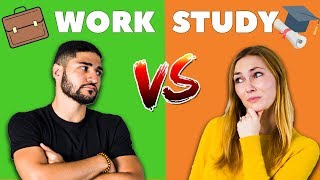
Madeline Mann and Maddie Caffey debate whether master's degrees are worth it. A grad degree helps your career only if it teaches skills you can't learn on the job and you've confirmed it's right for you. Research your industry, talk to people in the field, and prefer applied programs or work experience over grad school as a career delay tactic.
Chapters
Hey, everyone, this is self made Millennial. I'm Madeline Mann, and check it out. I am joined by Maddie Caffey, the host of Primal Career YouTube channel. Have you checked it out yet? Because it's amazing. And today we are going to talk about is a master's degree actually worth it? He doesn't have one. I do. We're going head to head. We're talking about, should you get a master's degree right after you graduate you, is it going to make you a more compelling job applicant or is it the right thing to do for a career transition? I don't know. So let's go for it. Stick around to the end because we are going to talk about if you actually make more money across your career, if you have a master's degree. So let's jump in. Let's get in the ring, head to head. Okay, so today we're talking about graduate degrees, master's degrees that you don't necessarily need for your job.
Yeah. So we're not talking about lawyers, doctors, or any other.
Exactly. So optional degrees. So I'm going to read you a statement, and you have to tell me whether or not you think it's true or false.
Perfect.
Okay. Going to grad school right out of college will advance your career.
So I think it's true only and only if you will learn some stuff in your master's degree that you won't learn on your own, like online or in a current job, which is pretty rare in 2019. But if you don't know, like, if you know yourself and. And you know that you're not disciplined enough to, like, just follow a course online by your own, maybe a master's degree is a good idea for you.
Yeah, I would say that. So I did do my master's right out of undergrad, and I caution people against that a lot just because it is not a place to discover yourself. It's not a place to figure out, oh, is this the right career choice for me? Because as you're saying, you know, if there's so much that, so much time that goes into it, so much money, it is a very expensive way to discover whether or not it's the right thing for you.
Many people choose to go for a master's degree because they're afraid of the real world and they just want to buy some time to just figure out what they want to do afterward.
Right.
Which is a really bad idea.
Yes. So what I did is I literally did like 50 informational interviews to make sure that the degree I was pursuing was the right one. And. And it ended up being wonderful for me. And I did end up getting that boost in my career. I was working the entire time I was in grad school and I was networking my booty off. All right, second statement. Grad school is the best way to change careers.
I don't think it's the best way, so I think it's false for me. Like I said in the other point, I think you can learn relevant skills on your own, online or in a job. I'll give just a specific example. One of my friends back in Canada was a technical engineer and he changed to IT consulting just because he focused on his transferable skills. So during the job interview process, he didn't talk about his engineering experience. He focused on his transferable skills, for example, leadership, teamwork, communication. And this is how he got the job. Because to be a consultant, you need all these skills. So he just focused on that. And this is the main tip I give everyone. When you start a new job, just focus on the transferable skills first and then the technical skills or the skills that you need just for this job. Because you don't know what you will think in a couple of years. And focusing on your transferable skills will just help you in the long run.
I like that a lot because I've seen applicants, because I'm on the front lines, I work in hr. I see all these resumes come in. People, people focus on building these side projects where it shows these transferable skills. So maybe it's outside of their current job and they present those on the resume. And I will say that sometimes a grad program can help you change careers. Maybe. But I will say I do get resumes where people are over educated with not enough experience. And in the end, companies want to see the experience usually more than the education, or they want to see both equally. So I definitely think that education without experience won't get you the results that you were really hoping in your career change. Okay, so we're rolling right in to statement number three. Grad school makes you a more attractive job applicant.
So I think you know better than me on this one. But according to what I hear and all the stereotypes that we hear, like in school and everything, I think it's true. I think companies will prefer people with a more advanced degree, like a master's degree, for example. So what do you think about that?
Yeah, I would say so. Some companies are very strict about it. They definitely want you to have a degree, especially if it's a higher up role and it can help you get that edge. I definitely think that it gave me an edge earlier in my career. I got a job that I think I was especially reaching for, but the degree helped me get there. I will say though, as someone who's read so many resumes, I sometimes call the education section of a resume the degree cemetery where all of these degrees go to die. People get degrees and then don't use them. And so in that case, it can actually hurt you because companies don't want to pay for someone who has a master level education. And that degree doesn't even apply to the job that they're hiring them for. So they're hiring a more expensive candidate who has maybe the same amount of skills in that specialty as someone who doesn't have a degree. So look out for what degrees you're actually getting. Okay, so this one's a good one and somewhat something that a lot of people ask. Graduates from master's programs make more money.
So I think it's false. And I have a clear example. So two years ago I applied to PwC and I applied with one of my friends. But the difference was that I came out of university with a basic degree and she had a master's degree. We had the same interview process, we applied for the same role, the same department, and the same job responsibilities. And at the end we received the same offer. Why? Because I think she had a master's degree in engineering, which wasn't relevant to our job in IT consulting, and because we had the need for the same training. So PwC had no incentive to pay her more because she will receive the same training as me. So the salary was the same. So my tip here is to do your research about your industry, the company or the role, just to see if companies really make a difference. And even if there's a difference, you will have to do the math to see if the cost of a master's degree will offset your increased salary in the long run.
Yeah, my master's degree was very expensive from usc, so I definitely understand that. And I will say that yes, over your career, you can make more money with a Master's degree. I think that that is true though, when I'm looking at my master's degree. To be honest, I don't know if I absolutely needed it to get to where I am today. And you're right, certainly certain industries, it really makes a difference for others. They're dropping off the education requirement from the entire job description. It's amazing. And so you should really talk to People in those industries talk to people who have degrees and don't have degrees, see what's right. Also, when I was in my master's degree, I worked the entire time, and I also was at a program that was applied. And what they mean by applied is that it wasn't theory, it wasn't research. It was actually we had projects with major companies. We had to have an internship in order to graduate. So maybe look for programs where there's a very distinct applied element. And I think that that can actually help boost you, help get you that higher salary in the long run, and hopefully get in that higher salary band, if that makes sense.
All right, so that was our four statements.
Those are our four statements. Thank you so much, Maddie, for being here and dropping some knowledge.
Thanks for having me.
Yeah.
What.
What do you think? Should they have a master's degree or not?
I think the main tip is do your research and then you'll get your answer.
Yes, exactly. I think we're completely aligned on that. So where can we find you?
Well, you can find me on YouTube, just at Primal Career. Link in the Description or on LinkedIn.
Yes, I will link it in the description. Thanks so much. Wi Fi. High five.