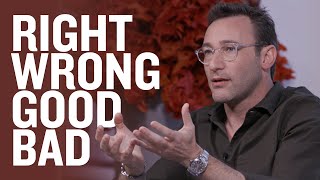
Simon Sinek explains how an infinite mindset shifts judgment from right or wrong to context-dependent. A strength like organization can become a liability, while disorganization might fuel entrepreneurship. You're never simply a winner or loser, just sometimes ahead or behind.
Chapters
One of the great things about adopting an infinite mindset is I've stopped looking at things in terms of, right, wrong, good, bad, but taking things more in terms of context, right? So I'm not against finite games. If you're in a finite game, you have to play with a finite mindset. But if you're in an infinite game, you have to play with an infinite mindset. And with an infinite game, of course there are finite games, of course you have a product to make that has to get out on time. And there's a beginning, middle and end. And you have to meet your deadlines. And we get these products out on time and meet our finite objectives in order to advance the infinite vision, right? So for example, I'll give you a perfect example. So we're constantly told to know our strengths and our weaknesses, right? Build on your strengths, mitigate your weaknesses. Are they strengths? Are they weaknesses? Or is it all context? Right? So if you're very self confident, sometimes you're arrogant. So in other words, a strength can actually have liability, but our weaknesses sometimes have strengths. I'll give you a perfect example. I am chronically disorganized. I mean, it's embarrassing, right? And this I've always believed was a horrible weakness. And I beat myself up for it. And I say how I need to fix this. And I try all these systems that don't really work because you have to be organized to have an organized system.
I'll give you a perfect example of just how disorganized I am as a young entrepreneur. When I was just starting out, I would go to a networking event. And of course you collect business cards. And a good entrepreneur, an organized entrepreneur, would take a business card from a prospect. If somebody goes, I think you're great, here's my card. And they would have sent an email on the cab home and followed up the next day and be like, would love to set up a meeting and come and show you our product. Yahoo over here would lose the business card for the time I got it to the time I got home, right? Two weeks later, I'd find it under a pile of things.
Brush off the dust bunnies, and I'd call them up and say, hey, remember we met at that event two weeks ago. They wanted to work with me even more because they thought I was busy.
Is disorganized a bad thing?
The answer is context. Sometimes, yeah, it really is. But not always. And so now when I look at myself or I look at the weaknesses or strengths even of my own organization, I don't I no longer think in terms of right, wrong, good, bad. But I rather think, like, this is really valuable in this context. This is really dangerous in this context, so I can mitigate and move things around and understand what to leverage. So it's much more about balance and context than is about right, wrong, good, bad. And all of this has come from learning to adopt this infinite mindset that I'm never a loser or a winner. I'm just ahead and behind. Sometimes I'm ahead and sometimes behind, but I've never won and I've never lost.