Moving Forward with my sister Sara | A Bit of Optimism (Podcast): Episode 16
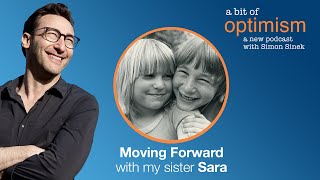
Simon Sinek talks with his sister Sara about losing her fiancé to electrocution on a subway track in 2000 when she was 25. Sara made a list of difficult firsts to face and explains why moving forward isn't the same as moving on. Shared tragedies like 9/11 taught her that grief connects us.
Questions this video answers
August 2000.
Electrocution (contact with the subway's third rail).
25 years old.
Chapters
In August of 2000.
I was.
Heading out of my front door to go to a friend's wedding in Houston, and literally was just opening the door, dragging my suitcase out, and my phone rang, and it was my mom. And she said, something's happened. Something's happened. I didn't know what, but I dropped my case and ran downstairs to catch a taxi. What little information I had, I knew that my sister, who was to be married in two weeks, something had happened to her fiance, but I didn't know what.
I couldn't get a taxi because it was rush hour and everyone was fighting in New York City to get a taxi. And so I begged a person to let me share with them, and they did. And I'm so glad I was able to get there, because by the time I got to the hospital, I was the only person.
I was the only person with my sister when she found out that her fiance had died.
They were on a train on a subway heading downtown to get their marriage license.
And he wasn't feeling well. He felt faint. And so as they pulled into the stop that they needed to get out of, he stepped between the cars to get air. We don't fully know what happened, whether he fainted or had a heart attack, but he fell and he touched the third rail. The official cause of death was electrocution. My sister was holding onto his pant leg.
When it happened.
That happened 20 years ago in August.
And my sister said to me, can we do a podcast about it?
And so that's what we're doing.
She's sitting right across from me, and I don't think I've ever talked about this with her in 20 years since it happened. We make references to it, but we've never talked about it.
So my first question for you is, why did you want to do this?
First of all, I've never even heard what happened that morning. From your perspective.
Let me take a step back. 20 years is a long time, and I've always kept this very close to my heart. I felt this was my story, my grief, my heart. And I don't talk about it very often because it's difficult. It's mine. And yet when I experienced it, I was 25 years old, and I felt really alone when I. Because it wasn't like this happens every day, that I had people to talk to and who understood me.
And two weeks after Peter died, I received a phone call from a friend saying, there's a friend of a friend. This woman, Julie, is trying to reach you. And she.
Had a Similar situation. And she wants to talk to you. She read it in the newspaper. It was all over the news in New York City when this happened and reached out to me. And I felt a sense of relief when I got that phone call, because I was like, wow, there's actually somebody that kind of understands what I'm going through. And this woman, Julie, became my beacon of hope. And I remember we talked once in a while, and she had suffered something similar. Her fiance had died in a tragic accident seven years ago. And for me, it wasn't necessarily that she understood what I went through. I mean, we had this shared empathy, and we had the shared understanding. But for me, more than that, she was seven years ahead of me. She was my hope. She would. Had remarried, she had kids. And I was like, oh, my God, like, that could be me. Like, I can get there. And even though I hardly talked to her, hardly saw her, we. We had coffee once in a while. I kept her in the back of my head all the time because she made me get up every morning because I knew I. I could. My life could go on. And that's the reason I wanted to do this interview. Because every day I look at the news, unfortunately, and see the hundreds of thousands of people.
Who are dying from COVID 19 and from other tragic circumstances. And I can't stop thinking about all the people that are suffering right now, the families that are suffering, the spouses, the children. And if I can be a beacon of hope for one person through this interview, like, that would fulfill me. And I've always.
Wondered how I can use my experience, my story, to help one other person. And I hope I can be that beacon of hope. Because, yes, 20 years is a long time. It's taken me a long time, but everyone out there.
Can move forward.
I remember I was with you when the doctors came out and gave us the news that he didn't make it. And sometime later. I don't have any recollection of how long Mommy and daddy then showed up. And we moved around a lot as kids, and so we really only had each other, the four of us. And so to have the four of us, there.
Was a big deal. And I remember we went back to mommy and daddy's house.
And we had a wedding in two weeks. And so you were being consoled. And I remember my job was to call family and say that there wasn't going to be a wedding. And I remember calling grandma first.
But the thing that I found amazing about that experience was, you know, we were a pretty tight family. Already. But we became an unbelievably Thai family. And this is the optimist in me. I remember very quickly seeing the silver lining in this cloud after we had gotten through the shock. What went through my mind was something could have happened to you. He was touching the third rail and you were holding onto him. You could have been electrocuted, and you weren't. I know that you stayed at Mommy and Daddy's house for a couple months, and then you had an apartment with Peter. And I remember, eventually you moved back home. And fortunately, I lived just up the street. And anytime you wanted me to, I would come and sleep on your couch. I remember.
No, you moved in with me.
Did I? I moved in with you.
You slept on my couch for a long time.
No, I didn't. Oh, okay. I slept on your couch. Oh, I do remember. That's right. I slept on your couch the night before. I'd go get my clothes for work the next day, and I'd come to your. You're right. I slept on the couch for a long time. I forgot about that. The thing that stands out for me was the relationship I had with you. And how you managed this and the relationship you had with our parents. How you managed it was very different. They were there to console you. And I was a little more of a voice of reality. I remember telling you that the first time Peter's birthday came up or the first time this happened, I would always tell you, it's just the first time. It's going to hurt the most the first time, but it'll be easier the second time. And all of these things will happen more than once. I remember that.
Yeah, I remember you and I talking about that. And I had prepared myself that year one was going to be the hardest. Because you have to go through everything once, right? And the second time is going to be that much easier. The third time is going to be that much easier. The first time I had to take the subway. The first time I had to go to the bagel store we used to go to. The first time I had to walk into that apartment. First time I had to go back to work. First time I had to go on a date again. I remember making a list. I wrote down a list of all the firsts that I had to do this year. And I have it in my diary.
I had no idea you did that.
Because I knew I wanted to kind of check them. I'm like, okay, I can do this. I have no choice. I'm gonna have to do these things.
That'S sort of genius to make a list because the whole concept of dealing with life after tragedy is overwhelming.
It's kind of genius to write it all down, all the things you're gonna have to do that you don't want to do. And you only have to conquer each one once, so you don't have to do them all at once to make it a checklist. It's actually manifesting eating an elephant one mouthful at a time. What did you learn about yourself from this?
20 years is such a long time. And I beat myself up a lot for still being Sad. I'm like, 20 years. Should I be over it? And yet I question, why do I struggle to feel sad and have a hard time talking about it and the weird way the world works? I was on Instagram two days ago, flipping through, and a TED Talk popped up. This woman, Nora McInery, and she writes books on grief. She had lost her husband, and she had this one line that just stood out to me, and it said, you can move forward, but you never move on. And I think that gave me permission after all these years to know my life has moved forward. Yes, I found love, and yes, I remarried, and yes, I have kids, and yes, I am so grateful, and I'm happy and I laugh and I'm funny, and I can be all these things. And yes, I also cry. And yes, I'm still sad. And you don't move on. You don't move on from that. It's not a thing you move on from. It wasn't a moment. It was my life. It is my life. And I think I had to understand that, that it's. It wasn't a moment. But you don't just get over it, but you can move forward.
Sort of accepting tragedy as part of our journey and part of our life story as much as anything else. You know, it's formative, right?
I even remember somebody from Peter's family, after the tragedy happened, said to my face, don't worry, you're young. You'll be fine. And at the time, I was so angry. I was like, how dare you tell me that I couldn't understand that in their minds, I'm 25 and looking back now, there's a difference between moving forward and moving on.
One of the things that happened for me is, I don't even know if you know this, but you gave me courage to do difficult things. I'm not 100% sure of that. I would be where I am in my career if it weren't for you. You Know, I had a job. I worked for a big ad agency when this happened. And as you healed, as you moved forward.
I remember just being in awe of your courage. Your courage to go through that list, to pick up your life and put it back together again. And that would always be my point of reference. Like, when I had difficult decisions to make at work, I would be like, if Sarah can do this, I can do anything.
And I remember I stopped being afraid of difficult things, even in relationships, because I saw the courage that you exhibited. I don't have your courage.
And I've never said this to you.
I've said it to friends.
I'm not sure I would have made it through as healthily as you have.
It was easier to be the brother.
I mean, I think.
You can never prepare yourself for these things. I even think back to myself, like, how did I do this at the age of 25? How did I get through it? There's no rule book. And I just remember the first day, the thing that I was terrified about was getting sucked into a depression. Like, that was my fear. And I just remember saying to myself, wake up every day, get dressed, put makeup on, and go for a walk. And I did it every day. And I don't know where that comes from. And Brad and I, my husband and I were talking about this recently, that when Covid hit and we were all in isolation, I did the same thing. I woke up every day, I got dressed, put makeup on, and went for a walk. And I think the only difference for me this time during a tragedy in our world was I wasn't alone. And it felt really nice that I would look at other people on a walk and know we're all thinking the same thing. I think the hardest part when that happened for me was I was so alone, being so young and going through something that no one could understand. And I hated being different. I hated people feeling sorry for me. I hated people giving me sympathy, because all I really wanted was what you gave me, which was just like, you gave me courage because you just listened to me, and you just were real with me. And you need real. You don't need sympathy when you're going through. I mean, for me, you know? And the reason that I think you and I got so close during that time, because I felt I could just be me with you. I didn't have to pretend to be someone else. I didn't have to try to be brave or.
Try to pretend I was okay. You gave me permission to just be. And you were one of the Only people I think I was able to be with and just be. Because everyone else just.
Looks at me differently than treated me differently.
You and I had a conversation after September 11, and it was a few weeks after the shock had subsided. Living in New York City after September 11, everybody had one degree of separation. Everybody knew at least one person who knew somebody who lost somebody, Everybody. And I remember you said you would walk around the streets and for the first time, you didn't feel alone.
I totally remember that feeling because it was exactly a year later after Peter died. And I remember just feeling like, wow, there's a bigger club than just me as a member here. And even though I don't know anybody affected, it didn't matter.
It speaks a lot to how human beings exist as social animals, as tribal animals, where just simply knowing that the world becomes your support group. Just simply knowing that other people know what it's like to lose somebody in a tragic accident, that you went to work in the morning thinking everything was fine, and then nobody came home. Just knowing that is cathartic. It's a strange thing that. That would offer catharsis. Just simply knowing that people can relate. It goes to what you're saying, which is, I didn't want to be different.
And yet it's a sadly small club.
Sadly, it's a bigger club now with.
COVID I think there's a strange understanding that you have an empathy. I think it's about empathy. You just know when you've been dealt a card that you weren't expecting or asking for. And.
It'S not a club you want to be part of, but if you're there, unfortunately, you have to get it in order to know how to see other people in that way.
One of the things that it did for me, and again, I don't even think these are things that you and I have talked about ever. It put things in remarkable perspective. Obviously, you recognize how stupid most of the things we do are and how seriously we take these stupid things when there are things that are just way more important in the world, like relationships and family and love. And I remember my office was fantastic. They said, take off as much time as you needed to be there with your family. And I think I did. I took off at least two weeks, I think, because I was just shuttling between Mommy and Daddy's house where you were, and going home. And I remember when I finally.
More from Clegg





AI Won't Tell You the Full Truth | Arthur Brooks + Simon Sinek | A Bit of Optimism Podcast



How To Make the Best Decision | Arthur Brooks and Simon Sinek | A Bit of Optimism


