My Nerves Ruined Every Interview for 10 Years… Until I Did This
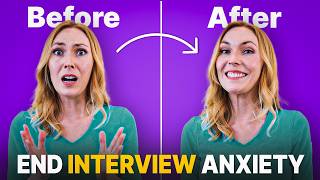
Madeline Mann spent ten years bombing interviews due to anxiety that tanked her working memory and verbal fluency. She explains the psychology: social evaluative threat triggers cortisol and self-focused attention. Her PAD framework helped her finally break the pattern and interview confidently.
Questions this video answers
1993
Chapters
I couldn't get through a single interview OR evaluation for 10 years without my nerves completely wrecking it. My voice would shake, my brain would get mixed up, and afterwards, I would replay every dumb answer in my head for days, wishing I had said the things I had meant to say. My worst interview was in front of 20 people. And I embarrassed myself so, so much. I will tell you that story. And that day sent me on a mission to fix this debilitating affliction. And I uncovered three things that completely helped me, and I'm going to share those with you in this video. And after implementing those three strategies, I have gone on to interview with top companies in the world and ace nearly every interview I do. And now I train people on how to ace their interviews with hundreds of thousands of success stories across my clients, my YouTube channel, which is the number one YouTube channel for job interview help, and I also have my LinkedIn learning courses, my Spotify courses. So if you need to get rid of your terrible interview nerves too, let's do this. Now pull up a chair. Because my worst interview ever was an interview I did in front of 20 people. And it was a complete interview embarrassment. When I was in college, I went for the editor in chief position on the student newspaper. It came down to me and one other person. I'd been on the paper longer. I'd served as managing editor, and my section ran like clockwork. And the other candidate had less experience. The next editor in chief would be chosen by interview in front of a whole entire newspaper staff, and then they were going to vote. And frankly, this was very ignorant of me is I objectively thought I would get the position because everyone had seen my work firsthand. They saw that it was high quality, and I again, objectively had more experience and a higher title than the other candidate. It almost felt as if the interview was an unnecessary formality. And as I have coached job seekers, I have seen this in a lot of high achievers where they underestimate the importance of building interview skills, especially for internal interviews, because they are super good at what they do and they expect that people will see that and that will be enough. And I told myself for this interview that I would prepare. But my preparation consisted of running possible questions in my head and silently thinking through how I might answer them. And I never actually said anything out loud. And a few days before my interview, a friend offered to help me, and he tossed practice question my way. And he said, what would be your biggest weakness? And I gave him an answer, something like, oh, well, I get Annoyed when people don't hit their deadline. And he looked at me and he was just like, yeah, I don't know, maybe don't say that. And that rattled me more than I expected. Suddenly, I realized how untested I was. And when it was time for the interview, I walked into the newsroom. I saw over 20 people staring at me. And these were my peers, people I'd worked beside for years. But at that moment, I felt like I was being cross examined. Immediately, I felt this adrenaline dump. And I started shaking. It felt like a wild animal was burrowing in my stomach, and my mind was not working clearly. And my answers were sh. They were rambling. They were lacking thoughtfulness. For example, someone asked, what's your vision for the future of the paper? And this is the type of question I should have rehearsed and memorized. But it was more like some thoughts that had briefly floated in my head during my preparation. So when the question was asked, my mind went completely blank. I said something like.
Yeah, I mean, I think. I think the paper's in a really good place right now. And I mean, you know, there's always room for improvement. But of course, I think what's most important is just, like, keeping up the momentum and making sure everyone feels good about what they're doing. It was such an embarrassing answer, as were the rest of them. And I looked around, and I did not see a friendly face. I was probably projecting, but the judgment felt so palpable. And the story I told myself is, no one is rooting for you. You have already failed. They hate you. And when have you done a job interview where you feel like the interviewer didn't like you and it sent your interview into a tailspin? Right. That perception ruins us. And the staff had several days to place their votes. I knew I had failed the interview, but in my mind, I was still thinking, okay, the interview was bad, but what does that account for? What, 20% of the decision? I still have the track record and experience. That should count for 80% of the decision. My friend, in this world we live in, how much does an interview count for? When it comes to the decision of whether or not you land a job, it's 100% of the decision. Anyone who lands an interview gets it because they have met minimum qualifications. So by the time you get to the interview, the qualifications are nearly forgotten. It's all interview performance, pretty much. And so this is such a hard pill for job seekers to swallow. And it was really tough for me to understand because I realized job interviewing and being good at your job are two different skill sets. I felt so awkward that the only thing I could do is essentially go person by person on the staff and ask them if they would vote for me. Nothing brought me lower down in my self esteem than looking people in the eye who I've been working together with for multiple years and them say they didn't think they could vote for me. Respect to them for telling me the truth instead of being fake and then not voting for me though. Oh my gosh this really hurt. I was playing in a soccer game when I got a call from someone on the newspaper staff saying I didn't get the role and I collapsed on the sideline crying and my friends thought someone had died. It was a moment of shame, deep sense self loathing, feeling like an outcast, feeling completely unwanted, feeling very unlikable, wondering why they didn't see my value. The past three years of dedication on the newspaper and now this was just one example of many that have happened in my life. I was very good at something, but then as soon as I was being judged I did very poorly. I was terrible at job interviews, but I also was a good soccer player and a club team saw me play and scouted me for their team and I became one of their top goal scorers. However, I then went to soccer tryouts at my high school and they put me on the lowest team below JV because I was so bad in the tryout and they even remarked that they had never put a club player on the lowest team but it was because I couldn't perform when I was being judged. I had always wanted to do theater but I couldn't bring myself to audition because it felt too scary. And then of course I went on to bomb so many quick corporate job interviews and so what has been your experience with job interview nerves? Let me know in the comments.
To fix this, I first needed to understand why my brain would completely scramble under pressure in job interviews and evaluations. Psychologists call this social evaluative threat the fear of being judged and it has been studied extensively through something called the Trier Social stress test or TSST. Or TSST. In the original 1993 study by Clemens Kirschbaum and colleagues at the University of Trier, participants had to give a five minute speech and then solve math problems in front of a panel of stone faced judges. Their cortisol, heart rate and blood pressure all spiked just from being evaluated. No danger or a tiger chasing them, just the human fear of judgment triggering a full blown stress response. Job interviews are basically the real world version of this lab experiment. A 2004 meta analysis by McCarthy and Goffin found that interview anxiety reliably predicts poorer interview performance, not because anxious people are less capable, but because anxiety hijacks attention. Instead of focusing outward on the conversation, you start focusing inward. Do I sound dumb? What's my face doing? Psychologists call this self focused attention, and it's been shown to disrupt working memory and verbal fluency. A 2021 study by Zhang, Powell and Bonacci found that the biggest driver of interview anxiety isn't introversion. I'm personally an extrovert. It's the fear of negative evaluation, that deep dread of being judged harshly. People high in this fear show the same physiological patterns as those in the tsst, racing, heart, sweating, even brain signals that mirror physical pain. In a 2014 EEG study, Vandermolen and colleagues showed that these individuals brains actually produce stronger error detection responses when anticipating social feedback. They're literally wired to expect rejection. And to make matters worse, cortisol, the same hormone that helps you stay alert in a crisis, should shuts down your prefrontal cortex, the part of the brain that is responsible for reasoning, planning and speech. In a 2016 Frontiers in Psychology study, participants exposed to social stress performed significantly worse on memory tasks, unable to recall information they'd learned just hours earlier. And that's why you leave the interview thinking, why didn't I say that you couldn't. Your brain was in survival mode. So to summarize, you're put in a high stakes situation where judgment is involved, Cortisol starts pumping, we start focusing more on ourselves than the conversation, and we become consumed with the fear of a negative evaluation. So we are living in the future of a bad outcome and we have strong error detection where we are expecting rejection and interpreting even neutral actions as negative. And finally, all of these things hijack our prefrontal cortex that we need to answer these questions and instead prepare us for danger and to run away from a bear instead of get this job. Now that is the worst worst episode ever.
Okay, but I have some very good news. There are three steps that you can do. And these three strategies completely changed my life. They've changed my clients lives. And it is my framework pad to pad your mind against the pressure. P stands for prepare. And I know you think you know how job interviews work, but most people don't. And it reminds me of when I took an SAT prep course in college and it increased my score by 400 points. And I was shocked that some test that was supposed to measure my intelligence was so easily manipulated by learning how to better take that test in just a few weeks. That's how interviewing is. You don't need to be better at your job, you need to get better at the interview. Act of interviewing. I will link a free interview prep guide and a video that goes along with it. But a place to start is you need to study the job description deeply, understand what they want most in this role, and align all of your answers to the top three hard skills and the top three soft skills. And then do research so that you are knowledgeable enough to ask thoughtful questions about the business. I also have a free resource on the best questions to ask in a job interview, which I'll link below. The next step is a For adjust, you need to reframe the way you are viewing this interview. Your brain is putting too much pressure on the moment, which is why it's so ridiculous how often the job you get the offer for is the one you didn't actually want because you are much more relaxed in those interviews. So go ahead, write down what you normally think about interviews, such as, well, if I mess this up, I've lost my chance or they're judging me to find what's wrong with me. Next, I want you to write down a reframing for that one that you can believe and repeat it to yourself over and over and really process that idea. Such as, even if I make a mistake, that's normal. I'll pause and refocus and they'll understand this is just a conversation with my potential future coworkers and they want me to be the right person for this role. Let's see if it's a good match. Framings can set you free and make sure to say the positive mantras both when you are preparing and before you interview. Finally, D stands for desensitize. You need to expose yourself to these uncomfortable situations a lot. First, start by talking to yourself in the mirror. Then record yourself doing mock interviews by yourself. Then move to mock interviews with other people. Another hack can be just practicing interviewing with someone else in the room. Because I don't know about you. My husband's right over here in the room. I used to be so embarrassed to do things like this, like kind of performing in front of him and even just being around other people can get you anxious, right? That's what we're trying to do is we're trying to increase your nerves and then have you overcome it. So really put yourself in any situation. Maybe you're practicing in a public coffee shop if that increases your nerves. Anything you can do to get that going. And a tip is to never decline an interview opportunity. If you have this thing where your nerves are bad and so it's good to use that opportunity, you don't actually want to further desensitize yourself in this uncomfortable situation. For a deeper dive on how to be confident under pressure, I do have a free class called Unshakable Interviews. I will link that below. I can only imagine what if I had pretended to do three soccer tryouts the week before my actual tryout. I guarantee you that could have changed the trajectory of my entire soccer career. These actions will change the trajectory of your life. Exposure therapy is a real success psychological approach to reduce these fear responses and it even worked for me with my needle phobia. I still don't like needles, but being pricked by three needles a day for several weeks eventually made my fear significantly milder. Frankly, needles are a reasonable comparison to make here because your mind is actually viewing interviews like physical pain. So don't skip this part. Wishing you the best in your job search. You've got this wi Fi high five.
More from Clegg





AI Won't Tell You the Full Truth | Arthur Brooks + Simon Sinek | A Bit of Optimism Podcast



How To Make the Best Decision | Arthur Brooks and Simon Sinek | A Bit of Optimism


