Should You Work With Your Friends? with my friend Will Guidara | A Bit of Optimism Podcast
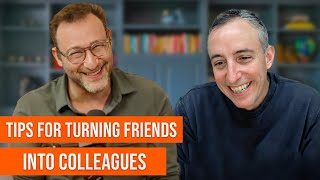
Simon Sinek talks with Will Guidara about going into business with friends. They explore how to separate the friend role from the colleague role, when ego gets in the way, and why some friendships need intentional maintenance or a clean break.
Chapters
Here's a question I'm supposed to ask you.
I can't even read it with a straight face.
Should you do business with your friends or should you not mix the two?
The reason Will and I are laughing is because we're talking about doing a business together. And we had a huge fight about it before, before we got on the podcast. And now we're asking, should we be doing this? If you've been listening to this podcast, you'll know that. Friendship at the top of my mind lately. We trust our friends. We can rely on our friends. These are essential attributes for a co worker too. So do friends make good co workers? I invited my friend and occasional co worker Will Guidera to talk about if it's a good idea or not for us to work together. Will is the author of the New York Times best selling book Unreasonable Hospitality. He's also a producer and writer on the last season of the Emmy award winning show the Bear. And prior to that, he was the co owner the of. Of 11 Madison park, which at one point was named the best restaurant in the world. But above all, he's my friend. This is a bit of optimism.
Having you on the podcast is like cheating.
Because you're, you're one of my male friends that I say, I love you too, you know, and the love I have for you is real and, and, and permanent. And the reason I say having you on the podcast is cheating is because.
It'S, it's. I feel like it's too easy. Like I, I can talk to you forever. I always learn something from you. You always make me laugh. And my friendship with you means more to me than many things.
Dude, the feeling is mutual. By the way, the last two things. I always learn something from you as well when I'm wrestling through a new idea. You're one of my favorite people in the world to talk to about that idea because I always end the conversation understanding it more clearly than I did at the beginning. And there are very few people in the world that I laugh like a third grader when I'm around.
You know, one of my favorite things about us is when we fight, we find a reason to make a joke.
And the only reason I know this is because five minutes before this podcast, you and I were on the phone in a fight that ended up us hurrying to apologize to each other because we had to get on the podcast. But the thing that I found so enjoyable is not only do we want to get to resolution when we fight because we don't want to hurt each Other. And we don't want to be the person that hurts the other. We really like it. It hurts me more that I hurt you than you were hurt, you know, And. But because you and I are like fifth graders, if the opportunity to make a joke arises, even if the situation is not. Does not call for it, we cannot resist. We have to make the joke.
It's like, game off. Came off.
Joke, joke, joke, joke, joke.
All right, game back on. I really need to tell you about how you made me feel serious.
Serious again. Exactly. Will Guidera, you are one of the most talented people I know. And my favorite thing about what's happening to your life is that you were a famous restaurateur. I guess you still are a famous restaurateur who your career has made an unexpected turn where you probably will never own a restaurant again, if I had to guess. And you are now a guru, a thought leader, teaching us how hospitality works, but more importantly, how to treat people, which is what ultimately hospitality is.
Did you think you were going to be a restaurateur owning restaurants for the rest of your life? Like, I want to know how unexpected this turn is. Or did you always kind of know that your career had a. I had a second. A second act.
Had you talked to me five years ago.
Is it five years, six years now, I would have told you that I will always live in New York City and I will always own and operate restaurants in New York City. And then I had a falling out with my business partner. We fell out of love. And after some time, it became clear that splitting the company and the process of figuring out how to split it was.
Well, in essence, tearing apart the very thing we'd spent all that time building.
And in a revelation, like a cinematic style revelation, one day I was like, no, the best thing for me to do is sell him everything. That happened to be just before COVID So.
It was like two months before COVID that I signed on the dotted line. The contract to sell.
Woke up a few days later.
After a few days of some celebration, right? I sold a company that's a big deal with a full on identity crisis. Who am I, who is a restaurateur without any restaurants? And frantically, aggressively started raising money and putting together a team and going out to sign leases. And literally, Covid started one week before I was set to sign three restaurants and an office, leases in New York City. Then I went up to the country, to our house up there for what I thought was going to be a few weeks, right? Like all of us did. In that moment, a few weeks turned into a few months. I was kind of keeping all those deals warm. And then one day I decided to just stop.
Because I think for many people, Covid gave us. In spite of the.
The loss of life and financial suffering and loneliness and isolation, most people that I know of can point to one thing that they consider to be a gift that Covid gave them, a shifting of perspective. And for me, it gave me the gift of just stopping. And rather than running back to do what I'd always done, it gave me the gift of taking the time to decide what I wanted to do next.
And that's when I reached out to you. And the idea of unreasonable hospitality was born. And I wanted to write the book because, well, we'd been talking about it for a while, and now I finally had time and space to focus on it, but to teach. And I figured if I could spend really intentional time putting words to the things I really believed in, it would make me better at.
But the idea that a friendship.
That a partner, a work marriage, the identity of that relationship is intertwined with the business. I guess the thought I'm trying to get out is like, is that healthy?
Because I've gone into business with friends where things worked. I've gone to business with friends where things didn't work. And I've gone into business with friends where it absolutely destroyed the friendship, whether it was successful or not. And I've gone in the other direction where it had no impact on the friendship. Maybe the friendship even got better whether it worked or not. So is it conditional on the friendship? Were you friends first and then went into business together, or did the friendship form in the relationship? In the.
In the business, the friendship formed. In the business, we worked together first.
Okay.
I mean, man, I don't know that there's one right answer to this because.
Because I think this question comes up a lot, which is, should I go into business with my friend?
I mean, what is going into business with a friend actually mean? It's. It's effectively signing an agreement to commit yourselves to one another and help grow an idea together. Which, by the way, is not dissimilar to marriage.
I mean.
Yes, and.
Well, I mean, I'll play it out just for argument's sake. Ideally, you're friends with the person that you marry in addition to being lovers, and then one day you decide to get married and you're signing an agreement to commit yourself to them and them to you. And in many cases, then you have a child and you are Committing to growing that idea together.
I know a lot of people who started businesses with friends because either the friend just happened to be there. I've seen a couple of those.
I know of plenty of marriages that have started that way too.
For what it's worth, the lucky roommates club kind of thing, you need a friend you trust and who wants to build it with you. But I've also had this conversation with people, which is, if you truly want a business to succeed, sometimes you have to get used to the idea that you may have to fire your friend.
Yeah. I mean, when does it succeed versus when does it fail and not to.
Well, it's not a question of the business succeeding fail. But sometimes that friend Peter, principles out like they were hugely valuable emotionally and Skill set from 0 to 1, but don't have the skill set to go from 1 plus.
Yeah.
And so friends. And so sometimes this is the dirty truth about business, which we don't talk about. But sometimes you do have to fire your friends.
Sometimes you have to. Or sometimes you stop choosing one another. Right. And the same way, like you hear this marriage principle all the time.
The secret to a healthy marriage is to wake up every single day and choose that person. And it's an active choice. Right. It's not a passive thing. You re engage in the relationship every single day. And I think.
Listen, friendships and business, they end for different reasons and in different seasons. But sometimes it's because one person has outstayed their. Their value. Sometimes it's because they no longer are prioritizing one another to the point that they're willing to fight through what is necessary to make it work.
You and I do something that I think most friendships don't, which is there is a brutal honesty. Not about the other, although that happens too.
Emphasis on the brutal.
There's a brutal honesty about ourselves and you and I, in a moment of tension where one of us is digging in for some reason or another, the other person will ask, is this your ego?
And the default answer for anybody else being asked that question is no, even if it's yes. What I think is the lesson here is when one of us says to the other, is this what you actually feel or is this your ego? And the other person will say, it's my ego. There's a vulnerability even in extreme tension. I guess where I'm getting at is like, how did we learn that? Have you always been that honest about yourself or did. How did you learn that? Because you and I will say, it's my ego and we'll back away from the argument.
I mean, in the conversation we just had, I think that came up twice. In one case the answer was yes. In the other case the answer was no. Yeah, right. About two separate things.
Two separate things. Yeah.
I, I think that, okay, A. Ideally, as you get older and you become more self assured, you're able to actually say, gosh, you're right, this is about my ego. And this is not rooted in the right place. Without fearing that you will lose the other person's respect for having made that mistake. You're, you're confident enough in yourself to make a mistake and admit to having made one.
But I'd also say, okay, going into the phone call we just had, we both, whether it was an active thing today or it's invariably an active thing, generally have made the choice that we are going to hold on to one another. We are friends and we are not going to let like, I will not let you go and I know that you're not going to let me go.
No.
And so in a moment where if you say, is that your ego. If I lie.
Yeah.
Now there's a rupture in our friendship that's going to be hard to repair. And.
It'S just the older you get, the smarter you get. I think more often than not.
And it's easy to just make the choice, I care enough about this person to do what I need to do in order to preserve and pursue this friendship.
I want to go down this path of you said something which is you talked about confidence. You have the confidence to admit your own failings. And the question I'm asking myself is what comes first, the confidence to be vulnerable or the skill of being vulnerable that leads to confidence. And I'm just thinking about my own experience. I don't think I worked on my self confidence in order to be vulnerable. I think I took the excruciating risks to be vulnerable and it ended up helping me build my confidence.
Yeah, I think I'd agree with that. I mean, you could argue in one sense one begets the other, but there are plenty of people that become more confident that never become more vulnerable. More often than not, vulnerability leads to confidence. Yeah.
And I think it's unfair, I think it's unfair to human beings to say, ah. In order to have successful vulnerable relationships, friendship, business, marriage, first you have to work on your confidence. Because at the end of the day, the thing that makes us fall in love with each other is the fact that we can be insecure and we can be like, nobody is Purely confident. We all have insecurities and anxieties and sometimes it's, you know, it's because they're deep seated and sometimes because I had a bad night's sleep, they come and go. I've been thinking about this a lot lately, which is how we present ourselves to the world versus how we present ourselves to our partners. And by partners, I mean business partners, close friends, romantic partners. Like however you want to define that in private, intimate spaces. Right. And there's much talk, especially on social media, about living your true self out loud.
Right.
Whatever that means. And I'm not sure that's 100% true. I don't think you should lie to the world. I don't think you should present yourself as something you're not. However, we have to bend and mold ourselves, code switch for the situations that we're in order for society to function. Right. I like sitting down in a chair and being comfortable. And this is me, right? I can't do that if I'm having a first meeting with somebody. It's disrespectful.
Yes.
I like, I like putting my feet up on a desk. I can't do that if I'm interviewing for a job. And if somebody says, why are you putting your feet on my desk? You're like just being myself, just being my true authentic self. You don't get to say that. Like we, we make different jokes depending on the company we're in. We have different levels of, of form, of formality depending on the company we're in. We push back differently depending on the company we're in, other words. And if we were all just ourselves all the time, every stable institution would just. Society would stop working. So because we're never truly, truly, truly our full selves in public, because it's not, you can't really be. We play, we balance the line, we sort of, we play the teeter totter of, you know, being myself but also being socially, you know, being a functional member of a civilized society. It's those intimate relationships when I'm in private that all of the society's expectations can be ripped away. And those places I can be my true authentic self. And if you have intimate relationships where you cannot be your true authentic self, that is where confidence starts to flail. You have to have some place you can do that. In other words, you're playing a public Persona in a private relationship. That is where, where the moist air of bacteria grows, the bacteria of insecurity.
I want to add just another layer to this though, because here's the thing. Yes. I'm not going to curse in front of kids. I will curse in front of you. I will not curse. More likely than not on this podcast, but if you and I were having a drink, I'd probably let a few exactly. Curse words fly.
Exactly.
The thing is, though, these are all actions. How my posture in the chair, whether I kick my feet up, whether I curse, all this stuff. I do think we can be consistently ourselves when it comes to principles.
Yes.
And I know that whether you are on stage in front of 10,000 people, or whether you and I are having a pizza in your living room, your principles are going to be the same. You're going to live with integrity. You're going to hold yourself to a certain standard of accountability. You are going to lead with vulnerability. Yeah. And this doesn't change what you said, but what I do think it means, like, as it pertains to where this started with vulnerability and its relationship to confidence. I mean, listen, relationships are relationships. The lessons we learn from those in life apply to those in work and vice versa. And.
The most confident leaders are the ones that are vulnerable with the people on their team. The longest marriages are those where one person is vulnerable enough to tell the other person how they made them feel and how they were hurt by something completely unintended. And the same applies in friendship. And chicken or the egg on this one is, do you stop being vulnerable because you're not confident? Or you tried being vulnerable.
With the wrong person, like you took the wrong risk with the wrong person.
That's it. And the number of friends that I and you both have who are never vulnerable in relationships because they tried that and it got thrown in their face. And by the way, now they live in insecurity in their relationships, and that's.
When they start living their public Persona and their private partner.
That's when they start living their public Persona privately. And so I think I'm going to go back to what I said some moments ago, which was a thought, but I think I'm going to double down on that thought, which is we have to take the risks to put ourselves out there in intimate situations, being at a business partner friendship or a romantic partner, and the times where you. It not only does it not backfire, it actually contributes to the relationship. It becomes easier to take those risks. And you become more confident in saying, I screwed up or that's my fault or I don't mean to be an an. It's my ego that's getting hurt.
Yeah.
And those conversations become A lot easier. Like, I think.
10 years ago, if you said, is it your ego? I would have said no when it was.
And. And by the way, your ego would have then, maybe even five years ago, you to probably yell at me for even asking the question, and the relationship would have really taken it.
There's a rule we have at work that I absolutely love, and it's. It's incredibly true, which is if the response is above a 5, it's about something else.
Gosh, I love that we use it.
At work, but it's really true in any. Like, if. If your spouse yells at you for not putting the cap on the toothpaste. I told you a hundred times, you.
Know, not about the toothpaste.
It's not about the toothpaste. And the problem is, is we don't listen to the volume. We listen to the words, and then we get defensive. Like, what's the big deal? It's just the cap on the toothpaste. So you put it on, who cares? Nothing's happening. Right? And a fight ensues, as opposed to saying to ourselves, this is not about the toothpaste.
Yeah. You know, and then, by the way, I have the courage to say I feel like there's something more at play. Can we talk about it?
Your job is to listen to their story and to learn to respond with curiosity. Tell me how you feel. Why do you think you feel that way? Is that really true? You know, can you give me. I understand the example you gave me. Can you give me more examples to help me understand where I'm failing you?
The example thing is so interesting because sometimes when I'm in a tense moment in a relationship, I'll say that, hey, can you give me examples? And the response is, we don't need to rehash it. I'm like, no, I'm not trying to rehash it, but I would like to understand what I am doing inadvertently to make you feel that way, such that I can be better at not doing it.
The examples have to be specific. The examples have to be specific.
They have to be very specific because sometimes it's a simple word, and sometimes you need to trace all the way back to it, Feel that way, such that I can be better at not doing it.
The examples have to be specific. The examples have to be specific.
They have to be very specific because sometimes it's a simple word and sometimes you need to trace all the way back to it to realize, A, the whole thing is misplaced, or B, gosh, there is this little thing That I do that is totally grading on this person. And it's so easy for me to stop doing it. And the impact is profound if I can.
Okay. What do people not understand about friendship breakups?
Oh, man. What do people not understand about friendship breakups?
It's so big, that question, and such a big question. I'm so glad you have to answer it and not me.
Also positive in the negative, like, what I know.
I think that people.
Are much lazier and more passive in friendship breakups than they are in, like, romantic relationship breakups.
And.
In being so. Are undermining the unbelievable importance of valuable friendships in our lives.
Yep.
And we've talked about this all the time, how.
With everything that exists out there about being a good leader, a good dad, a good husband, wife, whatever, we don't talk about friendship nearly enough. And yet that is the one that actually energizes you and sets you up for success in all the other relationships. And we are so much less intentional in our pursuit of those friendships. Intention at the end of something is just as, if not more important than intention at the beginning of something. Think about some of the closest friends you have in your life.
You think about vulnerability and the things you've experienced with them and the things you've told them, the things about you that only they know, and yet they just drift away. Imagine if that was the case in a marriage. You're, like, one day, you're just not married, and you don't even know what happened. Like, it's. It's a bizarrely.
Counterintuitive thing.
I think you're right. I think what people do not understand about friendship breaks up is they require the same level of effort and stress and courage as breaking up with a business partner or breaking up with a marriage. They require effort. The only difference between our closest friendships and our business partnerships and our marriages is there's no contract.
Yeah.
And so we go through the excruciating pain of ending those relationships because we have to unwind a contract.
Where there's no unwinding a contract in a friendship. And so we can. We can get away with being lazy or avoidant.
And by the way, actually addressing it, even if it is the end of the road for a friendship, is not only an act of generosity to them, but towards yourself as well.
And I think that there's a courage that comes from leaning into it and say, I think we are growing apart, and I think we're both showing up. I think we're just.
I think we're playing roles. I Think we're both playing the role of friends. But let's be honest. I can't be happy in this unhappy in this friendship, and you're really happy in this friendship. There's no way that our feelings are completely opposite. So if I'm feeling this unsatisfied and this unhappy, I have to believe that you're somewhere around close to that feeling as well.
And by the way, sometimes, like, intentionally going to end a friendship is the best way to save it.
I've tried so many times to end my friendship with you, and I just end up closer and closer.
No, but one of my best friends for this is like 10 years ago. We'd known each other since college. I was just feeling under invested in with the friendship, and I was giving a lot more to it than I was receiving out of it. And one day I called him. I was like, hey.
I'm investing too much into this friendship and not getting nearly enough back from you. And if that's your way of telling me that you're busy, your life has moved on, that I think we're closer than you think we are, then great. But can we just have that conversation so I know where we stand? And he just needed to hear that. And he's like, oh, my gosh, you're right. No, this is an important friendship to me.
And he, to this day, is still one of my closest friends in the world.
Well, this is my big complaint about how we treat friendships, or how we treat friends, rather. Right. Which is most of us think we're good friends, and most of us are actually pretty bad. And the example that I often give is, would you cancel on a meeting for a friend, or would you cancel on a friend for a meeting? Oh, but my friend will understand, you know, and to your point, which is we get lazy with our friends or ignore our friends or don't call our friends because quote, unquote, they'll understand. And it's really quite dismissive to assume that somebody's fine with bad behavior.
Yeah.
Or dismissive behavior or being deprioritized constantly. Occasionally it's acceptable, but constantly it's not acceptable, and I'm guilty of it. There's one friend I have I'm thinking of right now, which is, I am so guilty of deprioritizing her all the time. And the reason is, is because she lets me. And the reason is, I mean, I'm an asshole for doing it, but she's constantly like, don't worry about it. It's okay. I understand. And it Occurred and she never said anything to me. But she's constantly showing up as a good friend. And it got to the point where it was so unbalanced that I. I felt like such an asshole.
Because she kept showing up for me in my. In when I needed it most. And I kept failing and I had to have a hard conversation with myself. That you better up your game because you do not deserve the friendship that you're getting.
Yeah. Or stop taking.
Or stop. Or stop taking. Yeah.
And it's not a behavior that. That amount of dismissiveness is much less prevalent in marriage or in work. Or you can say the same thing. Have you ever canceled a date with your wife or a friend back and forth or taking care of your kids in a friendship? And I'm not saying you should. Like, you can't get away with it.
You can't get away with it. Friends. I think it's one of the reasons so many of us are actually worse friends than we think we are, is because we can be. I think friendships allow us to get away with things that. To your point, marriages and business relationships that just. There's just no room for it, for whatever reason, the institution just doesn't allow for it.
I don't think it's possible to live a life worth living if you don't have a group of friends that you pursue constantly, that you love, that you trust, that you will do anything for. And by the way, depending on your bandwidth and how much you have going on in your life, whether you have kids or a job and how busy you are and your work, that list is going to be longer or shorter. But you need to have a group, and it should only be enough people on that list that you can actually give them the time the friendship deserves that you call really, really good friends. Because if you don't, I just think there's way, way too many things that you're missing out on.
And. And. But I also find busy people are patient with busy people.
Yeah.
And it's not a question of how much time is committed, although some actually let me. I'm going to take that back. Every friendship has its own currency.
Like you and I, when we are together, we are all in. Whether it's for 20 minutes or an hour or a day. Like, you and I are very intense and very intentional in whatever interaction we have. But you and I can go months without talking.
But it doesn't affect my feelings for you. So time is. Quantity is not our currency. Quality is our currency.
Yeah.
For other friends, I have quantity Is the currency. Like, I like seeing them a lot, they like seeing me a lot, or we talk a lot. And if that falters, one of us will say, something's wrong. Yes.
By the way. And then similarly with us, if we hung out and didn't go very deep at all, one of the people would say, hey, what's going on here?
Right? Because depth. Depth is our. Is our currency. And so you. If you and I are superficial, one of us is. Is going to either say, are you mad at me? Or is something else going on in your mind?
By the way, I think busy people are patient with busy people. And I also think busy people are normally the people that always make the time for the things that matter more than people that are not busy. In my experience, that one. I don't.
That. Let me think about that for a second. I mean, look, I'm my most productive.
I mean, there's the adage, if you want to get something done, ask your busiest.
Right? Ask a busy person. Right? Here's this question I'm supposed to ask you.
You're gonna know. This is so much funny. You ready?
Yeah.
You're gonna laugh. All right. I can't even read it with a straight. Should you do business with your friends or should you not mix the two?
I mean.
Well, yes, I think.
I don't think that's. I don't think it's binary.
That's like saying should you get married or not? Depends on who you are and who the other person is and how you're going to navigate through it.
I think, for example, if you have no money, you shouldn't make a. Choose a business partner who's a multimillionaire because one of them is hungry and one of them isn't. And the level of commitment they will give to the business will be very.
Very different unless it's clearly delineated in the structure.
It'll breed resentment. It'll breed resentment. And so what I've learned, having successful and unsuccessful experiences in business with friends, is the motivations and have to be similar and the very clear expectations set early on because we will make assumptions about the other person's commitment. And you and I, again, are pretty good about that. We will. You and I have had blunt conversations, a listen, and it's not personal. It's just like, hey, listen, I need you to manage my expectations. What realistically do you have time for in this? Because I'm going to go all in. I'm okay if you're not all in, but I need to know you 10% in, 20%, 50% in. And by the way, that number can change. But you got to tell me. Yes, and I think you can go into business with friends so long as everything's on the table. Don't leave anything up to assumption.
And is that fair? I think that's 100% fair.
And I'd also add this.
You can't stop being friends.
You don't replace the friendship relationship with a colleague relationship. You now have two relationships.
That is true. And under appreciated. Let's go down that rabbit hole.
Like there's a.
You're dual hatted.
Like, okay, so you and I, if I'm having a hard time in work or with a. With my dad or with my wife or whatever, if, If I just need someone to talk to, you're one. You're one of my people that I'll call.
Yeah, likewise.
Okay. Now we start a business. Now we have a whole other. By the way, like, that's what we're going to talk about. When we talk, it's normally about something going on in our lives or we're just going out and giggling and having fun and talking about philosophical stuff. We start a business. Now we have a whole nother basket of things we need to talk about. Yeah. If we stop doing the first group.
Yeah.
Like, it's like when you grow a business, you can't stop being the thing that gave you the opportunity to grow.
But we have learned and I think it's important, which is you learn to compartmentalize to a degree and talk to each other differently.
Yes, exactly.
I are having a business conversation. We do not. We sound like we love each other. We sound like we trust each other. We can speak to each other in shorthand. We can be a little bit irreverent. Like, we can do all those things that a friendship affords you. But it sounds like a meeting.
But then we'll put our friendship hat back on.
Yeah.
And pursue that relationship.
And it is very compartmentalized. And with practice, it can be very fluid. We can actually bounce between the two. But there's two distinct relationships happening that if somebody were to, you know, watch.
They. They would hear our tones of voice sound different. Even our level of respect changes. You know, like, if we're in a friendship and you say something, I'd be like, that's bullshit. But if we're in a business context, I'm not going to speak to you that way.
Yeah.
I'm gonna say, I don't think I agree with that one. I. I think Can I push back on that? Is how I would say.
It's almost what we were saying at the very beginning. The principles. Our principles remain the same, but our actions will change.
And we're code switching in the relationship because we have to.
Yeah, because.
And I think that's where people make a mistake. They act like friends in the business context, or they act like business in the friends context. Slating the two. Because it happens to be the same person.
It happens to be the same person.
I mean, when we were doing the final edit on Unreasonable Hospitality, had any other friends said some of the things to me that you said to me, then that would. But because.
I trusted you to do that project with you. Because of our friendship. But once we were doing it, we were colleagues.
We were colleagues. And. And again, the friendship affords both of us a little more latitude. But still, there's a level of.
There's still a level of respect. Well, there's always a level of respect. I've hired friends to work with me, and so they. They went from being my equal to my. My work subordinate. And I hate the term, but, you know, there is a. There is a work hierarchy. I pay their salary, you know, and that one is tricky. But because it's based on respect, there's still a code switching. Like when we're in work mode.
Yeah.
I do get the final word. They can push hard, hard, hard. But at the end of the day, if I say, look, this is my decision, that's it, we're done, and that's it. No pushback. But when we're not at work, I have to remember that I'm not the boss. Like, now we're equals, and I've gotten really good at that.
But I have struggled because not everybody's as practiced. I can compartmentalize the two differences.
I think anyone listening to this that is a part of a family business.
Can resonate with everything we're saying very, very clearly. Right. It's no different.
Right.
If I work with my dad, when I go to work, he's not my dad. Okay. He's my boss.
Yeah.
And at home, he's my dad. And I'm gonna engage with him differently as my dad than I am as my boss. And, yeah, the moment you stop doing that, you're creating either tension in that relationship or in the many surrounding relationships.
And you have to be able to separate. Like, I work with my sister, and when we're in work mode, we talk to each other quite differently than when we're in, like, brother and sister mode.
Yeah.
And we do it. It's a toggle.
Very.
The word code switching, like, started to gather negative connotations over time. But in this context, I think it's. What we're saying is it's a form of, honestly, respect.
It's a term that comes from social sciences. And it's. It just comes. I learned it way back in anthropology, you know, when I was an anthropology major in college. And it was not. It didn't have any baggage associated to it. It was just. It was just a thing, you know?
Yeah.
That you act differently for the environments that you're in.
I mean, like. But in this context, like, it's saying, hey, if I'm your friend and now I work for you, I do need to change the way I engage with.
You, change the code by which you follow in how you engage as a.
Form of respect, not just to you, but to everyone around us.
And one of my best friends in the world is a senior officer in the military. Right. And we're irreverent to each other. We call each other in good times and bad times. He's one of my best friends. And when I'm in an office with him, in on his base, with his subordinates sitting around him, I call him sir.
Because I show respect. And I. You know, I sometimes use his call sign as well. And people know we're familiar, but I don't overplay the familiar card because it's rude to the room and disrespectful to the rank that he's. That he has. And I think it undermines his position. So I show particular deference. I would never call him sir outside of. You gotta be kidding. But if I worked in your restaurant and you asked me to do something, I wouldn't overplay the friendship code. So I'm simply making a case that switching the code by which you follow for the environment you're in. Let's say you and I called each other pookie, Right. That every time we. Hi, pookie. Hi, pookie.
Like that. This is simply a hypothetical.
Just to be very, very clear, I'm speaking very coarsely.
And you and I always call each other Pookie, right? And if I'm working for you now and you come to work and I'm like, hey, pookie. It undermines and it creates doubt that you're giving me preferential treatment because it's.
Excessively familiar, people will respect me and you both less.
Correct.
I think in any relationship.
We make investments, like relationship capital investments. And you can Draw down on them a little bit. But if you start over drawing on those accounts, suddenly you wake up one day with, with a, with a problem on your hands. And I, I think that's not just pertaining to friendship and work.
Right.
Like, yeah, you're going to get more latitude if you're really close, but if you take advantage of that, you're going to create real issues. The same is you do get grace from a really good friend. You can cancel on them at the last minute and they will understand. But if you do that too many times, you need to maintain a positive balance in that account. Otherwise it's not an actual friendship.
You know what I'm learning from this whole conversation? If there's a theme that's running through this whole conversation, it's the term respect.
That you have to respect the person for who they are, for what they are doing, what they're trying to do, in addition to being their friend.
Like, I have deep, deep, deep love for you, but I also have deep, deep, deep respect for you.
And because I have respect for you, how I will talk to you publicly is going to be very different than how I talk to you privately. Because I want to big up you in public, where if I talk to you that familiarly in public, it would undermine what you're working towards.
Yes.
So my, I'm not kowtowing. I'm offering support for somebody I love. You know, it's kind of like fight in private, but then once a decision is made, we all toe the party.
Line a hundred percent.
It's the same thing, which is there's nothing worse than somebody who publicly undermines whatever the decision is because they disagree. We all had our opportunities to fight. Decisions were made. Now we all work. And by the way, I've seen this in the Marine Corps when they study leaders, they're also studying followership. And they want to see that if you have, if you disagree with your leader and the leader asks for your opinion, you will be honest about the fact that you think we should take a different course of action. But once the leader makes the decision, that you will work tirelessly to see that the leader's decision is successful.
Well, yeah.
And if it fails, you don't say, I told you so. Yeah, you pivot and try and find a new way to see that the team and the leader succeed. And they're looking for good followership. And I think that's what we're talking about here, which is respect. That there's a level of respect and support.
And by the way, Just to that point.
In every great friendship.
Sometimes you need to lead and sometimes you need to follow. And if you're always only playing one role, there's something wrong, I think.
Yeah. And look, at the end of the day, like, you and I had disagreements galore as we were editing your book. Right?
Yeah. Yes. I've said more times than I can count that you are the greatest editor on the planet. I really mean it. And, like, the process, I feel like just like a peek behind the curtain. The process of editing the book with Simon was this. I went over to your house, sat across the table. This is what you insisted. I had sent you the manuscript like, six weeks earlier and called you and said, hey, have you read it? Like, really craving some feedback here. You're like, come over. So I went over to his house and for five days, read the book out loud. And by the end of those five days, we shaved 25% off that book. Or 20%. I don't know the percentage. A big number.
And the book is markedly better. Markedly better.
Because you know why that process worked? Because if I sent you my comments, cut this, cut this, cut this. This doesn't work. Move the order, change this. I'm criticizing a creative product which is very personal.
Yeah.
And every creative person will take the criticism personally. Because you can't not. Right.
It's hard not to. And it's cold. When we are reading the book together and I'm making observations, you're with me.
Yeah. It was like a difference between to and with.
I didn't shave 20% off. We shaved 20% off.
Yeah.
I didn't change the first chapter to the second chapter. We decided that the first chapter should be the second chapter.
But here's the thing. This is my first book.
Book.
Book. You're a New York Times bestseller multiple times over. Yeah. I can totally understand how some people will be like, yeah. But if I tell people that Simon played such a big role in editing it, then they're not going to think I had anything to do with it. And, like, it's going to totally, like.
It's an. I get that, by the way.
I get it, too.
By the way. I've been there. I've been insecure about, is it my accomplishment? Will people respect me less if I had help? And I think there is a line like, my friends in the military who are now retiring and going into private sector. These people are very senior. They're badasses, and they're so humble that the business world misperceives them as insecure because they're like, you achieve. They're like, no, I couldn't have done anything without my team. My team is they. They do it so excessively that when I talk to the meetings that have helped, you know that. No, I didn't. I set up some of them. But when I. When I talk to people who they've had meetings with, those people, I'm like, how'd the meeting go? They're like, I don't know if he's got it. He just doesn't seem tough enough. I'm like, are you kidding? Do you know who you're talking to? And they're like, yeah. He just came across as like a little soft. Like, just like. I don't know what he's. I think, yeah. And it's because they overplay the humble card. So there is a line.
But if you play it in the right way, not only will people not think you are less than, they will be like, oh, my gosh. This is a really confident person who wrote a damn good book and is so confident in what he did that he's willing to really shine a light on the person that helped him.
And here's my favorite thing about unreasonable hospitality. I've told it to you. I say it publicly all the time. My favorite thing about unreasonable hospitality is you have sold more books in the time it's been out in one year, two years, whatever it's been, then I have sold with any of my books in the same period of time. And your book is on trajectory to outperform. Start with why. And that makes me so insanely proud. It makes me so insanely proud that the success of unreasonable your unreasonable hospitality is so good that you will blow past start with why and you will do it in a much short. It took me a million years to sell the many. As many books as I've sold with start with why? You will be there in less than half the time. And I cannot tell you how I have genuine joy for that genuine joy.
I love you.
Thank you.
I love you too.
Multi layered, multifaceted. Thank you.
I love you too. And to watch, to be a part of your second act. Because I had nothing to do with your first act. I simply came and ate at your restaurant a couple times.
That was all I did to contribute to your first act, but your second act. To be able to stand alongside you because we became friends before your second act. We became friends when you were still at the restaurant.
Yeah.
And so you were my friend first. But to get to stand by you and be a part of your second act while you were a part of mine as well. Because I'm doing new things, and you are a partner to me in these new things. I guess we've just answered the question, like, can you go into business with your friends? You're damn right you can.
You damn right. You started this by saying, is this phase of my life. Does he coming or has it been a surprise?
Yeah, it's been a surprise and the greatest surprise ever.
And.
I just feel like everyone has another chapter in them and whether they actually live it is to be determined. But we all have it. It's just a matter of flipping the page and seeing what's. What's on the next one. And, And. And.
And I will. I will close with this. If you choose to have a second act, a third act, fourth act, whatever act you're into or up to, you will find the courage to do that, the confidence to do that. If you do it with a friend, because that friend who's with you judges you. Zero loves you. No matter whether it succeeds or fails, whether you do it with them or do it by yourself, so long as that friend is by your side, you will find the courage to make dramatic and difficult change, dare I say it? Easy.
There's been really fun, Pookie.
Oh, God, I hope that doesn't stick.
My bad. I should have picked like, bro. Oh, my God. Bro.
It's even worse. I guess Pookie is what we're stuck with.
Shit.
Hey, buddy.
Hello, buddy.
I think we have to log off.
This is fun. I'll call you soon.
I love you. Bye.
I love you.
If you enjoyed this podcast and would like to hear more, please subscribe wherever you like to listen to podcasts. And if you'd like even more optimism, check out my website, SimonSinek.com for classes, videos, and more. Until then, take care of yourself. Take care of each other.
More from Clegg





AI Won't Tell You the Full Truth | Arthur Brooks + Simon Sinek | A Bit of Optimism Podcast



How To Make the Best Decision | Arthur Brooks and Simon Sinek | A Bit of Optimism


