Simon Sinek Announces Optimism Press
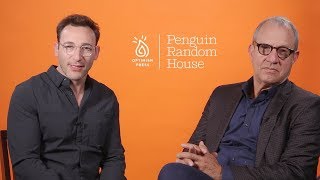
Simon Sinek and Adrian Zakheim announce Optimism Press, a new Penguin Random House imprint for books about imagining a better future. The first authors include Summer Rain Oaks on plant care and Bruce Deal on trust and community. They want to shift how people think about work and society.
Questions this video answers
17 years.
How to Make a Plant Love You.
About 600–700 plants (mentions '600' and 'up to 700').
Trust First.
City of Refuge (Atlanta, Georgia).
Chapters
Hi, I'm Simon Sinek and this is Adrian Zakheim. And we are the co publishers of a new imprint at Penguin Random House called Optimism Press. Adrian has been a publisher at Penguin Random House for how many years?
17 years.
17 years longer than I've been alive.
I've been an author with Penguin Random House for more than a decade now. So this is something that has been a long time in the making where we decided to start something new together. So we called this imprint that we've started Optimism Press. What is the reason that you wanted to call it Optimism Press?
Well, since this is a mission that you wanted to undertake in the beginning and since optimism, since you identify yourself as an optimist and optimism is clearly part of your mission in everything you do, it just seemed like the natural jumping off point for anything we were going to do together that had. That really was under your brand. So it wasn't a difficult question for me and I don't think it was for you either.
No, no, I think it's a perfect shelf.
Optimism is a perfect shelf for which all ideas that are either mine or ones that I fall in love with should sit on.
They should be first and foremost forward facing and have a confidence that the future is bright. And I think all of the ideas that we hope to share with the world will pay off the promise of optimism.
What is your vision for Optimism Press?
I imagine a world that does not yet exist. I imagine a world in which the vast majority of people wake up every single morning inspired, feel safe at work and return home fulfilled at the end of the day. I've completely devoted my life and career to trying to build this world. And one of the nice things about my journey is that I have the opportunity to meet some wonderful people who are contributing to building that world. They're running organizations, they're inside organizations, they're leaders, they're. There are all sorts of people and some of them have ideas that I believe are so significant that the rest of us need to know those ideas. And so for me, it was so exciting to have the opportunity to form my own imprint with Penguin Random House that we have an opportunity to introduce the rest of the world to the people. And the ideas that I think are essential pieces of the jigsaw puzzle to help build that vision.
And what gave you the idea to work with Penguin Random House in the first place?
Well, you and I. You've been my publisher for all my books and you and I have known each other for over 10 years now. Over a decade. And I think it's safe to say that we do good work together. You know, I could not have written any of my books without you. And it's become more than a business relationship. It's a true friendship and a true collaboration. And I trust you immensely, and I trust your judgment. And you are extremely good at taking good ideas and making them into great ideas. And so when I had this idea to form the imprint, there's, quite frankly, no one else I'd rather partner with to help do it, because we will find good ideas and we'll make them into great books.
And in fact, there were books before the imprint that we collaborated on. Not your books, but other writers, many of which were quite successful. We had fun doing it.
It's true. It's true. It's true. We have helped. We have done things together under different imprints, and it worked out well. So it was a good. We had precedence. This was low risk for you and me because we knew.
We knew we could work together.
So what was the reason you wanted to do an imprint with me?
Well, it goes back to the same question. We had worked together on books that you had found in your travels, and several of them had worked out really well and introduced me to some fantastic writers and thinkers. And so when you said, why don't we formulate a strategy together and do this in a sort of planned way instead of just by lucky accident, I jumped at the opportunity. It seemed like a fantastic chance to do some great publishing.
I think one of the things that people don't realize about our friendship is that a lot of the risks that we take aren't actually risks for us. I think you and I see a lot of things we do as no brainers. You know, we have common cause and we know how to work together. And I think other people, when we say we're gonna do this, people go, but we go, no, no, it'll be fine. And we've had it. It's worked out okay.
Knock on wood. Yeah.
So far, so good. So far, so good.
It's been fun. Simon, what do you hope to achieve with your new imprint?
I know that my ideas are a piece of a bigger jigsaw puzzle. My own books, this big vision that I have, I have a couple of the pieces. And so what I'm hoping is that these books, as we build them over the course of time, offer a road, a path.
A compass direction on how we actually build this world that's different from now. The goal is to give, not only to share the ideas that we stumble upon that we think are valuable, but also to give bigger platforms to our authors. I hope that they all have bigger and successful careers as. As speakers for this movement, for their own ideas. So I'm really hoping to give them a bigger, louder platform because certainly all the authors we've signed up so far, we've fallen in love with them and their ideas, and we want others to fall in love with them and their ideas, too.
Tell us about some of the authors that we've already signed up with for the list.
So the book that we are launching with is by Summer Rain Oaks. It's a book called how to make a Plant love you. I met Summer many, many years ago. We've been close friends for a while, and.
She'S just a powerhouse and an optimist and a wonderful human being. And she has this fantastic idea about how to raise plants, how to look after plants. She's been featured in the press multiple times because she has. I don't remember, hundreds, 600 plants in her New York City apartment, in her Brooklyn apartment. And I've been there.
I think it's up to 700.
It's up to 700. And it's an amazing place to visit. You know, you sort of move the vines out of the way to wash the dishes. You know, it's really fantastic. And she. These plants grow and thrive inside her New York City apartment. And it's because it's not by luck. It's because she understands the plants, and she understands where to put them and how to nurture them. And so we. The way we treat plants is we see a plant that we think is pretty, and we think, ooh, it would look nice over there on that coffee table. And we buy the plant, we put on the coffee table, and the plant dies. It's because we bought the plant that we wanted and put it where we wanted it. And the reality is you have to know where the plant wants to be, not where we want to put it. And you have to put it in the place where it's more likely to thrive. What I love about Summer's work is it's a metaphor, because we do that with people. We take somebody, we put them in the job that we want them to do, and then we get frustrated that they don't succeed. And so we move them and they don't succeed again. But we never actually think to ask, where would they naturally thrive? What environment, what position, what job should we put that person in so that they'll do well, though? Yes. On one level, Summer's book is actually a wonderful book for people who want to know more about how to look after plants. But there's really a very important and deep seated message contained within this book about how to treat people. Really, it's a big metaphor that if you learn how to take care of plants, how to make a plant love you, we're actually learning how to make people love you. How to make people fall in love with their jobs and each other. It's just a wonderful. And it's so full of depth. And she's such a talented writer.
I couldn't think of a better book that I'd rather introduce the world to our imprint with. We're also publishing a book by Bruce Deal called Trust First. As you know, Bruce runs an organization called City of Refuge in Atlanta, Georgia. And he. I don't know how to put it. He saves people, to put it mildly. Drug addicts and hookers and all these people that he takes on the street, and he gives them a second chance and he believes in them. And when you and I met Bruce, I think we were. The whole room was enamored with him. Because Bruce does something that I think few of us have the courage to do, which he. He gives people extreme trust. He takes somebody who the rest of society would say is unworthy of our trust, and he trusts them as if they were old friends or family. And what he has learned is that when you take the risk to trust people, they rise to the occasion and they're able to transform their lives, they're able to transform their path into one that is more positive for them and those around them. And though it is a remarkable story about trust and what Bruce is doing, it's an extreme version of a lesson I think we could all learn. I think few people, and I don't think we'd ever recommend for anybody to trust the way Bruce trusts. I think that's a whole other order of trust. But if we could learn to trust better than we do now, to take the risk to trust people more than we do, to learn from Bruce's example, I think it makes for better organizations and it makes for better collaboration. You know, better work environments, better cultures, better society, better friendships.
Talk about inspiring.
When I brought Bruce and Sommer to your attention, what's the reason that you also said that we have to do these books?
Well, you know, I examined our earliest conversations about this program, which was to give to. To seize an opportunity to identify voices that were inspiring in some way that inspired us to operate on a higher level in the Case of summer. Yes, as you said, it's about plans, but it's really about living life at a higher level and enhancing life. So that was an easy one. And then Bruce.
Not only does he trust people, but in his case, he put himself and his family and not in considerable risk for many years and became a living example of how trust transforms individuals, families, communities. And in the case of his hometown, Atlanta, whole cities. And he has been a tremendous change agent. So on every level, that book, and he himself personally, is a source of huge inspiration. And I think will. Will change lives.
I tell you what, I'm excited about this imprint, which a pattern is starting to form in the books that we're publishing and planning to publish. Many books are about the idea that the book is about. Clearly, you buy a book and it's about that. Whatever it says on the COVID it's about that. I mean, that's what most books are about. What I'm starting to see in our books is our books operate on multiple levels. There's the idea set that you'll read in the pages, and then there's an underlying idea as well.
I think all of our books seem to operate, have at least a duality.
At least.
At least a duality.
In which case, I think when we first said we're going to do a book about how to make a plant love you, people scratch their heads, our eyebrows raised. You're publishing a book about what? And here we are saying that the imprint exists to inspire a different kind of world. And this is. This is our first book, but I think that's correct. I think a lot of our books will be unsuspecting when we announce what they are, but they fit our strategy. And I think a lot of them will be metaphors, frankly, and have those dual messages. I'm really. Yeah, it's exciting.
Last question. How do you hope that Optimism Press will. Will change the way people think about business and life?
One of the things that I think all of the work that I'm interested in does is it challenges people's perspective of how they think the world works. And it forces people to examine their own preconceptions. And some of the things that we are even told are just the way the world works. And I'm hoping that in total, all of our work in some way shape or form challenges at first and then changes people's view of how the world works, but also what is possible.
I think if we read all those books, I think we will all be changed. We'll all be slightly different because of it. You know, everybody used to believe the world was flat at one point until it wasn't. And I'm hoping that this library that we'll produce will have a similar effect. That many preconceived notions on how to treat people or how the world works or how businesses work or how organizations work will be different 10 or 15 years from now, in part because of these books.
I hope so.
I hope so, too.
Yeah.
And then when I've done it, try it again, then you say, and why do you want to do it with me?
So.
Simon, wait. I'm not done laughing.
You're not done laughing?
It's hard for us to do serious, huh?
We don't do serious. No.
Okay. So, Simon, what is your vision for optimism? Press.
More from Clegg





AI Won't Tell You the Full Truth | Arthur Brooks + Simon Sinek | A Bit of Optimism Podcast



How To Make the Best Decision | Arthur Brooks and Simon Sinek | A Bit of Optimism


