Simon Sinek: Building Real Trust in Work + Life | Amsterdam Business Forum 2025 | Full Conversation
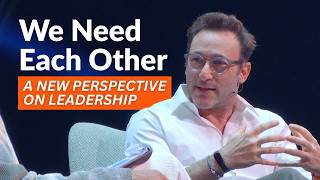
Simon Sinek argues that trust can't be bought or programmed, only earned through reciprocal relationships where people ask for help. Asking for help creates deeper bonds than offering it because it requires vulnerability. Real change needs leaders to develop human skills and model the behaviors they want to see.
Chapters
That was a great— Oh, you're getting whoops already. Do you get used to that?
It's wonderful.
Yeah?
I hope I never get used to it.
No? No.
I'm flattered every time.
Oh, beautiful. Well, listen, I want to start with getting your energy right because this is the last of a trip. You were previously in Oslo, right? And before that, Helsinki? You know many of the topics that have been talked about here on stage inside out, back to front, 360 degrees. How do you stay focused and avoid kind of drifting into autopilot?
It's one of the reasons I like doing this. You know, I gave the Start with Why speech for so long, and I love it, and I believed in it. But the reason I retired the talk, giving it, even though I still live my life based on it, is for that reason. I started having out-of-body experiences when I was on the stage where I was speaking and I was thinking about like my shopping and things like that. And it was just the strangest thing. And that's when I realized if I can't be fully present, then I shouldn't do it. And one of the reasons I love a conversation and I love talking to an audience is because I have no idea what you're going to say and I have no idea what they're going to say. And so I have no choice but to be be fully here.
Yeah. And for people in the audience, you know, who also maybe are reaching that point in their careers where they feel like they know what they're doing, they know their stuff, what are the signals they should be looking for and how do they fix them? Because I mean, do they just have conversations with other colleagues of theirs? How do they?
It's such a good question.
You know, I've seen this a lot more with senior people than junior people where they actually get bored.
They're quite bored with their careers, but secretly they don't want to talk about it because, you know, the first few deals that they tried to make were difficult and then they got good at it or producing a show or making a widget or whatever the thing is.
It was hard for a while and then they got good at it. It's one of the reasons they got senior. And a lot of them either just, they're on autopilot, they like the money so they don't want to make any change.
Or they're scared to change. But it's unbelievable how many people I meet who are bored.
I hate boredom. And so one of the things that I've done throughout my career is every time things got good, I sabotaged myself. And I made it difficult because I love a steep learning curve. And so when I started off in advertising, I started off and, you know, I got promoted and I did well. And then sort of things started to plateau, you know, like I was doing well. And I quit and tried something else.
And I always throw a wrench in it. Even the way I write books, I write my book completely differently each time. And, you know, and I want to try something different and new.
So after I wrote Start With Why, I think, I can't remember if I did Leaders Eat Last next, but then I wrote like a book based on a children's book just to mix it up for me, to challenge me if I could do something different.
So I'm a great believer that if somebody is at that point in their life, It doesn't have to necessarily be a career thing, but like challenge yourself to do something different. You don't have to bet the whole house, but try something new that you have to admit to your team, I have no idea how to do this. And that's what scares people. That's what scares people. We're choosing to do this and I have no idea what to do. But if you remember, the thrill of our early careers was that.
So I—
and it also makes you a good leader to be able to admit that.
But is that one of the conditions, as it were? So it's self-sabotage, but do it as part of a group, like tell your colleagues you're about to—
Yeah, I mean, look, I'm exaggerating by calling it sabotage because you're not destroying anything. But doing it with the group, telling everybody, because that's part of the fun, is relying on other people. And I think a lot of leaders are afraid to say, I don't know, or I'm stuck, or I made a mistake. And at the end of the day, what distinguishes the great leaders from the good leaders is their ability to say, I made a mistake, I don't know, I need help. And, you know, even just talking about it, you know, having to say to your team, I need help, like freaks people out.
Yeah.
But there's multiple ways to do it. When I talk about—
first of all, I no longer like the word vulnerability because it's—
Oh yeah. You see the energy change in the room.
I like the concept. I don't like the word.
Okay.
Because if I say to leaders, be vulnerable, you know, half would be like, absolutely, and half would be like, eh, because it sounds weak. The word sounds weak and nobody wants to be weak.
So a friend of mine uses the word and I really like it, available. Make yourself available.
Be available to admit when you make a mistake. Be available to admit that you need help or ask for help.
And we don't build trust with our teams by offering help. We build trust by asking for it. It's a great honor.
For someone to try something new and try something different.
And by the way, there's ways to admit it.
There's ways to be vulnerable. I'm not talking about sort of like being all depressed about it. You have to own the fact that you don't know something or that you're trying something new. So for example, you're not gonna come into a meeting and say, "I decided to try something new. I don't know how to do this. It could go in any direction." Don't do that. That's not a good idea. But you can walk into a meeting and go, "OK, I've decided to try something new. I have no idea how this is going to go, and it could go in any direction." You own it.
And it's the confidence that inspires the people. It's the confidence that you are walking into the unknown, and that's what inspires people to want to help and join you. If you're all depressed about it, they'll freak out.
And that's when you get to ask people and they'll raise their hand and jump in.
And what if you're a team member who wants a leader who is more like that, who is more challenging? How do you start that conversation?
What do you mean? Somebody who wants somebody who wants—
If you want your boss to be that person.
Oh, to be that person?
Yeah.
I mean, be the leader you wish you had. You know, unfortunately we can't get people to behave the way we want. You know, you can try, No number of anonymously sent books to your boss will make them change the kind of leader they are, but please keep trying. But I'm a great believer that you practice the leadership skills you wish that those around you had. And so if your boss is struggling to be available and admit mistakes and ask for help in private, Be empathetic, just as you would want your boss to be empathetic with you if you were struggling. And, you know, in private, go and see them and be like, hey, are you okay? I know there's a lot of pressure right now and I just want to check in on you. You know, be that leader.
But there will also be people who, yeah, drop the, you know, start with why in front of their bosses as well. But do you use your own techniques in your own life to kind of when you face challenges?
Yeah, of course.
I mean, talk me through, for instance, the Golden Circle, like how— when was the last time you kind of went into that thought process to overcome a challenge in your life?
So, so all of my work is semi-autobiographical, right? So all of my work is the result of me going through some sort of struggle. Start With Why was not an academic or commercial exercise. It was born out of pain. It was born out of loss of passion. My work was good, superficially my life was good, and I didn't want to wake up and go to work anymore, which is very embarrassing. And I hid it. I lied to people that everything was great when everything was not great. It was just superficially great. And it was that loss of passion that sent me on the journey to try and refine my passion. And what worked was I realized I knew what I did, I knew how I did it, but I didn't know why. It worked for me. When you read a great book or see a good movie, you tell your friends. And so I told my friends, and my friends started finding renewed passion in their work. And they said, they asked me if I would talk to their friends. And before you know it, I've got a career talking about this thing called Start With Why.
That wasn't the idea.
It just kept working.
Leaders Eat Last was the same thing. I was struggling with trust.
I, you know, especially when you start to have a little bit of success, All of a sudden, you know, I've got more friends and all my jokes are funnier. And I freaked out.
I had a couple of experiences where I thought somebody was my friend.
They weren't. They were working me for some sort of access or something or other. And it freaked me out. And simultaneously, I was spending a lot of time with the military and I would meet people who would give their lives for each other. They would give their lives for people they didn't even like. In business, we don't even like to give credit to somebody else. And I just wanted to be more— I wanted to spend time with people like that. And so I literally went to understand. I called in all these favors and traveled around to all these military bases just to understand it. I didn't expect it to be a book, but it kept working. And this idea of creating a circle of safety, psychological trust amongst a team, and where trust actually actually biologically comes from. It's a feeling.
Where does that feeling derive from biologically?
What are those chemicals?
Describe the feeling to me when you feel fully trusted by someone and when you trust in someone fully.
I think it's the same as love.
I think deep, deep, deep trust is the same as love, which is it's your willingness to bare your soul, but it's also your willingness to be able to hold space for another. I think it goes both ways, right? Yeah. I mean, I'll tell you a funny thing that I've—
I'm writing this book about friendship, right?
And here's a little observation that I've made that is kind of amazing. We all know that you need somebody in your life I hope everybody has somebody in their life, at least one person, hopefully more, that in your darkest times when you're depressed, when you're angry, when you need to vent, when you need to just get something off your chest, when you're not at your best, that you can call somebody and they can hold space for you. Like, I hope we have— I hope everybody has at least one of those people in their lives, right? What I found amazing is the number of people that we have in our lives that we can call to brag and say how great we are and I did something amazing is an even smaller number.
Think about that for a second. I can call more people with my problems than I can call to say, "I'm amazing." Why? And I think it's because— and it goes to this thing of trust, right? Which is to hold space for someone who's doing well and have no jealousy and have no envy, but to celebrate them like you're their parent, the pride, that is even more difficult.
And I was talking to a friend of mine, great human being, who's very successful, and I was telling him this observation that I've made, and he looks at me and goes, "Yeah, I have no one." He's done well in his life, and he keeps it all a secret to himself.
He never gets to say, "I made it big today." Is that just a part of us that also just withholds that? Like you feel a little bit— I know personally I find it difficult to take pride in my work and shout that out.
That's what I'm—
exactly.
Like you want to, like when something good happens, you want to tell somebody, right? And those friends that you should be able to tell, why is that number smaller than the number that we can feel that we can go to with problems? And I find that astonishing. So when you ask me what is trust? What is love? It's the person who is available for a range of emotions, for the full range of emotions that we have as human beings. Because if I can't open up about all of my life experience to someone, then they're only knowing half of me. They're only knowing me in dark times, but I want them to celebrate me like I want to celebrate them. Like, I was so honored. A friend of mine sold his business. He made a ton of money, more money than I'll ever see in my life. And he called me up to tell me. I was the first person he called. And I literally couldn't wipe the grin off my face.
I was so proud of him. And the honor, the honor—
That he called you.
That he called me. And that's— this is trust. This is love. It's not just the giving.
It's the ability that you're there for them. Another one of my friends, I hadn't talked to him in a while.
I didn't talk to him in a while, so I called him up and checked in.
I said, "How are you?" He goes, "I'm okay now." I'm like, "What do you mean you're okay now?" He goes, "Well, I've had a rough go of it for the past week or so, but I'm fine now." And I'm like, "Why didn't you call me?" He goes, "Well, you know, I didn't want to bother you." And my immediate reaction is— I can tell you exactly how it went. I said, "You're an asshole." which is not what you expect someone to say when they're telling you, you know, in their time of need. And I said, "How dare you deny me the honor of getting to sit in mud with you when you're going through a hard time? Like, how dare you deny me that honor? Like, being your friend is something I take seriously.
And I don't want to just be there for the good times, and I don't want to just be there for the fun. And I'll always call you when I'm struggling. I know you'll always be there for me, but do not deny me the honor of getting to do this I can see it means a lot to you.
Yeah.
It does mean a lot to me.
I'm just trying to figure out, because yeah, it also means a lot to me, like this sense of not being able to talk about openly about Pride. I'm still struggling to understand why won't we let that into our lives?
I think we feel guilty.
We feel guilty that we've done something good. Yeah.
And also worried that it might go away very quickly.
Yeah, maybe we think we're jinxing ourselves, or maybe we think that it's somehow gauche to— but we're not talking about taking a full-page ad in the newspaper saying, I'm great. We're talking about calling someone in private.
And it's okay to celebrate yourself.
I think it's important to celebrate yourself. It's one of the things that gives us confidence, right?
To say, I did it. I did okay, I did good. Because don't we want our kids to be able to celebrate themselves? Don't we want our colleagues to celebrate themselves? The people who we're leading, don't we want them to be able to be excited about their accomplishments so we can say, you did this, you're amazing? Like, we want our kids to be able to be okay with that. We don't want them to brag. We don't want them to think they're better than other people.
You know, a healthy ego is the belief that you're good. An unhealthy ego, arrogance, is the belief that you're better than others. And like I said, I think a healthy human being has a range of emotions and denying yourself the opportunity to express them is missing out.
And I guess it's also a moment to reevaluate, like, yeah, what are the things that I'm proud about and why, trying to understand really why has this meant so much for me. And it's probably often a way deeper It's got a deeper motivation, deeper reason than the superficial one you initially think of. Do you reevaluate, for instance, your why? Do you reevaluate your why? And if so, I mean, is this like a daily thing? Is it weekly? Is it—
Evaluate, no.
A why is fixed.
Our why is fully formed by the time we're mid to late teens, and that's it. You have one why for the rest of your life. And the reason is, is because we are all products of our upbringing.
You and I are the sum total of how we were raised.
You are the way you are because of the experiences you had, the people who were in your life when you were a kid. Mine was the same. And now, whether you're living in balance with that or not, whether you're making choices and decisions that amplify who you really are, that's a different conversation. That's when we talk about authenticity, right? Whether this is truly you or this is an act. But there's only one you, so I don't evaluate it.
At the same time, you know, we—
But I do check in with it.
We heard from Neil earlier and he mentioned this quote that he loves from, I believe, a podcaster called Richard Roll, like, "Mood follows action." So you can kind of train yourself if you start behaving, if you create a new behavioral pattern. And yeah, that will change your mood and maybe even ultimately, why not, like the values.
I mean, you're also talking about why it's important to have a sense of humor, right? No one can be angry or sad when you're smiling or laughing. You can't.
It's just impossible.
And I think sense of humor is underrated as a leadership skill. Like in a hard time and a stressful time to be able to crack a joke. And make people smile, it's very hard to be angry and it's very hard to be sad when you're smiling.
And so that's true.
Yeah. If even living in your why, it can wear you down, right? It can, you can just, you know what you want, it's fixed. I'm just wondering, how do you keep optimism alive without crossing the line into like, into LinkedIn sunshine mode where everything is perfect.
It's a good point.
I think we have to first define what optimism is, right? Optimism is not blind positivity. It's not blind positivity.
It's not everything's great, everything's fine.
You know, the company's struggling, your team is struggling, and you're like, you think you have to be positive and sunshine because that's what's good for the team.
But the reality is that's That can be quite toxic and it can actually make people feel worse.
Optimism is the undying belief that the future is bright, but it is not naive and it can accept darkness in the now. Both in my personal life and my professional life, I can walk into the team and say, "Okay, this is the hardest thing we're ever going to have to deal with. It's easily the most difficult thing I've ever had to deal with." I do not know how to get through it. It's going to be hard. It's a rough time right now, but I know one thing and one thing for sure. If we stick together and we work together and we take care of each other, we will come through this and we will get through this and be even stronger than we are now. That's optimism.
And what are the signals that— I mean, because it's such a fine line to balance, especially if you're a leader of a team, like, how do you know if if this is healthy optimism or toxic positivity? Are there ingredients to that?
I think toxic positivity, you don't even sometimes believe it yourself. I think you're putting on an act. Again, I can be in a dark place and still believe I'll get through it. Like, it's okay. Now, this requires one caveat. None of us, a total of zero people on the planet, of us are strong enough to do what we're talking about alone.
It's too difficult.
This thing called life, this thing called leadership, it's just— none of us is that smart or that strong to do it alone, which is one of the reasons I'm so obsessed about friendship right now, which is this idea of having courage to be optimistic, to be able to talk about difficulty, but to stay positive about the future. The courage to be available emotionally, the courage to be there for someone, the courage to ask for help. None of us have that internal fortitude.
Courage is external. The reason a world-famous trapeze artist has the courage to try a brand new death-defying act for the first time, it's because of the net. It's the net that gave him the courage. The reason you have the courage to jump out of a perfectly good airplane It's the parachute on your back. It's the external thing that gives you the courage. All we need is one person in our life, just one, who says, "I believe in you. I got you. And if this whole thing goes sideways, I will still be there for you." And that gives you the strength to do whatever needs to be done.
That's why it's important to talk about all the things you're going through, the good and the bad, because you need those people, you need to build that trust, we need to build that trust so that somebody can be there for us. And by the way, I know like we're not just talking about personal lives, this is what we're talking about is solid leadership, right? I want my team to have the courage to do difficult things. I want them to have the courage to say no to things that put us out of integrity.
I want them to have the courage to speak up and speak out to me, to somebody on the team.
I want the—
I have the courage to put their ideas forward.
And the only way that that's going to happen is if I make them feel that I have their back when things go wrong.
And pushing further on that, you've talked a little bit about 8 Minutes and the importance of how that's the kind of technique that you use. Maybe you can elaborate a little bit on that.
It's a magical story. My friend Maria is my best friend, one of my best friends, and I was at her place hanging out, you know, and I said, "How have you been?" Similar to the other story, she goes, "Last week was really bad." I said, "Why didn't you call me?" She goes, "I did." I'm like, "No, you didn't." She's like, "Yeah, I texted you a whole bunch of times." No, you didn't. And so I pull up my phone to prove to her that she never reached out to me. And, you know, I have a whole bunch of texts from her. Hey, how are you? What are you doing?
I'm like, how do I know that that's a cry for help? That's every other text you ever send me. And so she read an article.
She read an article that there was a study done that human beings only need 8 minutes of attention from somebody to feel not alone. And so we came up with a code. We came up with a code with each other, which is when one of us really needs each other, the other, we're really in a hard place, you text each other, "Do you have 8 minutes?" And that just means I really need you. And anybody can step out of a meeting for 8 minutes.
And it doesn't mean you're gonna hold the whole space, you'll get in touch with them later.
And the number of times we don't do this because I'm like, "Oh, I need an hour." You don't have an hour, and then it goes and goes, and we don't wanna burden someone. No one feels guilty asking for 8 minutes. There's no burden, right? And it works.
And it doesn't happen often.
It's something you reserve, but the couple of times I've had that text—
I mean, that's the thing. It's something you reserve. I can already see myself thinking, like analyzing my call for help or 8 minutes thinking, "No, no, no, this isn't an 8-minute worthy." text or whatever. Yeah. How does that— yeah, it's a bit like the— how does that translate to the workplace though? Because leaders, I feel like there is a pressure for leaders to constantly be available emotionally as well for their colleagues. So is that a technique that you think could work?
I've never thought about it in a work context. I mean, maybe if there's an emergency, but that should never come up. I mean, unless you're like working in the emergency room, you know, none of us, very few of us are doing anything that, you know—
Life or death.
Life or death. And so I would hope my— look, if somebody at work came to— me with that, I would respond, but the question it would raise for me is where are their friends? That's the question it would raise for me. It would make me— I would deal with it, but I'd be even more worried about them.
And tell me a little bit about the focus on friends for your book. Where did that come from? As someone who has focused so much on lessons for the business community, it's not It came from a conversation with my friend Will Godera, who he's the author of Unreasonable Hospitality.
Great book, by the way.
We realized that there's an entire industry to help people be better leaders.
I'm a part of it.
There's an entire industry to help people find love, right? And there's precious little about how to be a friend.
And if you think about it, you know, you'll struggle to be a leader if you don't have a friend.
You'll struggle to find love if you don't have a friend, because when things go sideways at work or in your relationship, like, you have to call someone for advice. And that should be a friend, or it should include a friend at the very minimum. And then you look at the state of the world, you know, with rising levels of anxiety and depression, in extreme cases, suicide. Even the obsession with longevity. Friendship literally fixes all those things. Friendship is the ultimate biohack. But very few of us are actually very good at being friends, right? Like if I ask everybody, "Are you a good friend?" Most people say yes. And let's peel the onion one layer. Would you cancel on a friend because you have a meeting?
Would you cancel on a meeting because a friend needs you?
"Oh, but my friends will understand," right? We're pretty shitty friends, right? Like if you have a really bad row with your loved one, divorce is not the first reaction. You'll go for couples counseling and you'll try and work through it. And it might end up as a breakup, but you really try to make it through the relationship and you seek counsel, right?
If you have a problem with a colleague or a boss or somebody who, who you're responsible for at work, you don't immediately quit or get fired.
That's not what happens. There's a coach and there's a conversation and you work through tension. The number of friendships that I've seen, friendships that have, you know, over a decade and they consider themselves good best friends, one bad fight, one violation of trust, friendship's gone. Why are there no friendship therapists?
Right?
Why are there no friendship coaches? Why is nobody there to help us manage through friendship?
And what's your answer to that?
We have to learn to be friends.
Well, why haven't we put enough focus on friendships?
I think we take it for granted. I think we take our friends for granted because for all the reasons I said before, which is, oh, but my friends will understand.
There's assumptions that we make that, you know, I can't rely that I'll always have my job because I'm not in total control of it. I cannot rely that I'll always have my relationship. I have to bring my A-game because that's the deal and everybody knows it because the industry taught me that.
But I think we just don't think of friends that way. And also there's a range of friends, right? You have friends that are just fun.
You're not going to go to them with your problems and that's fine. They're just fun. But I think when you start having deep meaningful relationships and that's what's lacking. I'm not talking about the silly fun ones. I'm talking about the deep meaningful relationships.
And then I've even started asking myself, and like, who am I spending time with? You know, I have a limited amount of time in a day, I have a limited of time in a lifetime. Am I spending my time with people who teach me something, who inspire me, who celebrate me, who make me feel like I'm the best version of myself? Who give me a space to be my broken and best version of myself?
Like, am I spending time with those friends or am I spending time with friends because it's a warm body and I get to watch a movie with them because I'm too afraid to be alone? You know?
And I started questioning the people that I was— some of the people I was spending time with.
And I realized I didn't—
I needed to work on those skills.
And you've built in some hacks, haven't you, in order to make sure that you do spend quality time with the right type of friends?
Well, I mean—
Reserving times of the week, for instance, or—
Well, I think just being disciplined, you know, yeses and nos. You know, I think we all say yes to people because it sounds like fun. I never enjoy hanging out with them, but whatever. You know, like we—
like if we're really honest with ourselves, We kind of all have a few friends like that.
By the way, we're that friend to somebody else too.
Yeah.
Like we call up and be like, wanna? And they're like, eh, I guess. Yeah, sure. You know, like it's not a judgmental thing. Like I'm that to other people. You know, they should spend less time with me. They should say no.
Hey, I wanna shift focus a little bit and talk about, talk about, the different generations, because, you know, we had Dr. Eliza Philby on earlier, and she was talking about the different behaviors we can expect from Boomers, Gen X, Millennials, and Gen Z. What is your take on how those generations can best work together in, in a team, in, in a workplace?
So the question It's all about empathy, right? We bring our own story to work, and that story is a lens, and we evaluate everybody else that we are with through our lens. And what we need to do, doesn't mean you have to agree with people, but it does mean you have to understand where it comes from.
We have all these labels and judgments, especially of younger generations, and I guess the younger generations have it of us. Again, based on that lens. But I'll give you an example. So when I was young in my career, if you wanted a raise or a promotion, the way you got it was you work really, really hard, you accomplish something, you go to your boss and be like, look what I did, I deserve a raise or a bonus. That was how things were done. And kids now will come to me and be like, "Pay me more and you'll see what I can do." And I'm like, "No. Like, shouldn't you do something first?" And we label that as entitlement, because it sure sounds like it. Right?
So the question I'm asking is, where did that come from? That's the empathy. Where did that come from?
And then you take one step back and be like, all right, let's look at how capitalism and business and leadership has sort of progressed over the past 20, 30 years, 30, 40 years, right? And you know, you start to see a pattern where in the '80s and '90s, this Jack Welch, GE rise of short-termism.
You start to see short-termism become normalized, like quarterly results are the thing. You start to see the rise of shareholder supremacy, where we now prioritize the wants, needs, and desires of a disinterested external constituency over a customer or an employee. That's now normal.
We— and by the way, we used to think private companies were better than public companies because they didn't have the same pressure. The number of companies that are venture-backed, you now have a disinterested external who's putting pressure on you so they can meet their financial goals, not yours.
Right?
So I think the pressure is just as bad in a lot of private companies as well.
We start to see mass layoffs where the company is profitable, but we want it to be more profitable. So you get to lose your job. Right? Like that is now normal. Like we don't even think that's shocking. And so now you, you look at a young generation who's entering the workforce And I guarantee you, close to 100% of them, one of their parents was laid off or one of their friend's parents was laid off through no fault of their own.
It's not a meritocracy.
The company missed its annual projections.
They did fine. They just missed the number and somebody lost their job.
So what they've seen is the transition where it used to be the company was loyal to you and you were loyal to the company. You worked a bunch of years, you got the proverbial gold watch. There's now an entire generation when I talk about the gold watch, they have no idea what I'm talking about, right?
Some of you have no idea when I say gold watch, right? And I'm not going to tell you. You work a lot of years and they give you a gold watch and say, thanks for working for a lot of years. They've grown up now in a world that demands loyalty, but offers none.
And so now you look at their behavior and they're thinking to themselves, right, this is not, you know, the cultural response is, well, the company's gonna offer me nothing. I might work my brains out and at the end of the year, I'm just gonna get laid off anyway.
Might as well cash in early. Might as well get that money up front because there's no guarantees.
And they're right. That is the correct response.
For the business world that we live in today.
And so that's what I mean by empathy. Because if you don't ask, where did that come from? And you don't like peel the onion a little bit, what you'll do is you'll call them entitled, you'll treat them as entitled, you will put all these barriers up and try and teach them your way, which is not appropriate for the times we live in. And so once you know that, you say, Got it.
They're afraid of losing a job through no fault of their own. Okay. So the next time the company goes through a really difficult time, I'm gonna make sure that they feel safe.
The next time they screw up, I'm gonna say, okay, try again instead of making them afraid that they're gonna lose their job. And I have to earn and prove to them that it's okay. And eventually, to the point you made before, eventually the feeling will reverse.
Reciprocate. And the expectation is to do that for each generation. It's almost like you need in-house psychologists.
I mean, you want empathy up the chain of command as well.
You want the younger generation to have empathy for the older, wiser, who've seen a few of these things before. But that's—
I mean, that would be nice if you could get it.
I think the burden is higher on the older ones 'cause you should know better.
Yeah, and it's inevitable to talk about AI in the workplace, but in this context, what you're describing is a very kind of, yeah, human-centric approach to understanding the motivations and behaviors of these different generations and seeing how that can improve the workplace. But we're embracing AI more and more. So is it, you know, is the future pretty bleak that we're not gonna get that level of understanding?
It's a choice.
It's a choice.
Like, if you become a leader, like when you were junior in your career, somebody taught you how to do your job. You either went to school for it, if you're an accountant or something like that, or the company gave you lots of training.
Why did they give you that training?
Because they want you to be good at your job.
That's why they gave you the training.
They're not idiots. They don't expect you to know how to do it if they didn't show you how to do it. But they'll eventually promote you and they give you no training.
You get promoted to a position where you're now responsible for people who do the job you used to do, but nobody teaches that. And so the choice to become a leader means I will choose to learn this new skill that's difficult, right? When you enter a relationship, You have to make choices to learn how to listen. You have to make, you have to, you have to do that.
And so the AI conversation is, well, what kind of person do you want to be? What kind of leader do you want to be? What kind of partner do you want to be? What choice are you going to make? And I'll give you an example. Let's say you have a fight with someone. I don't care if it's at work or at home, right? You have a fight with your girlfriend, right?
And you feel bad and you want to put it right.
And so you go to ChatGPT and you say, here's what happened. I want to take responsibility.
What should I say to repair this relationship?
Have you read my phone?
And careful. And ChatGPT gives you a perfect answer and you don't memorize it, but you got it.
You got the gist, right?
And you go to your partner and say, and you give what ChatGPT told you to say.
And she goes, thank you. That is, thank you so much. Yes, I, yes. Did you get that from ChatGPT? And if you say yes, you're back to being in a fight again.
Yeah.
Because you weren't sincere. You weren't sincere. That doesn't mean we can't use ChatGPT, right?
If you have a fight, you have a fight with somebody at work or you have a fight with your partner, you should get advice.
You should get advice from your friends.
If you have a therapist or a coach, you should get advice from them.
And you take all the advice from people and you form a strategy and you go to your partner and you fumble and bumble and say, "I wanna put this right." And it comes from the heart. And it's that that makes somebody fall in love with you or trust you. It's that you actually mean it. It's the sincerity. It's not that you got the words right. It's that it came from you, from the heart, not from the head.
Right?
And we're in a society right now that is so obsessed with the net result, the end result. Like, I wanna write the perfect apology. I wanna write the perfect press release. I wanna write the perfect blog post. You know, we're all wearing metrics devices and like we're all so obsessed with the metric and the end result that we've forgotten the value of the process. We've forgotten the value of the heart. It's not just the head.
Right?
So for example, could AI write my next book? 100% it could.
There's enough out there that it could take source material from. I could tell it all my thinking and it'll bang out a book.
I have no doubt, right?
I've tried it with articles. It's scary good and getting better.
But here's something I know. Here's something I know for a fact.
I am—
smarter, I am a better problem solver, I am much better at pattern recognition, I'm better at understanding the logic of an argument because—
not because books exist with my ideas in them, it's because I wrote them. It's because I struggled to organize the thoughts. It's because I had sleepless nights trying to solve problems. I was having brainstorming sessions with a million people to help me. I had to ask for help. It was that I wrote it. The struggle of the process is what made me better. And that's why I'm talking about the example with the partner, which is it's the process, it's the struggle of the process that makes you a better partner, a better boss, and better employee, that you're choosing to be a better version of yourself. Now, AI can absolutely live alongside. It can be one of the resources you call upon. But I would like to learn the skill, and I would like others to learn the skill too. I don't want them to just say the perfect thing. I want them to know why they're choosing those words.
Yeah, the discomfort of thought, of analysis.
Yeah.
And so it's just a choice. It's just a choice.
But I mean, at the same time, Peter, in our opening talk, Peter Hinton told us about one of the most popular AI apps that was scanning kids' homework books. And giving them all the solutions. You know, our whole system is still wired towards speed and output. So are you genuinely optimistic that we're going to—
You know what I'm going to say.
Yeah, you are optimistic.
Yeah, yeah, I am genuinely optimistic.
And the reason is, is because engineers always forget one thing every time.
Every single time they forget one thing. They don't know how people will react. They always forget that they're a human being.
People want shortcuts.
They always— they never fully appreciate the full uses of all of these technologies that they invent.
They always make predictions and they almost always get all those predictions wrong because they always forget the human element, the fragility and frailty of human beings. And sometimes, and by the way, it's blessings and curses because you're talking about it, the pressure. So again, let's ask why.
Why are kids looking for shortcuts beyond the fact that they're kids and they hate doing homework, right?
Well, what pressure do we put on them? Are we putting pressure on them to get the grade or are we putting pressure on them to learn? Those are different things. Well, now let's look at the capitalism that we've been living under for the last 40 years.
Are we—
do we have pressure put on us to hit the quarterly numbers, or do we have pressure put on us to help build a company that will last forever? Those are very different things. And so maybe our school system, maybe society at large is simply responding to the environment we're in. Look at politics right now. Politics is becoming just a reflection. And I think we forget the impact of the business world because almost everything is business. —right? And America is to blame, because so goes America, so goes the world. And America sort of experimented with and perfected the short-term form of— Jack Welch, Milton Friedman, these are American CEOs, American economists. And because America got super, super wealthy, the rest of the world went, well, it's working for them. I actually think this is an opportunity for Europe.
I actually think this is an opportunity for Europe, because I know, I know when I talk to people here, the humanity, the lifestyle.
Like, Europeans understand that lifestyle is more important than the amount of money you make, right?
Like, the foundations are richer in Europe. And I think the capitalism that we have right now is so broken, and we're seeing the ripple effects, and we're talking about some of them, that there's an opportunity to offer an alternative. And by the way, I'm a diehard capitalist. I like Adam Smith capitalism, the capitalism that did actually contribute to America becoming what it became. It's only the past 40 years that it's been corrupted and short-termism and all the other stuff we're talking about. And I think Europe has an opportunity to teach the world a better longer-term—
But isn't it Adam Smith capitalism that's led to things like me feeling like a lot of my self-worth derives from how on— in demand my time is, which is not a very healthy place to be.
Again, these are choices, right? And again, I take cues from Europeans.
You know, in America you get 2 weeks holiday. That's it. Crazy. And a lot of people don't take it because of fear that if I do, that it'll hurt my job or hurt my promotability. And so even if they do go away, they're going to be on the computer the whole time working. Yeah. Americans, The country of France shuts down in the month of August. I know, right? One French person in the audience. One person celebrating a month worth of holiday.
What do you get, 5 weeks, 4 weeks?
It's pretty common, 25 days here, right?
I mean, that's epic, and you take it. You go away.
I think there's something that Europeans understand that I think is Anyway, just food for thought. I think there's fertile soil here, or not.
Okay, we're going to open it up to the audience at this point. We have a question right there. Put some hands up. Do we have questions on Menti?
How come nobody sat in the front row? Look, they're all reserved.
They're scared. Yeah, good question. Okay, I've got a microphone here. Perhaps you can stand up. Oh, okay. Let me go into the audience. Okay, I had a question here. I've got one there. And whoa. Okay, let's take this one first. Yeah, come to you. I'll hold it.
Hey Simon, it's great to meet you again. In July we met on stage.
Were you the guy who was hiding in my bushes outside my house?
We covered that.
Nice to meet you again too. Go for it.
What's your question?
Yeah, so my question is I'm the proud uncle of two I have two nieces. Floor just turned 2 last week. Jorine, who is now 4 years old, she does start with why, but she's actually even better at sticking to why. So why, why, why. And so I was wondering, are young children the masters of why? And do we as adults lose it over time?
Oh yes, so, so yes. The simple answer is of course.
Kids want to know how the world works. They have no judgment of each other. They're completely nonjudgmental.
It's kind of magical.
And there is something that happens when we become older that we lose it. I know some of the biology around it as to why it happens. But yeah, I mean, and if you think about sort of our favorite people that inspire us, they have a childlike quality to them. They either have a childlike curiosity to them or a childlike wonder. Or they just sort of speak their mind. And we find it sort of endearing because the adults in us, like, we sometimes hold back. Not the Dutch, they tell you. The Dutch tell you. But yeah, I think you're right. I think we can learn a lot from kids.
Yes. Okay, we've got a question over here. Do you want to stand up? What's your name? My name is Iris.
I'm currently dealing with a lot of people in many global companies that go through enormous burnout crisis. Yeah. I'm just wondering, with all the things that you were talking about, um, the importance of friendship, of a support network, the importance of authentic leadership and connecting and having true conversations, how do you see that, you know, being solved in the workplace? Yeah. Because a lot of these Gen Zs, they are, they are young, they don't establish a good relationship with their leader and they don't have real true friends that they can connect to. Again, overgeneralizing, but just—
Yeah, no, I think you're— the generalization is fair.
You know, I've talked to a lot of young people and they will admit to me that they like their friends, they have fun with their friends, but they would never go to their friends in time of struggle. And they would admit that they wouldn't be surprised if their friends canceled on them because they got a better offer from someone else. Which, you know, is an amazing thing to hear. Sad.
And I think one of the mistakes that we've made is we've confused workload with burnout.
Well, it's related to some degree, but, you know, you can work with passion and work long hours, and you can work long hours with no passion, and you're more likely to burn out. Because when you're working with passion, working those long hours is invigorating. And I got this wrong for many years. I was very strict in my company that I didn't want anybody to work after hours and I didn't want anybody to work on weekends because I believed in balance and blah, blah, blah. And a company I did some work with called Watercooler, they gave me some data that showed— because what the company is, they predict burnout. That's what they do.
And they showed me this data, which was amazing.
And basically, people who never work on weekends and never work in the evenings, very, very high risk of burnout or flight risk because they're bored and not very engaged. So very high flight risk, right? People who work too many nights and too many weekends, very high rate of burnout or flight risk because they're overdoing it.
But people who occasionally work nights and weekends are actually very, very happy, and they're choosing to work those nights and weekends because they care. Because they care. And I immediately got it wrong. So now I don't mind if people work nights and weekends.
I monitor how often they're working nights and weekends. That's number one.
But also I check in with people and we have to do that.
Are you okay? How are you feeling?
And I think the rapport of being able to check in with each other, this is as much as true with young people in friendship as it is with work.
Are you okay? How are you? is a question we very, very rarely answer. And I'll leave with one final thought. A friend of mine, George Flynn, who retired as a 3-star general in the Marine Corps, he said that his test of leadership is if somebody asks you, "Are you okay?" and actually cares about the answer. That's a leader.
Okay. Thanks very much, Simon. Another question here.
Yeah, hello. My name is Maya. I'm living in Austria. I'm Dutch, actually, and I used to be restaurant manager, and I struggled with this situation that I was happily finally becoming a leader and wanted to give my team the opportunity to be creative and put in their thoughts, and I ended up with they couldn't handle that.
You ended up with what?
The creativity. They couldn't handle the opportunity for creativity I gave them to give in their thoughts on the situations we had to face. And they, thought I didn't know how to job and they didn't listen to me anymore. So I was wondering what could have been the preparation steps to set up the team for this freedom of thoughts?
Oh, okay. Yeah.
All right. So I hope everybody's okay, but this is going to go for another hour. All right. You're very brave to ask that question. In an audience. Without knowing the details, I'm going to just make up an answer because I don't know the specific circumstances.
But it sounds like things I've heard before, so I caution that my answer may not apply to you.
But—
I've seen this before.
My team doesn't get it. They didn't give me anything creative. They're not up for the challenge. They've disappointed me again. That's not the case, right, with you? No. So then I'm completely misunderstanding the question. I'll give my answer anyway. And we can check in— I can check in with you later and find the real circumstance. What I found out, just as an aside, is that, look, the only common factor in all my failed relationships is me, right? And I think that in business we sometimes forget that we have an impact in the teams and the people with whom we work. And when I hear people say, "Nobody on my team gets it, the company's direction is wrong, all I do, I have to fix everything," The only person I can trust is myself. I'm starting to think like maybe it's not the team, maybe it's not the company, maybe it's you. And that's a very hard thing for people to come to terms with because it's much easier to create a narrative that everybody else is getting it wrong because it's very hard to say I'm getting it wrong. So, I raise that. That may not be for you, but I've seen that pattern. All right.
Yeah, we have a question here. Simon, hello. My name is Andre. I do a lot of some public speaking, not at this scale, not near this, but I quote you a lot and I sound very smart. So first of all, thank you so much for writing all your books. Thank you. Give people credit though. They think it's still me. So thank you.
I want to say that. My lawyers will be in touch.
Um, just want to say, um, I think the book that had the biggest impact on my life that you wrote was actually not Start With Why and was The Infinite Game. Um, massive, massive change in my career, but the way I think. When I'm a South African, I live in London, so when I feel a little bit down, I switch on my phone and I go to your, um, A Bit of Optimism podcast. I need a bit of Simon. So here's my question, and it's a personal question to you.
Where do you get your inspiration from?
In other words, who is your Simon Sinek?
So my sister and I are insanely close. We moved around the world as kids. And so the only common, the only common people we had in our lives were each other because we kept losing our friends. Right. 'cause we kept moving, and this is obviously pre-internet, pre-FaceTime. And so as a result, she and I are extremely close. So, and we're insanely honest with each other. We work together as well. And so we'll be in a meeting, and at the end of the meeting, one of us will call the other person and be like, you can't talk to people like that. You know? Like, we are like, and it's an amazing thing. So my sister inspires me, but I also, I love, I love people who serve. And if you ask me like where I get inspiration from, I love people, I love artists, and I love people in the military. They're the same person. They're the same person. Both of them, whatever they do, for whatever reason they started, for some reason it becomes a calling. Whether it started that way or not, it becomes a calling. Both of them know that they're not going to get rich doing what they're doing. Both of them have to sacrifice tremendously to do the thing that they do. And both of them, 100% of their work product is for someone else. And so my favorite people to spend time with are my friends that I've made over the years in the military and artists. They're the best people in the world. They inspire me. I don't have that level of grit like they have. I wish I did. Thanks very much, Simon.
Hi, Simon.
My name is Sylvia. I forgot my previous question really because of the nerves, but I had another question.
Can we— can you turn up the audience mic a little bit, please?
Yeah.
I had another question. It was related to the previous, but I forgot it because of the nerves now. So I'm so sorry.
You can't remember your question.
But can I ask another question that I also—
Yeah, I like that. I forgot my question because of my nerves, but can I ask another question?
Simon, I buy leaders that I work with your book Together Is Better.
Thank you. I love that book. Thank you.
And my question in the app was, I really felt you before when you were talking to him, and then I sent in the app, can I give you a hug. So maybe we can do that afterwards.
Okay, maybe we can do that afterwards, but thank you very much. Okay, let's go to some non-physical related questions over here. Let's go to this lady. Okay, lovely. What is your name and, um, your organization?
My name is Jolene. Um, I have a question. As a person, I'm try to be positive, and I hope I am an optimistic leader, but sometimes I really struggle with skeptic people, but I truly want to understand their side of the vision. But how, as an optimistic leader, can you inspire them or make it work together?
Yeah, it's a very, very easy answer. Don't worry about it.
They're on their journey.
They're on their journey, and you can't convince them to change. The only thing you can do is show up consistently, consistently. So I know a guy, he works at a company that I love, this company Barry-Wehmiller, which I've written about in Leaders Eat Last. And when Barry-Wehmiller came in with this amazing new leadership stuff, And like they believed in people and trusted people. And it was like everything that I talk about, this company does. It's wonderful. And this company showed up, they bought his company, and he thought it was all stupid and he hated it. And he just wants to work hard. He takes pride in his work. Leave me alone. I don't need any of your mushy, mushy stuff.
Just leave me alone.
And he showed up to work every day. The way he described it is angry, not depressed, Just angry.
He only trusted like a small handful of people in the world.
He didn't trust or like anybody at work.
He just wants to come to work, do his job, go home, leave me alone.
Your stuff is stupid. And they just consistently would come to him and say, "Morning, morning." And he would say, "I don't need it." "Morning." And over time, they just never stopped believing in him. They just continued doing it, treated him no matter what. They never tried to convince him, they never told him he was wrong, they never yelled at him, they were just consistent. And then at some point, the company that offers listening classes, communications classes, and he thought, "I'll give it a try, I'll see what this is all about." And it absolutely transformed him. He learned so much from that class, he let down his guard, and he realized, "I've been angry at home, I've been angry at work, I'm an angry person, I don't want to be angry anymore." And he is an amazing human being, but it took him years.
And so, don't worry about it, they're on their journey. We don't know what their story is, we don't know what they've gone through.
It's not for us to ask, it's just for us to be there for them with consistency, And they'll either come or they won't. But it's not your burden. It's not your burden.
I'm Rachel from the UK. I work in healthcare and I'm— we're recognizing burnout at quite high levels in healthcare. And when I look to Christina Maslach's work and we talk about the canary and the mine, we've got a lot of canaries dropping. Yeah. But our leaders really aren't looking to our environment. Yep. To try and improve that. Yep. So it reflects very much back on us as the healthcare professionals. Yep. And we don't like the word resilience because if we aren't resilient and we're burning out, It makes us feel weak. How do we encourage our leaders to look at our environment and support us better, ideally preventing burnout?
Yeah. So I know US healthcare better.
I'm going to assume it's something similar. I have a few friends who are emergency room nurses, A&E nurses, and they have told me that if you work in an ER, there's a very high rate of alcoholism. You never ever ask for help. You never admit weakness because it's just culturally not acceptable. And they said that when we went into lockdown during COVID the drinking just went up. That's all that happened is the way they cope with stress is unhealthily. And the— and leadership, as you said, that does nothing to support. One of the things that I learned in the US military, and they learned this through Afghanistan and Iraq, that the amount of stress that their doctors and nurses had to deal with, with combat medicine, that they realized that the rate of burnout and unhealthy ways of dealing with stress was too high, so they developed entire teams of mental health professionals who deploy not for the patients, but for the doctors and the nurses. That's literally their job, is to protect the mental health of the doctors and nurses. That's their entire job. And when COVID happened, I called up the Surgeon General of the Air Force.
I said, hey, you know those mental health units that you have?
What are they doing now? They said nothing because we're not deployed. I said, can we deploy them domestically?
Can we send them to our hospitals to look after our doctors and nurses? And there's a whole rigmarole and they're not legally allowed to, blah, blah, blah. But then I started asking the question is, why don't hospitals have mental health professionals that are there for the doctors and nurses? That's their sole job.
And we know the answer. It's because it costs money. And it does.
If I can't bill it to the insurance or to the state, then I'm not going to spend the money.
And what the leaders of hospitals don't understand is it's going to cost you way more in the long term than this thing in the short term. So I think one of the things we have to start doing, and I'll do my part if you do your part, is we have to talk about it.
We have to make that which is implicit explicit.
We have to have doctors and nurses to have the courage to say, I'm struggling. I don't have the strength for this pace. And I know nobody else does, because all it takes is one person to say it, and you get sort of like one other person goes, "Me too," you know? But nobody will unless somebody goes first. And so I can tell the stories about these needs for these units, and they exist, and there's models, and we can copy the models, we don't even have to start from scratch. But I also need people to say, "We need help." And it starts with one. So it's going to take both of us, but we have to make that which is implicit explicit.
5 minutes left, I'm afraid, and there's also a couple of questions from Menti. So I'm going to take this one here. Short question.
Want to do one from over here on this side?
I've been standing next to this guy for like the last 8 minutes. It would be awful to walk away from him.
This guy. Hi, Simon. I'm Simon. I have a question regarding friendship. You said that that you've got some friends— your friendship sounds very balanced, all the friendships you have, because you can talk either positive things or negative things that happen in their life. I'm struggling with what you call deep meaningful relationships with friends because on one hand I have friends that are just— I've sort of a bragging relationship with, and on the other hand I have friends that's almost a whining topics that we discuss. I know I'm the common denominator, but I struggle with both friendships or friend groups even where it costs me energy as I'm trying to steer the draggers towards being vulnerable and the naggers towards being more positive and optimistic. Yeah. I'm not having fun in my friendships.
I love you, man. That is true.
Okay, thanks very much. So the question is, what am I doing wrong?
So you want to try something really, really, really, really difficult?
Call up one of them, or do it over dinner, you know, do it in person. Don't do it over text, please. And have this conversation. Can I have an uncomfortable conversation with you? And let them say yes, because they get to volunteer to be in a difficult space, right? Never spring it on somebody. Don't just like, otherwise it's coming in hot, right? Can I have an uncomfortable conversation with you? They'll say yes. And you go, I struggle in this friendship, if I'm honest. I like you, we have, you know, I enjoy the time, but I'm not sure I'm getting a lot out of this, and I don't know how you feel about this friendship.
And so really, I'm asking you to tell me what this friendship means to you, if anything, and I'm okay if it means nothing, but I want to know from you. And the reason I'm having this conversation with you is because I want this friendship to be better.
And I know "Look, if I'm struggling, I have to believe that you're not having fun either, because it's never gonna be one of us loves it and the other one hates it. That's never gonna be the case. And so if I'm feeling uncomfortable in the friendship, are you also?
Because I wanna talk it through." And then shut up.
And then from that point on, once you've put it on the table, your job is to simply say, "Tell me more. What else?
Go on." And you let them say everything. "No, no, it's great." And you go, "Really? Because it's not always great for me, and I don't believe it's always great for you." You've got to get them talking, but you've got to become the listener.
And you'll discover that some of those friendships actually have the capability to be the kinds of friendships you're looking for, or you'll discover they don't. But either way, you'll find clarity.
Okay. 3 minutes.
So my name is Anita. I'm the CEO of a family company, and I wanted to ask a question, but since I have 3 minutes, I'll ask another one. I have this gorgeous lady here sitting next to me who is my daughter and who tells me, Mama, you're one of my best friends. And I actually tell her, I'm not your friend, I'm your mother, because I think it's something else. But I wonder how you, how you see that. Can I be her best friend?
Okay. No, no, I'll take this teaching.
I'll tell you one of my favorite things about my career, right, which is people ask me about parenting things.
I have no children, right?
The only thing I have is lots of opinions. So here you go. It's said that you, of course, can have a friendly relationship with your kids, but if the parent wants to be the best friend of their kid, which is different than the kid wanting to be the best friend of their parent, but if the parent wants to be the best friend of their kid, you will lose the ability to parent. And so, because there is a dynamic. So I think you've done something right if your daughter wants to— views you as her best friend and trusts you enough to tell you everything, to go to you for everything. So I think you should be very proud. And I think you can be both.
She shut it down though, and I tell her I'm not. I'm not. Okay, very, very— because we've got like a minute left and we have to be tight on time, unfortunately.
What's your question? Hi, Simon, I'm V. I'm following you for 7 years now. Thank you. You're the backbone of my company. Oh, thank you. But beside that, I really, really thank you for your 8-minute tips. Oh, good. I turned it around into 5-minute tips. So I tell my best friends, and since then we've been meeting monthly to see how we're going. Oh, love. But yeah, we might have need to have a code in the company when that friend is calling you at the office, and it might just be Simon is calling, and to step out of a meeting and to be there for the friends. So, or do you have any other Because we have a game, Simon Says. Yeah, that's a game. Yeah. So maybe Simon calls and you walk out and—
So I'll give you a serious answer, right?
You can't walk up to a stranger on the street and say, will you be my friend? It doesn't work. Friendship is earned. And it comes, sometimes it's quick, sometimes it's slow, but there's an exchange and it has to be two ways. And no matter the desire, I am not equipped to be there for your team and your team is not equipped to be there for me for one very simple reason, I don't care.
I don't know them, and neither do they. They don't know me, and I don't know them. It's the equivalent of strangers, right? And so, as much as I appreciate the idea of it, I want them to be able to turn to each other, to people they know and trust, because that interaction— like I said, we don't build trust by offering help, we build trust by asking for it. And the willingness to take the risk with someone you know The impact of that is vastly greater than asking somebody you don't know. Then it's just a professional relationship.
It's just a paid— it's a therapist, which has value, but it's not a trusting, deep, meaningful relationship. So as much as I appreciate the offer, they are better equipped to take care of each other than I am of them and they are of me.
Do you have a code? All right. Thank you very much, Simon. We've got to leave it there, unfortunately. There's a bunch more questions, but we haven't got time, I'm afraid.
Can I have 30 seconds? Yes, you may.
Let me tell you why I came here. Let me tell you why I do this. There is a connective tissue in everything I spoke about today, whether I'm talking about friends, whether I'm talking about leadership, whether I'm talking about running a company, whether I'm talking about working at a company. Which is we need each other.
And as you've heard, I think that the way the world has progressed for the past 40 years has hurt us. It's hurt economies, but it's hurt individuals, and it's hurt teams, and it's hurt trust.
And it's embarrassing that I have a career, right? I talk about trust and cooperation, there should be no demand for my work.
But the fact that there is demand for my work means that we know that this is something people want, and we know that it's something missing in the marketplace. And so I am here, the reason I do these events is because I'm trying to change the world we live in into the one that we imagine.
But I know I cannot do it alone.
I can do my part, I can scream from the treetops, I can write the books, I can do the online posts, I can do the talks, but my work is useless without you.
You're working in the companies, you have the employees, you have the people who you're following.
You're building the companies, you're defining what business can look like for the next century. Other people defined the business world that we work in today, and we get to redefine it to be the one we want.
Listen to the questions we're getting. People don't trust each other, they're burning out.
How do I find a friend? We have control over what the future looks like, and we have the solution.
For absolutely every single question that was asked today.
What I'm asking for is your help. Become students of leadership. Become a better version of yourself. Learn the human skills, not the skills of the head, but the skills of the heart. Learn how to be there for each other, how to hold space, how to be there when somebody needs help, and how to ask for help yourself.
Because if we work together, this is an army, If we work together, mark my words, we will change the world we live in today for the better. Thank you very much. Thank you.
Thank you very much, man. Welcome.
More from Clegg





AI Won't Tell You the Full Truth | Arthur Brooks + Simon Sinek | A Bit of Optimism Podcast



How To Make the Best Decision | Arthur Brooks and Simon Sinek | A Bit of Optimism


