The Infinite Game with Dr. James Carse | A Bit of Optimism - a Podcast with Simon Sinek: Episode 24
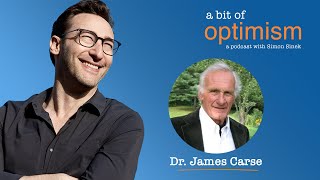
Simon Sinek talks with Dr. James Carse about finite games, which have winners and losers, versus infinite games, which continue indefinitely. Carse explains why belief ends questioning, how surprise keeps play alive, and why infinite thinking matters during crises like pandemics and climate change.
Chapters
In the mid-1980s, a philosopher by the name of Dr. James Kars wrote a little book called Finite and Infinite Games. And in it he defined these two kinds of games. A finite game is defined as known players, fixed rules, and an agreed upon objective. Football, baseball, there's always a beginning, middle and an end. And if there's a winner, there has to be a loser. Then there are infinite games. Infinite games are defined as known and unknown players, which means new players can join the game at any time. The rules are changeable, which means every player can play however they want. And the objective is to perpetuate the game, to stay in the game as long as possible. We are players in infinite games every day of our lives. There's no such thing as being number one in your marriage. No one ever wins career. There's no winning global politics. You can come in first in the time you're in school, but you can't win education. And there's definitely no such thing as winning business. But if we listen to the language of so many leaders, it becomes abundantly clear that they have no idea the game they're playing in. They talk about being number one, being the best, and beating their competition based on what. Based upon what agreed upon objectives, time frames, or metrics. And this is a problem because when we play with a finite mindset in an infinite game, when we play to win in a game that has no finish line, there's a few very predictable and consistent outcomes. The big ones include the decline of trust, the decline of innovation, and the decline of cooperation. I am enamored by the concept of the infinite game, so much so that it profoundly changed the course of my life. And I ended up building upon Dr. Kars work and writing my own book about how to actually build and maintain an infinite mindset. Dr. Carse sadly passed away in September of 2020. But I had a chance to talk to him over the summer and I wanted to share that conversation with you for a couple of reasons. One, because he's absolutely wonderful and remarkable and fun, and two, because I think his work is really valuable in this day and age. This is a bit of optimism.
Doctor Jim Carse. Yes, it is so damn exciting for me. You are what the kids say these days, the OG.
You are the original.
I read your book Finite and Infinite Games many, many years ago and it so profoundly influenced my view and changed my view of the world. And I remember I wrote you an email in 2014 just to thank you and say how much I was a fan. You resplended Two weeks later.
And said, thanks.
All those years later. I then wrote the Infinite Game based on what I think of as a truth. You know, there are a lot of people in the world who have theories about what the world looks like and how does it. They're just that they're theories. But there are very few people, maybe once in a lifetime that come across and put something out there that is a truth, like biology or physics and your understanding of finite infinite games. It's a truth, it's just fundamentally true. How did you come up with this idea of the concept of the infinite game?
For one thing, I, I had a very kind of competitive, athletic type childhood. My dad was a professional athlete, he was a boxer. And so, you know, the, the family life was full of kind of, it wasn't violent, but it was, it was act very active, very competitive. And I was more or less comfortable with it, not completely. And then went to college and realized that I was not cut out for some kind of acute competitive profession. Once I got into completely into the academic world, I found myself really very comfortable in that world. I didn't realize I, you know, growing up I never thought of being a teacher or a professor. Professor. But once I got there I thought, oh man, I'm home. And so I loved it. And so immediately playing with ideas, well, I realized we sat around once a week, you know, 12 or 15 of us from different disciplines in the faculty talking about game theory. And I realized after a while they were, what they were talking about was winning or losing a game or maximizing their winning and minimizing their losses. Or if they weren't playing, they weren't talking about playing the game, which I thought was interesting. So I mean, the idea of play itself suddenly appeared to me to be a very complicated notion, nothing simple at all. So I wrote a paper, I did my part in the seminar. Making a distinction between the finite and infinite type of play they didn't like.
Is such a profound idea. When I first tripped over the idea, somebody gave me a copy of your book. That's how I learned about it. And at the time I was doing some work with some folks in the military and we found that to be unbelievably useful in discussing long term strategy.
Because so much of foreign policy strategy and military strategy is finite, finite, finite. But there is an infinite component to all of this. And the problem is, was we were as a nation developing all of our infrastructure based on one mindset, which is a finite mindset, and ignoring the infinite. And it was so profound for everyone I shared this with, because as you said, it completely changes the way you not only do your work, but how you live your life. Flash forward, many, many years later, I'm telling my sister about this as I'm writing my book and we started talking about how in an infinite game, there's no such thing as winning or losing. There's only a head and behind. Everything is ahead, it's not going to last. And if you're behind, it's not going to last.
Yeah, yeah, right.
And she tried it on her son. So I have a little nine year old nephew, very, very competitive little kid. He gets very, very angry when he loses. And my sister went to watch one of his football games and he scored a losing touchdown and was very angry. And they lost the game, the team lost the game. And any other parent would have dispensed with the standard parenting advice, you know, it doesn't matter who wins or loses, how to play the game. But my sister didn't give that advice. She said to him, it's okay, you had a behind day today and another time you'll have an ahead day. Which was the advice she gave to him. So he realized that his loss was temporary.
Yeah, good, good. No, that worked well. I noticed that with my own children. You know, I have three kids and I noticed a lot of difference in their play when they were playing something. Like you just talked about a softball game or ping pong or anything, you know, no one was quite happy at the end. You know, everyone was a little bit unhappy, even the winners, they thought they could have done better, you know, but then when they got into the games where they made it up as they went along, they could play something all day long. People know, kids would come over sometimes. I'd go play with them or my wife would or whatever. You could go in and out of the game and keep going. And it was just a very, very different kind of environment, different climate, a different way that they related to each other. And I thought, wait a minute, this is, this is worth writing down.
It plays to the idea of ethics as well, doesn't it? Because when you're playing in an infinite mindset, like if you're doing Lego or you're building something or you're drawing, as you said, some creative pursuit that your kids were doing, it necessarily generates creativity. An obsession with the finite generates strategies only to win, which can, which can sometimes lead to some rather unethical choices. There's no really unethical choices when you're making Lego, you know.
Yeah, yeah, right. That's true. Well, you know, that's an important point in a way, because when you're in a finite game, the ideal of, you know, when you're doing your best, it's because you've already figured out what to do. In other words, your big decisions are behind you, not ahead of you. So you know, this is going to be your strategy. This is what you're going to do when that person does this and so on. So all of your, all of your moves are thought out first. But when you're an infinite game, you. You wait to see what the thoughts are as you move into the, into the situation. So it's. You're always, you're always dealing with the kind of. In other words, you're always operating with a certain degree of novelty that you, you will not necessarily use in a finite game.
I need to say that again. That is so good. So in a finite game, all your best thinking is behind you, and now it's simply the, the muscle memory or the application of all of that thinking.
That's right.
Whereas in the infinite game, all the best thinking has yet to come and you have no choice but to step into the unknown.
Right.
And that's unnerving for a lot of people, the finite, I think, a lot of people, not because it's better, but because it's, it's either easier or at least it's more tangible.
See, that's what I saw with these guys in that discussion, that faculty group. They didn't like, they were sort of allergic the ways. The way I felt about it. Allergic to play. Because once you're in, if it's really play.
What'S lying ahead of you is still unformed. But so, so the ideal of a, of a finite player that what every finite player tries to do is in effect win the game before you start it, know exactly what you're going to do, every move you're going to make. And, and the game is just an illustration of what you've. Just a kind of demonstration of what you've already figured out. So that it's like playing in the past. You have like you're playing something you've already made up and decided to do, rather than playing inventively, creatively, imaginatively, and so on.
I need you to unpack something for me so I understand that the infinite game is not the absence of finite games. It's the context within which finite games might exist.
That's right. That's right.
You can absolutely have wins and losses within the pursuit of Something greater for sure. But, but the thing that I need you to help me understand, because I don't, is when it's the reverse. So, for example, a Marine once told me, a US Marine once told me that no plan ever succeeds. Contact with the enemy in a finite game, in a battle where there is a winner and a loser and there's a beginning, middle and end, it's finite. Explain that to me. Where the creativity lies in front of them. Because as soon as you have contact with the enemy, who's got very different plans, everything goes sideways. Or is that just like chess, which is you. You should prepare for all of the different variations. Just riddle me that. Just walk me through.
Okay, let's go through that again. You see now, now, now what a warrior trains for is to have a perfect response to every move the enemy makes.
Yeah.
So you, you, you, you are planning not to be surprised. You want to know everything the enemy can possibly do. Now, of course, intelligent military planners know that the enemy is also human. And they're going to, they're going to have their own imagination and they're going to do something that will surprise you. So you, the whole goal is to minimize the degree of surprise. And so that's what, that's what the military trains you to do, to reduce that margin, you know, that surprise in there. And that's why there's so much training. That's why when you go in the military, that's all there is.
But you could say that for everything, right? Every finite. An athlete who. It's all to minimize surprises.
Yeah, right. Yeah, I remember. You know, I spent hundreds of hours on a football field trying to get myself not to be surprised by what some other guy did.
Yeah. I mean, but it seems I'm just. As you're talking, I'm running all the. That game through my mind. School, you know, where there's a beginning, middle and end to the school year. You get a grade.
Yeah. That's great.
It's the same thing you want to. You study to minimize the surprises on the test.
Exactly. Exactly. Yeah. Right, right.
Oh, this is so good. How did you learn an infinite mindset? Was it innate or is it something that you had to train for?
The way I see it is that an infinite player, infinite players prepare themselves to be surprised. So you expect surprise.
And rather than find, you know, trying to keep it from happening, so you set up a situation that's bound to develop in a way you can't anticipate. That's what, In a way, that's the Way a poem, a poet starts a poem, has a great first line. Or I'll bet you start, you've started books that way.
You have a chapter you really like, an idea you really like, you put it down. The next thing you know, this comes, that comes, that goes.
Are you still susceptible to finite, to slipping into the finite?
Oh, hell yes. Yeah, I know actually.
I'm pretty competitive. You know, you can't go through a life as I have without being, you know, a whole bunch of degrees and honors and appointments and, you know, advancements and so on without being competitive. So, you know, I'm, I'm happy to admit that and enjoy doing it along the way.
They're not mutually exclusive.
No, it's very important to, to keep that distinction in mind that, that what's important about a finite game is that it's, it occurs within a larger context, within the, within an infinite game. And I'm, I'm a great promoter of finite games. I mean, I think they're, they're important. There are a lot of reasons why you'd play a finite game. But how, how did I get there? I'm not sure. I think it was, I would describe the process as more osmotic than I would kind of step by step, you know, it kind of poked in. And the more I looked around, the more. Well, what happened, Simon? I would say it this way. Once the idea got sort of clear in my head, I saw it everywhere.
Yeah. As the master of the infinite mindset, what is your take on this current situation? With the pandemic?
With the pandemic? Well, what I think is that we are now in a position where we can do some really good long distance thinking and step back and look at all these things we're doing, sort of abstract ourselves from them for a while. Do we really want to spend our lives doing what we've been doing? We really want the kind of government, the kind of society, the kind of technology, the kind of this, the kind of that that we have. It's a good time to look at it. It's a good time to, to do a little infinite thinking yourself, you know, where, how far are we going with it? And as a matter of fact, I, I, I think I mentioned to you I've already written a book about that. Yeah.
Which I'm keen to read.
Well, I've got the, I've got a first draft. I've, I'm hesitating to show it to anyone yet, but it'll get there.
But that's what I'm Trying to say that now this gives us a marvelous opportunity, as I put it, to find a new way through the approaching. The one thing we know about this pandemic is it's only a mild version of what's going to happen when the environment crashes. Yeah, I mean, it's going to be horrible.
Really.
There's no way of getting around it.
You know, it's so funny, you talk about the environment, which is even, it's well intentioned, but even the messaging for climate change has been very finite, oriented.
Oh, very, very.
You know, people talk about we're killing the planet. No, we're not. No, the planet will be fine. The planet life is infinite. It will find a way through. All we're doing is killing ourselves. Because as I don't have to tell you, in the finite game, it's the game that ends, but the player continues to live. In the infinite game, it's the player that ends, that drops out of the game. The game continues with or without you. Climate change is destruction of our own species. The planet's fine.
Oh, yeah, it gives a damn.
Right?
Yeah, right.
You said something that I want to read back to you. That is because obviously you had a long and storied career. You, you've done much more work than just the infinite game. Out of curiosity, which is your favorite book that you've written?
Whoa, whoa. You know, I have a hard time with that one. I'm not sure. I think probably the book on belief. This is the religious case against belief.
Against belief. Yeah, a religious case against belief, which, you know, I've made a career out of talking about the importance of belief.
How do you define belief?
Well, what interests me is that characteristic of belief, you know, the kind of, it's the true believer. I'm targeting the person who says, this is the way I see it, this is it, this is the end of the discussion, and so on. But of course, I always have to go back to the Greeks. Now, the Greeks had made a distinction between knowledge which you know which is true, and you gnosis that, that you know, it's, it's like you're saying it is the truth and it's obvious truth. You don't have to believe it. You know, it, it's in your head, it's already working there. You don't have to defend it. It's. It stands by itself and that they, they oppose that. To doxa, which is opinion. We use that, we use that word, say in the phrase orthodox, orthodoxy, meaning right opinion, you know, having an opinion. And for the most part, when people talk about their beliefs, I think the way you're talking about it, it's more like an opinion. This is the way I see it. If you have an argument against that, I'll entertain the argument. But so far this is my opinion about that subject. Well, that's one thing, but, but when people say I believe in this person or that thing or that movement, that idea, then I, I, I'd see it as the point where you've turned your thinking off. Now the one thing about, about serious believers, usually they come in a system. There's a system of thinking that goes with it that in addition to the, the mere idea or the, the belief itself or the opinion itself. So they come in systems. But what a, what a, a critical thinker would do is question the system itself rather than, than a belief in it, you know, belief based on it. So you, you begin to look at all the assumptions that led you to that belief and so on. But believing for me has the negative. That's why there's, I make a religious case against it because it is, it's where your thinking stops. It's where wonder stops. Aristotle said at one point, philosophy begins in wonder. It's a great phrase. I like to think of religion as something that ends in wonder, not in belief. So, you know, that's my, sort of, my grand definition of religion, if I have one.
I do so love this idea that belief is where thinking ends and that if we have beliefs, it is okay to have beliefs. But to be closed to challenging our own beliefs or to your point, system is important. And if we still cling onto those beliefs, we should know the reasons why.
That's right. Right.
We should know the reasons why. And again, it could be something, it could be nostalgic, it could be because that's how it was with my parents. And I want to continue that legacy, but I think to be able to explain why I hold onto a belief without a criticism of someone who holds a different belief. Yeah, and that's, I think that's very hard to do. It's much easier to, it's much easier to define what we believe in by saying what we believe against.
Well, as a matter of fact, most believers are, they have a whole, I mean, everything on their side is matched by something negative on the other. Yeah. So, so it's like two systems. These are beliefs, these are unbeliefs, you know, and, and they, they, and so that's why I, I consider myself neither a believer nor unbeliever. Yeah. You know, Being an academic, that's not too hard. You know, it's, it because, for example, just take any, any big intellectual category, Theory of evolution. Now if you're, if you're a certain kind of Christian, you would say, I don't believe in that theory. But if you were a scientist, the theory is not a belief, it's, it's a testing of, it's an examination. It comes from, you know, the word theory comes from the Greek word for seeing. So to have a theory is to have a vision, a sight of something, to see for yourself the way something is. So that's different than having a belief.
What is your thought as to what happened to our society, why we became so dogmatic in our beliefs, whether it's left or right, you know, they're both equally as bad, where I'm right and you're wrong. How did we get to the point, or has it always been this way? How do we get to the point where it seems so exaggerated, where both sides of the aisle, our country's so divided, where that belief has become a kind of truth to people? Yeah, I'm just fascinated by your thoughts as to how we got here.
If I think in great big terms, it would be something like we are now entering a new age of anxiety in a way. And there's a lot of uncertainty out there. And so the uncertainty of a number of kinds. Number one, a lot of traditional institutions are losing their grip so that you have less guidance. You feel that like the ground is shifting more under you, there's not a solid place to stand. So people are tempted to find positions where they can just stay there and let the world swirl around them, you know, and they don't have to question themselves. And I think self criticism is absolutely crucial to being human to begin with. But this is what's disappearing.
This is really profound. So in times of uncertainty or when there's a feeling of anxiety, our desire to hold onto the finite or our desire to hold onto belief goes up. Because inherent in the infinite game, I have to be open to the uncertain. But if I'm feeling anxious, the uncertain is the thing I do not want.
Exactly.
Yeah. And so I'm going to ground myself in belief because it gives me comfort.
Right.
So it seems the way forwards is, it's environmental. Right. It's for our leaders to offer a sense of vision and to offer a sense of, to offer some sense of certainty or some sense of hope or something that we can lock onto.
Right.
Which will then inherently make us all more open minded to each other. But absent that right, absent something outside us, inside us, we become more. More dogmatic and more fixed in our beliefs, and we believe even more strongly that I am right and you are wrong.
Yeah, that's right. That's the way it works. Yeah, exactly that way. And you know, you know, one thing, one feature about an infinite game that. About the whole theory, in a way, is that it's neither left nor right. Right. It's not religious or irreligious. It's not there, not here. It's not big. It's not little. It doesn't belong into the usual categories that people put stuff into. I mean, you couldn't tell from reading my book what my political views are, for example. In fact, I don't even have political views. I would put it this way. It's one thing to have. It's one thing to have a politics. It's another to be political. I'm political, but I have no politics.
Explain the difference.
Well, I'm concerned about the way a whole society, a polis, operates now. There are all kinds of views about how it should operate. Point is, to be political is to have a sense of the polis. Now, that was. That's what interesting about Aristotle. He thought a philosopher is a person who had by definition, a social conscience. That is, you were concerned about what the society you lived in. Now he. Aristotle lived in a terrifically wild, crazy society, Athens. But he. He also had a real respect for what he called the demos. You know, D E M O s from democracy, a people. Actually, you could translate a lot different ways. A neighborhood or a gathering or an institution, even a country. But a demos has its own identity and all the people in it are of it and think in its terms. And Aristotle thought to be a really reflective person, or as he called them, contemplative. He used that word, you have to be a good citizen to be political.
You said something that I think sums up the magic that is Jim Carse and why I adore you so much. And I think it sums up this conversation as well, which is in the sense that I am endlessly fascinated by, with the unknowability of what it means to be human.
It's paradoxical.
It is, yes. Paradox is the word. That's the word, yeah. It is a paradox.
Our desire for certainty, to understand and for explanation is. We yield to the joy of finding explanation in that which is unexplainable and the joy of finding certainty in that which is uncertain. Yeah, it's just the most magically human experience in the world, because human beings are almost all aspects of our lives. Paradoxical.
Yeah. Yeah. Well, yeah. I mean, I can go on for a while. Please do. Somehow you got me hooked on Aristotle here, but, but of course, I love the guy Aristotle. But the first sentence of his, Metaphysics, which is kind of the big work of Aristotle, the first sentence goes, everyone, every human being by nature has a desire to learn. That's, that's his thing. Now I, I looked at that for a while. I thought, I mean, I looked at it in Greek, which is. It reads a little differently in Greek. And it, like every, everyone, everyone born human has a desire, a long thing to see for oneself. That's really the way I would translate that line, to see for oneself. Yeah, you want to see it. You don't want someone to tell you. You want to see it yourself. And that's what Aristotle thought is what makes us, what makes us human. And I thought, wow, that's a terrific insight. But what that implies is you're never satisfied. I mean, that's why that desire doesn't die. It lives with you your whole life. It's there because, you know, there's still more you haven't seen. You want to, you want to see it. And so you keep going at it. And that's what, in the end he, he calls it, as I said before, he calls it contemplation. It's filled with what he also called energia, energy, which is in some definitions of Aristotle is life itself. So it's like a living, Living contemplative. Contemplatively. And that seems to me to be a high, the highest expression of, of our humanity.
Jim.
I adore you. I adore you. I adore you. You have the most wonderful manner. You just, you're open. You know, I hold myself to the high standard of wanting to be a more infinite minded person and live my life with an infinite mindset every day. And you know, I've often referred to not just your work, but to you as the gold standard for me. And so it's an honor, it's a joy to sit down with you and talk to you. Thank you for taking the time.
Yeah, Simon, this is my, my pleasure as well.
It's a joy, really.
Yeah, I'm very happy I have you, as a matter of fact.
Because I had a long, long desire to see some of these ideas go to work. And you put it to work and I very much appreciate it. I think you've done it brilliantly.
Thank you. Thank you. That means everything to me.
Yeah.
All the best.
Okay. Thank you.
Take care of yourself to clean those.
Yeah, you too. Absolutely. All right.
I'm really glad I got to know Jim Carse and have him in my life for a little bit. I'm definitely going to miss him. But in the spirit of the infinite game, I'm also proud to carry his torch and spread his work so that it may live on way, way beyond his own lifetime. Until next time, take care of yourself. Take care of each other.
More from Clegg





AI Won't Tell You the Full Truth | Arthur Brooks + Simon Sinek | A Bit of Optimism Podcast



How To Make the Best Decision | Arthur Brooks and Simon Sinek | A Bit of Optimism


