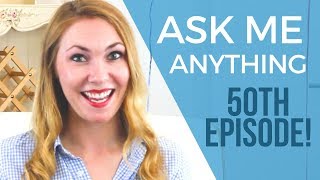
Madeline Mann marks 50 episodes by explaining how unsolicited resume feedback that flooded her inbox sparked the channel. She spends 11 to 17 hours per episode, keeps a 217-page idea document, and films about 15 minutes of raw footage for every minute that makes the cut.
Questions this video answers
50th episode
11–17 hours per episode
About 217 pages
Sunday afternoons (films several videos in a day)
About 15 minutes of filming for every 1 minute of final content
Chapters
Hey everyone, this is Self Made Millennial. I'm Madeline Mann, and today we're celebrating our 50th episode.
Which means it's been a year of talking about our ambitions, our missions, and me getting super animated in front of a camera and weirding out my neighbors.
This video is an Ask me anything and I asked you all to send me in questions and I said, you know, it could be about me, my career, anything random. And you all did not disappoint. I'll answer. What total fail led me to this channel? Some behind the scenes facts about how the episodes are made, and then we'll branch off onto some more random questions and one actually gets a bit morbid. Alright, alright, first question. Why did you create Self Made Millennials? So the story goes, I work in HR and recruiting. I see tons of resumes come through every day and I read them and I noticed a lot of people were making the same mistakes, that they just changed certain things. They would be able to really get some amazing opportunities. And so I started responding to every sing resume that came through and the result was a disaster. People were so mean back to me because I was giving them unsolicited advice. And then the other people who weren't mean to me generally would either just be completely silent or then want to hop on the phone and talk more about the resume and do a bunch of different edits and iterations. And it ended up blowing up my inbox with so many more emails than I had ever expected. It was at that moment I realized that I wanted to help. But helping one on one when people did not ask for that help is just not the way to do it. So I thought about ways that I could get the message out. And one thing I've always loved is video editing. So I took a look at YouTube to see what was out there. And there's a lot of great advice, but there wasn't a lot of videos that were made for learners like me. I really like videos that are fast and actionable and structured and, you know, a little bit silly. So I just dove in, started making videos. The first few ones were incredibly awkward and never made it to online, I guess, until now. Hey everyone.
Hey everyone.
Hello. Yeah, that was rough. But since then I've been building my confidence. I've been having a lot of fun with this and you all have been amazing, commenting and encouraging me and getting really into the content. So I just want to say thank you. Alright, next question. What is the life cycle of a video? How do you come up with Topics, is it scripted? How long is the shoot? Hmm. So any given episode, from start to finish, that's from writing it, filming it, filming it, editing it, creating thumbnail, all of that. I estimated it to be about 11 to 17 hours per episode. The way I come up with topics is my everyday life. The topics are everywhere. And I keep this document where I just write down the ideas all the time. And last time I checked, that document is about like 217 pages. In my free time, I'll just go through the topics and I'll add more information to each. And as I build up an episode, I'll add stars next to the title of the topic. And once it gets to four stars, that means it's an episode that is ready to be filmed that weekend. I film all my videos on Sunday afternoons. I film several in a day so that, you know, I could take a weekend off here and there. How long does a shoot take? I approximate that about for every one minute of content you watch, that's about 15 minutes of filming. I leave a lot on the cutting room floor because I want to chop this up, make it rapid fire, make it as efficient as possible. So hopefully I'm doing an okay job. Next question is, if you could have coffee with one person who you've never met, who would it be and what would you discuss? I would choose Kim Scott. I've been a huge fan of hers since I read her book Radical Candor. And we have exchanged a message or two on Instagram before, but I wouldn't consider that meeting. So I'd meet her, we talk about how she builds organizations and she has such a great sense of humor. So probably swap stories about working in tech. And if you haven't read her book, get it. Radical Candor. It's how you give really direct but empathetic feedback. What have you learned from creating videos for a whole year? I would say that I've realized I really love making videos. I just love geeking out on interviewing, career stuff. And the number of views and the number of subscribers I've had has been kind of a very steady increase, which has been great, but it's also not a meteoric rise. And I realized that if I cared about the views and monetization as much as I would have quit a long time ago. And I realize it's not about that. It's just I love talking to you all and I can just see myself talking to you all for a very long time. Alright, so back to the paper. I got a lot of questions on blockchain and cryptocurrency, and that's the industry I work in. And maybe that's another video where I can answer all of those individually. But I'll do a blanket statement about blockchain technology. First thing I want to say is that blockchain technology is nothing to be afraid of. I mean, you should approach every different project you hear about with like, a healthy level of skepticism. But the technology itself is going to change the world, I guarantee it. You don't need to know the deep, deep levels of how blockchain works. I'm sure many of us cannot explain the intricacies of the Internet. I also don't think you need to fixate on things such as the price of bitcoin, but more about the potential future trajectory of the mark that cryptocurrencies and blockchain technology can leave on our world. It's like we're all sitting around in the 90s talking about, is AOL going to be the core cornerstone of the Internet, when really we should be talking about the future of email and instant messaging and browsers. So my advice is to learn more. It's still super early in the adoption life cycle. And, you know, instead of going out this Friday night spending money on drinks and dinner, just put that money into cryptocurrency. Just start playing with it and see what it's all about. I'll link my favorite crypto app in the description that will help, you know, shepherd you into this ecosystem. If you're interested, check it out. Okay, rounding out the video here, have you planned your funeral? Yes, it will be a free resume editing workshop. No, I'm just kidding. I have given some thought to what would happen after I die, but not the actual funeral part of it. I will say I'm not a big fan of flowers because I feel like they're so expensive and they also end up dying pretty quickly. So instead of flowers, I like to decorate with like, dogs and cats, interspecies friendships. That's. That would probably be like a petting zoo slash funeral situation. I would certainly have FOMO if that ended up being my funeral. Well, that's it, folks. Thanks so much for hanging out with me for 50 freaking episodes. Make sure you subscribe so you can see the 50 more to come as well as hit a like on this video. Thank you so much everyone. Wi Fi high five.