This Cover Letter Formula Actually Gets Interviews
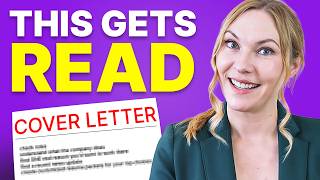
A cover letter should be seven sentences max with two parts: show you love the company, then show why they'd love you. The Barney Method starts with a tailored reason for applying, adds your unique value tied to the job description, and opens with a referral from LinkedIn outreach.
Chapters
Yes, it is worth your time to write a cover letter, but only if it's fewer than seven sentences and includes two incredibly important details. Do this and you'll quickly write the best cover letters that get interviews and I will show you exactly how. And stay to the end because I will show you the highest performing sentence that will get someone to read your cover letter. Here's a real cover letter and it represents what 90% of COVID letters sound like. And I actually picked a shorter one. Thank goodness. The average cover letter is actually a bit longer than this, but no one wants to read that, so let's take a look. To whom it may Concern okay already. No, this sounds overly formal, outdated. It's similar to Dear sir or Madam. Don't do those. The best option is to say Company name team. Or you can get a little more specific like Company team name team. So that would sound like Target Customer Support Team. And now this is customized but not overly formal. Just please make sure that you triple check every cover letter to make sure it has the correct company name. You would not believe how many people forget when they copy and paste their cover letters to put the right company name. Please find my resume for the position of Technical Sales Manager. I bring experience, experience partnering with customers to understand technical needs, translating complex solutions into clear business value, and driving revenue through consultative sales. I am skilled at managing sales cycles, collaborating cross functionally with technical teams and building long term client relationships. What's good is this seems relevant to a technical sales manager, but it's vague and is likely just repeating what the resume says. So what is the point? I believe my technical aptitude, strong communication skills, customer focused approach and results driven mindset would allow me to make a meaningful contribution to companies. Okay, never self describe, never call yourself results driven, a good communicator, creative, whatever. All of those things can be implied and shown instead of said in this way. That is unconvincing. I am motivated by solving problems, supporting customers throughout the buying journey, and helping organizations adopt solutions that deliver measurable impact. Okay, I don't hate this sentence because it talks about their motivations, which is something a resume does not explain. This brings something different, but it's still mostly corporate platitude, platypus speak and largely a waste of time. Thank you for taking the time to review my application. I look forward to forward to the opportunity to discuss how my background aligns with your team's goals. Delete useless sentences. Sincerely, Candidate okay, let's rewrite this since so many people are using bad AI prompts To make cover letters they are sounding overly generic, formal and long and we are going to zag while everyone else zigs. Baby. You are going to write a specific casual and short cover letter. You can use AI too, but just use it in a way that will help actually help you. Now a quick clarifying point. A cover letter is used as a way to help a recruiter make a decision when they're a little bit on the fence about you. If your resume is trash, then likely your cover letter won't be seen. So you have to make sure your resume is as strong as it can be. And I will link a free workshop below that has gotten really high ratings. Formula to use for your cover letter is called the Barney Method. If you were alive in the 1900s and as I was, we had a television program called Barney and Friends, the role that Selena Gomez is most known for. And Barney has a famous song that goes I love you, you love me, I love you, you love me. And that's exactly the basis of this cover letter formula. Let me explain. So we always start with I love you. Why are you interested in the company in this role? This is something that is not on your resume and it's important for the company to know. It is such a powerful framing for your cover letter because companies are getting so many generic applications right now that anything that you can do to show that you actually read the job description and were intentional about applying to this role instead of using one of those dreadful auto applier that applies to 60 jobs a minute that will help you to get the attention of the company. I almost pass up on someone because they were going for a project management role and their experience was in design. I saw their cover letter and it perfectly explained why they are making the career switch and how they built skills for the switch and why they were specifically interested in the industry that I was hiring in and their short cover letter gave me confidence in giving them the interview and I'm so so glad they did because their resume just didn't say enough and the COVID letter filled in all those gaps. I am curious, do you usually write cover letters right? I usually do or I usually don't in the comments. Okay, so we think of the Barney song. Always start with step one I love you. So say why you're interested in the company and the role. Avoid purpose washing, which is where companies put some jargon nonsense as their mission on their website. That sounds something like our mission is to drive innovation, to improve the human experience or something like that. And then you vomit the same nonsense on your cover letter saying I'm really interested in your company because of its commitment to improve the human experience. No one talks like this. A decent reason could sound like I'm interested in the product designer position because when I read how do Scape embeds research directly into the design process, it stood out as the type of place I want to work. With my heavy research background, I am specifically targeting these types of opportunities. Next step of the Barney method is you love me. All right. This is the part where you might be tempted to say vague things about your organizational skills or resourcefulness. Resist the urge. Reread the job description and pick out the major themes and the biggest problems that will need to be solved. Then use this section to to tell them why you are uniquely fit to solve them. Tell a story or explain why you are a fit despite an unconventional background. Do not simply repeat the experience listed on your resume. So here's an example. I saw the open product designer role as a strong match after walking through your product demo and noticing similarities to the work I led on Born True's SaaS platform. As the first product designer hired, I built the core core interface from the ground up, establishing patterns that now support over 6,000 enterprise accounts. The challenges outlined in this role, particularly about balancing flexibility for advanced users with clarity for new ones, closely reflect the problems that I solved while scaling Born True from an early stage product into an enterprise ready platform. There you go. An entire cover letter in five sentences. And this example again is showing specific specifics towards the role and the company. But I still have two more high power tools to make your cover letter even better. And the second tool is that first sentence you can write at the beginning of your cover letter that will guarantee the recruiter will move on to the next sentence. Now one thing I will acknowledge is that a lot of people say no one reads cover letters anymore. Then you'll also hear the next person say I read them all the time. That's because typically recruiters at large companies don't don't read cover letters. They get too many applications and their jobs are a bit more precise about fitting specific openings with specific skilled individuals. Recruiters at small and medium sized companies are a bit more likely to read cover letters because they get fewer applications. They still get a lot, but fewer and are often more willing to take into consideration less conventional candidates. Each personality they bring into a company has has an outsized impact on the culture, so they may choose someone who isn't maybe perfect on paper but overall has a great attitude and is passionate, which can be seen in the COVID letter. So there's no guarantee that your cover letter will be seen, but there is a good reason to write one. Okay, so back to it. Use the fluff test to help you get rid of unnecessary information in your cover letter. Here's what you're going to do. Read each sentence in your cover letter and ask could this be said by most other applicants? For example, maybe you closed your letter with I appreciate your time and I'm interested in learning more about the company. This provides no new information, it just takes up space and anyone in the world could have written that sentence. So cut it out. I'll also link my free Tell me about yourself worksheet, which has helped thousands of people both in their job interviews and in their cover letters explained explain their value. So I'll link that below. Now, here is the best first sentence to add to your cover letter. This will dramatically increase the odds that someone will read beyond the first sentence of your cover letter. Okay, so step one look on LinkedIn for people who work at the company. First look for people you might already know. Then move on to people who know people who know you. Sometimes you can't find someone like that, so just look for someone who you may have something in in common with, such as you both lived in the same city before. You notice they have an interesting background, they switched industries like you did. Whatever. So next, reach out to that person and share whatever you have in common or whatever. Is that interesting thing you noticed about them? Such as you notice that they made a big career change from education into tech just like you did, or that they've been at the same company for over 10 years and that's right rare to see these days. Just something interesting you saw. Then ask them in that same message. I'm considering the company you work for as a potential place I'd like to work someday. Do you like working there? People are usually quite happy to share their opinion and perspective and they may shoot over a short message such as yes, I've been here for a long time and I think it's a really great place to work. Perfect. That is everything you need for that first line of your cover letter. So so here's what it will sound like after hearing from Name your title, who said they really enjoy working at Company Name, I'm excited to put forward an application for job title. So here it is in practice after hearing from Lane Kim, your director of operations, who said she really enjoys working at Kim's Antiques, I'm excited to put forward an application for the VP of Marketing role. This will catch the company's attention, show that you actually care about this position and took some time to research the company and it just goes so far in a job market like today's. So you've got this wi fi high five.
More from Clegg





AI Won't Tell You the Full Truth | Arthur Brooks + Simon Sinek | A Bit of Optimism Podcast



How To Make the Best Decision | Arthur Brooks and Simon Sinek | A Bit of Optimism


