Use this Message to Connect with Strangers on LinkedIn
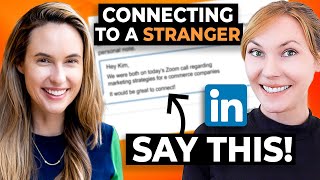
Kim Kaupe explains how to connect with strangers on LinkedIn without looking like spam. Always send a personalized message, not a generic request. Use this template: say what you noticed about them, mention where you found them, and ask clearly what you want.
Questions this video answers
January 5, 2023.
She says the two-sentence connection message she recommends works about 80% of the time.
Every Wednesday at 1pm Eastern.
Chapters
How do you connect with someone on LinkedIn? Should you include a message and if so, what should you say? Especially if you just met them or don't know them at all. This is self made Millennial. I'm Madeline Mann and you'll learn all of that and more in this video. I am a human resources leader and job search strategist who turns job seekers into job shoppers. You may have seen me in these places New videos on Thursdays. I have a special guest today, Kim Cope, who is the founder of the Fan Engage agency Bright Ideas only working with a list clients such as Paul McCartney, Oprah and the New York Mets. You might recognize her from Shark Tank securing offers from four out of the five sharks. Or you might know her from her role as the judge on the 2019 Miss USA pageant. And she also knows a lot about how to build a personal brand on LinkedIn and stay the end because Kim will reveal the two sentence connection message that she sees work 80% of the time. Okay, Kim, Kim, can you quickly define what connecting on LinkedIn is? Such as how do you do it? The purpose, the Benefits?
Connecting on LinkedIn is really easy and you're definitely going to want to do it. It's a quick and easy way before a meeting or after a meeting to stay in touch with people that you are going to be interacting with. And it's super easy. You log into LinkedIn, you look up somebody's name and right there, usually in a big blue lettering it will say connect.
Yeah, and so we're connecting with people that we've met. Do you ever connect with people who you don't actually know personally?
I connect with people that I might not know in terms of met them personally. But maybe I follow. Maybe it's somebody that I read an article that I thought they were really interesting. Maybe I saw them speak at a conference and thought they had a really interesting presentation. So I'm familiar with them and perhaps their work and their knowledge, but I might not actually know that person from a, you know, let's shake hands and catch up over a beer.
Agree. I think that LinkedIn is a place where you should absolutely be connected to everyone you know personally, all the, the contractors you work with and the coworkers and, and the clients. But then there's also this whole other opportunity to connect with people outside of those who you've met in your day to day and that can really expand your network. So just a quick shout out to everyone. It's okay to reach out to people who you don't totally know on LinkedIn. That's kind of the beauty of it. So do you think you should include a connection message or not?
Absolutely. I think including connection messages will absolutely set you apart from other people that might be connecting. And quite frankly, it's just sort of a polite thing to do, I think. I always think you wouldn't walk into a bar, snatch up somebody's phone and just start putting your number in. You would say, hey, it's nice to meet you. Maybe have a little bit of a conversation and then put your contact information in. So a connection request is the same way you might open up a message and say, read this article or saw your presentation or saw that we have co workers in common and I just wanted to connect and learn more about what you're doing.
I'm sure you get hundreds and hundreds of connection messages. I do too. Or connection requests. At that point, you, you don't know who to connect with unless they've put a message there. Something that you know that they're not necessarily just spamming you to kind of get into your network, but that they have seen your work or want to work with you or something like that. I have seen though that from a job seeker perspective, it's really important that we have a network that is a bit bigger. One of the things that happens with recruiters is when they're searching to find people to interview for roles, they are looking for people who are in their second, third, fourth degree networks because LinkedIn will only show them those people. And so if your network is too small, like say a hundred connections, that then leads to you not showing up in their searches. So it's so important that we get these connections pumped out. If we don't, then we're not going to show up in searches. So that's. I just really want to underscore this. We will talk in a second about what to write in the connection message. But let's clear something up right here. What is the difference between connecting and following on LinkedIn?
I'm glad you brought that up because it's kind of a gray area that some people don't always know. So if you connect with someone, it means you will see their content and they will see your content. So it is a two way street. You are connected. Everybody is seeing everybody's stuff. If you are simply following someone. For instance, I follow Mark Cuban from Shark Tank. I will see Mark Cuban's posts because he's posting them and I'm following him. But Mark does not see my post because we are not connected. I'm merely following him. So it's a one way street instead of a two way street.
I think it's great to do follow if you are trying to just kind of catch up with someone who maybe you're looking at someone who works at a company, you want to follow their posts, see if they post about open roles, see what's happening at their business. Like it's such a great easy way to just make sure your feed is followed full of relevant information. But the connect it gives you that direct message option that is pretty nice of now you're able to communicate. Cause I don't think unless someone has set their profile to be an open profile, which I do have an open profile where anyone can message me for free. If you follow them, that doesn't give you the access to message them for. For free, I believe. Is that correct?
Correct. I think also if you. Depending on what if you subscribe to LinkedIn Premium, for example, that comes with I believe it's 50 in in messages a month. So you can message people without necessarily having to be connected to them. But you have to pay for premium. So.
Right. If you want to know more about should we pay for premium or whatnot. If that's. If that's an interesting topic, definitely comment below if that's of interest. Also while we're sending these connection requests, your profile should be updated. It should include the value add to the world. Have a really excellent headline which I have a headline formula for you. I have exactly what you should put on your profile. So I will link a form full checklist that you should be using to update your LinkedIn profile at least once every six months. I will link that down below. One thing that's a little bit tricky is where do we connect with people on LinkedIn? Sometimes I go to people's profiles and they have just the follow button. But there is a sneaky way to still connect with them. How would we do that?
So if you land on somebody's page that has a follow button, what you're going to want to do is go just to the right of the follow button. You're going to click that and the third drop down is going to say connect. So the connect button is still there. It's just a little bit harder to find. I also know that I get a ton of questions on people saying well I want to put a follow button on my profile. That's something that I want to do. And I would say if that is something that's of interest to you, you can turn on a new feature on LinkedIn called Creator Mode. And turning on Creator Mode allows you to move that button from a Connect button and to a Follow button. And if you need help turning on Creator Mode, you can go to turnoncreatormode.com and I have a 15 minute video that'll walk you through how to do that. But if you do want to move from a Connect button to a follow button, that's how you do it.
So I am on Creator mode right now. I did Creator Mode because I'm a creator, right? That is, I'm not on LinkedIn to get a job. I'm really truly there to add value and spread the message. I think that that's a really important thing to do on LinkedIn is to build your personal brand to your thought leadership. And so if that's of interest to you, definitely go to turn on creative road.com, make sure that you, you follow those steps. But also I have a free walkthrough. It's like a free training of how I was able to build a following on LinkedIn, how I was able to build a personal brand, attract jobs, speaking engagements, clients, all that stuff. I will link that free masterclass down below so that you can get access to how to go about that, because that is, that's a big undertaking. But really in this online world today, our brand is so, so important. Is there a connection limit on LinkedIn?
There is definitely a connection limit and more importantly, there is a limit to how many people you can connect with per day. Most of us understand that one of the main concerns on any social media platform is bots. Sort of like a necessary thing. We know it's on Instagram, we know it's on Facebook, and unfortunately for all of us, it is also on LinkedIn. So one of the ways that they have set up to find these bots is bots will sometimes automatically send lots and lots of connection requests in one day. Like 500 connection requests in one day. Obviously way more than probably a normal person would send. So it flags it in the system and says, hey, wait a second, something's going on here. So if you try to connect, I believe the number, they're always changing it, but I believe the number right now is more than 500 in one day. I could be wrong, it could be 250. So depending on when you watch this, it might be a good Google. But yes, if you're doing massive amounts of connections in one day, this system will flag and say like, hold on, are you a bot? What's going on here. So I would say a good rule of thumb is do a handful every day. You know, less than 100. Don't go crazy. We definitely don't want you getting flagged by the system thinking that you're a robot.
Exactly. I've heard so many different numbers too. I love the suggestion of just Google it, but LinkedIn has never come out and fully said, here's how many you can do a day if you keep it under 50. Like, I've never seen anyone get get pinged for that many. Keeping under 100 as well sounds pretty good too. Let's talk about what to put in the connection message. Let's first start because I know you get so many connection messages. What are some of the worst things to say?
Automatically asking for something or what I call, you know, the McDonald's request. Just like you walk up to the window at McDonald's and say, Hey, I would like a cheeseburger with a side of fries. You're at McDonald's. People expect that. But walk up to somebody at a party and say, hi, I would like to go home with your husband and give me that purse you're holding. I mean, people would be like, excuse you. That's a bit of a request. So I think obviously coming into somebody and saying, give me five minutes of your time or give me advice on this, that's always a little bit hard because you're sort of walking in straight away and asking for something, which I think is a little abrupt.
I completely agree. It's way too rushed. And then it's also a pretty big flag to me if the message is just something extremely generic. Like, I saw you have an interesting profile. I know that person just sent that to a hundred other people. Like, they have no idea who I am. Or I see we have mutual connections. They don't say which connections. They don't say, oh, we both worked with, with Kim or whatnot. No, there's like we have, we have mutual connections and the same industry and often it's not the same industry, it's just this massive spam message. So I completely agree. It's like rushed intimacy or just complete generic. Do you get kind of those gener messages as well?
Absolutely. And unfortunately, once again, I think we have a lot of the bots to thank for that because there are all sorts of services that say, we're going to send messages to a hundred of your best prospects and see if we can get them onto your shipping freight company. And so they just, yes, send out these very generic messages, and you're like, obviously, this has nothing to do with my day to day.
Exactly. And so what would be a better connection message approach? And let's first start with someone we had met either at a meeting or an event.
I think the easiest way to think about this is really think about the three P's, which is, number one, personalize the connection request. So. Hey, Kim. Hey, Madeline. So going back to what we were saying before, you can kind of tell the generic messages because a lot of times they don't use your name. Number two, involve a place. So, hey, we met at the conference last week. Hi. We just got off a zoom call. Hey, I saw that you're a friend of Derek's and he mentioned you, or I saw you wrote this article or I heard you on a podcast. I mean, the list goes on and on, but placement.
How.
How did this person cross your path? I think that that's extremely helpful when you're writing that connection request. And then last but not least, the third P is just please. I know it sounds crazy, but we have to remember that a connection request is just that it's a request people could deny you. So I always like to say, I'm really excited to keep learning from you. Please, I hope you'll allow me to connect and follow along. So really saying, I would love to conn. It would be great if we could. So I always think about those three Ps when I'm structuring a connection message.
And I really hope people don't overthink it because what you just said is perfect. I think that sometimes people might try to put too much or maybe you have an ask that you want to ask after that meeting or after that conference, and people try to shove that into the connection message. But I love your simple approach because really, it's just saying hi. It's just saying hi. Hey, we should connect. It doesn't have to be something extra. You don't have to be, you know, adding in the entire conversation into that message. I love that so much. And so what about a connection message with someone who doesn't actually know who we are? We haven't legitimately met them before.
I would just say again, if you have a mutual connection, mention them. Hey, I saw that we both know Madeline in common. Would love to connect and keep learning from you. Or if not, I always say honesty's the best, best policy. I've written connection messages and said, hey, I started on my friend's profile, and three clicks later, I ended up on yours. I really Think it's interesting what you're doing and I would love to connect and keep learning from you. So sometimes honesty is the best policy.
Absolutely. And I think it's about noticing that person of if you did end up on their profile, why are you reaching out? What specifically made you interested in them? Maybe it's that you took an unconventional path to product management and you both went to Syracuse. You don't necessarily know this person. They might not be someone who you can talk about their podcast that they're on, but it's not just some random connection. And also, I mean, if there is something to compliment them on, I know I am a sucker for compliments. It makes me grin ear to ear when I get a connection message of someone saying, hey, Madeline, I watched a bunch of your YouTube videos. It helped me land a job. It'd be so great to be able to connect with you here on LinkedIn. I'm like, oh my gosh, you are part of the family. I love that. And even just seeing someone's posts on LinkedIn and continuing the conversation, maybe they commented with you back and forth. Maybe they left a really thoughtful comment on a LinkedIn post and you put that in your connection message. If I loved your perspective on the future of artificial intelligence on. On that post today, would love to connect. So I love that. I think. I think we're just. We're just focused on not being a generic Eric. Eric. Right. Yeah.
Nobody wants that.
No. Well, amazing. So, Kim, this was so helpful. Tell us a little bit more about how we can stay in contact with you and find you.
Well, LinkedIn is a pretty great place for that, so you can find me at Kim. And the last name is Kalp. K A U P E. I'm always putting out lots of posts and pictures and videos. And then I also have a LinkedIn Live that I do every single Wednesday at 1pm Eastern on the platform, so. So I'd love to see you there.
Amazing. Well, I'm going to send you away with a WI Fi high five.
More from Clegg





AI Won't Tell You the Full Truth | Arthur Brooks + Simon Sinek | A Bit of Optimism Podcast



How To Make the Best Decision | Arthur Brooks and Simon Sinek | A Bit of Optimism


