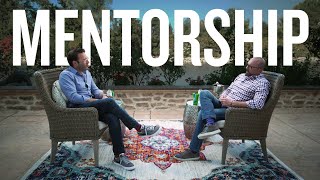
Simon Sinek recounts a personal mentorship with Ron Bruder to revise his understanding of what mentorship means. He describes how mentor relationships evolve like friendships, are mutual (mentors learn as much as they teach), and are characterized by mentors making time for mentees rather than being assigned or purely transactional.
One of my mentors, Ron Bruder.
Taught me what mentorship was really all about. I met him professionally. I was introduced to him. He was very accomplished, very successful, many years my senior. Very wise. We got along, and a week or two later, I had a question that I thought he might be able to help me with, and I called him and he took my call. I only met him once and then took my call again. And then we met for lunch. He just kept saying yes. And he became my mentor, you know, And I remember I was at his house one day and I was getting. I was leaving, and I put my arm around him and I used the M word for the very first time. I said, I love that you're my mentor. And he said something to me that I didn't expect. He said, and I love that you're mine. And that's when I realized a mentor relationship is more like a friendship. You know, you can't just walk up to a random person and say, will you be my mentor? Just like you can't walk up to a random person and say, will you be my friend. That's not how it works. Mentor relationships evolve.
Because a mentor always has time for you.
They see something in you for some reason that they make time for you, and they learn as much as they teach. They come into it because they learn something. I never knew that Ron was getting something from our time together. I thought he was just doing me favors because he was an amazing guy.
And a mentor relationship is. It's a mentor, mentor relationship. So this whole idea of, like, you're assigned to be someone's mentor, like, maybe that could work. Well, it seems again, going back to sort of a transactional, like, transaction, you know, you have to have mentors and you have to seek them out. I remember when I was junior looking for a job, you know, people would say, what are you looking for? And my standard answer in every interview as an entry level, you know, idiot, was, that's the theme in my. In my career. The next book. I'm just a more senior idiot now. Yeah.
When they say, what are you looking for? My answer is always the same. I said, what I'm looking for is probably akin to looking for love, but I'm looking for a mentor. And every job that I was looking for, I was more concerned about the people I would work for than I was how much they would pay me or whether the account was high profile or low profile. And so I took jobs with, like, accounts that nobody ever heard of because I didn't care. I cared about the people I was going to work. I wanted to work with really smart, amazing people who would teach me and help me grow. And that's one of the reasons I got to work with some of these wonderful people. Yeah.