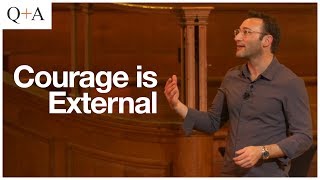
Q&A excerpt from a YouTube session in which Simon Sinek argues that courage is primarily external—rooted in human relationships and trust. He illustrates this with examples (people risking their lives for others, a tightrope walker using a net) and links courageous behaviour to servant leadership and long-term bonding (military training, unit cohesion).
Chapters
The first four principles that you spoke about seems like it's really underpinned by courage, which you spoke a lot about. And courage to a lot of people individually, within teams and within business is a scary thing. What would you say fosters courage? Is that an internal thing, is that innate? Or is that something that you actually seek from the people around you?
Yeah. So in my experience, courage is an external thing.
I've had the opportunity to meet people who have risked their lives to save the lives of others. And they didn't have to. They would not have been faulted if they didn't. They were not ordered to. They may have violated orders in fact to do so. And I've had the chance to ask them, why did you do it? And almost unanimously they say because they would have done it for me. And, and it's the sense that someone has my back that gives me the courage to do something for them. If you're a world famous tightrope walker and you wanted to try a brand new death defying act for the first time, you're going to do it with a net. It's not your ability that gave you the courage, even though you're really good at it, it's the net, it's this external thing that gave you the courage and you build it.
So I think that the.
To live with a servant's heart, to be that leader, that empathetic leader, what that engenders is that people start to believe that you have their backs, that you would do something for them, that you would sacrifice your interests to protect them and miraculously they'll do it back. And the only thing that makes you a leader is you're the one who went first, you're the one who took the risk first. Right? That's the only thing that makes you the leader. Leader is not because you have the rank. We call you leader because you literally led us. You went first towards the danger, to take the risk, you set the tone. And people may have been cynical at the start and you did it again. And they may have been cynical again and you did it again. And they realized, wait, this is for real. And weird human things happen and they start to offer you the same kind of love and trust back. I believe it's external and I believe it's based on the quality of human relationships, which means it doesn't happen overnight like in the military. They do not build the trust in combat. It's not when they step off the plane with their rifles and arms do they all trust each other. It's in peace time, where they're training and training and training and training and learning to love each other. The Israelis, one of the most successful militaries in military history. The unit that you train with when you're 18 years old is your unit for the rest of your life. So when you're in your mid-40s and you get called back for reserve, it's the same people you trained with when you were 18 years old, because they so understand that the bonds that you form when you're a kid, that they want those bonds throughout your entire military career, they understand where the trust comes from.
So I believe that we talk about human beings, we forget we're social animals. You know, there's an entire section in the bookshop called self help. There is no section in the bookshop called Help Others.
And yet, at the end of the day, by ourselves, we're crap. Like, we're just not that good by ourselves. We're not that strong, we're not that clever. But you give a team, together we can lift anything and solve any problem. Not a single person on earth solved any problem by themselves. It never happened. And even if it was their big brain, there was somebody who believed in them, who gave them a break or funded them. Whatever it was, they did not do it alone. And I think it's our ability to foster relationships that underpins the courage we need to do all those difficult things.