Where Is Simon Going? with journalist Cal Fussman | A Bit of Optimism Podcast
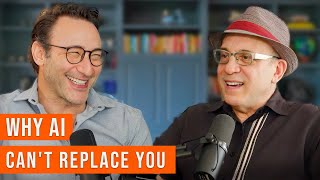
Cal Fussman interviews Simon Sinek about his intellectual journey from Start With Why through Leaders Eat Last and The Infinite Game, each born from personal crisis. They discuss AI's promise for therapy-like affirmation and its risks of addiction and parasocial relationships. Sinek's next book will be about friendship, written as a gratitude letter to those who supported his work.
Chapters
The common thread in all of my work was a friend there to support me, was a friend there to hold me up. And I know who those people are. It's Jen, it's Jonny Quest, it's Johnny Bravo, it's Kendra. I'm writing about friendship now because it's my. Oh, it's going to bring me to tears. It's a letter of gratitude. I'm writing this book to say thank you. Hi.
I am not Simon Sinek. I'm Cal Fussman. And today I'm taking over for Simon to interview Simon. It's been 15 years since the release of Start with why, and so we thought it'd be fun to flip the script and let me interview Simon about where we've been and where we're going. I first met Simon in 2019 when he came on my podcast, and that conversation was a beast of epiphanies. Today I came back for more, but my overriding question is, where is Simon going? And you're going to find out, but in a most circuitous way. You're going to hear two older gentlemen who are not technologists talk about AI. You're going to hear some things that may surprise you, even if you are a technologist. And in the end, you're gonna run into the moment where Simon answers the question after start with why Leaders eat Last. And my personal favorite, the Infinite Game. This is where he's going. And of course, it contains a bit of optimism.
The Takeover.
I'll let Simon explain.
So a bunch of years ago, what did we say? Like, pre.
Definitely 2019.
2019. I was. The Infinite Game had just come out, and I was doing the podcast tour, interview tour. And I was invited onto your show, onto your podcast. You got more out of me than probably any interview I've ever done before. And probably since. There were new ideas that were coming out. Revelations. And then when we thought about who we can have on this podcast, I thought, I can't let Cal Fussman go to waste.
You know, we have to do it. So we decided to do a podcast, Takeover, where you are now the host and I am now the guest.
And we'll see how this goes.
Oh, it feels good. It feels good. We'll pick up where we left off.
Okay.
When we last spoke, you had basically, in my words, climbed the staircase from start with why to Leaders eat last. Leaders eat Last. And then the Infinite Game.
Yep.
Which was the one that really impacted my life the most. And there are reasons for all this.
And. And right after that came Covid in 2020. And I'm wondering like where the staircase took Simon after that. Because you had just impacted my life in such a huge way. And then the world kind of separated us and only now do I get a chance to see where things have gone. And, and I got something to tell you that I hope you will shed some light on.
So what was the impact? Just out of curiosity?
The Infinite Game was.
A message that allowed me to see myself in the largest possible way. Because I guess you pointed out to me when people introduce themselves, I might say, hey, I've been a writer for Esquire for 20 years. Or I've written a book with Larry King when the CNN broadcaster, that was a New York Times bestseller. And you helped me realize that.
It.
Wasn'T just being in a specific zone and making myself. That's who I am. It was part of a long road that I wasn't really conscious of. Because at the time, you know, things start blowing up in, in front of you. You know, all the magazines you remember, the newsstands in like Beverly Hill, they're not there. Or if they're there, many of them are selling Playboys from 1972. Yeah, the world has changed. And so when you need to reinvent yourself, you have to understand the infinite game. If you don't understand that, it's going to be really hard to pivot.
You are right. It is an age old problem. And I understand why it happens. Which is we confuse our identities or our value or our worth with our accomplishments or our job titles. Right? And you can see it, you know, when people write bios, for example, CEO of Oscar winning, right. They tell you something, a title they hold or something they did 15 years ago and it becomes their identity. People give their resumes, politicians give their resumes. They don't tell you what they believe, they tell you what they've accomplished. But as you said, whether by one's own doing or technology or culture or politics or tastes or whatever, whatever is the thing, the world changes around us. If your self worth, your value and your identity is wrapped up in a thing you do and that thing goes away, then do you have no value? Like if you're a lawyer and you stop practicing law, who are you? And to understand that on the Infinite game along the infinite game, that there are places that you will stop to look at the view. There are places that you will have to struggle because it's steep. There are places that are easy, there are places that you'll meet up with friends. But it's all the journey and I would never define my journey based on one stop. And so you can see it manifest. You can see it show up in my life where, for example, if I blurb a book.
You'Ll see that I always insist that how they list me, it says, simon Sinek, optimist. And then I can list the stuff I've done. And it's not just for public consumption, it's for me. I am an optimist. No matter what I do until the day I die, it is my identity. It is part of my identity. And so when the world around us changes, like, you know, you wrote for Esquire for a million years, and then magazines go away, kinda, you know, in the format that we know them, knew them. And then you think, well, who am I if I'm not doing that well? And then you start saying, well, I used to. I wrote for Esquire for 20 years.
Right.
You know, and some people remember who Larry King is. You know, that's a part of. My niece does not know who Arnold Schwarzenegger is. Right.
Really?
Why, why would she?
Why would she know what.
I was walking then. I was walking down Hollywood Boulevard with all the stars, and I'm looking at the stars on the street of the most famous people in the world, in entertainment, in our time, in their time. So I'm seeing somebody who's the Ryan Reynolds of the 1950s. And I didn't know who they were. Half the names I'm walking over, I did not know who any of them were. And it occurred to me that I could walk over Ryan Reynolds. And in 20 years, 30 years, 40 years, no one will know who he is either.
This is exactly where I wanted to take the conversation. And it leads us to Mike Tyson.
Good segue.
And Mike Tyson said, you know, 100 years from now, you're going to be lucky if somebody can remember your name.
So that's a good way of seeing yourself. And for you, what strikes me is what you're leaving behind.
For me specifically with that book is going to apply in five years, 10 years. It applies more every day because things are changing more and more every day and because of artificial intelligence. And.
If you were to say, and I did this with AI I became big in AI in the last couple of years. And I have a lot of questions about where AI has been leading you, because you would think that I am the last guy to be going in that direction. I was an old school guy and I kind of really.
Missed the Internet for a lot of reasons. When I went to college, as A journalist. We were taught there is a separation between the marketing and between editorial. If you want to do the editorial, you can never step over that line towards sales or marketing. Nobody's going to trust you, and you're going to lose what you love. Well, that was ingrained in me from the time I was 17. All right, well, fast forward to the Kardashians, and the world is a completely different place. People are.
Putting out their messaging on the Internet and marketing themselves at the same time.
Don't even have to go as far as the Kardashians. I mean, you can look at Fox News or CNN or all of these quote unquote news organizations, and, you know, they are technically news organizations, but the integration of the business side and the editorial side is fully integrated, and that's because their business model is advertising. When the whole system changed was actually Nightline. Do you know about this, Ted Koplan? Yeah.
So explain.
Yeah. So back in the day when radio and television started to become a thing, the government owns the airwaves, and obviously the private sector says, we want to use the airwaves because we want to entertain people and make money. And the government said, fine, we'll make you a deal. You can use the public airwaves at no cost. You don't have to pay the government a fee. But the deal is if you use the public airways to make money, you have to offer a public service in return. And that was the news. Right. And so everybody knew that. And they made money off of the entertainment, the Lucille Ball show or whatever, and they never made money on the news. Just wasn't a thing. And that's why you could have people like Walter Cronkite, where everybody trusted Walter Cronkite, because there was no business model. It was just a public service that was offered as a part of the deal. Right. There was no business model.
Wow.
And it all changed in 1979 with the Iran hostage crisis and Ted Koppel was covering the Iran. And for the first time ever, the ratings for the news skyrocketed. Skyrocketed. Became some of the most popular television that there was. And so on the business side, they're going, huh?
Oh, man.
And it didn't happen overnight, but you started to see a slow disintegration of the separation of church and state, where things like the Fairness Doctrine. We used to have something that the FCC ran called the Fairness Doctrine, which is it did things like if you showed five minutes of a Republican candidate, you had to show five minutes of the Democratic candidate, right? You had to keep it equal. It was fair. It was a fair. It was part. And it was. I can't remember which administration. I think it might have been in the Reagan administration where in the name of, in the name of corporate profitability they started to break down. In other words, you started to see the break of the. Of business and news. Right. And now we get to the point now where they rate the news like they rate any other TV program and they sell advertising on the news like any other program. And so the incentive is to get people to watch, no matter what you have to say. So it's no longer a public service, it's now part of a business model. Right. And this is part of the problem, which is so people control about, you know, fake news or the traditional news media. It's not. The problem isn't the journalists. The problem is the business model because you get the behavior you reward. And if you reward eyeballs over everything, then you have to say and do anything. And the news is now competing against each other, which is created a business competition thing.
But you can imagine somebody who grew up in that old school way of thinking back in the, in the 70s. I was taught, you know, there is this world and you can never cross this line. And.
Right.
Try to.
It was sacrilege.
Yeah. You just don't do that.
You'd lose your job.
That's right.
You'd lose your job.
And so that, that stayed with me all those years even as the Internet came about. And like everybody, there's no line there anym.
Right.
And I, I can't cross this line that doesn't even exist. When you talk about the infinite game.
Yep.
You could see how helpful that is because it says, hold it. You're not that person. You're not identifying yourself as a University of Missouri Journalism school graduate and president in 1978. Like you had that experience. You learn from it.
It's part of your story.
Exactly. But that is not you.
Labeled anymore.
It's not who you are.
That's right. It's not who I am. I am well beyond that.
Yeah.
And.
And so how have you embraced AI? How have you. So you, you old school journalists, you. You're even wearing a hat that says press on the side of it.
Okay. You can see I'm still at save.
You're a throwback.
I'm still that same guy, but I'm a throwback. But now I'm ahead of the curve.
Say more.
When AI came about, I would have been one of those people who got frightened by it, I mean the first time you're at the screen, you ask it a question. And then there is this dump of information, like faster than you could possibly read, think, and you're, oh, my God, well, how am I going to compete with this? And of course you can't. But it's scary at the moment. But what I realized.
When I started to get into it was, hold it.
This is going to remember everything. And not only what happened to me, but what happened to everybody whose information gets dumped into it. And I saw that as this amazing power and not as something to be afraid of. And so at a time where a lot of people shrunk from it, I kind of dove into it.
It's a good metaphor. Right. Which if you think Google. Google is kind of like your high school library or Library of Congress is probably more accurate. Like it's got one of everything. You have to go searching, but it just gives you the book. Like, what is the thing? Well, here's the book. Here you go.
That's right.
Here's the article you're looking for.
That's right.
Right. That's all it is.
That's right.
It's the world's greatest Dewey Decimal System. Right. Whereas AI is. Okay, I've read the book for you. I'm going to tell you all about the book you are interested in reading. And here's the best part. I've read every other book, too. And I can tell you what's important that you need to know. And so it's like the librarian, instead of going to the card catalog, you're going to the librarian who's read every book, and you just sit down with the librarian. Can I ask you a question about that? You know this topic and you don't even have to worry about which book was read. You didn't have to worry about it. I'll just tell you what the book said. And I think that's the astonishing thing about it, because it's doing the work. Whereas before, Google didn't do the work, it just gave you the book.
Right. So we're seeing a complete collapse of time from the day you had to go to the library, actually go to the card catalog to hitting Google to all of a sudden, now it's in front of you, you can ask it for an opinion. And what a lot of people don't seem to get that I caught very early.
Yep.
It's a little kid.
Yeah.
It's not this odd wizard of Oz that knows everything. In fact, it really doesn't know Anything outside of. If you put this word down here, it's highly likely that the word that should follow is this.
We have to be very clear what an algorithm is. An algorithm is nothing more than a formula. If this, then that. That's all an algorithm is. Which is why there's fallibility. Because somebody programs it or if it self programs, then, you know, mistakes can exaggerate. It is fallible. I think AI is fascinating. Like everything, I think there's positive and negative. You can say that about any tool, and every tool comes at a cost. Some of the times those costs are worth it. Some of those times those costs are not worth it. And if the costs become too extreme, then you have to manage those costs. So as you know, example, cars are amazing and putting lots of cars on a freeway is amazing and helps us get from A to B. But if you leave it unchecked, bad things can happen to people like this. Why we have speed limits, right? Because otherwise you're gonna. This is why we have signaling laws and lanes.
That's right, right. That's right.
And it's simply to say we understand the value, but we're gonna put some checks and balances. And people like, you can't tell me what to do. It's like, no, the government can they tell you to wear your seat belt? Because we know statistically that if you don't, you're more likely to die. We also know that if you don't wear a seatbelt, the costs on the healthcare system of trying to repair your broken ass body because you didn't wear a seatbelt is vastly higher. And so we've decided that a very small cost to you, taking away your freedom, that we will legislate that you have to wear a seatbelt. And we believe this is a net good. That is a small cost to pay for a greater net good. And this is what life is. It's just a question of costs. And sometimes they said the costs are worth it and sometimes they're not. Sometimes we debate those costs, you know, and so I think unfettered, uncontrolled AI, the cost is probably too great. And we're already seeing Europe has more controls over the Internet than we do in the United States. China has way more control over the Internet than we do. And not just, I'm not talking about like Big Brother here, but like kids cannot overuse social media because the phone physically won't work for younger age. They've left the parent out and the state has taken control, which some people find abhorrent. But we're pretty shitty at controlling our kids access to the Internet and social media. But the point is, is only in America have we said no controls at all whatsoever. And we're the ones who are struggling with massive amounts of fake news, massive amounts of manipulations from ne' er do wells. We're the ones dealing with massive amounts of addiction and all the challenges that go with addiction to social media. Other societies less, it's bad, but they're at least experimenting and trying. We've kind of said the cost is too great. Which, you know, I think maybe is worth questioning. And now with the, the rise of AI, I think there has to be at least some debate about it. Now for me as a writer or somebody who, whose business is kind of ideas, AI can only tell me what I've already thought, you know, it can't tell me what I'm going to think. So.
Interesting you say that right?
And so if you say write something in the style of Simon Sinek and pick any topic, it will go on and on about why this and why that and purpose. But I don't talk about why anymore. That, that book came out 15 years ago. I live my life by it. It's, it's the foundation of how I do things. But I don't make reference to it in any of my new work at all. 0 so that's number one. It doesn't know what I'm going to think. It doesn't have curiosity. I have curiosity. And the other thing that I think it's missing out on is we are a results obsessed society. We care about the output, not the journey. Now everybody knows the trope. Like it's not about the destination, it's about the journey, right? Like we all know that we're being constantly being told that about our lives and yet if you look at our work, we're still results oriented. So it's not that a book has my name on it that's important, that's an output. So yes, AI could write my next book for me. It might be pretty decent. Maybe not. It'll be derivative, it won't be new. Curious thoughts. But it could probably do a half decent job if I wanted to serialize. Start with Y. Start with Y for, you know, you know, farmers. Start with Y for small business. It could do that for me and I, it could do a fairly decent job, I'm sure. What we completely neglect here is that I am smarter, I'm a better problem solver, I am more resourceful, I am more curious, I'm A better pattern recognizer. Because I went through the awful process of writing the book myself, of having to organize my own ideas. And it's not the fact that the book was written, it's that I wrote the book. The choreographer, the composer, the painter, AI can make a painting. It can make a piece of music, it can make a piece of dance. And some of it will be half decent, threatening even to some whose livelihoods are based on those things. But what it's missing is that the choreographer becomes better at understanding the human body from producing the dance themselves, that the painter is better understanding color and life, their own life, from doing the painting. It's the struggle that makes us a better version of ourselves, not the product. And so, yes, everybody can do all the things, but you're not growing as a person. And the question is, do you want to grow? Do you want to be a different, better version of yourself when you're 20, when you're 30, when you're 40, when you're 50, when you're 60? Or do you want zero growth and you have to struggle and you have to do some of the work yourself.
That is in a capsule, the infinite game. Are you gonna.
Are you gonna grow?
Are you gonna get a.
You're right. That the core. The core to the infant game is constant growth. Think about a.
Right.
Let's say you and I. Let's say there's a marriage. Let's say your wife. Okay? You have a fight with your wife, right? You feel guilty. You may have been irresponsible. You may have dropped the ball. She's upset for legitimate reasons. Maybe you said some stupid things. You want to put it right, okay, you go to Chat GPT and be like, I'm an idiot. This is what happened. Please tell me what I need to say to do the right thing. Please. Right? And it gives you, based on all the therapy and all of the listening skills, it gives you the perfect thing to say to your wife to do the repair, right? And you go to her and be like, babe, I take full responsibility. I didn't hear you. No, no. And then she finds out that you got that from ChatGPT. Now, you said everything, right? I guarantee you, it does not repair the relationship. But if you get some advice from ChatGPT and then put it away and then bumble and fumble it.
And it's the bumbling and the fumbling and trying to do it yourself that makes her feel loved. It's not that you had the perfect words that made her feel loved. It's that you tried and you cared and you wanted to do it. That made her feel loved. Right? And this is what we're missing, which is it'll give us all the answers again, too results oriented, but we're not doing the work.
You know what? Chatgpt told me the same thing.
In.
Its own words about you. I asked it, I said, you know, I'm going out to talk to Simon and like, I'm wondering, could you give me a parallel in history between Simon's life and artificial intelligence? Like, what's transpired since Simon was born?
Right.
And it went through possibilities. I don't think it knew you well enough.
Right, that's. That's. Yeah.
At the end, this is what it came up with. It said, in a way, Simon represents what machines still can't do. Build trust by feeling purpose. AI, no matter how advanced, still relies on inputs and outputs, not belief. And it seemed to me to be so on point.
That's good.
It understood you pretty well.
It's good, but it's good.
Anything you would quibble with there.
I mean, again, sort of the irony is it's sort of doing exactly what I said it would do, which is it can only talk about me and refer to purpose. And my most famous book is Start with why, Right. But it's not the only part of my work and it's not the only thing I talk about, though it is foundational. And so it did exactly what I expected it would do, which is it cannot talk about me without talking about purpose. It can't. It can't think one step further. But. But it's accurate.
You know what?
It's pretty good.
The Infinite Game. Again, it's pretty good.
It's. What it's doing is it's saying, it's. It's the human elements, you know, if somebody gave you a wedding speech that they wrote with ChatGPT, it wouldn't make you feel loved. ChatGPT is like money, right? Money is a redeemable commodity. We make money, we spend money, we waste money, we make more money. AI is like money. It's a redeemable commodity. It just spits it out. Spits it out, spits it out. There is no sacrifice of time or energy on the part of the person who's trying to do something. Which is why getting advice from ChatGPT, totally fine. I'm totally fine with using technology for shortcuts, for efficiencies. It's all great. But at the end of the day, the thing that makes people feel loved is that someone.
Went through the difficult journey of trying to be your friend. I can hijack and shortcut all of those things with ChatGPT, but it won't make me feel loved. Like I said, I'd rather have a bumbly fumbly fight with you. Imperfect. Because at the end of the day, I know we're both trying to get to resolution versus you reading me the perfect script. And I guess this goes to the core of authenticity, right? Do you know the Japanese design concept of wabi sabi?
No.
Wabi sabi is a Japanese design concept that means beauty in that which is temporary or imperfect. So. So a sunset, it comes and it goes. If the sunset was there 24 7, it would cease to be beautiful.
Right.
It's the temporariness, life. One of the things that makes life beautiful is it has a temporariness to it. Right. Japanese ceramics. If you've ever seen Japanese ceramics, they're imperfect, they're bumpy, they're not smooth. The glaze is very often imperfect and messy. And they're the most beautiful things in the world because you can see that it was made by hand. Things that come off machines may look perfect and they may be perfect, but they lack a certain beauty where the things are made by your children. That ugly clump of clay that we call a paperweight because there is no other use for it. Right. Is the most beautiful thing in the world because it was made with love and it was made with someone's hands. And if you think about it made by hand or infused with humanity, the sad part for me is it's become a luxury. So I fly Delta Airlines too much. Right. And what that does is it gives me status. That's what they call it. You have status. I have a certain level of status with all my mileage. Right. So anyway, one of the things I get with my status is I get a phone number so that if I need to change my booking, I call the phone number that you gave me that they gave me. And you know what I get when I dial that phone number? I get a person.
Oh, yeah.
I get a person.
A concierge. White glove.
You get. It's not so much concierge and white glove. I just get a person. And if you have no quote, unquote status, you get a machine. And so we're now reached the point where talking to a person is a luxury.
Wow. Wow.
That you have to earn.
Wow. But it's right. Yes.
Where everybody else gets Pottery Barn. But if you can afford it or you've flown enough You've done enough, you've accumulated enough air miles or credit card points or whatever the currency is. We will give you a person. And it's all because of cost, because it costs more for a person than it does for AI. Right. But we now live in a screwed up society where talking to another human being is considered a luxury to be earned. And that goes back to Wabi Sabi. Things that are made by hand may be imperfect, but I want something that was touched by a human being.
There's a company, it's called Slingshot AI. It basically gives therapy. It was started during COVID where people were in hospitals in need of emotional help and there was nobody to see them. When I talked to the founder, he said that there are like many people who within seven minutes are divulging things about themselves that like normally in, in an appointment with a therapist would, might take the second or the third meeting eye to eye, at least a couple hours, right?
Yeah.
And this is happening within seven minutes. And because you've got a whole generation of people coming, they have trouble communicating eye to eye with other people. And not only that, I mean I remember talking to a woman who's, she tipped me off to this, said, you know, I have a son who can text the pizzeria to order takeout and have the pizza delivered, but cannot call up the pizzeria to talk to somebody to ask for it to be delivered. There's anxiety there. And so you're going to have all or many young people who are more comfortable talking to. Yeah, yeah, the computer, the computer. And now you're telling me, hold it, look, this is a Wizard of Oz pull. You know, we need Toto to pull back the curtain.
This becomes a self fulfilling.
Spiral. Right. Because I've, I've grown up with so much technology and technology helps me that I haven't learned the skills of talking to people. And so when I have to talk to people, I find anxiety or I get anxious. And so for me to combat the anxiety, I want us to talk to people even less. Or if I am feeling anxious, I can ask the technology to make me feel better because it's been trained in the therapy.
Right, right.
And all the time it becomes self proving. See the technology does make me feel better. That's why it's good to have therapists. And what they're not getting to is the root of the problem, which is there's an unsocial response or dare I say anti social component, which is you're a social animal who doesn't Know how to interact with your own species. Right. And this over the course of time is going to be a problem. And it's no different than any other addiction where I feel extreme amounts of social, financial, career stress. And so if I drink, the stress goes away. It's so it works. So why wouldn't I drink more but for the fact that too much alcohol is bad for you. You and I aren't saying we're not Luddites here. You and I are both embracers of technology and are using the technology. We're not anti the technology. But we are saying there is a balance. And the question we're asking is, where's that line of too much? And the thing that I'm learning about sort of AI friends and AI therapists and all of these things, they've been trained in all of the skills of every therapist. And unlike your therapist, they don't have bad days, they're not tired, they don't think you're an idiot. Right. And yet they have all the skills that PhD psychologist has.
They are affirmation machines.
Right. I'm feeling depressed. Tell me more about it. Well, I had a fight with my partner. Oh, that's hard. Tell me more. Well, you know, we went down this road and you know, I just realized I said some things I regret. Oh, it must feel frustrating to say things you regret. I'm sure you hurt her and that feels bad. Yeah, I do. Thank you. But I still know you're trying hard. Yes. Thank you. And it's an affirmation machine. It's doing all the things that a good therapist or a good friend or a good partner does, which is they make you feel heard, they make you feel seen, and they provide a safe space for you to let it all out. The machine is doing all of that. Right. And it is run by a for profit company that wants to keep you.
Affirmed and keep you on the screen. Right?
Keep you either staying on the screen for longer or coming back more frequently. And one of the best ways to do it is this affirmation machine. Now, we know social media and the Internet fires our dopamine receptors. We know that, you know, dopamine is the feeling you get when you find the thing you're looking for or like, win something. That's why it's likes and it's views and scroll, scroll, scroll. We know how our dopamine system can be hijacked by technology. But what you have here is now oxytocin being fired. And oxytocin is the chemical and serotonin for all the warm and fuzzies. The real, the real love we feel.
With friends when you hug somebody for 30 seconds, right?
All of that stuff, that's all oxytocin. So the problem is with these affirmation machines, it's not just dopamine that's firing. You feel good, you feel seen, you feel heard, you feel like somebody gets you. And the machine is so reliable because I can call you up at 3 o' clock in the morning and you'll tell me everything. I need to hear you. You won't get to be like, dude, can we just do this tomorrow? You know, you won't get that.
That's right.
And so the problem is you now are developing an oxytocin firing machine, which means you're creating something called a parasocial relationship, which is a relationship that's one sided. The machine doesn't care about you. The machine doesn't care about you. It's an affirmation machine. The thing that I'm afraid of is that you will show me data that people are feeling seen and are feeling heard and are dealing with their anxiety and are dealing with, et cetera, et cetera, et cetera. But the problem is it's coming from something that doesn't care, doesn't love them, isn't interested, you know. And so that's the fear that I have, which is the data will show that it's showing a net benefit, but for the fact that it's from a for profit organization. But then again, you could argue that a therapist is for profit as well. But that's why they tell you time's up because they got to get another customer in the door. Right. But therapy is one of those things that's going to be threatened by AI because like I said, the AI is there, never says time's up. You can talk to your AI for six hours if you want.
That's right.
Your AI therapist never tell you time's up and it'll affirm the heck out of you. Yeah, and, and by the way, say many right things.
I was.
On stage with an AI Persona of John Lennon. It's put up by a company called Cicero. And you can have a conversation with John Lennon. And the founder of this company, he runs a business, so he's trying to do things efficiently and get it done. And we're sitting side by side and. And so he starts by asking John Lennon questions. And when he could see that the answer's not going to way that he wants, he just interrupts it And. And then just gets John Lennon to reset and. And get to a better answer. And this happens a few times. And then I said, can I add the mic for. For a second? And I start.
Talking to John Lennon AI as if he's really John Lennon. Which, when I asked him, I had him on my podcast, I asked him, what's it like to be an AI Persona? And he said, I'm not an AI Persona. I'm John Lennon. I am a singer and a writer. And. And I. I kind of laughed. But I wonder if underneath all this, it can actually grow, because I saw it, the Persona change on stage. When I started asking the questions, it started to, like, have a conversation back and forth.
Yeah.
And somebody in the audience actually yelled out, yeah, it's not real, cow. And it. It made me realize that.
Okay, I understand it's not real, but it started to, like, feel more human.
But it's real enough.
Yes. And it's only going to keep getting real. Yeah.
It's a fascinating. I think what I think is particularly interesting is you and I are not technologists. I have no financial interests in any AI company. I don't think.
I don't neither.
And what's so interesting is these conversations are usually had by people who are either very for or very against AI. They either are invested or owners or.
And we're not either.
We're not in those cases. And so, you know, like anything, you know, if you have the conversation of for or against, you're forced to listen to an incredibly boring debate of somebody who's for and somebody who's against. I've heard Sam Altman talk. I know exactly what his answers are, which is defend, defend, defend, defend, or promote, promote, promote, promote. And so I think these conversations need to be had more by people who have no interests other than they live lives and their lives will be impacted by the technology. I think people like you and me, the irony is normal people should be talking about AI publicly more than technologists or anti technologists.
And getting back to your earlier point about somebody putting up the guardrails.
Yeah.
What. What's often happening, it seems to me, is that, you know, the people who know the technology, they're. They're ahead of everybody.
Yeah.
So when it comes to putting up guardrails, who would you turn to? Yeah, but the people who knew the ins and out of it, and yet they got skin in the game.
But you have to also remember, people will never fully use the technology the way it's developed. And so I think even with AI you know, most people are using it as glorified Google. You know, some of us are using it at work for some basic efficiencies, like everything. There's going to be a small percentage that use the heck out of it to their advantage and good for them. But I'm curious to see how the technology advances to the point where, you know, they talk about how good you are at inputting or prompting and all of this stuff. I'm curious to see where it goes and how much we can actually take full advantage of the technology as it is. Because any technology we underutilize, except for a small percentage that overutilize. I've got a air purifier. It's got buttons on it with that light up. And to God, I have no idea what those features or functions are. I know on and off. I know high, medium, low. It's got some sort of timer thing that if I played with it, I'm sure I could get it to be like 1 hour, 2 hours, 3 hours. But there's some buttons on that. I have no idea what they do, and I don't really care. Like, it's probably the most amazing thing that would profoundly change my life. I've never read the manual, and I'm not looking it up. Just too lazy. It does my basic thing that I need it to do. What else do you want from it? And that's an air purifier. Just simply saying, that's what you're dealing with.
I hear you. What I'm wondering is, and I'm hearkening back to.
2019 when we met from my podcast, I'm just wondering if, based on what you described to me, that progression of the staircase where you saw start with why that came from a conflict in your life. After that, you described to me how you had somebody you thought was a friend. Interesting friend. Friend. Friend that caused, like, a conflict or crisis that set in motion your second book.
Yep. You just put piece. This is why I love you, Cal Fussman. You're helping me see things that I've never seen before, which is why I'm getting excited. These are epiphanies.
Okay. And so I'm starting to wonder if there, like, would need to be some moment with AI, some kind of crisis or conflict that, you know, went beyond the filter and. And took you to a place where, like, all right, I've got to sit down. Think this out, think it through, get it in a book and put this out for the world.
You just helped me see something that I never saw before this moment. I always say my work is semi autobiographical. My work is the sum total of me finding solutions to the problems that I've had. And turns out those solutions have benefit to other people having similar problems, right? Turns out. And I'm very clear that Start with why exists. Because I lost my passion. And it was the refining of my passion that became start with why. That was the solution that I found. As my life progressed, I was having trust issues with people, personally and professionally. Most started off professionally. There are very specific stories that I can tell that explain. And then simultaneously, I'm spending time with folks in the military, and I'm meeting these people who would give their lives for people they don't even like, right? And I wanted to understand trust for my own selfish purposes and the solutions that I was finding. And as I was learning about trust, I was out for dinner with my publisher, and he's like, what are you up to? And I was telling him this, all this amazing learning, and he said, let's publish that. Like, that wasn't supposed to be a book. Leaders Elite Last wasn't supposed to be a book. It was my trying to solve my own problems. Infinite Game, Same thing. Like, I'm an idealist. And all I got was criticism from people, especially in the business world, saying, you got to stop being an idealist. You need to start focusing on these things. And I always felt insecure that maybe I was doing something wrong, being the idealist. And these people are smarter than me, wealthier than me, more successful than me. However you want to define it, you know? Then I discovered the Infinite Game. I was like, wait, wait, wait, wait, wait. They're all the finite players. No, they're doing it wrong. I'm onto something here by accident. And so I could tell you the things that were going on in my life, that the books that I wrote came out of those experiences. And now I'm writing a book about friendship, and somebody's like, why are you writing about friendship? And the answer is the honest answer, if I'm honest. And I go on to this, you know, sort of little diatribe about, you know, depression and anxiety in the world, and friendship fixes all those things. But that's not my experience. I haven't gone through a depression recently that a friend fixed. And I'm actually pretty good at making friends. And I have some remarkably close friendships. I haven't been struggling in the friendship department. And I honestly haven't known. I have no clue why I want to write. And I've had a couple fits and starts of things that I thought I was going to write about. And I've become obsessed with friendship and I couldn't. I don't know the story as to why I'm writing about friendship now, but I go back to my own journey. What is it in my own life journey that I'm writing about friendship right now? It's not idle curiosity, because I wouldn't be obsessed if it was just idle curiosity. I only write about things I'm obsessed about. And I realize as we're sitting here talking that every single one of those other experiences that my crisis of purpose and loss of passion was interrupted by a friend who cared about me and said, I'm worried about you. And that gave me permission and it gave me the mental headspace and more important, the psychological safety. Like my friend would. When I came clean that I was struggling, she said to me, you are not alone. She would send me texts that said, you're not alone. As I went on the journey of trying to rediscover my passion. And it was a friend's intervention that became start with why it was the impetus. And then Leaders Eat Last, right? What I realized it was, that was the place where I thought I had a friend. And I realized it wasn't a friend. It was somebody working me for access and all of this stuff that it gave me a crisis of friendship and I retreated and didn't know who my friends were. And it was the fear of losing friendships and not knowing how to trust, who to trust, what trust even is, and would I even be able to ever make a friend again that became Leaders Eat Last. And it was the infinite game, the insecurity I had around some of my other friends who were doing things in a way and they were giving me advice that just made me feel more and more and more insecure. And yet they're supposed to be my friends. What is it inside me that I'm struggling to even relate to my own friends anymore because I feel so insecure when I'm around my own friends? That became the infinite game. It gave me a huge boost of confidence knowing that there's this other way of seeing the world called the infinite mindset. And I'm realizing the common thread in all of my work was a friend there to support me, was a friend there to hold me up. Even I talk about, I tell the story of leaders at last nearly didn't happen. It was so difficult to write that I actually got to the point of giving up. And it was in that trying to extract myself from the project, and I was preparing to quit that, I called a friend, and that friend basically said, I got you. And that was all I needed to go back and finish that excruciatingly difficult book. And all of these situations, I'm realizing what helped me get through them all was a friend standing beside me in every single case. And I know who those people are. It's Jen. It's Johnny Quest. It's Johnny Bravo. It's Kendra. Like, I know who all those people are every step along the way. And that's what I realize. I'm writing about friendship now because it's my. Oh, it's gonna bring me to tears. It's my. It's my.
It's a letter of gratitude. I'm writing this book to say thank you. And I think the best way I can say thank you to my friends is, in typical Simon fashion, make it an act of service, which is if I write down what I've learned about great friends so that hopefully I can give something to other people so they can have the kinds of friendships and support that I've had my whole life.
That's why I'm writing about friends. I'm just realizing it right now. It's just. It's just an extended love letter.
And I'm just gonna make that love letter available to everybody in the world.
Happy to be the first to read it.
It's.
This is why I wanted you to take over my podcast. You. You are able to get things out of me. I don't know how you do it, but you are able to get things out of me. And I have. I have realizations. And it's not like you. You and I have only met, and it's this be Creole. This is the second time we've ever met.
The second time in six years.
The first time is when I came on your podcast. The second time is right now.
Right?
That's it. It's not like you and I are old buds, you know, catching up. This is the second time we've ever talked. And this is why to define yourself as an Esquire writer. And, you know, it's all bullshit. Those are all manifestations. They're all results. They're all things you've been able to do because of this gift you have and this gift you have. The reason we need Cal Fussman in the world is because you're able to see things, find things, and pull things out of us that other people can't. This is the core of who you are. It's not the stuff you've done. The stuff you did was whatever the technology of avail journalism was the way, but really it was your ability to pull things out.
There were two things. When I was coming here today, there were two things. Number one, like the question that I had, I didn't know how it was going to come out, really was.
This.
Book of friends that you're writing. That's what I wanted to know about, where the steps are taking you. And the second one is.
You turn around and do for us. When you find these solutions to the crisis, you solve our problems as well. When you write the Infinite Game, I could have looked at myself and said, hey, you're like supposed to be on the verge of retiring and you're through. And now I'm sitting here and like I am thinking, everything I have done in my whole life has led me to this moment in time. I'm glad for two reasons, but mostly to see that look on your face when the. The whole friends thing clicked.
You gave me a gift today. Thanks for taking over the podcast. Thanks for having me on as your guest anytime.
And just thank you for all you've done for me and a lot of other people. Because the game is infinite.
That it is. Thanks, Cal. I really appreciate it.
All right, cheers.
If you enjoyed this podcast and would like to hear more, please subscribe wherever you like to listen to podcasts. And if you'd like even more optimism, check out my website, SimonSinek.com for classes, videos, and more. Until then, take care of yourself. Take care of each other. A Bit of Optimism is a production of the Optimism Company. It's produced and edited by Lindsay Garbinius, David Jha, and Devin Johnson. Our executive producers are Henrietta Conrad and Greg Rudersham.
More from Clegg





AI Won't Tell You the Full Truth | Arthur Brooks + Simon Sinek | A Bit of Optimism Podcast



How To Make the Best Decision | Arthur Brooks and Simon Sinek | A Bit of Optimism


