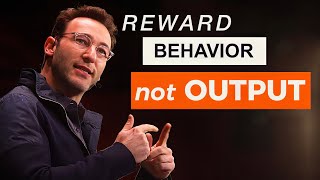
Simon Sinek argues companies should reward the behaviors that create good outcomes, not just the numbers. He warns against keeping high performers who damage culture, and shares how a junior employee got promoted for showing initiative even after losing a pitch.
There's nothing wrong with rewarding hitting a goal. There's no problem with that, so long as you also reward.
The behavior that got you to the goal and don't reward apparent behavior. You know, I think under performers, believe it or not, are not the biggest culprit of underperforming organizations. It's keeping toxic geniuses on the team for too long. The lack of courage to get rid of high performers who are just, everybody knows, destroy the performance of everybody else. I think that has more of a negative impact on an organization because you're chipping away at your culture bit by bit by bit. And by the way, you lose respect from your teams because everybody knows this person is toxic. And by the way, when I say toxic, we've attempted to coach them.
There's no change.
And. And you talk a big game about values and ethics, and yet you keep somebody who obeys none of it. They just happen to be a high performer. That has more damage, I think, than underperformers. Under performers, you can usually coach up. I think incentives and incentives and rewards are a big deal as well. So a quick personal story. So when I was young in my career, I worked for a big ad agency, and.
We had a big new business pitch that was happening. I don't remember the beginning of the new year. And usually the senior folks do the pitches and the junior folks do the support. And I was junior, and I was assigned to this pitch. So supporting role. And it happened to be Christmas, and all the senior leaders went on vacation, but Yahoo was still at the office. So they gave me and another junior person an assignment, which is called prepare the war room, which basically means hang the research on the walls. That took an hour. And so we still had a week to kill. And so we decided to comb through the data and comb through the research, find insights and write the whole pitch ourselves, you know, kill time. And when the leaders came back, we presented our document to them, and they actually used our document and our strategy in the pitch. And we lost the business. We did not win the pitch. And my boss gave me a huge promotion. He actually moved me up two levels. I skipped a level because he wasn't rewarding my outcome. He was rewarding my behavior. And guess what he got. He got a lot more initiative, because that's what got me promoted was initiative. And he was smart enough to know that if he only came up to me, like, great effort, but you didn't win. So there's nothing I can give you next time I'm not helping or I'M playing it safe, or I'll just leave it for the other folks to do the work, because that's the behavior he rewarded. So I'm very impressed by organizations who adapt their incentive, reward, and recognition programs to align with the behavior that they actually want. And I'm not saying abandoned performance. I'm saying balance performance. We over it's tipped too far on performance for legitimate reasons. It's just easy to measure, right? One's quantitative, one's qualitative, and it's easy to recognize, count and reward quantitative. That's why we do is more difficult the other one. And it and sometimes you have to trust the leaders that they know what they're doing and who they who they're who they're building up. You also want to be careful about not making heroes out of people. But that's a different convers.