Why the Job Market is IMPOSSIBLE Right Now
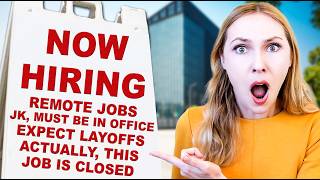
Madeline Mann breaks down why job hunting feels brutal right now: layoffs in tech, media, and finance flooded the market with experienced candidates, many advertised jobs are fake or mislabeled, and AI tools mean 46% of applicants are now competing with AI-written resumes. Venture-backed companies stopped hiring when interest rates rose.
Chapters
You aren't imagining things. Landing a job in this job market, in this economy is like trying to find a needle in a haystack, but the haystack is on fire. And then you realize, oh dang, the hay is also a bunch of decoy needles. Yikes. There are many reasons for this. First is we have been constantly pelted in the gut with the onslaught of news of high profile layoffs. We see so many of these companies who have grown a lot in the past decade now course correcting and laying off thousands of employees as the economy cools. Even Zoom, which hit meteoric success when a little thing called the coronavirus pandemic hit in 2020. And all we could do to see our friends, grandmas and coworkers was hop on Zoom. And yet they just laid off 15% of their staff less than three years later. There are plenty of companies that are not having layoffs. It is a misconception that because well known companies are having layoffs that other lesser known companies aren't still chugging along and and hiring. But the challenge first comes in the concentration of layoffs in certain industries such as tech, media, finance and retail. Whereas industries like health services, construction, hospitality and government continue to add jobs. One of the challenges with these high profile layoffs from top employers like Disney, Meta and Deloitte is that these layoffs then flood the job market with highly desirable candidates. So not only are you competing with thousands of more professionals, but they have strong experience to boot. Having a strong resume is so important right now. So I will link a powerful resume workshop that has led to thousands of success stories. It's a free class. I will link it below. But Alice, this rabbit hole goes so much deeper than layoffs, which we are going to dig right into. But first, hello there. If we haven't met yet, I'm Madeline Mann. It's a pleasure. I am a human resources leader and job search strategist who turns job seekers into job shoppers. You may have seen me in Bloomberg, Wall Street Journal, New York Times, and more. Subscribe to do something good for your career and stay to the end because I reveal two antidotes to this bonkers job market. So layoffs are happening, but there's lots of headlines of how jobs are being added and every month. So that's all good, right? Not quite. Let's take a closer look at what those jobs are first. There's an absolute epidemic of ghost job postings online. I do a deep dive into this in my video on the lies that are told on job descriptions, but essentially there's a massive amount of jobs online that are either already filled or companies are not intending on filling them. A 2022 survey from Clarify Capital revealed that half of hiring manager keep a role open since they are always open to new people. Which is hilarious because they say we are always open to new people. And you say oh wonderful, perfect, I'm new people. And they go ew no not you. And look at these other reasons they leave the job open to keep employees motivated, to keep the impression that the company is growing, to stay open to potential future candidates and simply because they forgot to to take it down. Additionally, the competition for remote jobs is so fierce, but many companies mislabel remote jobs. At the top of the page is the job advertised as a remote role, only to scroll down and see that this is clearly a hybrid work situation. This is one of the many common pieces of misinformation that job descriptions feed us constantly. Have you come across a job description with inaccurate information in it? Let us know what inaccurate information that was in the comments. One thing that I hear from a lot of people interpreting the stats on there being a large amount of open roles is that those open roles represent low skill jobs that aren't what a lot of educated people are looking for. I thought that that was a pretty sound theory until I took a deep dive into what a lot of these open roles are. Such as I saw an article that said that the city of Los Angeles has over 10,000 open jobs that they are struggling to fill. I went into the job board expecting to find low level undesirable jobs, but actually found really solid jobs with good pay. What I couldn't help but notice is that these are jobs that require special expertise. I mean, I fancy myself quite the Renaissance woman having led human resources at companies where I interfaced with every department and now taking on the role of Chief Everything Officer in my own growing business. I have a very particular set of skills, skills that I've acquired over a very long career. But heck, I could not do any of these jobs. On this job board you can make great money as an electric distribution mechanic, as a trainee making six figures, and as someone more experienced upward of $180,000. And there's lots of other skilled roles that aren't the usual career paths that people gravitate towards but are quite lucrative. So what we are actually seeing here isn't 10,000 low level jobs, it's thousands of jobs where there is a skill gap in the talent market. As a professional who is constantly adapting to the changing world. You should make it a priority to build relevant skills, filling skill gaps and going for these in demand but less obvious jobs. I did a video on why you need a boring job. A lot of people have told me that this video really changed the way that they view their career, so I will link that for you to watch. Not yet though. Finish watching this video before you go over there. Now the next reason that the job search is a struggle right now is the rise of job seekers using AI. Job boards were already incredibly flooded with applications before the mainstream use of AI. But now, according to a survey from resume builder.com 46% of job seekers currently use AI in their job search. This means that job seekers are able to tailor their resumes and cover letter letters in a matter of seconds instead of minutes or hours. I'm not saying that their use of AI is making their applications better. I actually did a video which I will link below on really good AI prompts to use in the job search and even we admit in that video AI is completely spitting out trash sometimes. But what I am saying is that hiring has never had so much noise. There are so many more applications that for a hiring team to find qualified candidates, they have to sift through so many irrelevant applications that it is harder than ever to get noticed from applying online. This flooding has been the case for a while, especially for top employers like Google which gets over 2 million applications a year. But now even lesser known employers are getting flooded pretty severely. While this is so frustrating, this doesn't concern me. I've been helping job seekers turn into job shoppers for the better half of a decade and I've always beat the drum that applying online is not where it's at. It's been a bad strategy for years now and it's an even worse approach. And I steer my clients away from applying online because that process is too slow and too crowded. The faster way is to implement job shopping strategies to cut the line. I'll link a workshop on those strategies below if you need help on that. Now we can't discuss the job market without acknowledging what we are seeing in the economy and following the economy feels like we are watching our phone battery as it gets dangerously close to zero percent and not having a charger in sight. People and companies are spooked about if they will have enough money in the coming months and years. And if we look back, 2014 marked the start of the meteoric rise in venture capital with low interest rates, money was cheap, and these budding companies like Uber Airbnb and Dash were pumped with billions of dollars without even needing to be profitable. Many of these companies were designed to make our world more convenient, and they were pretty affordable to utilize their services. I can't tell you how many cheap Lyft and Uber rides I took from bars in my 20s. And this was before all of these fees on these apps got completely out of control. We weren't paying low amounts because these services were inexpensive, but instead because venture capital was subsidizing us as they proved a concept while money was cheap. But today interest rates have increased. Money isn't cheap anymore, so venture capital is tightening its belt, meaning these flashy growth stage businesses are no longer getting the funding to hire teams quickly, the way that we've seen in the last decade. So in review yes, it's a spooky time to be on the job market and if you're freaked out, I hear you and you're invited to our next outing where we will go have a comfort food potluck luck. We will indulge in a feast of emotional eating and at the end of the night we will embrace in a group hug or a group primal scream, whichever comes first. But I'll tell you, I am optimistic. Look, with the right strategy, you can beat the competition. When I work with clients, it's two pronged. First, you have to aim at the right opportunities and make sure you have the right skills while not wasting time on unnecessary degrees and certifications. And then second, know how to catch the employer's attention and then have them clearly see your value. And you can do this because so few people are following these job shopping strategies so you can stand out. The class on how to go job shopping is below. Have you noticed any of these points about the job market? Let us know your observations in the comments and you are a true friend for making it to the end. Be sure to like this video and subscribe to this channel if you haven't already. You've got this Wi Fi high five.
More from Clegg





AI Won't Tell You the Full Truth | Arthur Brooks + Simon Sinek | A Bit of Optimism Podcast



How To Make the Best Decision | Arthur Brooks and Simon Sinek | A Bit of Optimism


